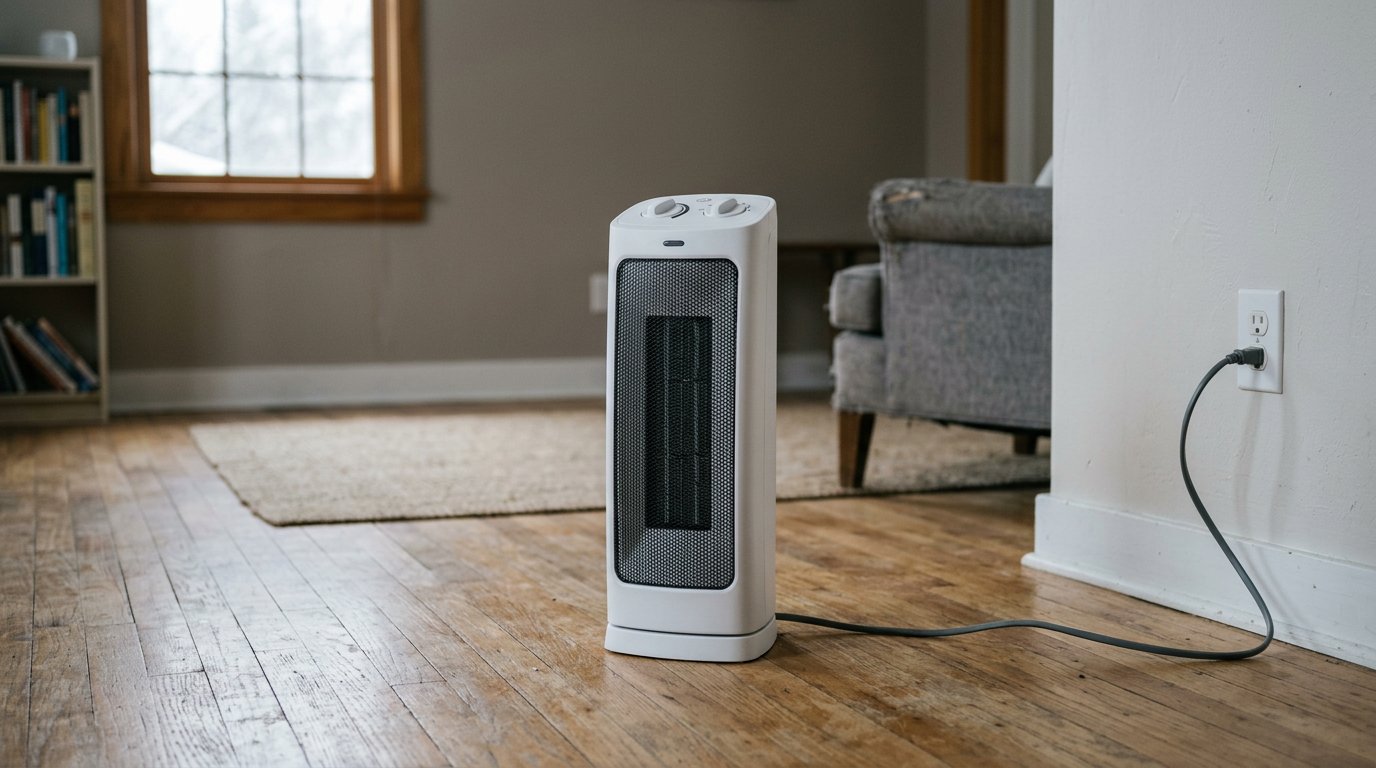
The short version: space heaters send fewer people to the emergency room than any other appliance we track — and they are still the most dangerous one in the house. About 1,600 ER visits a year, but 11.8% of those end in hospital admission, roughly four times the rate for countertop kitchen appliances. On the recall side, 22 U.S. recalls covering about 2.7 million units, effectively all of them fire or burn hazards. Before you plug one in this season, check the recall list below — including a June 2026 Vornado recall of about 255,000 tower heaters — and plug the heater directly into a wall outlet, never a power strip or extension cord.
Every autumn the same advice circulates: don’t leave a space heater running overnight, keep it three feet from anything flammable. It is good advice, but it is rarely connected to what the actual failure data shows. We maintain two public datasets built from U.S. Consumer Product Safety Commission records — a recall index and an ER-injury index — and read together they tell a sharper story about this one appliance.
Few injuries, but the most severe
Here is the comparison that surprised us when we built the injury index. These are national estimates from the CPSC’s National Electronic Injury Surveillance System, averaged over 2020–2024:
| Appliance category | Est. ER visits / year | Share admitted to hospital |
|---|---|---|
| Countertop kitchen appliances | ~22,700 | 3.2% |
| Vacuum cleaners | ~16,600 | 8.2% |
| Space heaters (portable electric) | ~1,600 | 11.8% |
| Air purifiers | ~190 | 7.0% |
A space heater is roughly fourteen times less likely to put you in an emergency room than a countertop kitchen appliance. But if it does, you are about four times more likely to be admitted rather than treated and sent home. Kitchen injuries are mostly cuts and minor burns. Heater injuries skew toward the kind of burn that keeps you in a hospital bed.
The recall record points the same direction. Of the four categories in our index, heaters account for 22 recalls and about 2.7 million units — and effectively every one of them was issued for a fire or burn hazard, not a pinch point or a choking risk.
Recalled heaters to check for right now
These are recent, high-volume electric space heater recalls from the CPSC database. Recalls never expire, so if your unit is covered, the free remedy still applies.
| Announced | Recall (official CPSC notice) | U.S. units | What CPSC reported |
|---|---|---|---|
| June 4, 2026 | Vornado SRTH small room tower heaters | 255,000 | Fan blade can detach from the motor shaft, slowing or stopping airflow and leading to overheating. 32 reports of overheating, 8 fires, one smoke-inhalation report. |
| November 7, 2024 | GoveeLife and Govee smart electric space heaters | 512,500 | Can overheat. 113 reports of overheating, including seven fires and one minor burn injury. |
| July 11, 2024 | Atomi smart heaters | 99,400 | Fire and burn hazards. |
| June 16, 2022 | WarmWave and Hunter ceramic tower heaters (Sienhua) | 580,000 | The cord and plug can overheat. Eight reports of fire at the plug or cord, plus dozens of overheating reports. |
| June 11, 2019 | AmazonBasics ceramic space heaters | 377,000 | Can overheat. 25 U.S. reports of overheating, burning or sparking; no injuries reported. |
| April 2018, re-announced August 2018 | Vornado electric space heaters | 350,000 | Can overheat in use. The recall was re-announced after a fatal fire involving a recalled unit was reported; 19 total reports of the heaters catching fire. |
Unit counts and incident descriptions are the figures CPSC published for each recall. This table highlights recent high-volume recalls; the full category tally (22 recalls, about 2.7 million units) is in our recall index.
Related, not a heater recall (added September 8, 2026): on August 13, 2026 the CPSC announced a recall of about 960 Sunnyside 1-K kerosene heater fuel containers (batch 26082, sold on Amazon and Do-It Best hardware stores May–July 2026 for about $13) for violating the mandatory portable-fuel-container safety standard, a flash-fire and burn hazard. No injuries were reported. If you run a kerosene heater, check the bottle, not just the heater: CPSC recall notice.
What actually fails, according to the recall notices
Read the hazard descriptions side by side and the mechanism is remarkably consistent — and it is not “the heater was too close to the curtains.”
- The unit overheats internally. Vornado (2018), AmazonBasics (2019), Govee and Atomi (2024) were all recalled for overheating in normal use.
- The cord or plug overheats. The 580,000-unit WarmWave and Hunter recall was specifically about the cord and plug, with fires reported at the plug.
- Airflow stops. The June 2026 Vornado recall is the clearest example: the fan blade can come off the motor shaft, so the fan slows or stops while the element keeps heating.
All three are about a heating element continuing to run while heat stops leaving the appliance the way it should. That is why the standard advice works, and it is also why two habits matter more than most people realize.
The two rules the failure data actually supports
- Plug it straight into a wall outlet. Not a power strip, not an extension cord, not a surge protector. A space heater is one of the highest sustained-draw appliances in a home, and the WarmWave recall shows what happens when the connection point is the weak link. Power strips and light-gauge extension cords add exactly that kind of connection point.
- Keep the air path clear, and look at it. Blocked intakes and stalled fans are the failure mode behind the largest 2026 recall. If a heater starts running noticeably hotter, smells hot, or the fan sounds different, that is the symptom that precedes the reports in these notices — stop using it.
The usual guidance still applies too: three feet of clearance from anything that can burn, a hard floor rather than carpet or rug where possible, and no unattended overnight running. Look for a model with tip-over shutoff and overheat protection — though note that several of the recalled units above had protective features and were recalled anyway, which is why the recall check matters more than the spec sheet.
How to check whether your heater is recalled
Find the model number on the rating label — usually on the base or the back of the unit — and search it at cpsc.gov/Recalls, or check the manufacturer’s support page. If your unit is covered, follow the brand’s process: the recalls above have offered refunds and, in the 2026 Vornado case, a remedy that starts with submitting photos of the unit.
Two things worth knowing: recalls do not expire, so a 2018 or 2019 recall still entitles you to the remedy today; and heaters are commonly resold, handed down and stored for years, which is exactly how recalled units stay in circulation.
Choosing a heater for this season
If you are replacing one, our category guides cover current models and where each type makes sense:
- Ceramic vs infrared vs oil-filled — how the three heating types differ in practice
- Energy-efficient space heaters — and what running one actually costs
- Garage heaters — a different problem, with different safety requirements
- Space heater vs electric fireplace — if you want the heat and the look
On running cost, a 1,500-watt space heater is one of the most expensive appliances in a home to operate — roughly $745 a year at the U.S. average electricity rate for 8 hours a day through the heating season, and anywhere from about $570 to $1,800 depending on your state’s rate. The full per-appliance breakdown is in our appliance running-cost data.
Frequently Asked Questions
Are space heaters actually dangerous?
They cause far fewer emergency-room visits than kitchen appliances or vacuums — about 1,600 a year by CPSC’s national estimates — but a much higher share of those visits are serious: 11.8% end in hospital admission, roughly four times the rate for countertop kitchen appliances. On the recall side, the 22 heater recalls in our index cover about 2.7 million units and are effectively all fire or burn hazards.
Can I plug a space heater into a power strip or extension cord?
No. Plug it directly into a wall outlet. Space heaters draw high current continuously, and the connection point is a documented failure mode — the 580,000-unit WarmWave and Hunter recall was specifically for a cord and plug that could overheat, with fires reported at the plug itself.
Which space heaters have been recalled recently?
The largest recent ones are Vornado’s SRTH small room tower heaters (about 255,000 units, June 2026), GoveeLife and Govee smart electric space heaters (about 512,500 units, November 2024), Atomi smart heaters (about 99,400 units, July 2024), and WarmWave and Hunter ceramic tower heaters (about 580,000 units, 2022). Each links to its official CPSC notice in the table above.
My heater has tip-over and overheat protection. Is it safe?
Those features help, but they are not a guarantee — several recalled models had protective features and were recalled anyway, for faults the protection did not catch, such as a fan blade detaching or a plug overheating. Checking the model against the recall list is the more reliable step.
Do space heater recalls expire?
No. CPSC recall remedies do not expire. A heater recalled in 2018 or 2019 still qualifies for the published remedy today, which matters because heaters are frequently stored, resold and handed down.
How much does it cost to run a space heater?
About $745 a year at the U.S. average electricity rate, based on a 1,500-watt unit running 8 hours a day through the heating season. Because state electricity rates vary roughly threefold, the same heater ranges from about $570 to $1,800 a year depending on where you live.
How to cite this data
TheHomePicker Space Heater Recall & Injury Dataset (2026), compiled from U.S. Consumer Product Safety Commission recall notices and CPSC NEISS injury data. Available at https://thehomepicker.com/space-heater-safety-recall-data-2026/. Free to use and republish with attribution and a link.
Download the data
Download the dataset (CSV) — all 22 U.S. space and electric heater recalls (2015–2026) with date, units, hazard and a direct link to the official CPSC notice for every row, plus the CPSC NEISS emergency-room table shown above.
Reporters:
for custom data cuts (by brand, year, failure mode, or unit count) or comment, reach us via our contact page.
Method and sources
Injury figures are national estimates from the CPSC’s National Electronic Injury Surveillance System (NEISS), averaged over 2020–2024, as compiled in our appliance injury index. NEISS estimates carry sampling error and an injury “associated with” a product is not evidence of a defect. Recall figures and every incident description come from the CPSC public recall database, accessed through SaferProducts.gov; the category totals are from our appliance recall index. Running-cost figures come from our running-cost dataset.
This page contains no affiliate or sponsored links and we have no affiliation with any brand named on it. The data is free to cite with a link, and we are happy to prepare a custom cut for journalists and researchers. If a product has failed on you, reporting it at SaferProducts.gov is what makes analyses like this possible.
Sources: U.S. Consumer Product Safety Commission recall notices 18136 and 18199 (Vornado), 19752 (Amazon), 22168 (Sienhua), 24298 (Atomi), 25036 (Govee), 26532 (Vornado SRTH); CPSC NEISS 2020–2024. Last updated September 8, 2026 (recall check: no new portable-heater recalls since June 2026; one related fuel-container recall added).
The other way people heat a bed: our electric blanket recall record covers 12 CPSC recalls of electric blankets and heated bedding, 2016–2026, with how long each product had been on sale before it was pulled — a median of three months, and two that ran for more than three years.