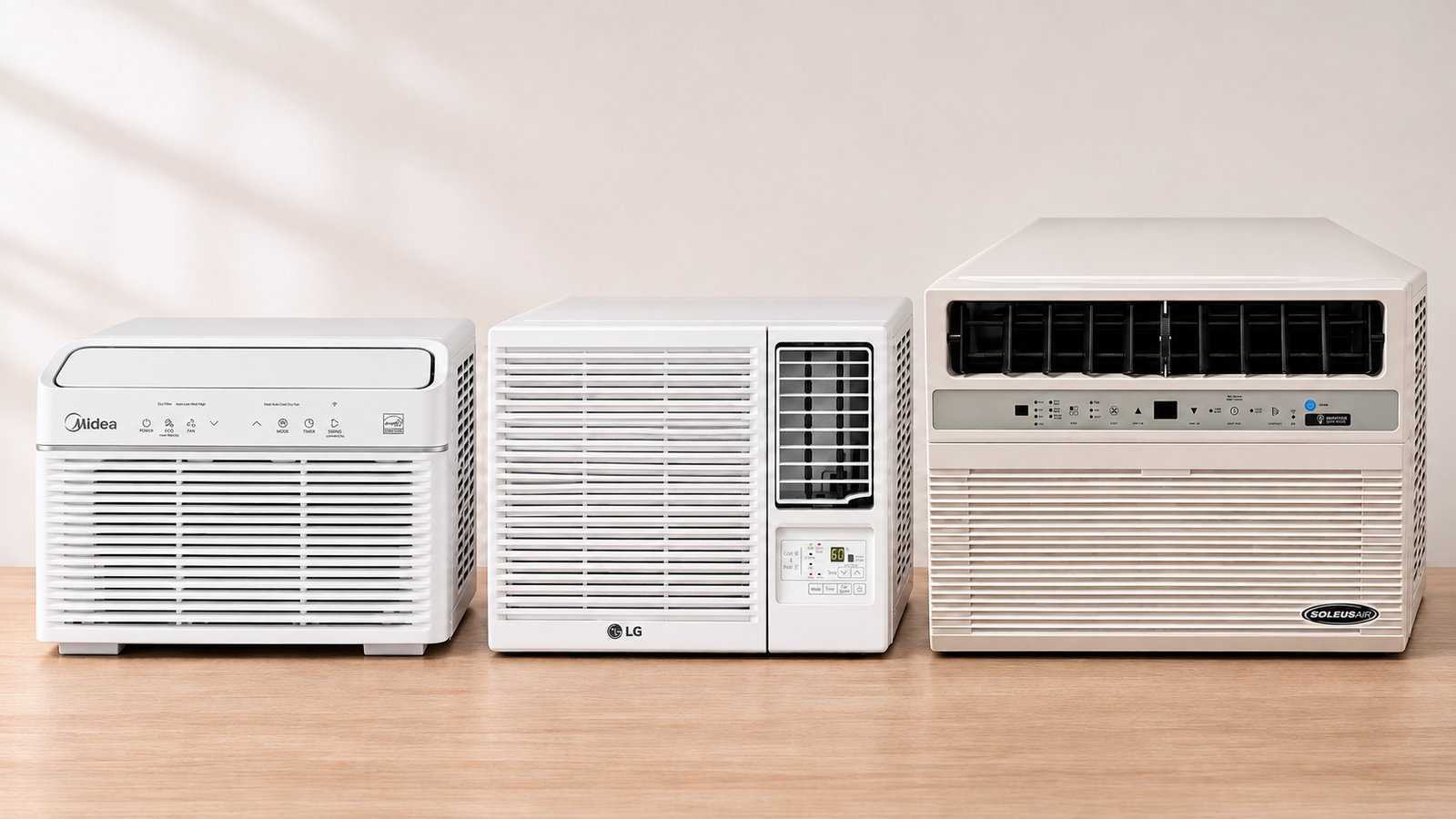
Two window units sold as air conditioners “with heat” can plug into the same kind of 115-volt outlet and still be different machines once the weather turns. LG’s LW8023HR puts out 3,850 BTU of heat, about half its 7,600 BTU of cooling, from a part its manual calls an electric heater. Midea’s MAW08HV1CWT runs its refrigeration backward to pull heat in from outdoors, and its manual is plain about the catch: “If the outdoor side temperature is below 41°F, the machine will shut off and display ‘LO’.” This guide shows how to tell which kind a listing is selling, how cold each maker says its unit can still heat, and which heat figures the makers actually publish.
AI disclosure: The text on this page was prepared with AI assistance.
We did not test these air conditioners or measure their heat output. This guide is built from Midea, LG and Soleus Air product pages, owner’s manuals and specification sheets, the federal EnergyGuide labels, ENERGY STAR’s product listing and its heating test method for room air conditioners, and Amazon’s product data, all checked on November 10, 2026. Where a maker’s documents disagree with each other or with a listing, we show both.
Quick answer: Read the EnergyGuide label or the manual, not the box: “With Reverse Cycle” means a heat pump, as on Midea’s MAW08HV1CWT, while LG’s LW8023HR heats with an electric heater. The LG’s heat strip has no outdoor cut-off in its manual but makes only 3,850 BTU from 1,260 watts. Heat pumps can get more heat from each watt but quit in the cold: Midea’s current manual says below 41°F, and Soleus Air says its 10,000 BTU WS5-12HW-301 must not be used in freezing outdoor conditions. If this would be a room’s main heat where winter nights stay below about 40°F, none of the three is a winter heater; they are spring-and-fall heat, which is how Midea describes its own unit.
Two machines behind the same “with heat”
A heat strip is the simple one. It is a resistance element sitting in the airstream, and it turns electricity into heat at a fixed rate. ENERGY STAR’s heating test method for room air conditioners uses the same conversion every resistance heater obeys: watts times 3.412 gives BTU per hour. Outdoor temperature doesn’t limit the element itself, because it warms indoor air directly. LG’s manual for the LW8023HR lists an “Electric Heater” among the unit’s interior parts, and the manual we read gives no outdoor temperature limit for heat mode.
A heat pump reverses the job the unit does in summer. ENERGY STAR’s draft specification for room air conditioners describes “reverse cycle” as switching the roles of the two coils, so that the indoor coil becomes the condenser that warms the room and the outdoor coil becomes the evaporator, “utilizing outdoor air as a source of heat.” Moving heat can take less electricity than making it, as the ratings further down show. But the outdoor coil has to pull that heat out of the air, and that is where the cut-off temperatures come from.
How to tell which kind a listing is selling
The product title won’t settle it. On Amazon, Soleus Air’s WS5-12HW-301 is titled as having a “10,000 BTU Heater,” while the owner’s manual for the same model says “Our units use the latest heat pump technology on the marketplace.” Midea’s and LG’s Amazon listings both use the phrase “supplemental heat,” one for a heat pump and one for an electric heater.
Three documents do settle it. The first is the yellow EnergyGuide label. Midea’s reads “Room Air Conditioner With Reverse Cycle,” and its ENERGY STAR listing uses the product class “With reverse cycle, with louvered sides, and less than 20,000 Btu/h.” The label for the LW8023HRSM, which shares the LW8023HR’s manual, reads “Without Reverse Cycle,” in a copy hosted by a retailer; we didn’t find one filed under LW8023HR itself. The second is the manual: Midea titles its manual “Inverter Window Heat Pump,” and LG’s parts list shows the electric heater. The third is the specification sheet. LG’s lists 1,260 watts and 11.0 amps for heating against 670 watts and 6.3 amps for cooling; Soleus’s heat pump lists one power figure for both modes.
How cold it can be outside
For a heat pump, this is the number that decides whether the unit is any use in your winter, and Midea’s documents give three versions of it. The manual on midea.com, with a date code of 20231221, lists heating operation for outdoor temperatures of 41°F to 75°F and says the unit shuts off and shows “LO” below 41°F. An earlier edition of the same manual, in copies on manual-sharing sites, says 39°F to 75°F. Midea’s product page promises “supplemental heat for spring and fall between 40°F – 110°F,” and the Amazon listing sides with the current manual: “heat pump function works when outside temp> 41°F.” We go by the 41°F in the manual on Midea’s site, the stricter figure. Midea’s troubleshooting answer for “LO” is to wait for the outdoor temperature to rise.
Soleus gives no shut-off temperature in the documents we read, and its manual pulls in two directions. One section says the unit “is not designed for freezing outdoor conditions. It must not be used in freezing outdoor conditions.” The troubleshooting section says heat pump technology “is the most efficient in heat mode above 30°F degrees” and “does not work as efficiently on temperatures below 30°F,” and recommends auxiliary heat from central air or a space heater. Freezing is 32°F, so the two statements disagree about the band between 30°F and 32°F. The stricter reading is the safe one: plan on this unit for weather above freezing.
ENERGY STAR’s heating test method gives a way to put these numbers in context. It sorts room heat pumps into four types by their compressor cut-in and cut-out temperatures and by whether they have active defrost. A Type 1 unit has no active defrost or doesn’t run below 40°F, and for Type 1 units the test simply assumes a cut-out of 42°F. Types 2, 3 and 4 have active defrost and cut-in and cut-out temperatures below 40°F, 17°F and 5°F respectively. By our reading of those definitions, a unit that shuts off below 41°F is Type 1. None of the three makers here states an ENERGY STAR heat pump type in the documents we read, and Midea’s manual doesn’t describe a defrost cycle for heating.
How much heat: the figures makers publish and the ones they leave out
LG gives the clearest numbers: 3,850 BTU of heating, 1,260 watts and 11.0 amps in heat mode, on both its product page and its specification sheet. Its newer manuals, in copies hosted by retailers, add “Electric Heater Specification : 115V 1,200W”; the earlier manual linked from LG’s own page, a 2022 revision, lists the electric heater without a rating. The figures don’t quite line up. At 3.412 BTU per watt, a 1,200-watt element should make about 4,100 BTU per hour, while 3,850 BTU corresponds to about 1,130 watts. LG doesn’t explain the gap, so we use its 3,850 BTU rating.
Soleus rates the WS5-12HW-301 at 12,000 BTU of cooling and 10,000 BTU of heating, with one power figure for both modes: 1,220 watts and 13.5 amps. The manual adds that power is measured with the fan on its highest setting, that the table is “for reference only,” and that actual data is on the rating label on the back of the unit. It doesn’t say at what outdoor temperature the 10,000 BTU was measured.
Midea publishes no heating capacity at all on the pages we read. The 8,000 BTU on the box, the EnergyGuide label and the ENERGY STAR listing is cooling capacity, and the 350 sq ft is a cooling figure too. The manual says the maximum current is printed on the unit’s nameplate rather than in the book. So a shopper can learn when the Midea heats, but not how much.
Put the two published ratings side by side and the difference shows up as plain division. The LG turns 1,260 watts into 3,850 BTU, about 3.1 BTU per watt. The Soleus turns 1,220 watts into 10,000 BTU, about 8.2 BTU per watt, roughly 2.7 times as much heat for about the same electricity. That is our arithmetic on the makers’ ratings, not a measured efficiency, and Soleus doesn’t state the outdoor temperature behind its rating. Both heat pump makers also warn about the cold: Midea says performance “may be reduced” outside its operating range, and Soleus says its heat pump “does not work as efficiently” below 30°F.
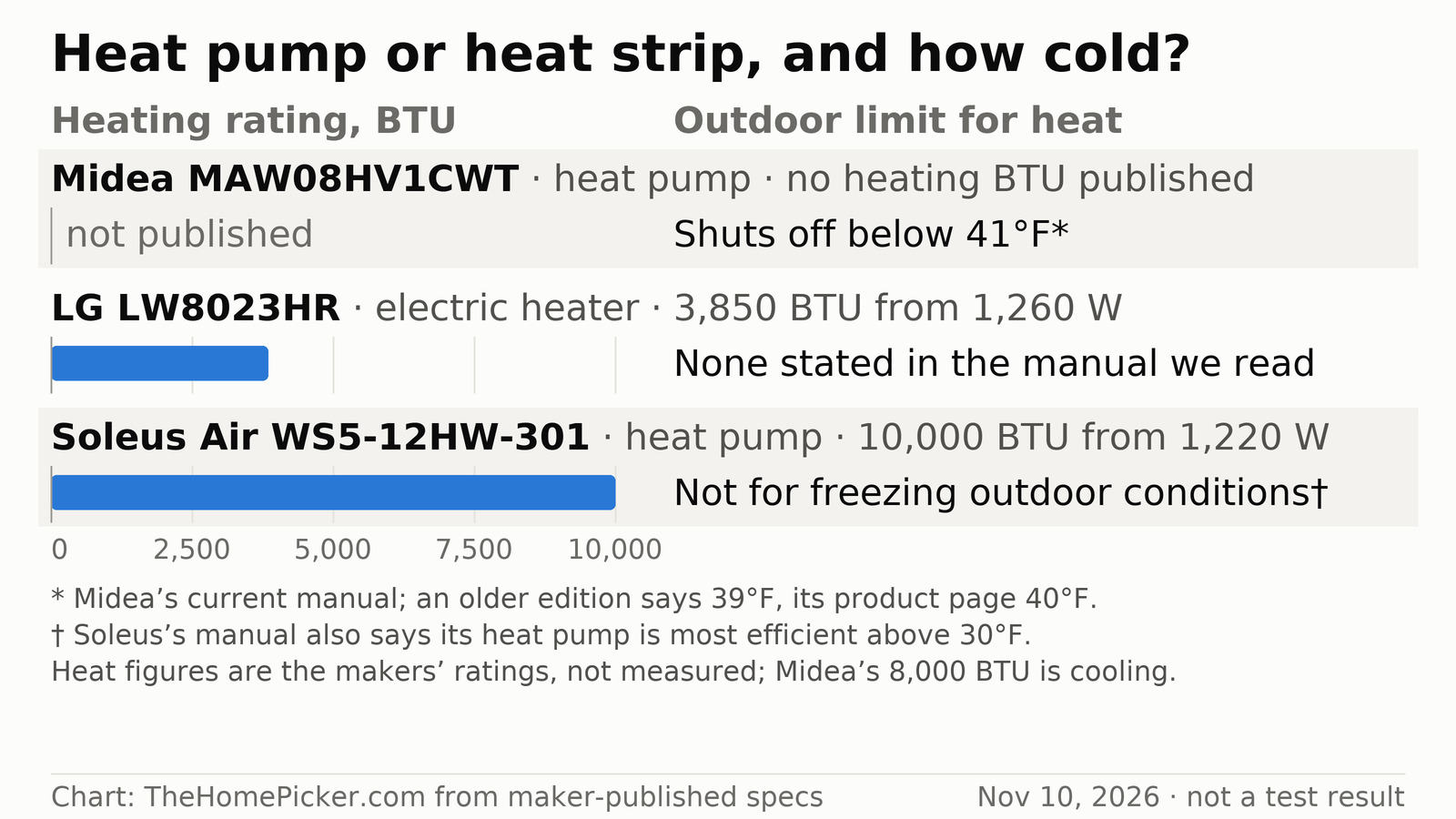
| Model | How it heats, in the maker’s words | Heat output and power | Outdoor limit for heat |
|---|---|---|---|
| Midea MAW08HV1CWT | “Inverter Window Heat Pump”; label: “With Reverse Cycle” | No heating BTU or watts published; the 8,000 BTU is cooling | Shuts off below 41°F (current manual); 39°F in an older edition; 40°F on the product page |
| LG LW8023HR | “Electric Heater” (115V 1,200W in newer manuals); sibling LW8023HRSM label: “Without Reverse Cycle” | 3,850 BTU; 1,260 W and 11.0 A in heat mode | None stated in the manual we read |
| Soleus Air WS5-12HW-301 | “Heat pump technology” in the manual; “Heater” in the Amazon title | 10,000 BTU; 1,220 W and 13.5 A for cooling and heating | Not for freezing outdoor conditions; most efficient above 30°F |
None of the three makers gives a square-footage figure for heating in the documents we read; the coverage numbers on these boxes describe cooling.
Plug, outlet and window
All three run on 115 volts. LG’s manual calls for a standard 120-volt, three-wire grounding receptacle rated 15 amps, a 15-amp time-delay fuse or circuit breaker, “a dedicated circuit,” and no extension cords. Soleus lists a NEMA 5-15P plug and 13.5 amps. Midea asks for a properly grounded receptacle and says the fuse or breaker needed depends on the maximum current on the unit’s nameplate. Those are the makers’ requirements; whether a particular outlet and circuit meet them is a question for the nameplate and, if in doubt, an electrician.
The window matters as much as the plug. Midea’s manual fits double-hung windows with openings 23.6 to 38.8 inches wide and a clear vertical opening of 13.8 inches; its Amazon listing says 24 to 38.5 inches and 14.5 inches, the tighter figures on both counts. Midea also says the rear of the unit “must be outdoors, not inside a building or garage,” with at least 11.8 inches of clearance around it. LG’s product page lists windows 21 to 34 inches wide and 15 inches high; its manual says 22 to 36 inches wide and 14 inches high. The Soleus is a saddle unit that straddles the wall and sill, sized for walls up to 12.5 inches thick and 31.8 inches deep overall.
The three we link to
Midea MAW08HV1CWT: a heat pump for mild weather
The Midea is a heat pump for cool spring and fall days and no help on a cold night. ENERGY STAR lists it as certified and Most Efficient with a combined energy efficiency ratio of 14.5, but that is a cooling rating; Midea publishes no heating capacity or heating efficiency, and its 350 sq ft claim is for cooling. The fact to plan around is the cut-off: 41°F in the current manual. It was sold by Amazon.com when we checked; the listing sits in a variation group, so check that the model shown is the MAW08HV1CWT. The 12,000 BTU MAW12HV1CWT, which shares the manual, was out of stock on Amazon when we checked, so we don’t link it.
LG LW8023HR: a heat strip with no outdoor cut-off
The LG makes the least heat here, but its manual sets no outdoor limit on heat mode, because its electric heater warms indoor air directly. LG rates it at 3,850 BTU of heat from 1,260 watts and 11.0 amps, against 7,600 BTU of cooling, and its manual warns of a slight heat odor the first time you switch to heat after summer, from dust on the heater. Even the cooling coverage varies: 330 sq ft on LG’s page, which also files it under rooms of 301 to 500 sq ft. It has two fan speeds and a slide in-out chassis, and its combined energy efficiency ratio is 11.3. It was sold by Amazon.com when we checked.
Soleus Air WS5-12HW-301: a larger heat pump on a saddle mount
The Soleus has the largest heat rating of the three, 10,000 BTU from 1,220 watts by Soleus’s table, in a saddle design that, in the words of Soleus’s product page, “sits low and over the wall.” The limits are in the same manual: no use in freezing outdoor conditions, and less efficient below 30°F. Two cautions about the paperwork. The Amazon title calls it a “10,000 BTU Heater” though the manual describes a heat pump, and the manual we read is hosted on the SoleusAir West site; the warranty in it is from Soleus N.A. When we checked, the Amazon offer came from a seller listed as Soleus Air rather than Amazon.com.
When a window unit is the wrong heater
If the room you want to heat sees winter nights well below 40°F and has no other heat, a heat pump window unit like the Midea will be off for exactly the hours you need it, and a heat strip unit like the LG will run, but only at the output of its 1,260 watts. ENERGY STAR’s test method has room heat pump types that keep running below 17°F and 5°F, but none of the three units here claims one in the documents we read. A ductless mini split is the usual next step for a room that needs real winter heat, and that is an installation job outside this guide. If all you need is summer cooling, see our guide to window air conditioners.
How to choose
- Heat pump heat for cool spring and fall days, sold by Amazon.com: Midea MAW08HV1CWT, as long as outdoor temperatures stay above 41°F.
- A little heat on days too cold for a heat pump: LG LW8023HR, with 3,850 BTU from its electric heater and no outdoor cut-off in its manual.
- The most rated heat on a 115-volt plug, and a wall the saddle fits: Soleus Air WS5-12HW-301, above freezing only.
- The heater is the room’s main winter heat and nights fall below about 40°F: none of these; look at a permanently installed system.
- A listing says “with heat” but not how: find the EnergyGuide label or the manual and look for “reverse cycle” or an electric heater rating.
Frequently asked questions
Does a window air conditioner with heat work in winter?
It depends on how it heats. A heat strip unit like the LG LW8023HR has no outdoor cut-off in its manual, but it makes only its rated 3,850 BTU. A heat pump unit stops when it gets cold outside: Midea’s current manual says the MAW08HV1CWT shuts off and displays “LO” below 41°F, and Soleus says its WS5-12HW-301 must not be used in freezing outdoor conditions.
What does “with reverse cycle” mean on a window AC label?
It marks a heat pump. ENERGY STAR’s draft specification describes reverse cycle as switching the roles of the indoor and outdoor coils so the unit heats the room using outdoor air as a source of heat. Midea’s MAW08HV1CWT label says “With Reverse Cycle”; the label for LG’s LW8023HRSM says “Without Reverse Cycle,” and its manual lists an electric heater instead.
How cold can a window heat pump heat?
Only as cold as its maker’s cut-off. Midea gives 41°F in its current manual, 39°F in an older edition and 40°F on its product page; Soleus says not to use its unit in freezing conditions. ENERGY STAR’s test method sorts room heat pumps into types that run below 40°F, 17°F or 5°F, but none of these three makers states a type in the documents we read.
Is a heat strip window unit more efficient than a space heater?
No. Any resistance heater turns a watt into about 3.412 BTU per hour, whether the element sits in a window unit or a space heater; LG’s heat mode draws 1,260 watts for its 3,850 BTU. A heat pump can do better above its cut-off temperature: on Soleus’s ratings, the WS5-12HW-301 makes about 8.2 BTU per watt against about 3.1 for the LG, by our arithmetic.
How we put this together: We compared Midea, LG and Soleus Air product pages, owner’s manuals and specification sheets (including copies hosted by retailers and manual-sharing sites, as noted above), the EnergyGuide labels, ENERGY STAR’s listing and heating test method, and Amazon’s product data, checked on November 10, 2026; we did not test these units or measure their output. BTU-per-watt figures are our arithmetic from the makers’ ratings.
As an Amazon Associate, TheHomePicker.com earns from qualifying purchases.