The short answer
Between January 2016 and August 2026 the U.S. Consumer Product Safety Commission announced 12 recalls of electrically heated bedding — electric blankets, heated throws, heating pads, heat wraps and one bed foot warmer — covering about 659,400 units sold in the United States. Every one of the 12 was issued for a fire hazard, a burn hazard, or both. The notices record 807 incident reports and 44 injuries.
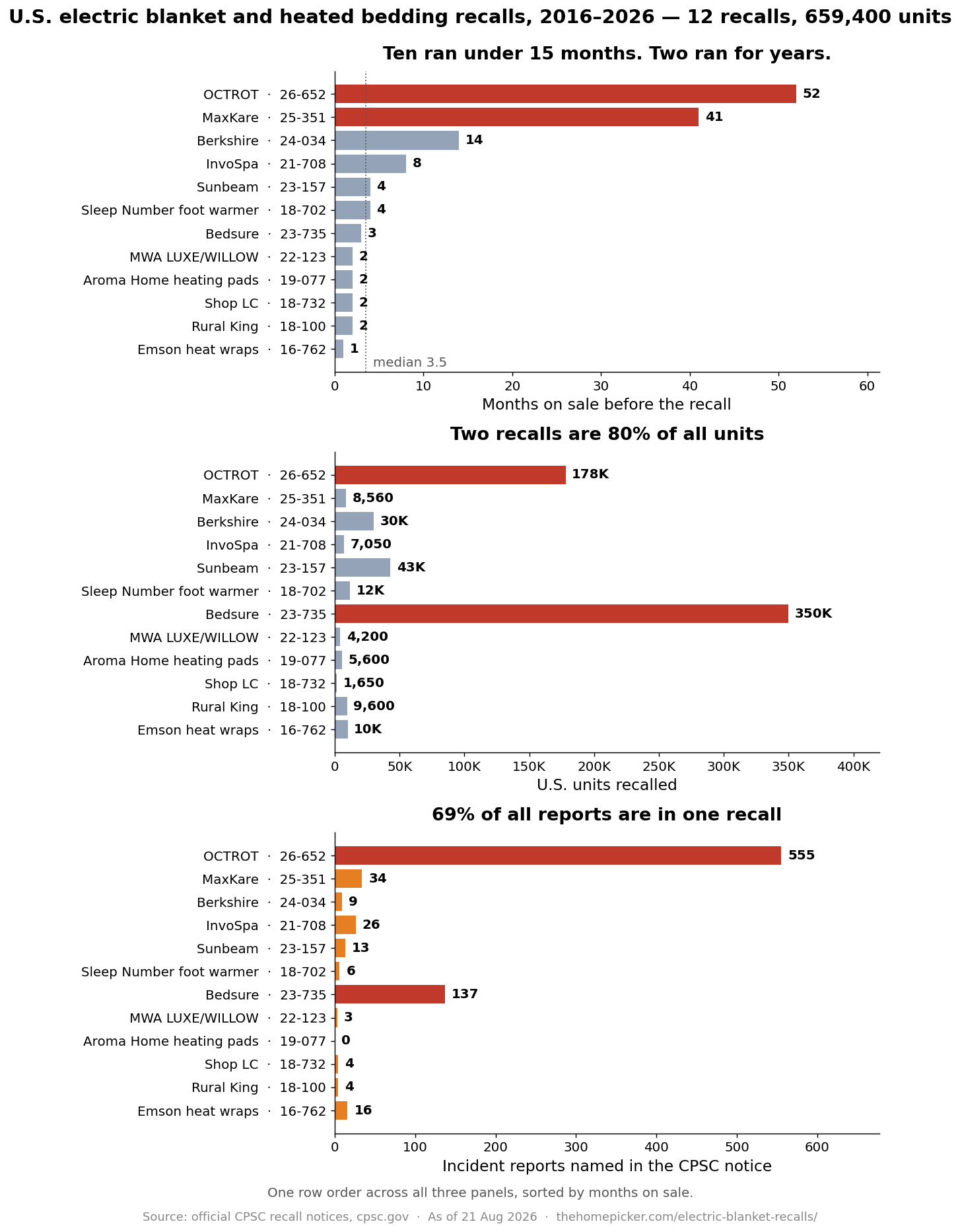
10 of the 12 had been on sale for under fifteen months when they were recalled — a median of 3.5 months. The other two ran for 41 and 52 months, and they are the two most recent recalls in the record.
Download the dataset (CSV, 12 recalls) — free to use and republish with attribution. Every field is linked to the official CPSC notice it came from, and every quoted sentence is re-checked against CPSC on each build.
Each of these recalls was covered on its own when it happened: a brand, a unit count, a refund offer. Putting 12 of them in one table adds a column none of the individual stories had — how long the product had been on the shelf before CPSC acted. That turns out to be where the variation is.
Every recall, 2016–2026
Sorted by the recall date printed on the notice. Incident, injury and fire counts are taken from CPSC’s own sentence for each recall, which is quoted in full in the CSV. Where a notice does not publish a figure the cell reads not stated here and is left empty in the CSV, with a separate column recording whether CPSC published a fire count at all — an unpublished figure is not a zero.
| Recall date | CPSC number | Product | U.S. units | Made in | Months on sale | Incidents | Injuries | Fires |
|---|---|---|---|---|---|---|---|---|
| July 27, 2016 | 16-762 | Emson UComfy neck and shoulder heat wraps | 10,000 | China | 1 | 16 | 3 | not stated |
| November 17, 2017 | 18-702 | Sleep Number foot warmers sold with 360 smart beds | 11,900 | United States | 4 | 6 | 1 | not stated |
| February 15, 2018 | 18-100 | Rural King electric blankets and throws | 9,600 | China | 2 | 4 | 1 | 2 |
| March 28, 2018 | 18-732 | Shop LC heated micro plush flannel sherpa throws | 1,650 | China | 2 | 4 | 1 | not stated |
| March 8, 2019 | 19-077 | Aroma Home USB Heated Hottie heating pads (recalled by TJX) | 5,600 | China | 2 | 0 | 0 | 0 |
| November 12, 2020 | 21-708 | InvoSpa electric throw heated blankets | 7,050 | China | 8 | 26 | 2 | not stated |
| April 21, 2022 | 22-123 | MWA LUXE and WILLOW heated blankets | 4,200 | China | 2 | 3 | 1 | not stated |
| March 9, 2023 | 23-735 | Bedsure electric heating blankets and pads (Bedshe International) | 350,000 | China | 3 | 137 | 17 | not stated |
| March 16, 2023 | 23-157 | Sunbeam queen size heated blankets (Star Elite) | 43,000 | China | 4 | 13 | 0 | not stated |
| November 30, 2023 | 24-034 | Berkshire Blanket and Home heated throws and blankets | 29,840 | China | 14 | 9 | 0 | not stated |
| June 18, 2025 | 25-351 | MaxKare electric blankets (manufactured by Yumo) | 8,560 | China | 41 | 34 | 3 | 2 |
| July 30, 2026 | 26-652 | OCTROT heated sherpa throws and blankets | 178,000 | China | 52 | 555 | 15 | 27 |
| Total, 12 recalls | 659,400 | 11 China / 1 U.S. | median 3.5 | 807 | 44 | 31 | ||
Source: official CPSC recall notices, read on cpsc.gov and last verified 2026-08-21. Units are CPSC’s published U.S. figures; units sold in Canada are excluded (about 3,600 for 19-077 and about 15,000 for 23-157). Fires are counted only in the 3 notices that publish a fire count (18-100, 25-351, 26-652); 19-077 shows zero because its notice reports no incidents of any kind.
How long they were on sale before the recall
CPSC prints the sale window in every notice — the month a product went on sale and the month it came off. Lined up, the twelve split in two. 10 of the 12 were on sale for under fifteen months, with a median of 3.5 months and 6 of them gone inside a single season.
The other two ran for years. MaxKare’s blankets sold on Walmart.com from June 2021 to November 2024 — 41 months. OCTROT’s sold on Amazon from August 2021 to December 2025 — 52 months, 15 times the median and more than 4 years. Those two are also the two most recent recalls in the record. Both sold through an online marketplace — though so did 4 of the short-window recalls, at 3, 4, 8 and 14 months, so the sales channel does not separate the two groups.
OCTROT’s notice carries 555 of the 807 incident reports in this record, so the longest run and the largest pile of reports are the same row. It would be easy to make more of that than the data supports. Time on sale is confounded with how many units sold and through what channel, and this record shows it directly: Bedsure was on sale for three months and still generated 137 reports, because it moved 350,000 units. The exposure window is a real difference between these recalls; it is not a cause.
What the sale dates cannot measure is how quickly CPSC acts. The recall follows the last recorded sale by a median of 2.5 months and never by more than 8 — but firms routinely halt sales while a recall is being negotiated, and an end date can equally mean inventory ran out. That column is partly a definition. Time on sale is the honest number here.
Two recalls are four fifths of the decade
The 12 recalls are not remotely equal in size. Bedsure’s March 2023 recall (350,000 units) and OCTROT’s July 2026 recall (178,000 units) together make up 80.1% of every unit recalled in the decade. The remaining 10 recalls share the other 19.9%, and 6 of the 12 cover fewer than 10,000 units each.
The incident reports are more lopsided still. OCTROT’s notice alone records 555 reports, 27 fires and 15 burn or electrical shock injuries — more incident reports than the other 11 recalls put together (252). It is the most recent recall in this record, announced in July 2026.
It is worth being careful about what “worst” means here, because the table supports two different answers. OCTROT has the most reported incidents and the most fires. Bedsure has more injuries (17 against 15), nearly twice the units, and the only report of second-degree burns in the set. OCTROT’s notice is also the only one here phrased as a risk of “serious injury or death” — but that is a change in how CPSC writes notices rather than a measure of this product: the phrase appears in almost no recalls before 2025 and in roughly a fifth of 2026 recalls, including ones covering a few dozen units. Read the incident counts, not the adjectives.
What that concentration means is that counting recalls per year tells you very little. 2021 and 2024 had none at all, 2023 had the most at 3, and a single recall in one year can carry more units than the previous five years combined.
What fails, and what CPSC does not say
All 12 notices name a fire hazard, a burn hazard or both. That is the one statement true of every row. It is tempting to go further and say they all overheat — 10 of the 12 notices do use that word — but two of the most serious do not describe overheating at all. Bedsure’s hazard is a controller malfunction. OCTROT’s is an electrical cord that detaches and ignites. Those are different failures with different fixes.
In most notices CPSC never identifies the failing part. Only four name a component: the electrical cord (Rural King, 2018 and OCTROT, 2026), the heating coils (Shop LC, 2018) and the controller (Bedsure, 2023). A fifth, MWA in 2022, names a condition rather than a part — the blanket can overheat if left plugged in and powered on for an extended period. The remaining notices describe what the product does without saying which part does it, and even there the wording differs: Sleep Number’s foot warmer “can short circuit and overheat”, MaxKare’s blankets “can overheat and ignite”, and the rest simply overheat.
The country column tells you less than it looks like it does. 11 of the 12 were manufactured in China, and the one exception is the 2017 Sleep Number foot warmer, made in the United States. But essentially all heated bedding sold in the United States is made in China, recalled or not, so 11 of 12 is roughly the base rate. Without knowing the country split of everything that was not recalled, this column cannot support a conclusion about where the safer blankets come from, and we are not drawing one.
What this data cannot tell you
There is no denominator. CPSC publishes how many units were recalled, never how many were sold. Without a total sold, none of this can be turned into a failure rate, a per-unit risk, or a claim that electric blankets are more or less dangerous than any other appliance. Anyone converting these numbers into a probability is inventing the bottom half of the fraction.
Incident counts are reports. Each is what the recalling firm told CPSC it had received, and the notices count slightly different things — overheating, burning, melting, sparking, smoking. Treat the total as an order of magnitude.
A recall is also evidence of a response. A brand that appears here is a brand whose problem was found and acted on, which is why the table should be read as a record of what has been caught. Twelve rows over eleven years is a thin sample, and the brands missing from it are simply brands CPSC has not announced a recall for.
How to check the blanket you own
The label sewn into the blanket, usually near the controller socket, carries the model number CPSC lists. Match it against the notice, not against the brand name — recalls almost always cover specific model and lot numbers rather than everything a brand sells. Every recall number in the table links to its official notice, which lists the affected models and the remedy CPSC agreed with the firm.
To search beyond this set, CPSC’s full database is at cpsc.gov/Recalls. If a blanket you own is on the list, unplug it and stop using it rather than waiting for the remedy — each notice sets out what the firm has agreed to provide and what it needs from you.
If you are replacing one, our guide to buying an electric blanket covers what to look for. Note that this table is not the inverse of a buying guide: a brand absent from it may simply never have been large enough to generate a recall.
Scope, method and exclusions
Scope. U.S. CPSC recalls of electrically heated bedding and heat-therapy textiles — blankets, throws, heat wraps, heating pads and bed foot warmers — announced between January 1, 2016 and August 21, 2026.
Excluded, with the recall numbers. Infrared sauna blankets are body-wrap wellness devices rather than bedding, so two recalls are left out: CPSC 26-036 (Lifepro Bioremedy, October 2025, about 78,000 units) and CPSC 26-511 (Tzumi SLF, May 2026, about 3,600 units), both searchable by number on cpsc.gov. Electrically heated apparel and hand warmers are outside the scope too.
Adding those two would take the totals to roughly 741,000 units across 14 recalls, 878 incidents, and 76 injuries rather than 44 — a 73% increase, all of it from the Lifepro recall’s 32 burn injuries, since the Tzumi notice reports six incidents and no injuries at all. The exclusion is a judgement about what counts as bedding, and it moves the injury figure (73%) far more than the unit figure (12%).
How the twelve were found. Every CPSC recall announced in the window was pulled from the SaferProducts REST API month by month with no keyword filter — 3,324 distinct recalls across 128 months — then screened three times at different breadths, matching over title, description, hazard text and product name:
- Screen A, narrow phrases (
electric blanket | heated blanket | heating pad | mattress pad | throw blanket | warming blanket): 14 records, 9 of the 12. - Screen B, narrow phrases plus form and body words (
throw, wrap, pad, foot warmer, bedding, sherpa): 93 records, all 12. - Screen C, bed-form nouns with no heat word required, title and product name only: 135 records, reviewed by hand, no additional in-scope recall.
Screen A misses 16-762, 18-702 and 26-652, and the reason is phrase contiguity rather than obscurity: “Heated Sherpa Throws and Blankets” does not contain the phrase “heated blanket”, a bed foot warmer is not a blanket, and a heat wrap is not a heating pad. A single narrow screen would have dropped the recall carrying the most incident reports in the set (555 of 807), the only U.S.-made one, and the oldest. Reproduce the pull with saferproducts.gov/RestWebServices/Recall?format=json&RecallDateStart=YYYY-MM-01&RecallDateEnd=YYYY-MM-01, which needs a browser User-Agent header — and deduplicate by recall number when you do. That range is inclusive at both ends, so consecutive months share a boundary date and the 96 recalls dated on the 1st come back twice. Concatenating the buckets gives 3,420 rows for 3,324 recalls, and an earlier version of this page published the inflated figure.
Three screens establish that the filters are complete against the pull. Whether the pull is complete against CPSC is a separate question, so here is the shape of it: an average of 312 recalls a year, a median of 25 in any given month and a maximum of 75. A pull that was dropping records would show up as thin months, and there is exactly one.
That month is January 2019, which holds a single recall against a next-lowest month of eleven — and the dates say more than the count does. The last recall of 2018 is dated 20 December, the next in the entire record is dated 30 January 2019, and nothing was published in the 41 days between. That window brackets the 35-day federal funding lapse of 22 December 2018 to 25 January 2019: the record stops two days before it began and resumes five days after it ended. The gap is in what CPSC published, not in what this pull retrieved.
How the quotations are checked. Every hazard and incident sentence here is diffed character for character against the CPSC database each time this dataset is rebuilt, along with the units, recall date, country of manufacture, retailer and notice URL. Ten of twelve match exactly; two diverge, and both are named. In 16-762 the API’s hazard text is shorter than the published notice. In 25-351 the API names Amazon and gives a sale window of September 2024 to May 2025, while the notice reads walmart.com, June 2021 to November 2024. This record follows the notice in both, and both divergences are declared inside the check, so an undeclared one fails the build. You can re-run that diff; you could not re-run “we read the page carefully.”
That distinction is not academic here. An earlier build of this page took the sale windows from the API for all twelve rows. Eleven were right; 25-351 was wrong by 33 months, in the one record already documented as API-corrupt, and the check did not catch it because the check reads the API too. The sale dates are now parsed from the Sold At sentence transcribed from each live notice, and that sentence ships in the CSV beside the dates it produced, so the derivation is inspectable. One of those twelve sentences is abridged: Shop LC’s lists sixteen television channels and platforms before it reaches the dates, and the CSV marks the cut with an ellipsis. The elided span sits entirely before the sale window, so the parse is still checkable against the notice by eye. Every other quotation on this page and in the file is complete.
Disclosure. TheHomePicker earns affiliate commissions on products we recommend, including electric blankets, and 5 of these 12 recalls involve products sold on Amazon. This record is compiled from CPSC notices. No brand has paid for inclusion or omission, and no recall has been left out for commercial reasons. There are no affiliate links on this page; the one link to our buying guide, above, goes to a page that carries them.
Dates and numbering. Dates are the recall date printed on the notice. CPSC numbers recalls and files their URLs by its own fiscal year, so 18-702 (announced November 2017), 21-708 (November 2020) and 24-034 (November 2023) carry a number from the following year. Recall numbers are shown hyphenated, as CPSC publishes them.
How to cite this data
“Electric Blanket Recalls 2016–2026”, TheHomePicker, compiled from official U.S. CPSC recall notices and last verified 2026-08-21. Available at https://thehomepicker.com/electric-blanket-recalls/. Free to use and republish with attribution and a link.
Download the data
Download the full dataset (CSV, 12 recalls) — date, CPSC number, product, U.S. units, country of manufacture, reported incidents, injuries and fires, the verbatim CPSC hazard and incident statements, retailer, and a direct link to every official notice.
Reporters
This record is compiled and maintained by James Lee. For a custom cut of the data — by year, hazard, retailer or time on sale — or for comment, reach him through our contact page. Corrections are welcome and are logged on the page.
Related datasets
This record is one of a series compiled from the same primary sources. Each is free to cite and republish with attribution.
- The Home-Appliance Recall Index — 77 CPSC recalls across every appliance category since 2015, about 29.5 million units.
- Space Heater Safety: Recall and ER Injury Data — 22 heater recalls plus CPSC NEISS emergency-room estimates. The nearest neighbour to this dataset, and the category with the most severe injuries.
- The Home-Injury Index — Estimated annual U.S. ER visits by appliance category, with hospital-admission rates.
- Mini-Fridge Recalls — Five recalls, about 1.5 million units, all for fire or burn hazards.
Frequently asked questions
How many electric blankets have been recalled in the U.S.?
CPSC has announced 12 recalls of electrically heated bedding between January 2016 and August 2026, covering about 659,400 units sold in the United States. That count includes electric blankets, heated throws, heating pads, heat wraps and one bed foot warmer. It does not include infrared sauna blankets, which are wellness devices rather than bedding.
Which electric blanket recall was the largest?
The March 2023 recall of Bedsure electric heating blankets and pads, distributed by Bedshe International, at about 350,000 units. CPSC said the controller could malfunction and cited 137 reports including 17 burn injuries, one of them second-degree burns. The second largest is the July 2026 OCTROT recall at about 178,000 units. Together those two account for 80% of all recalled units in this data.
What actually goes wrong with recalled electric blankets?
All 12 recalls were issued for a fire hazard, a burn hazard or both, but the mechanism is not the same in every case. CPSC names a specific part in only a few notices: an electrical cord that overheats (Rural King) or detaches and ignites (OCTROT), heating coils that overheat (Shop LC), and a controller that malfunctions (Bedsure). Most notices simply say the product can overheat without saying why.
Is an electric blanket dangerous?
This data cannot answer that, and any page that says it can is overreaching. CPSC publishes how many units were recalled, not how many were sold, so there is no denominator and therefore no failure rate. What the record does show is scale: 807 reported incidents and 44 reported injuries across 12 recalls in about ten years, with the reports heavily concentrated in one recent recall.
How do I check whether the blanket I own is recalled?
Search the model name on CPSC’s recall database at cpsc.gov/Recalls, and check the label sewn into the blanket against the model numbers listed in the notice. Every recall in the table above links to its official CPSC notice, which lists the affected model numbers and the remedy. If your model is recalled, unplug it and stop using it rather than waiting for the refund.
Are heated mattress pads and heating pads included?
Heating pads are: two of the twelve are heat-therapy products rather than bed blankets (Emson’s neck and shoulder heat wrap and the Aroma Home USB heating pads). Heated mattress pads are within the scope but no recall of one falls in this window — the closest is the 2017 Sleep Number recall of a foot warmer fitted under the mattress cover. Electrically heated apparel and hand warmers are outside the scope, and so are infrared sauna blankets, which are named and excluded explicitly in the method note below.
Are electric blanket recalls becoming more frequent?
The count per year does not show a clean trend. There were no in-scope recalls at all in 2021 or 2024, while 2023 had 3. What has changed is size: the two largest recalls in the decade are from 2023 and 2026, and the most recent one, OCTROT in July 2026, accounts for 555 of the 807 incident reports on its own, more than the other 11 recalls combined. On injuries the picture reverses: Bedsure’s 2023 recall reports 17 against OCTROT’s 15.
Where were the recalled blankets sold?
CPSC’s notices name Amazon in 5 of the 12 recalls, including both of the two largest. Several notices name more than one retailer — the Berkshire recall, for example, lists L.L.Bean, Target, Macy’s and QVC alongside Amazon. The recalls with no Amazon listing were sold through T.J. Maxx and Marshalls, Walmart, Rural King, HSN, Shop LC and Sleep Number’s own stores. Retailer is recorded as CPSC states it, which is why one row reads Walmart even though other databases list that recall under Amazon.