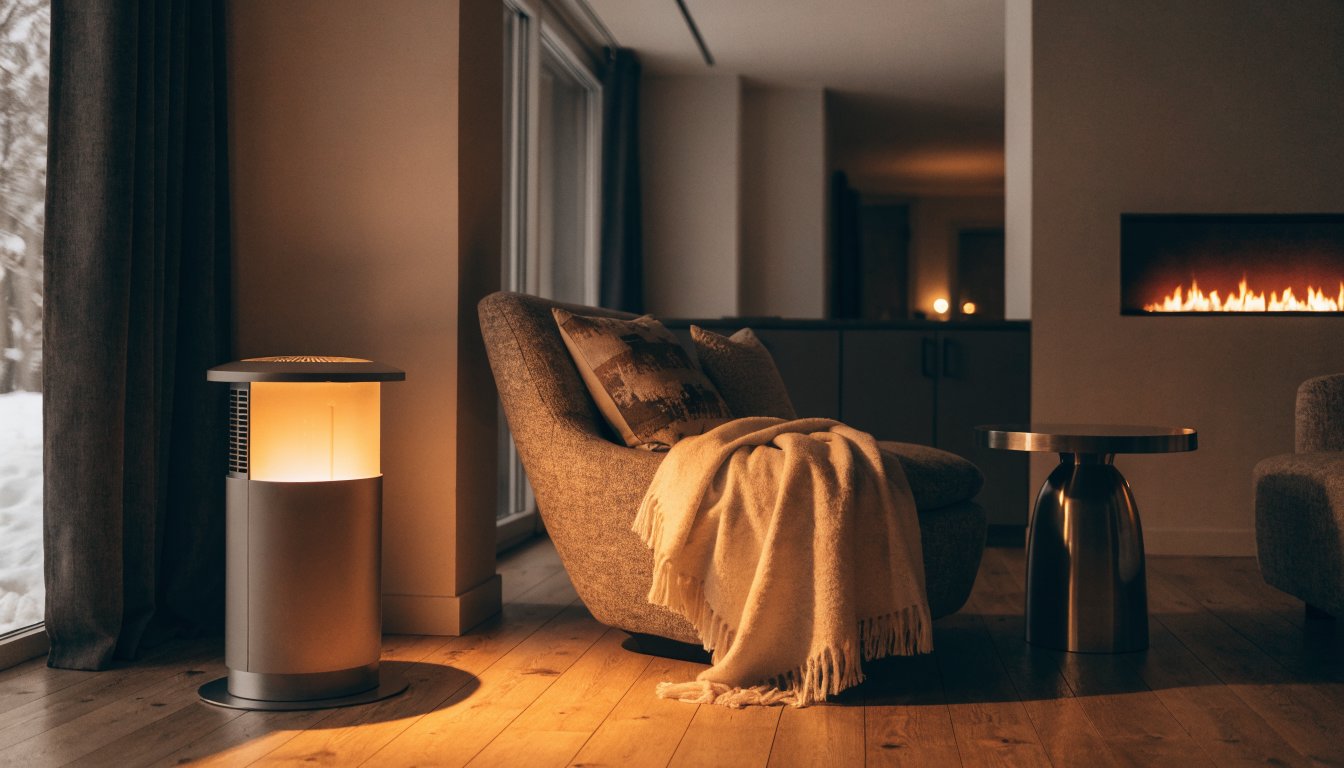
Quick answer: A plug-in space heater and a plug-in electric fireplace both top out at 1,500 watts (about 5,120 BTU) on a standard outlet, so they put out essentially the same amount of heat — enough to warm roughly one room. Choose a space heater if you want the cheapest, most portable, fastest way to warm a small space and don’t care how it looks. Choose an electric fireplace if you want that same heat plus a realistic flame effect and furniture-grade looks, and you’ll pay more for the ambiance. Pick on aesthetics, form, and features — not on heating power, because on a normal outlet they’re effectively tied.
Here’s the fact that reframes this entire decision: on a standard 120V wall outlet, a space heater and an electric fireplace produce the identical amount of heat. Not similar — identical. Both are capped at 1,500 watts, and electric heat is nearly 100% efficient, so every watt becomes warmth in the room. The glossy fireplace with the crackling flame does not heat your living room any better than the $50 plastic box from the hardware store. Once you accept that, the choice gets simple: you’re paying for looks, form, and features, not for heat.
This guide compares the two honestly — what’s the same (heat, running cost), what’s genuinely different (ambiance, placement, portability, price), and which one fits your room. If you’ve already picked a side, jump to our roundups of the best energy-efficient space heaters or the best electric fireplaces.
Disclosure: As an Amazon Associate, TheHomePicker earns from qualifying purchases. If you buy through links on this page, we may earn a commission at no extra cost to you. This never changes our recommendations.
Do they put out the same amount of heat?
Yes — and this is the most important thing to understand before you spend a dollar. A standard 120V wall outlet limits any plug-in heater to 1,500 watts. That’s a hard electrical ceiling, not a brand choice. Run the math — 1,500 watts × 3.412 BTU per watt = about 5,120 BTU per hour — and you get the number you’ll see on both space heaters and electric fireplaces (some listings round to 5,100 or 5,200). Because electric resistance heat is essentially 100% efficient, a 1,500-watt space heater and a 1,500-watt electric fireplace convert the same electricity into the same heat.
What that realistically covers: about 150–200 square feet as a primary heater — one average room. You’ll see listings claim “up to 400 sq ft” or even “up to 1,000 sq ft,” but those are best-case supplemental zone-heating figures under ideal conditions. Physics caps a 1,500-watt unit’s real comfort zone at roughly one room, whether it’s a heater or a fireplace. Treat big square-footage numbers as marketing, not a whole-home promise.
The one real exception: a few high-end fireplaces (such as some Dimplex IgniteXL models) offer a 240V hardwired mode that reaches 2,500 watts (~8,530 BTU). That is not a plug-in device — it needs a 240V circuit and an electrician, which makes it a different product class. Anything you simply plug into a wall outlet, heater or fireplace, is capped at 1,500 watts.
Space heater vs. electric fireplace: the head-to-head
| Plug-in space heater | Plug-in electric fireplace | |
|---|---|---|
| Max heat | 1,500W ≈ 5,120 BTU | 1,500W ≈ 5,120 BTU (identical) |
| Real coverage | ~150–200 sq ft | ~150–200 sq ft (identical) |
| Running cost | Same — both 1,500W | Same — both 1,500W |
| Ambiance | None — utilitarian | Realistic LED flame; runs with or without heat |
| Form | Portable floor unit, 4–6 lb | Wall-mount, recessed, mantel, TV-stand, or insert |
| Portability | High — carry room to room | Low — often mounted (stoves are the exception) |
| Price (approx, 2026) | ~$40–$120 | ~$130–$600+ |
What do they cost to run?
Exactly the same, because they draw the same power. Here’s the math: 1,500 watts is 1.5 kWh per hour of full-power runtime. At the 2026 U.S. average residential rate of about $0.15–$0.17 per kWh, that’s roughly $0.24 per hour, or about $0.20–$0.26 depending on your region. Run it eight hours a day and you’re looking at roughly $1.60–$2.10 a day, or about $48–$63 a month. The only way a fireplace ever “costs less to run” is by running its flame-only mode with the heater off — that’s just LED lighting, a few pennies an hour — or by cycling off sooner on its thermostat. It is never more efficient at making heat. (For where this sits among your other appliances, see our appliance running-cost guide.)
How do they heat differently?
The heat output is identical, but the heating method and feel differ:
- Ceramic / PTC fan-forced (most space heaters): heat in seconds, directional warm-air stream — best for fast spot heating.
- Vortex (Vornado): fan-forced but circulates whole-room air rather than blowing a narrow stream.
- Oil-filled radiator (De’Longhi): slow to warm, no fan, radiates gentle steady heat, completely silent, and stays warm after shut-off — the bedroom favorite.
- Infrared quartz (many fireplaces and some heaters): warms objects and people directly with a comfortable radiant feel.
In an electric fireplace, the flame effect is LED and completely independent of the heater — so you can enjoy the ambiance year-round with the heat switched off. If you want the differences between heater elements explained in depth, our guide to ceramic vs. infrared vs. oil-filled heaters covers it.
Which should you choose?
Choose a space heater when: your budget is tight (as low as ~$40–$70); you need to move heat room to room (office by day, bedroom by night); you want the fastest spot heat (ceramic) or silent bedroom heat (oil-filled); looks don’t matter; or you’re renting and can’t mount anything.
Choose an electric fireplace when: you want the same heat plus a realistic flame as a design feature; you want a permanent focal point (wall-mount, mantel, media console, or an insert to retrofit an old masonry fireplace); you’ll use the flame-only mode for ambiance in spring and summer; you want the heat source out of the floor traffic path in a home with kids or pets; and you’re comfortable paying $130–$600+ for the aesthetics.
What are the best models to look at?
Space heaters: The Dreo ceramic heaters give fast, quiet, feature-rich heat (thermostat, timer, remote) for around $50–$80; the Vornado AVH10 uses vortex circulation to warm a whole room evenly; the De’Longhi oil-filled radiator is silent and steady, the top pick for bedrooms; and the Lasko ceramic tower is the affordable oscillating option. See our full list in the best energy-efficient space heaters roundup.
For a silent bedroom option:
Electric fireplaces: The Duraflame infrared quartz stove is portable like a heater but adds a real flame (around $130–$200, no install); the Touchstone Sideline and R.W.Flame recessed units give a premium in-wall look with multi-color flames; and Dimplex inserts (like the Multi-Fire XHD) offer best-in-class flame realism for retrofitting an old firebox. Our best electric fireplaces guide has the full picks.
For a portable stove that plugs in anywhere:
What mistakes should you avoid?
- Expecting either one to heat a whole house. At 1,500 watts it warms about one room. Big “up to 400/1,000 sq ft” claims are best-case supplemental figures.
- Buying by BTU. Both cap at ~5,120 BTU on a normal outlet — a “higher BTU” plug-in listing is just rounding, not more heat. Don’t pay a premium for a bigger number.
- Using an extension cord or power strip. These units draw enough current to overheat cords and strips — a leading cause of heater fires. Fire codes require plugging directly into a wall outlet.
- Assuming a fireplace is cheaper to run. Same 1,500 watts, same cost. It’s only cheaper in flame-only mode.
- Assuming a fireplace is automatically safer. Both use the same heating element and carry the same fire risk from nearby combustibles; a mounted fireplace just stays out of foot traffic.
- Confusing 120V plug-in with 240V hardwired. Only a 240V hardwired install exceeds 1,500 watts. Anything you plug into a normal outlet does not.
How do you use either one safely?
Both categories carry real fire risk — heating equipment causes an estimated 38,000+ U.S. home fires a year, and space heaters account for a disproportionate share of the deaths, almost always when the heat source is too close to something combustible. The rules that prevent it are simple:
- Keep a 3-foot clearance on every side — the single most-cited rule. Away from curtains, bedding, upholstered furniture, rugs, and clothing.
- Plug directly into a wall outlet — never an extension cord or power strip, ideally on a circuit not shared with other high-draw appliances.
- Never leave one running unattended or while asleep unless it has a thermostat and timer. Turn it off when you leave the room.
- Buy only UL-, ETL-, or CSA-listed units with both tip-over auto-shutoff and overheat auto-shutoff. Cool-touch housing is a plus with kids and pets, and an oil-filled radiator or a wall-mounted fireplace keeps hot surfaces out of reach.
Frequently asked questions
Which is cheaper to run, a space heater or an electric fireplace?
Neither — they cost the same. Both draw 1,500 watts (1.5 kWh per hour), about $0.20–$0.26 per hour at typical 2026 U.S. rates. A fireplace only costs less when you run its flame-only mode with the heater off, which uses just LED lighting.
Can an electric fireplace heat a whole room?
It can heat about one average room (~150–200 sq ft) as supplemental heat. Listings claiming “up to 400” or “1,000 sq ft” describe best-case zone heating, not comfortable whole-room heat, and neither type can heat a whole house.
Are electric fireplaces safer than space heaters?
Not inherently — both use the same 1,500-watt element and carry the same fire risk from nearby combustibles. A wall-mounted or recessed fireplace does sit out of the foot-traffic path, reducing tip-over risk, but you still need 3-foot clearance, a direct wall outlet, and a UL/ETL/CSA-listed unit with auto-shutoff.
Do electric fireplaces use a lot of electricity?
On the heat setting they use the same 1,500 watts as any space heater — roughly $0.24 an hour, or about $48–$63 a month at eight hours a day. In flame-only mode with the heater off, they use almost nothing.
Do a space heater and an electric fireplace put out the same amount of heat?
Yes. On a standard 120V outlet both are capped at 1,500 watts (~5,120 BTU), and electric heat is nearly 100% efficient, so their actual heat output is essentially identical. The differences are looks, form, features, and price.
Why does a fireplace list a higher BTU or square-footage rating if the heat is the same?
Marketing. A plug-in unit can’t exceed about 5,120 BTU, so differing numbers (5,000 vs. 5,100 vs. 5,200) are just rounding. Large square-footage claims are best-case supplemental figures under ideal conditions.
Can I plug either one into an extension cord or power strip?
No. Both draw enough current to overheat cords and strips, a leading cause of heater fires. Fire codes require plugging space heaters directly into a wall outlet.
Which should I buy for a bedroom, an office, or a living room?
Bedroom: a silent oil-filled radiator or a very quiet ceramic heater. Office or spot heat: a fast ceramic heater or a vortex heater. Living room where looks matter: an electric fireplace for the same heat plus a flame focal point.
The bottom line
Stop comparing these two on heat — on a standard outlet they’re tied at 1,500 watts, and they cost the same to run. The real question is what you want in the room. If you just need warmth, cheaply and portably, buy a space heater — an oil-filled radiator for a silent bedroom, a ceramic model for fast spot heat. If you want that same warmth to double as a design feature with a year-round flame, buy an electric fireplace and pay for the ambiance, not the BTUs. Either way, insist on a UL/ETL listing with tip-over and overheat shut-off, give it three feet of clearance, and plug it straight into the wall.
Sources: Manufacturer and major-retailer listings confirming the 1,500W / ~5,120 BTU cap (Home Depot, Dimplex Multi-Fire XHD, Touchstone Sideline, R.W.Flame); Electric Fireplaces Direct and Fireplaces Direct on electric-heat efficiency; NFPA home-heating-fire findings (2019–2023) and NFPA 1 §11.5 on extension cords; HomeGuide and Energy Use Calculator running-cost figures; product pages for Dreo, Vornado, De’Longhi, Lasko, Duraflame, PuraFlame, and Dimplex. Prices and specs verified against current listings and subject to change.
Related heating & warmth guides
Safety note: for safety and recall history of home appliances, see our free U.S. appliance recall record — independent data, no affiliation, free to cite.
Before you plug one in: space heaters cause the fewest ER visits of any appliance we track, but the highest share of serious ones — and about 2.6 million units have been recalled, almost all for fire. Our space heater safety and recall data lists the models to check, including a June 2026 recall of about 255,000 tower heaters.