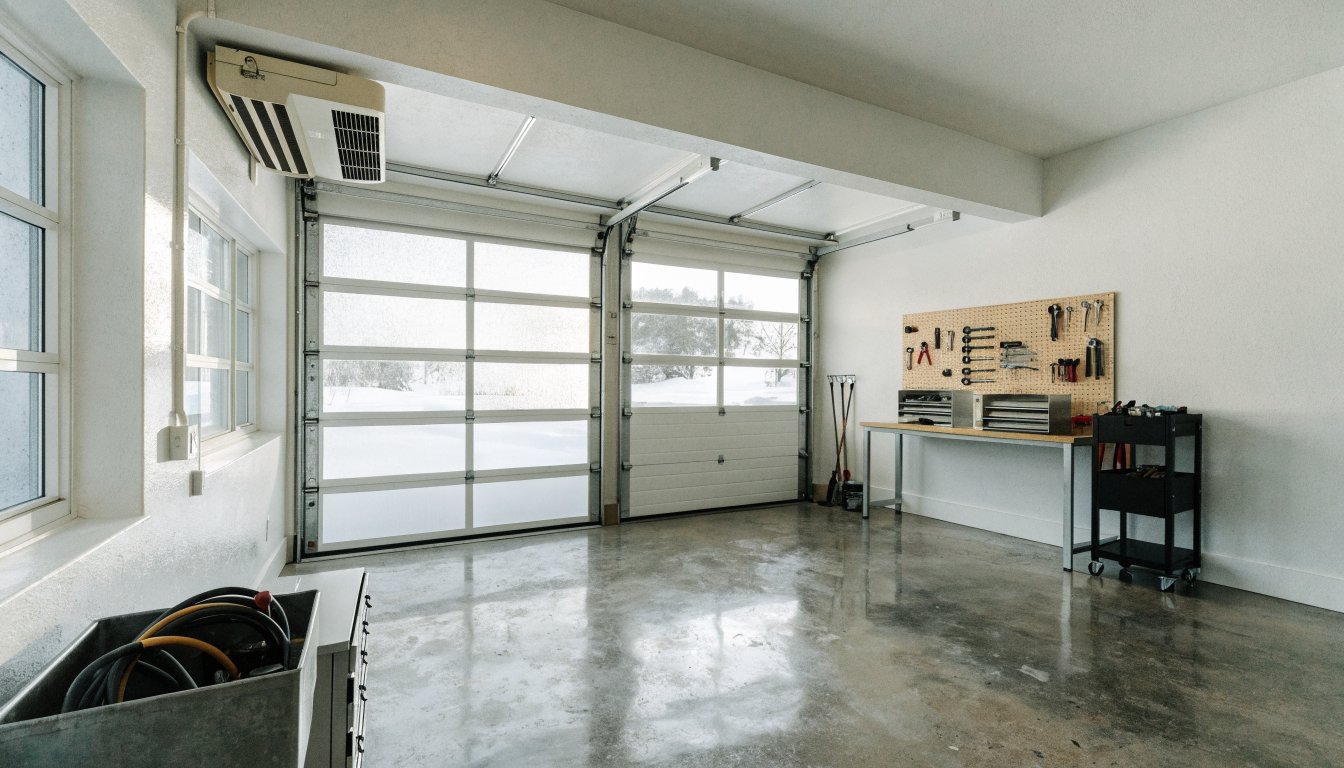
Quick answer: A standard 120V plug-in space heater will only warm a small spot at your workbench — it physically cannot heat a whole 2-car garage. To heat the entire space you need a 240V hardwired electric garage heater (if you have or can add a 240V circuit) or a gas/propane unit (best when you have no spare electrical capacity or an uninsulated, detached garage).
Quick picks: whole 2-car garage (electric) — Mr. Heater 5,000W 240V ceiling mount; best value 240V — TEMPWARE 5,000W; portable 240V — NewAir G56 (5,600W, plugs in); 120V workbench spot — Heat Storm HS-1500; big/cold shop (gas) — Mr. Heater 80,000 BTU unit heater; no-electric/detached — Mr. Heater Portable Buddy. Prices are approximate for 2026 and change often.
The single most common garage-heating mistake is buying the same $50 space heater you’d use in a bedroom and expecting it to warm the whole garage. It won’t — and the reason is simple physics. A standard wall outlet caps any plug-in heater at 1,500 watts, which is roughly 5,120 BTU, and a typical 2-car garage needs three times that much heat. So before you shop, the real decision isn’t which brand — it’s which power source: 120V for spot heat, 240V for a whole garage, or gas/propane for the biggest and coldest spaces.
This guide sorts the types, shows you how to size a heater to your garage, and gives seven real, currently sold models for 2026 — each matched to a clear scenario so you buy the right one the first time.
Disclosure: As an Amazon Associate, TheHomePicker earns from qualifying purchases. If you buy through links on this page, we may earn a commission at no extra cost to you. These are editorial picks from published specifications, not hands-on tests, and the commission never changes them.
Why won’t a regular space heater heat my garage?
Because of that 1,500-watt ceiling. A standard 120V outlet limits any plug-in heater to 1,500 watts ≈ 5,120 BTU (1 watt = 3.41 BTU). That’s enough to take the chill off a workbench or a small corner, but a whole garage needs far more. The sizing rule of thumb is about 10 watts per square foot for a moderately insulated garage — so a 400–500 sq ft 2-car garage needs roughly 4,000–5,000 watts (about 13,600–17,000 BTU), or a 30,000–45,000 BTU gas unit. In cold climates, budget more — 45–60 BTU per square foot. A 1,500-watt plug-in simply can’t get there, which is why whole-garage heating means 240V electric or gas. (For personal, spot heating — not a whole garage — our best energy-efficient space heaters guide covers the 120V options.)
What are the types of garage heater?
120V portable electric (ceramic/fan-forced) — spot heat only. Plugs into any outlet, capped at 1,500W. Cheap, portable, no combustion — but warms only the area right in front of it. For taking the chill off one work zone.
240V hardwired/high-amp electric forced-air — the whole-garage standard. Typically 4,000–10,000W, blowing heated air via a fan. Strong, even, thermostat-controlled heat with no combustion or CO — but needs a 240V circuit (often an electrician). This is the default for most insulated attached garages.
Electric infrared/radiant (quartz/tube). Heats objects and people directly instead of the air. Silent, blows no dust (good near paint or finishing work), and the warmth isn’t lost the instant the door opens — but 120V units are spot-only. For working in one area or drafty spaces.
Gas/propane forced-air (unit heater). 30,000–80,000+ BTU, natural gas or LP. Highest output and lowest operating cost per BTU — ideal for big, tall, cold, or poorly insulated garages — but produces carbon monoxide, so it needs venting, clearances, and a CO detector.
Portable propane radiant (“Buddy” style). Tank-fed and portable; indoor-safe models have an oxygen-depletion sensor. No electricity needed, so it works in a detached or power-less garage — but it still produces CO, covers a limited area, and adds moisture.
How do you size a garage heater?
Match the heat output to the space, insulation, and climate. The baseline is about 10 watts per square foot (moderate insulation, 8-ft ceiling); add more for cold climates, poor insulation, or high ceilings.
| Garage | Electric (avg. insulation) | Gas |
|---|---|---|
| 1-car (~250 sq ft) | ~2,500–3,000W (8,500–10,000 BTU) | ~10,000–20,000 BTU |
| 2-car (~400–500 sq ft) | ~4,000–5,000W (13,600–17,000 BTU) | ~30,000–45,000 BTU |
| 2-car, cold/poorly insulated | 7,500W+ | ~50,000–60,000 BTU |
| 3-car / shop (700–1,000+ sq ft) | 10,000W | 50,000–80,000 BTU |
What should you look for?
- Power source first. 120V (spot only) vs. 240V (whole garage) vs. gas/propane (biggest/coldest, cheapest to run). This decision drives everything else.
- BTU/wattage vs. garage size. Match the sizing math above — undersizing means it never gets warm; oversizing wastes money.
- Thermostat. A built-in adjustable thermostat lets it cycle instead of running full-time.
- Mounting and swivel. A ceiling or wall bracket saves floor space; adjustable louvers aim the heat where you work.
- Safety certifications. Look for UL/ETL/CSA listing on electric units and ANSI/CSA rating on gas.
- Tip-over and overheat protection on portables, plus a CO detector for any gas or propane unit.
The best garage heaters for 2026
Seven real, currently sold models, each matched to a scenario. Prices are approximate 2026 ranges that change with retailer and season.
Mr. Heater 5,000W 240V Ceiling Mount — Best Overall (whole 2-car garage, electric)
Type: 240V hardwired electric fan-forced, ceiling mount with a tilting head. Power: 5,000 / 4,000 / 3,000W high-medium-low, 240V; a 30A/240V professional hardwire connection is required. Output: ~17,060 BTU at the 5,000W setting — about 500 sq ft by the sizing rule above (the listing publishes no coverage figure).
Three switchable heat levels are the reason this one leads: you can run 3,000W on a mild day and keep the full 5,000W for a cold snap, instead of a single-output unit cycling hard on and off. Adjustable louvers and a tilting head aim the air where you actually work, and overheat protection is built in. The catch is the install — a 30A/240V hardwire connection, which for most people means an electrician. Best for a standard insulated attached 2-car garage with electrical capacity. Approx. $170 (checked August 2026; subject to change).
TEMPWARE 5,000W Garage Heater — Best Value 240V
Type: 240V hardwired electric fan-forced, ceiling mount with a variable mounting angle. Power: 3,000 / 4,000 / 5,000W, 240V. Output: up to 17,060 BTU, up to 592 sq ft by TEMPWARE’s own rating; by the sizing rule above, 5,000W suits about 500 sq ft.
The same whole-garage class as the pick above for less money, and with better controls than the price suggests: a full-function remote, a 1–12 hour auto-off timer, an ECO mode that adjusts or shuts the unit off from a built-in temperature sensor, and a thermostat adjustable from 45°F to 95°F. The body is heavy-duty steel and the unit is ETL certified. Same 240V catch, and the listing states it plainly: it must be grounded and hardwired to a properly sized breaker per the National Electric Code, and no power cord is included. Best for buyers who want whole-garage electric heat for less. Approx. $140 (checked August 2026; subject to change).
Stelpro ASCH48T — Best Portable 240V (no hardwiring)
Type: 240V plug-in portable electric, with a carrying handle. Power: 4,800W at 240V (3,600W at 208V); it plugs into a dedicated 30A / 250V outlet, typically NEMA 6-30R — no hardwiring, but the listing is explicit that this is not a standard household plug. Output: ~16,380 BTU; about 480 sq ft by the sizing rule above (the listing publishes no coverage figure).
This is the genuinely plug-in pick in the list: if the 240V receptacle already exists, you plug it in and move it wherever the work is — no electrician, no bracket. The thermostat is built into the unit, so you adjust it on the heater rather than wiring up a wall stat. The housing is powder-coated steel with a cool-touch exterior and a carrying handle, it is manufactured in North America, and two pilot lights tell you when power is on and when thermal protection has tripped. Warranty is 2 years. You still need the 30A/250V receptacle to exist, and the cord and plug are heavy-gauge. Best for someone who wants whole-garage heat but not a permanently mounted unit. Approx. $230 (checked August 2026; subject to change).
Heat Storm HS-1500-PHX-WIFI — Best 120V Spot Heater
Type: electric infrared, wall mounted, on a standard 120V household outlet (the listing states 110V) — this version is the wall-mount unit only, feet are not included. Power: 1,500W, 110V, standard outlet. Output: 5,200 BTU; up to 150 sq ft as a primary heat source, up to 750 sq ft as supplemental heat depending on insulation.
The plug-and-play pick: no wiring, quiet radiant warmth, a safe-to-touch grill, and a wall-mount body that keeps both the unit and the wall behind it cool. Mount it over the outlet and the cord hides inside the heater. The controls are the surprise for the money — Wi-Fi so you can set the temperature from your phone, a touchscreen digital thermostat, a remote in the box, and tip-over shut-off. Be clear-eyed about the limit — at 1,500W it cannot heat a whole 2-car garage; it’s for a workbench, one work zone, or a small insulated space. Approx. $150 (checked August 2026; subject to change).
Mr. Heater Big Maxx MHU80NG — Best Gas (big/tall/shop garage)
Type: ceiling-mounted forced-air gas unit heater (Mr. Heater part F260560, the natural-gas Big Maxx). Power: 80,000 BTU/hr; the fan runs on 120V, so the unit still needs an electrical supply. Coverage: Amazon’s listings for this same part number quote both 2,000 sq ft and “up to 2,667 square feet”; we use the conservative 2,000 sq ft.
Huge output and the lowest running cost per BTU, which is what makes it the answer for a cold, large, or high-ceiling garage, barn, or workshop that electric heat simply cannot keep up with. The body is a low-profile ceiling mount, and safety is handled by a high-temperature shut-off switch plus a gas shut-off flame sensor. It runs from a standard 24-volt or Wi-Fi enabled thermostat, sold separately. The constraints are real and non-negotiable: any gas unit heater produces carbon monoxide and must be properly vented, it needs a natural-gas supply (Mr. Heater sells a Big Maxx NG→LP fuel conversion kit separately) plus 120V for the fan, and it wants a 10 ft minimum ceiling height with 8 ft of clearance from the base of the heater to the floor — this is a professional installation, not a weekend job. (A 50,000 BTU Big Maxx suits smaller spaces.) Best for large, cold, or detached garages where gas is available. Approx. $550 (checked August 2026), unit only — the same heater is also sold in a bundle with a gas-appliance hook-up kit at a higher price; this link is the unit alone.
Mr. Heater Portable Buddy — Best Portable Propane (no electricity)
Type: Portable radiant propane, indoor/outdoor safe. Power: 4,000/9,000 BTU off a 1-lb cylinder (or a 20-lb tank with a hose and filter). Coverage: up to ~225 sq ft.
No electricity or wiring needed, indoor-safe with an oxygen-depletion sensor and tip-over auto shut-off, genuinely portable, and cheap. It still produces CO, so it needs ventilation and a CO detector, and its coverage is small — it’s not a whole-garage solution for a cold 2-car. Best for uninsulated, detached, or no-power garages and occasional use. Approx. $80–$110 (subject to change).
Dr. Infrared DR-966 — Alternative 240V Hardwired (3,000 / 6,000W)
Type: 240V single-phase hardwired electric, wall or ceiling mounted, bracket included. Power: 3,000W / 6,000W, 240V. Output: ~10,240 BTU on low, ~20,470 BTU on high.
The step-up option for when 5,000W is not enough. Its high setting puts out more heat than any other electric unit in this list, and its low setting covers a mid-size garage without running flat out. It is UL/C-UL listed, ships with the mounting bracket in the box, and has an adjustable thermostat with HIGH and LOW settings plus five adjustable louvers to aim the airflow. Be clear on one thing before you buy: it is hardwired and the power cord is not included, so it is not the answer if your reason for shopping was avoiding an electrician — that is what the NewAir above is for. Best as a heavier-duty alternative to a 5,000W unit in a cold or oversized garage. Approx. $176 (checked August 2026; subject to change).
What mistakes should you avoid?
- Using a 120V space heater to heat a whole 2-car garage. It’s physically impossible — 1,500W tops out at ~5,120 BTU, a fraction of the 13,600–17,000 BTU needed.
- Running a non-indoor-rated propane heater without ventilation. That’s a carbon-monoxide risk. Use only indoor-rated ODS units, and still ventilate and run a CO detector.
- Undersizing. A 3,000W unit in a cold 500 sq ft garage runs nonstop and never gets warm. Do the BTU math.
- Ignoring insulation. The best heater loses to an uninsulated garage door — insulate and weather-strip first for far cheaper running costs.
- Blocking clearances. Follow each unit’s mounting-height and clearance specs (gas unit heaters ~8 ft; infrared tube ~7 ft).
- Assuming a 240V outlet exists. Many garages only have 120V — budget the electrician cost before buying a 240V unit.
How do you use a garage heater safely?
- Carbon monoxide (gas/propane): all combustion produces CO. Use indoor-rated units (with an oxygen-depletion sensor on portables), ventilate, vent unit heaters properly, and install a CO detector on the garage ceiling. Never use an outdoor-only heater in a closed garage.
- Clearances: respect the published mounting height and side clearances (gas unit heaters around 8 ft; infrared tube around 7 ft above the floor).
- No flammables nearby: garages store gasoline, paint, and solvents — keep any glowing element or open flame well clear of vapors.
- Certifications and cutoffs: buy UL/ETL/CSA-listed electric units and ANSI/CSA-rated gas units, and never defeat the tip-over or overheat shut-offs.
Frequently asked questions
What size heater do I need for a 2-car garage?
A ~400–500 sq ft 2-car garage with average insulation needs about 4,000–5,000 watts of electric heat (~13,600–17,000 BTU) or a ~30,000–45,000 BTU gas unit. In a cold climate, size up to ~50,000–60,000 BTU. Rule of thumb: about 10 watts (~34 BTU) per square foot, more if poorly insulated.
Can I use a regular space heater in my garage?
Only for spot heat. A standard 120V space heater maxes at 1,500W (~5,120 BTU), enough to warm a workbench or small area but not a whole 2-car garage. For the full space you need a 240V electric or a gas/propane unit.
Are propane garage heaters safe indoors?
Only if the unit is rated for indoor use (with an oxygen-depletion sensor), you provide ventilation, and you install a CO detector. All propane heaters produce carbon monoxide, so never use an outdoor-only model in a closed garage.
240V vs. 120V garage heater — which do I need?
Use 120V only for spot heat in a small area (1,500W max). Use 240V to heat an entire 1–2 car garage — these deliver 4,000–10,000W (~13,600–34,000 BTU). If you don’t have a 240V circuit, budget roughly $200–$500 for an electrician, or choose a gas/propane unit.
How much does it cost to run a garage heater?
At approximate 2026 rates, a 5,000W electric unit costs about $0.80/hour (at ~$0.16/kWh); natural gas roughly $0.20–$0.50/hour; propane roughly $0.30–$0.60/hour. Gas and propane usually cost less per BTU, while electric is cheapest to buy and install. Our appliance running-cost guide puts these in context.
Do I have to hardwire a 240V garage heater?
Not always. Some 240V units — the NewAir G56 is the one in this list — ship with a cord and a 240V plug, so if you already have the receptacle you just plug in. Fixed ceiling units like the Mr. Heater and TEMPWARE 5,000W models here are hardwired and need a professionally connected 30A/240V circuit.
Is electric or gas better for heating a garage?
Electric is cheaper to buy, simpler to install, and produces no combustion or CO — it suits most insulated attached garages. Gas or propane costs more upfront but runs cheaper per BTU and puts out far more heat — better for large, tall, cold, or detached garages.
Forced-air or infrared — which type should I choose?
Forced-air warms the whole air volume fast and suits closed, insulated garages. Infrared/radiant warms objects and people directly, is silent, blows no dust (good for finishing work), and holds warmth better when the door opens — but it heats a targeted zone rather than the whole air volume. Our guide to ceramic vs. infrared vs. oil-filled heaters explains the element types.
The bottom line
Decide the power source before the brand. For a standard insulated 2-car garage with electrical capacity, a 5,000W 240V ceiling unit like the Mr. Heater or the cheaper TEMPWARE is the sweet spot; if you can’t hardwire, the plug-in NewAir G56 delivers the same class of heat from a 240V outlet, and the hardwired Dr. Infrared DR-966 is there for when 5,000W isn’t enough. For a big, cold, or detached shop, step up to the gas 80,000 BTU unit heater; for a garage with no power, the propane Portable Buddy. And if you only need to warm a workbench, the 120V Heat Storm HS-1500 is all you need — just don’t ask it to heat the whole room. Size it to your space, insulate first, and never run a combustion heater without ventilation and a CO detector.
About our picks: These are editorial recommendations based on manufacturer and major-retailer specifications (Mr. Heater, TEMPWARE, Stelpro, Heat Storm, Dr. Infrared Heater), verified as currently sold in 2026. We do not lab-test appliances; where a maker doesn’t publish a figure we say so, and we treat inflated coverage claims as supplemental, not primary. Prices are approximate and change frequently.
Related heating & warmth guides
Safety note: for safety and recall history of home appliances, see our free appliance recall index — independent data, no affiliation, free to cite.
Before you plug one in: space heaters cause the fewest ER visits of any appliance we track, but the highest share of serious ones — and about 2.6 million units have been recalled, almost all for fire. Our space heater safety and recall data lists the models to check, including a June 2026 recall of about 255,000 tower heaters.