
As an Amazon Associate, TheHomePicker.com earns from qualifying purchases. We only recommend products we would evaluate ourselves; affiliate links never affect our rankings.
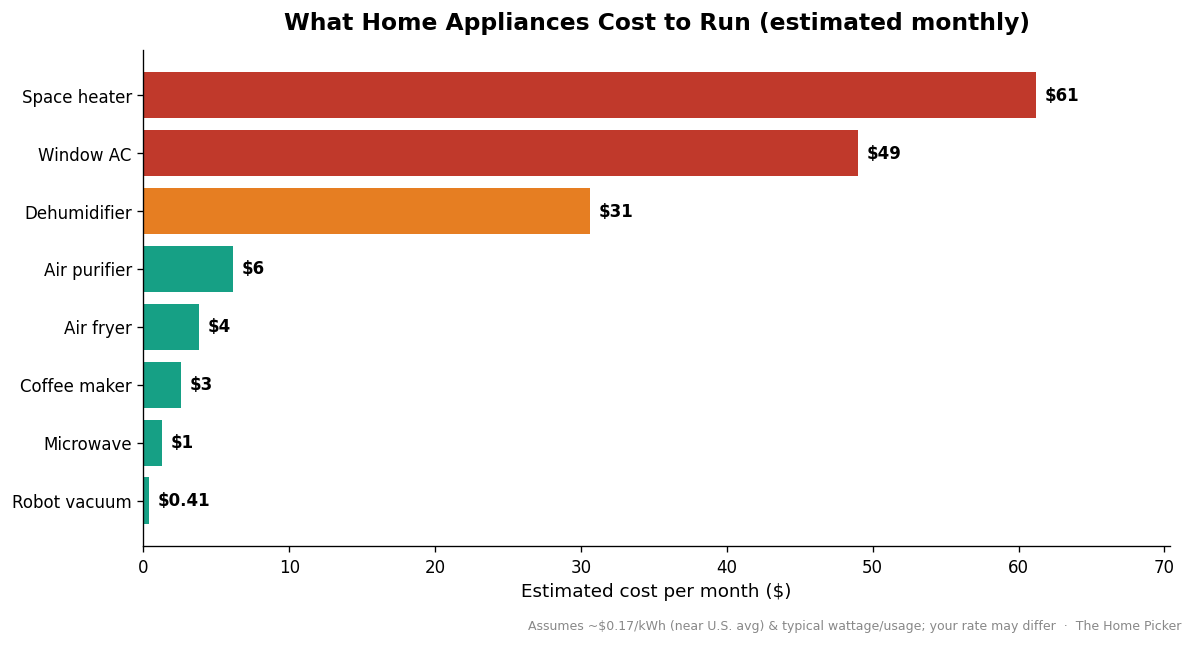
Quick answer: What an appliance costs to run comes down to its wattage and how long you use it. The expensive ones are the high-watt, long-running appliances — a space heater can cost around $61 a month, a window AC about $49, and a dehumidifier roughly $31. The cheapest are low-draw or quick-use devices — a robot vacuum is about $0.41 a month, a microwave $1, and an air purifier running 24/7 only about $6. If you want to cut your bill, focus on heating, cooling, and dehumidifying — not the small stuff. (Estimates assume ~$0.17/kWh, near the U.S. average; your rate may differ.)
Appliance running-cost data at a glance (U.S., 2026)
Free to use with attribution. Estimates from the TheHomePicker Appliance Running-Cost Dataset, calculated as wattage × assumed hours × the U.S. average residential electricity rate of about 17¢/kWh (EIA, 2026). These are typical-use estimates, not measured bills.
- The most expensive common appliance to run is a space heater — about $745 per year (1,500 W, 8 hrs/day, every day of the year).
- The cheapest is a robot vacuum, about $5 per year — a space heater costs roughly 150× more to run than a robot vacuum.
- A window air conditioner runs about $596/year on the same year-round basis; a dehumidifier about $372/year.
- Rank-ordered yearly running cost (typical use, ~17¢/kWh): space heater $745 > window AC $596 > dehumidifier $372 > air purifier $74 > air fryer $47 > coffee maker $31 > microwave $16 > robot vacuum $5.
- Because U.S. residential electricity rates vary about 3× by state — from roughly 13¢/kWh in the cheapest states to about 41¢/kWh in Hawaii — the same space heater can cost from about $570 to about $1,800 a year depending on where you live.
- Small kitchen appliances used briefly (microwave, coffee maker, air fryer) each cost only $16–$47 a year; the big yearly costs come from anything that runs for hours to heat, cool, or dehumidify.
Every yearly figure above assumes the same usage on all 365 days, which is what makes the appliances comparable to each other — it is not a claim that anyone runs a space heater in July. For seasonal appliances the number you actually want is smaller: 8 hours a day through a five-month heating season puts a space heater near $310, and a four-month cooling season puts a window air conditioner near $200. For any other pattern, multiply the monthly column by the months you actually use the appliance.
How to cite this data
TheHomePicker Appliance Running-Cost Dataset (2026), calculated from typical wattage and usage at the U.S. average residential electricity rate (~17¢/kWh, EIA). Available at https://thehomepicker.com/home-appliance-running-cost-2026-what-each-costs-to-run/. Free to use and republish with attribution and a link.
Download the data
Download the dataset (CSV) — every appliance with wattage, assumed use, kWh/year, and estimated cost per month and per year.
Reporters:
for a custom cost estimate (by appliance, usage, or your state’s rate) or comment, reach us via our contact page.
What each appliance costs to run
Below is the estimated monthly running cost for common home appliances, from most to least expensive. Every figure uses the same transparent math — typical wattage, a realistic daily usage assumption, and a national-average electricity rate — so you can see exactly where your money goes and adjust for your own habits.
| Appliance | Typical wattage | Assumed use | Est. cost / month |
|---|---|---|---|
| Space heater | 1,500 W | 8 hrs/day | ~$61 |
| Window air conditioner | 1,200 W | 8 hrs/day | ~$49 |
| Dehumidifier | 500 W | 12 hrs/day | ~$31 |
| Air purifier | 50 W | 24 hrs/day | ~$6 |
| Air fryer | 1,500 W | 30 min/day | ~$4 |
| Coffee maker | 1,000 W | 30 min/day | ~$3 |
| Microwave | 1,000 W | 15 min/day | ~$1 |
| Robot vacuum | 40 W (charging) | ~2 hrs/day | ~$0.41 |
Why heating, cooling, and dehumidifying dominate your bill
The pattern is clear: the priciest appliances are the ones that combine high wattage with long run times. A space heater or air conditioner pulls over a thousand watts and often runs for hours, so the costs stack up fast. A dehumidifier is lower-wattage but runs most of the day. These three categories are where almost all appliance electricity spending goes, which means they are also where the biggest savings live — a smart thermostat, better insulation, or simply running them less makes a real dent.
Why robot vacuums and air purifiers barely matter
People often worry about leaving an air purifier or robot vacuum running, but the numbers say not to. An air purifier draws so little power that 24/7 operation costs only about $6 a month, and a robot vacuum only uses electricity while charging — pennies a month. Quick-use kitchen gadgets like microwaves and coffee makers are cheap too, because you run them for minutes, not hours. Do not lose sleep over the small stuff.
How to calculate any appliance’s running cost
The formula is simple: (watts ÷ 1,000) × hours per day × days × your rate per kWh. Find the wattage on the appliance’s label or manual, and your electricity rate on your bill (the U.S. average is around $0.17 per kWh, but it ranges widely by state). For example, a 1,200-watt appliance used two hours a day for a month at $0.17/kWh costs about $12.24. Run the math on your biggest, longest-running appliances first — that is where your bill is really made.
How to lower your appliance running costs
Target the big three. For heating and cooling, use a programmable or smart thermostat, seal drafts, and heat or cool only the rooms you use. For dehumidifiers, pick an ENERGY STAR model and use a humidistat so it cycles off. Across the board, an energy-monitoring smart plug shows you exactly what each device draws, which turns guesswork into a plan. The low-draw devices — purifiers, robot vacuums — you can simply leave running.
Methodology
Monthly estimates use each appliance’s typical wattage and a realistic daily-use assumption (shown in the table), multiplied by 30 days and an electricity rate of $0.17 per kWh, near the recent U.S. residential average. Actual costs vary with your specific model’s wattage, how long you run it, and your local electricity rate, so treat these as directional figures for comparing appliances rather than exact bills. The formula is fully shown above so you can recalculate for your own rate and habits.
Frequently Asked Questions
Which home appliances cost the most to run?
The most expensive are the high-wattage appliances that run for long stretches: space heaters, air conditioners, and dehumidifiers. A 1,500-watt space heater running eight hours a day can cost roughly $60 a month at average U.S. electricity rates, and a window AC is not far behind. These are the appliances worth managing carefully if you want to cut your bill.
Which appliances are cheapest to run?
Low-wattage or quick-use appliances barely register. A robot vacuum costs only about $0.40 a month to keep charged, a microwave around $1, and even an air purifier running 24/7 is only about $6 a month. The reason is simple: either they draw very little power, or you only use them for minutes at a time.
How do you calculate what an appliance costs to run?
Use this formula: (watts / 1,000) x hours used per day x days x your electricity rate in dollars per kWh. For example, a 1,000-watt appliance used 30 minutes a day for a month at $0.17/kWh costs about $2.55. Your appliance’s wattage is on its label or manual, and your rate is on your electric bill.
Does running a robot vacuum or air purifier raise your electric bill much?
No. A robot vacuum only draws power while charging and costs pennies a month. An air purifier uses so little power that even running it continuously adds only a few dollars. If you are trying to lower your bill, focus on heating, cooling, and dehumidifying, not these low-draw devices.
More free TheHomePicker data
About the Author
The Home Picker Editorial Team
This report was researched and compiled by The Home Picker Editorial Team, which tests home appliances and maintains our public appliance recall, injury, and running-cost datasets. We publish honest, data-driven guidance and cite primary sources (CPSC, NEISS, EIA). Free to cite with a link — contact us for a custom data cut.