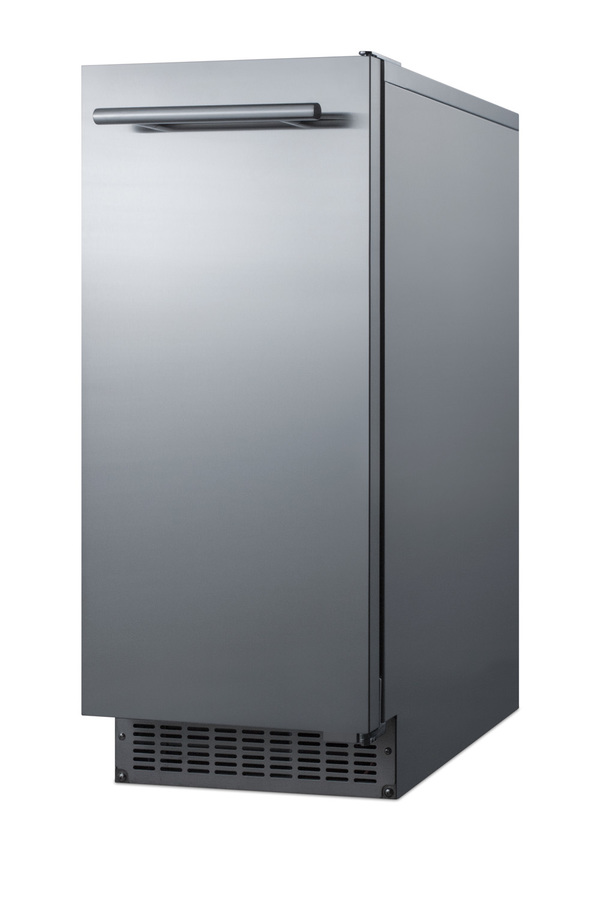
Before you measure the cabinet opening, find out where the water comes in and where the meltwater goes out. That single answer decides which undercounter ice makers are even candidates for your spot. There are three drain paths on the market: models that need no drain connection at all, models that drain by gravity into a nearby waste line, and models with an internal pump that can push water upward to a sink. Below, one exact US model stands in for each path, with the manufacturer’s own numbers.
As an Amazon Associate, TheHomePicker earns from qualifying purchases. Purchases through our links may earn us a commission at no extra cost to you.
The short version: if there is no drain anywhere near the cabinet, you are looking at a no-drain model such as the Whynter UIM-155. If a waste line or floor drain sits within a few feet and below the machine, gravity draining like the Whynter UIM-502SS is the simplest plumbing. If the only drain is a sink above the unit, or the run is long, the internal pump on the Summit BIM68OSPUMP is what makes that installation possible. Every one of the three still needs a cold-water line.
This guide compares manufacturer specifications, official user manuals and matched US listings checked on September 23, 2026. We have not installed or run these machines. It is a pre-purchase decision guide, not installation instructions: all three manufacturers direct the actual plumbing and electrical work to a licensed professional, and local code governs the job.
The three drain paths, side by side
Read the drain column first, then check whether the rest of the row survives your space. Numbers are the manufacturer’s, and blanks are honest: where a manual does not state a figure, we say so rather than borrowing a number from a similar model.
| Model | Water supply | Drain | Indoor or outdoor | Clearances and size | Power | Ice, storage and defrost |
|---|---|---|---|---|---|---|
| Whynter UIM-155 | Cold-water line; 25 ft food-grade hose included. Whynter states no diameter, and no pressure range appears in the linked manual | No drain required, per Whynter’s specification table and feature list | Indoor; the manual gives no outdoor approval | Front-grill airflow must stay clear; no numeric clearance in the linked manual. Unit 15 in W × 18 in D × 25 in H | 115/120V, 60 Hz grounded outlet; listed 120W / 1.8A. No breaker rating given | Crescent, 12 lbs per day, 6 lbs stored. Manual defrost roughly every 4–6 weeks |
| Whynter UIM-502SS | Continuous supply, minimum 15 psi and static pressure not over 80 psi; NSF inline filter (UIM-FR300) included | Gravity drain line included and required; unit under 5 ft from the drain, horizontal runs falling 1/4 inch per foot, air gap likely required | Indoor only; the manual says do not use it in an outdoor setting | At least 4 inches at the rear, 1 inch at top and sides. Unit 14.6 in W × 23.6 in D × 32.8 in H | 115V, 60 Hz, 15A grounded supply; separate circuit recommended, 15 amp fuse or breaker | Clear cubes, 80 lbs per day at 90°F ambient and 70°F water, 25 lbs stored. Also listed as manual defrost |
| Summit BIM68OSPUMP (Summit’s page marks this model discontinued, replaced by BIM63OSADA) | Installation section: 20–80 psi. Specification table: 7–113 psig. See the conflict note below | Internal pump raises water to a drainage point such as a neighboring sink, up to about 8 ft (2.4 m); 3/4-inch FPT connection on the pre-installation page, 5/8-inch drain tube in the pump model’s own steps | Indoor or outdoor per Summit, but the manual also requires an area protected from wind, rain, spray or drips | At least 1/6 inch (4 mm) at the sides for screw heads; front, upper and lower areas must stay clear for service. Cabinet 14.9 × 22.8 × 33.5 in excluding handle, legs and hinge | Installation section: 120VAC, 60 Hz, 15-amp breaker, separate circuit. Specification table: 115V / 60 Hz. A standard household circuit either way | Clear gourmet dice cubes; 47 lbs per day on the product page, 63.9 lb/day maximum in the manual at 50°F; 26 lbs stored. Frost-free |
No drain connection: Whynter UIM-155
This is the model for the kitchen island with a water line but nothing resembling a drain. Whynter’s specification table lists Drain Pump: No, and the feature list says plainly that no drain is required. What that phrase does not mean is no plumbing. The manual still sends you to the nearest cold water source with the supplied 25-foot hose — Whynter calls it food grade but publishes no diameter, and only the Amazon listing describes it as 1/4-inch — and it states that the required hardware is not provided, so a professional licensed plumber is necessary to complete the installation. A water line is usually a smaller job than a drain line, and for many kitchens that is the whole reason this model exists.
The cabinet side is partly settled and partly not. The manual permits recessed or fully built-in installation and tells you to position the unit so air moves freely through the front grill, and the cabinet itself is 15 inches wide, 18 deep and 25 high. What the manual never gives is a number for the gap at the rear or the sides, and Whynter’s own FAQ page still says ice makers need several inches of clearance around the sides and back, with built-in models typically vented from the front. Treat the rear gap as a question for Whynter rather than something this manual answers. Power is an ordinary 115/120V polarized and grounded outlet, which Whynter asks to be exclusive to the appliance; the listing puts maximum consumption at 120W / 1.8A. Output is modest and worth knowing before you commit: 12 lbs of crescent ice per day, with up to 6 lbs held in the bin.
There is one recurring chore that belongs in this decision. This is a manual-defrost machine, and the manual asks you to defrost it approximately every 4–6 weeks, or sooner if frost on the walls gets about 1/4 inch thick, by turning the unit off, removing the cubes and keeping the door open at least two inches. Choosing the no-drain path means choosing that routine, on a unit built into a cabinet.
Two more limits belong in the open. The manual the current product page links is the 2014 file, and we are not calling it the latest revision. And that manual never states a numeric ambient temperature range, a numeric installation clearance or a breaker amperage, and it never explains where meltwater goes. Whynter’s general FAQ says drain-free units recycle water internally, but that is a category answer on a shop page, not a statement about this model’s mechanism, so we do not repeat it as one. If you need exact clearances or a circuit specification for an inspection, ask Whynter for the current documentation before ordering.
Whynter UIM-155
Check Whynter UIM-155 on Amazon
As an Amazon Associate, we earn from qualifying purchases.
Gravity drain: Whynter UIM-502SS
If there is already a waste line, standpipe or floor drain near the cabinet and below the machine, gravity is the cheapest physics available. The UIM-502SS ships with the gravity drain line and the manual is direct about it: that line is required to carry water from the melted ice to a drain location. The conditions attached are the part people miss at the store. The unit should sit less than 5 feet from the drain or waste receptacle, every horizontal run needs a fall of 1/4 inch per foot, and an air gap will likely be required between the machine’s drain hose and the drain. The manual adds one more detail worth handing to your plumber: the drain hose outlet has to be raised above the top of the water level surface so drained water cannot flow back into the reservoir. Measure that distance and that fall before you fall in love with a cabinet position.
Water in is a continuous supply at a minimum of 15 psi with static pressure not exceeding 80 psi, filtered through the included NSF-certified inline filter (model UIM-FR300). Electrically it wants a standard 115V, 60 Hz, 15A grounded supply, with a separate circuit recommended and a 15 amp fuse or breaker. For the opening itself, allow at least 4 inches at the rear and 1 inch at the top and sides, and keep the unit pullable for service; the cabinet measures 14.6 inches wide, 23.6 deep and 32.8 high. Like the UIM-155, this one is listed as manual defrost on Whynter’s page, so budget for a frost routine here too — though this manual, unlike the UIM-155’s, never states an interval or a procedure, so ask Whynter what it actually involves.
Two boundaries. This is an indoor machine: the manual says it must be installed in an area protected from the elements and instructs you not to use it in an outdoor setting, with an ambient range of 50°F to 100°F and inlet water between 41°F and 90°F. And the headline capacity of 80 lbs per day with 25 lbs of storage is stated under 90°F ambient and 70°F water, which is the manufacturer’s test condition, not a promise about your garage in August. If your drain is above the machine rather than below it, this model is the wrong path and the manual’s own note points where to go next: a condensate pump can allow installation further from the drain, and it tells you to consult your plumber.
Whynter UIM-502SS
Check Whynter UIM-502SS on Amazon
As an Amazon Associate, we earn from qualifying purchases.
Internal pump: Summit BIM68OSPUMP
Sometimes there is no drain below the cabinet at all, only a sink on the other side of the counter. That is the case the pump model is built for. Summit’s manual describes the BIM68OSPUMP as having an internal pump that can raise excess water to a drainage point such as a neighboring sink, and the installation section puts a number on it: the pump may raise water up to about 8 ft (2.4 m), with the raising height dropping as you add bends to the pipeline. On drain sizing the manual gives two figures — its pre-installation page lists the drain connection as 3/4-inch FPT (NPT), while the pump model’s own installation steps have you clamp a 5/8-inch drain tube to the fitting at the back — so give your installer both. Summit states plainly that the unit requires professional installation and that the drain hose and other connection equipment are not included.
One status note before you commit. Summit’s own catalog page for the BIM68OSPUMP is marked DISCONTINUED, replaced by BIM63OSADA, even though the US listing we matched on September 23, 2026 still showed stock. That does not make the drain-pump path wrong, and this is still the clearest published example of it. But if long-term parts and service matter to you, ask Summit what the replacement changes about the pump, the drain fitting and the outdoor rating before you order.
Space and service access are specified differently here. The lateral side needs at least 1/6 inch (4 mm) of space for the projection of the screw head, and nothing may be installed at the front, upper or lower end that would block pulling the unit forward for service; the cabinet is 14.9 by 22.8 by 33.5 inches in the manual, excluding the handle, legs and hinge, while Summit’s page gives 33.63 high by 14.88 wide by 22.63 deep. The two depths that decide a flush install are on the page rather than in the manual: 24.5 inches with the handle, and 37.25 inches with the door open at 90 degrees. Power in the installation section is 120VAC, 60 Hz on a 15-amp circuit breaker with a separate circuit, while the specification table at the back of the same manual lists rated power as 115V / 60 Hz. Treat it as a standard household circuit and let the installer settle the breaker question against local code. That manual also contains a line stating that a Ground Fault Circuit Interrupter is not recommended because it could stop the product from operating. We are passing on that the line exists, not the advice, and the document carries no revision date, so we cannot say whether it has been superseded. GFCI protection for outdoor and wet-location receptacles is set by the National Electrical Code and your local jurisdiction, not by an appliance manual, and nothing in this guide suggests removing, bypassing or skipping one.
The outdoor question deserves the same care. Summit markets this as an indoor/outdoor icemaker with a weatherproof 304 stainless exterior, UL-S listed to NSF-12 commercial standards, and the manual agrees that it may be installed in either an indoor or outdoor environment. The same manual then says the unit MUST be installed in an area protected from the elements, such as wind, rain, water spray or drips, in a well-ventilated area between 50°F and 100°F. Reading those two statements together, a covered outdoor kitchen is consistent with what the manual asks for and an exposed patio is not — but that is our reading of Summit’s two sentences, not a Summit ruling, so confirm your specific location with them. Ice output carries a similar split: the product page advertises 47 lbs in a day cycle with 26 lbs of storage, while the manual’s specification table gives a maximum of 63.9 lb/day based on 50°F ambient and water temperature. Unlike the two Whynters, this one is described as frost-free, with no need to defrost the interior.
Summit BIM68OSPUMP
Check Summit BIM68OSPUMP on Amazon
As an Amazon Associate, we earn from qualifying purchases.
What to confirm before you order
Take this list to whoever will do the installation, or to the manufacturer, before the box arrives. None of it is a DIY instruction; it is what determines whether a given model can go where you want it.
- Where the cold water branches. All three models need a cold-water line, and all three manufacturers route the connection through a professional. Confirm there is a shutoff you can reach that is not behind the machine.
- Where the drain is, and whether it is below the unit. For gravity, measure the run and the fall. For a pump, measure the lift and count the bends. For a no-drain model, confirm with the manufacturer what happens to meltwater in your installation.
- The circuit. A grounded outlet that is not switched, and the breaker size your installer needs. Two of these manuals recommend a separate circuit.
- Ambient temperature and ventilation. Garages, sunrooms and outdoor kitchens swing outside the stated ranges. Check the front grill or kick plate is not going to be blocked by a cabinet panel.
- Defrosting. Both Whynters are listed as manual defrost; the Summit is described as frost-free. Only the UIM-155’s manual spells the job out — off, cubes out, door open at least two inches, roughly every 4–6 weeks — and a built-in unit that needs that every few weeks is a different ownership experience.
- Door swing and service access. Corner installations can trap the door, and every one of these units has to come forward for service.
Where the official numbers disagree
We found at least four places where a manufacturer’s own documents do not line up, and we are showing both values rather than picking the friendlier one. On the Summit, the installation section asks for 20–80 psi while the specification table lists 7–113 psig; the installation section says 120VAC while the table says 115V; and daily output is 47 lbs on the product page against a 63.9 lb/day maximum in the manual at a different temperature basis. On the outdoor question, the same Summit manual both permits outdoor installation and requires protection from wind, rain, spray and drips. The US listing we matched adds a third capacity figure of its own, titling the unit “62 LB” — retailer titles are the least authoritative of the set, so go by Summit’s 47 lbs with its stated day cycle, or the manual’s 63.9 lb/day with its 50°F basis. None of these are reasons to avoid the machine. They are reasons to have the installer confirm the pressure and circuit against the unit that actually arrives, and to treat a headline capacity as a laboratory figure.
Frequently asked questions
Do I actually need a drain for an undercounter ice maker?
Not always. Whynter’s UIM-155 is listed with no drain required and its specification table records Drain Pump: No. Models that do drain, like the UIM-502SS, include the gravity line and require it to be connected. Which type you can use depends on what exists behind the cabinet, which is why this is the first thing to check rather than the last.
Does “no drain required” mean no plumbing at all?
No. The UIM-155 still connects to the nearest cold water source with the supplied 25-foot hose, and its manual states that the required hardware is not provided and that a professional licensed plumber is necessary. The saving is the drain line, not the water line.
What if the only drain is higher than the ice maker?
That is the pump case. Summit’s BIM68OSPUMP uses an internal pump to raise excess water to a drainage point such as a neighboring sink, up to about 8 ft (2.4 m), and the manual warns that more bends in the pipeline reduce that height. For a gravity model, the Whynter manual instead suggests a condensate pump can allow installation further from the drain and tells you to consult your plumber.
How close does a gravity-drained model need to be to the drain?
Whynter’s manual asks for the ice maker to sit less than 5 feet from the drain or waste receptacle, with all horizontal runs falling 1/4 inch per foot and an air gap likely required between the drain hose and the drain. A standpipe with a trap below it or a floor drain is acceptable in that manual’s own wording, and the drain hose outlet must stay above the water level surface.
Can I put an outdoor-rated model on an open patio?
Summit describes the BIM68OSPUMP as indoor/outdoor with a weatherproof exterior, and its manual allows either environment. The same manual also states the unit must be installed in an area protected from the elements, such as wind, rain, water spray or drips, in a well-ventilated space between 50°F and 100°F. Reading the two together, a covered outdoor kitchen is consistent with that and an exposed patio is not — our reading of Summit’s two sentences, not a Summit ruling, so confirm your location with them. Whynter’s UIM-502SS manual is stricter still and rules out outdoor use entirely.
Is a bigger daily rating always better?
The daily figures come from different test conditions, so they are not directly comparable across brands. The UIM-502SS states 80 lbs per day at 90°F ambient and 70°F water, while Summit lists 47 lbs on the product page and 63.9 lb/day maximum in the manual at 50°F. Storage is the number to weigh day to day: 6 lbs on the UIM-155, 25 lbs on the UIM-502SS, 26 lbs on the BIM68OSPUMP. If you are still choosing between ice textures rather than installations, start with our countertop guide to nugget, bullet and clear ice, or compare plug-in options in our countertop nugget model comparison.