Disclosure: As an Amazon Associate, TheHomePicker.com earns from qualifying purchases at no extra cost to you. We may receive a commission when you buy through affiliate links in this article.
The IQAir HealthPro Plus has spent years as the benchmark that other premium air purifiers are measured against. At $899 for the standard model — or $1,199.99 for the newer WiFi-enabled HealthPro Plus XE — it asks a lot of your wallet. But for households dealing with allergies, asthma, wildfire smoke, or chemical sensitivities, the right question isn’t just “is it expensive?” It’s “does it filter particles that cheaper units can’t touch?”
We’ve compiled published testing data, documented specifications, and real owner feedback to give you an honest, unvarnished answer. Spoiler: the HealthPro Plus is a genuine performance leader for ultra-fine particle capture. But it carries real cons — including ongoing filter costs and a transparency issue around CADR — that every buyer should understand before spending $900.
Verdict in Brief
The IQAir HealthPro Plus earns a strong recommendation for large rooms and health-critical environments where standard HEPA filtration simply isn’t enough. If you can absorb the $899 upfront cost and roughly $365 per year in operating expenses, this is among the most thoroughly validated air purifiers available. If you want Wi-Fi and app control without a workaround, you’ll need the XE upgrade. If you’re trying to compare CADR numbers with competing brands — you can’t, and that limitation is real.
Who the IQAir HealthPro Plus Is For
This air purifier was designed for buyers who cannot compromise on air quality:
- Severe allergy and asthma sufferers who need filtration certified beyond the standard 0.3-micron HEPA threshold. Our roundup of the best air purifiers for allergies and asthma in 2026 puts the HealthPro Plus at the top of that list for a reason.
- Large open-plan spaces — the 1,125 sq ft coverage rating puts it in a category most purifiers can’t reach at this performance level.
- Wildfire-prone households where ultrafine combustion particles and smoke gases require multi-stage filtration.
- People with Multiple Chemical Sensitivity (MCS) who need documented gas-phase removal alongside particle capture.
- Buyers who prioritize long-term build quality — Swiss manufacturing and a 5-year warranty are rare at any price point in this market.
If you’re looking to reduce household dust in a 300 sq ft bedroom, there are significantly more cost-effective options. The HealthPro Plus’s advantage becomes meaningful when filtration requirements are serious and the space is large. For help sizing a purifier correctly, see our air purifier buying guide covering CADR, HEPA, and room size.
HyperHEPA Filtration: What Actually Makes It Different
Standard True HEPA filters are rated to capture particles at 0.3 microns with ≥99.97% efficiency. That benchmark handles pollen, pet dander, mold spores, and most PM2.5 particulate matter — and it’s genuinely effective. The problem is that some of the most harmful airborne threats are far smaller than 0.3 microns: ultrafine particles from cooking and combustion, certain aerosolized viruses, and smoke byproducts from wildfires all fall into the sub-0.1-micron range where standard HEPA certification stops.
IQAir’s HyperHEPA filtration technology is rated to capture particles down to 0.003 microns — one hundred times smaller than the standard HEPA test particle — at ≥99.5% efficiency. That’s not a marketing claim layered on top of a standard filter; it’s a separately certified filtration class that IQAir developed and patented.
Independent testing by HouseFresh confirmed the HealthPro Plus performs strongly on real-world ultrafine particle reduction, validating IQAir’s core filtration claims outside of manufacturer-controlled conditions. This is why hospitals, research labs, and clean rooms have long favored IQAir systems where documented particle capture is non-negotiable — not just good-enough filtration.
The 3-Stage Filtration System and What It Costs to Maintain
The HealthPro Plus runs air through three discrete filter stages, each with its own replacement schedule and cost. Understanding this before you buy is important, because the ongoing investment is real.
- PreMax F8 Pre-filter (Stage 1) — Captures coarse particles like dust, pet hair, and pollen before they reach the main filter stages. Rated lifespan: approximately 18 months. Its primary job is protecting the more expensive downstream filters, extending their service life considerably.
- V5-Cell Activated Carbon Gas Filter (Stage 2) — Handles volatile organic compounds (VOCs), chemical vapors, cooking and smoke odors using activated carbon and permanganate pellets. Rated lifespan: approximately 24 months. This is the stage that differentiates the HealthPro Plus from HEPA-only units for gas-phase contaminants.
- HyperHEPA H12/H13 Filter (Stage 3) — The core particle capture stage, responsible for the 0.003-micron certification. Rated lifespan: approximately 48 months — four full years of use before replacement. It’s the most expensive individual filter, but the extended lifespan keeps per-year cost manageable.
The IQAir replacement filter set is a meaningful budget line item. According to HouseFresh testing, annual operating costs — combining electricity consumption and prorated filter replacement costs across all three stages — run approximately $365 per year. Over a five-year ownership period, that adds roughly $1,825 in operating costs on top of the $899 purchase price. Total five-year cost of ownership: approximately $2,724. That number matters when evaluating whether this purifier fits your budget long-term.
Key Specifications
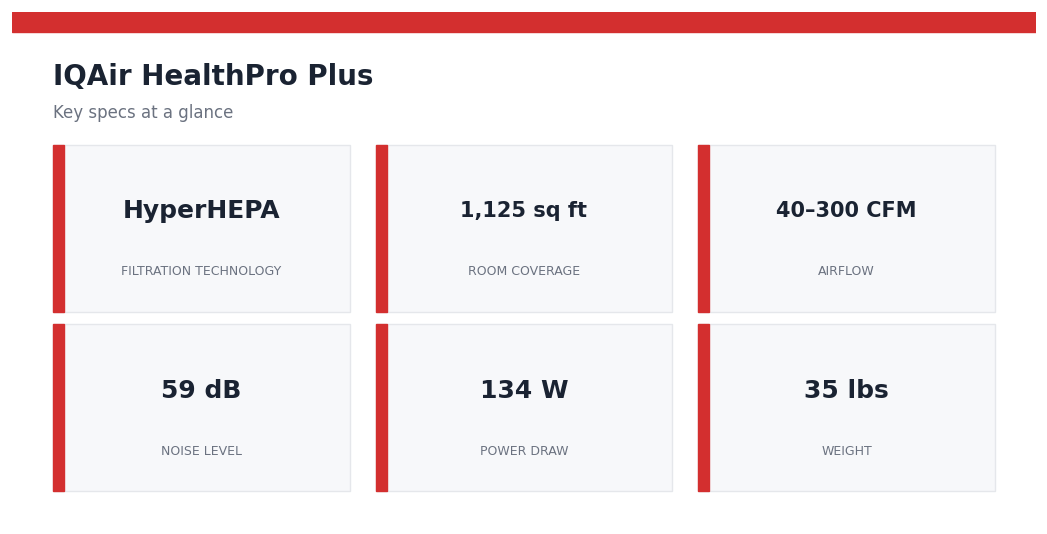
| Specification | IQAir HealthPro Plus |
|---|---|
| Filtration Technology | HyperHEPA (≥99.5% @ 0.003 microns, 3-stage) |
| Room Coverage | Up to 1,125 sq ft |
| Airflow (CFM) | 40–300 CFM (6 fan speeds) |
| Noise Level | 27–59 dB(A) |
| Power Draw | 8–134 W |
| Weight | 35 lbs |
| Dimensions (H × W × D) | 28 × 15 × 16 in |
| Filter Life — Pre-filter | ~18 months |
| Filter Life — Gas Filter | ~24 months |
| Filter Life — HyperHEPA | ~48 months (4 years) |
| Annual Operating Cost | ~$365 (electricity + filters, per HouseFresh) |
| Warranty | 5 years |
| Price — Standard Model | ~$899 |
| Price — XE (Wi-Fi) Model | ~$1,199.99 |
| Origin | Swiss-made |
Honest Pros and Cons
What We Like
- Filtration that goes beyond standard HEPA — Certified 0.003-micron capture is a meaningful, independently validated differentiator.
- Outstanding large-room coverage — 1,125 sq ft at this filtration level is rare. Our guide to the best air purifiers for large rooms shows how few units match it on both counts simultaneously.
- Three discrete filtration stages — particles, ultrafines, AND gases in a single pass.
- Long filter lifespan on the HyperHEPA stage — 4 years before replacement reduces maintenance burden.
- 5-year warranty — one of the strongest in the category at any price point.
- Whisper-quiet at low speeds — 27 dB(A) on speed 1 is among the quietest readings in the premium segment.
- Swiss manufacturing — build quality and quality control are consistently praised by long-term owners in verified reviews.
What Gives Us Pause
- High upfront cost — $899 is a steep barrier; the XE model at $1,199.99 is even more demanding.
- ~$365/year operating cost — over a five-year ownership period, operating costs approach the original purchase price again.
- Heavy and bulky — at 35 lbs and 28 inches tall, this is not a unit you’ll move between rooms casually. It’s a stationary investment for one space.
- No app or Wi-Fi on the base model — smart scheduling, remote control, and air quality monitoring via app require the $300-more XE upgrade.
- No officially published CADR — IQAir tests to a different standard than the AHAM CADR protocol used by most US brands. You cannot directly compare its clean air delivery rate against competitors on a spec sheet. Whether this reflects higher standards or a transparency gap is a legitimate debate, but it makes comparative shopping harder.
How It Stacks Up Against Other Premium Air Purifiers
The HealthPro Plus sits at the apex of the consumer premium market, competing with units from Dyson, Austin Air, and Blueair in the $500–$1,200 range. Its primary differentiator is the HyperHEPA filtration standard — no major consumer competitor claims independently certified performance down to 0.003 microns at ≥99.5% efficiency.
The honest complication is the absent CADR number. Because IQAir uses a different test protocol, you can’t line up its specs against a Dyson or Coway on a comparison chart and get a meaningful result. Independent lab testing (HouseFresh and others) has validated real-world performance, but buyers making a data-driven decision need to factor in that the comparison requires reading third-party tests rather than manufacturer spec sheets.
For buyers evaluating the full premium landscape before committing, our best premium air purifiers for 2026 roundup places the HealthPro Plus in context alongside its closest competitors, with honest notes on where each unit wins and where it falls short.
Bottom-Line Verdict
Buy it if: You have documented allergy, asthma, or chemical sensitivity needs; you’re covering a large room (700–1,125 sq ft); and you’re genuinely prepared for the total cost of ownership — approximately $899 upfront plus roughly $365 per year. The five-year warranty and Swiss build quality mean you’re buying a long-term tool, not a unit you’ll replace in 18 months.
Skip it if: You need smart home integration without paying $300 more; your room is under 400 sq ft where less expensive units perform comparably; or your budget doesn’t support the ongoing filter and electricity cost.
For health-critical filtration in a large space, the IQAir HealthPro Plus remains the standard-setter. Check current pricing and availability on the IQAir HealthPro Plus on Amazon. If Wi-Fi and app control are a priority, search for the IQAir HealthPro Plus XE with Wi-Fi instead.
Frequently Asked Questions
Q: Is the IQAir HealthPro Plus actually worth $899?
A: For people with verified allergy, asthma, or chemical sensitivity needs in rooms over 700 sq ft, yes — HyperHEPA filtration at 0.003 microns is genuinely differentiated from standard HEPA. For light household dust in smaller rooms, more affordable units deliver sufficient results and the premium is harder to justify.
Q: Why doesn’t IQAir publish a CADR rating?
A: IQAir tests to a stricter proprietary standard that differs from the AHAM CADR protocol used by most US brands. Because the test methodologies don’t translate directly, IQAir does not publish an official CADR number. Independent testing by outlets like HouseFresh has confirmed strong real-world performance, but side-by-side CADR comparisons with competing brands are not possible from spec sheets alone.
Q: What is the true annual cost of running the IQAir HealthPro Plus?
A: According to HouseFresh testing, total annual operating cost — combining electricity draw and prorated replacement costs across all three filter stages — is approximately $365 per year. This brings the five-year total cost of ownership to roughly $2,700 when added to the $899 purchase price.
Q: Does the IQAir HealthPro Plus have Wi-Fi or app control?
A: The standard HealthPro Plus ($899) does not include Wi-Fi or smartphone app connectivity. The HealthPro Plus XE ($1,199.99) adds both features. If smart control is important to you, check the latest availability of IQAir smart Wi-Fi air purifiers on Amazon before deciding between the two models.
Q: How does HyperHEPA differ from standard True HEPA?
A: Standard True HEPA filters are certified to capture particles at 0.3 microns with ≥99.97% efficiency. IQAir’s HyperHEPA is certified to capture particles down to 0.003 microns — 100 times smaller — at ≥99.5% efficiency. This covers ultrafine particles, aerosolized pathogens, and combustion byproducts that pass through standard HEPA filters without being captured.
You May Also Like
- Coway Airmega 400 vs IQAir HealthPro Plus (which wins for smoke?)
- Best Premium Air Purifiers of 2026: High-End HEPA Picks Actually Worth the Money
- Dyson HushJet Purifier Compact Review (2026): Is Dyson’s Quietest, Smallest Purifier Worth $350?
- Medify MA-40 Air Purifier Review 2026: Medical-Grade Filtration
- Levoit Core 600S Review 2026: The Air Purifier for Large Rooms
- Coway Airmega 400 Review 2026: The Large-Room Air Purifier That Works
- Best HEPA Air Purifier for Large Room 2026: Expert Review
- Best Air Purifiers for Wildfire Smoke 2026: Tested for Particle Removal