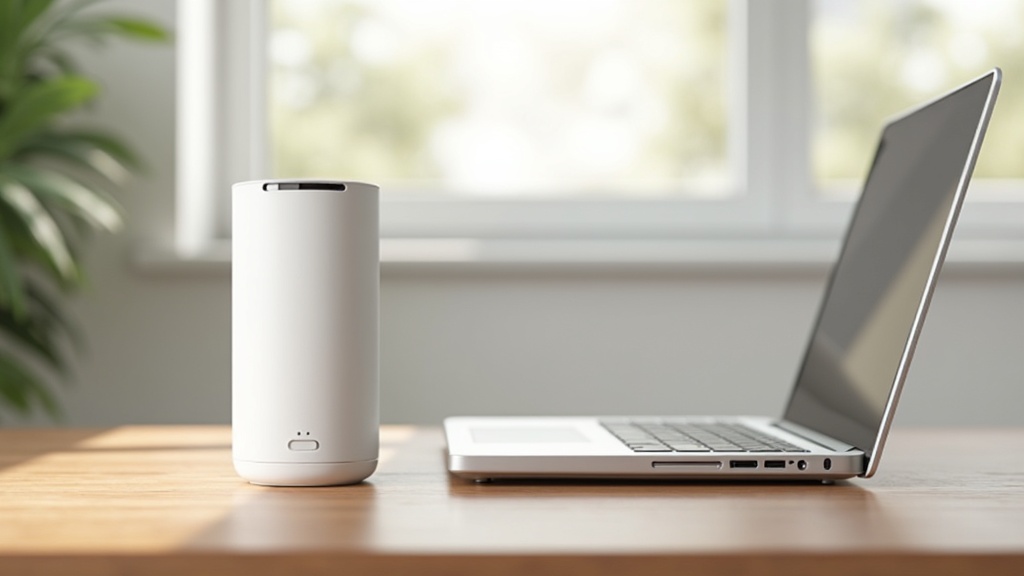
Dyson has spent the better part of a decade selling me tall, tower-shaped purifiers that dominate a room and cost as much as a used laptop. So when the Dyson HushJet Purifier Compact (HJ10) showed up as the company’s first genuinely small, desk-and-nightstand-friendly purifier, my first reaction was: finally. My second reaction, once I saw the $349.99 price tag stapled to a machine rated for a 203-square-foot room, was more skeptical. That is a lot of money for a little box of clean air.
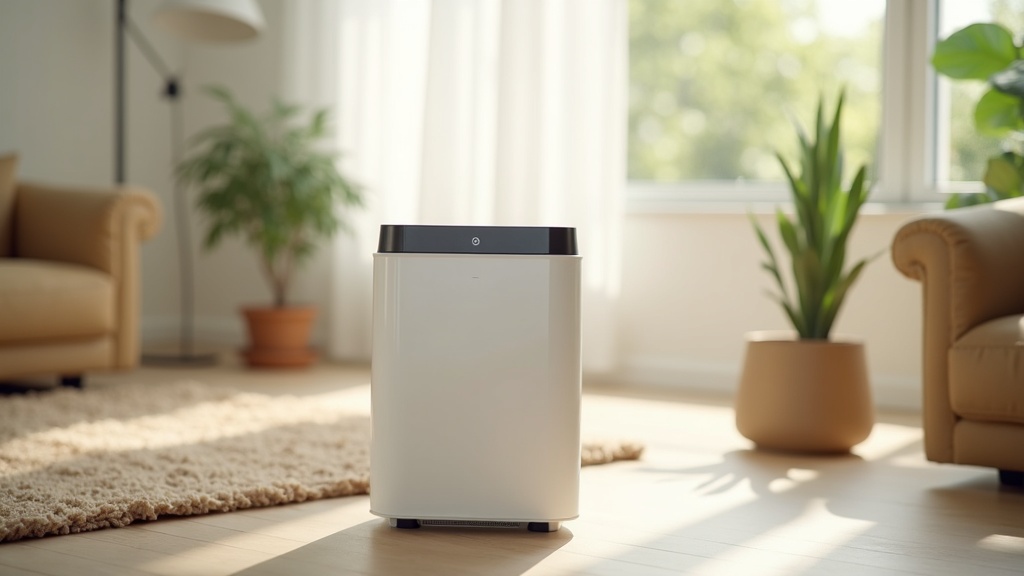
This just launched, so I won’t pretend I’ve lived with one for six months. What I can do is read the spec sheet the way a suspicious shopper should, pull apart the early hands-on coverage from TechRadar, Tom’s Guide, and T3, and tell you whether Dyson’s smallest purifier earns its keep — or whether a roughly $150 Levoit does 90% of the job. The box below has the short answer.
Quick verdict: The Dyson HushJet Purifier Compact is the quietest, best-designed small-room purifier Dyson has ever made. At 24 dBA in sleep mode it’s genuinely bedroom-friendly, the fully-sealed HEPA filtration is legit, and the 5-year main filter cuts the long-term hassle. But $349.99 buys you coverage for just ~203 sq ft — a bedroom, home office, or nursery, not a living room or open-plan space.
Who it’s for: Someone who wants Dyson’s design polish and near-silent night operation on a nightstand or desk, values a 5-year filter, and has a small room to treat.
Is $350 justified for 203 sq ft? Honestly — only if quiet, looks, and low-maintenance filters matter more to you than raw dollars-per-square-foot. If you just want clean air in a bedroom for less, a Levoit Core 300S at about $150 covers a similar-size room and is the smarter value buy. I’ll show you exactly where each one wins below.
See the Dyson HushJet on Amazon →
What’s actually new here
Every Dyson purifier before this one has been a big statement piece — the tower Purifier Cool, the Purifier Hot+Cool, the Big+Quiet that looks like it belongs in an airport lounge. The HushJet is the first time Dyson deliberately went small. It stands about 18.5 inches tall on a roughly 9 x 9-inch base and weighs around 7 pounds, which is compact by Dyson standards even if “desktop” is a stretch — I’d call it a nightstand, dresser, or end-table machine more than something you’d wedge next to your monitor.
The headline engineering trick is what Dyson calls HushJet air projection, and the name is a mouthful of marketing but the idea is real: Dyson says it borrowed the geometry of a jet engine’s contoured intake to move air with less turbulence, and turbulence is what makes fans loud. The payoff is the number Dyson leads with everywhere — 24 dBA in sleep mode. That’s whisper-territory, quieter than a library. On paper it’s the quietest purifier Dyson has ever shipped, and quiet is the whole pitch.
The other genuinely useful change is filter longevity. The main 360° electrostatic HEPA filter is rated to last five years, which is a big deal if you’ve ever owned a purifier that nagged you for a $50 filter every eight months. There’s a separate activated-carbon filter for gases and odors that Dyson says you’ll swap roughly once a year. More on the running costs later, because that’s where the “small unit, big brand” math gets interesting.
Performance and coverage — read this part carefully
Here’s the honest core of this review. Dyson rates the HushJet for rooms up to 203 square feet. That’s Dyson’s own US figure, and it’s refreshingly modest for a company whose larger units love to quote enormous “whole-room” numbers. Two hundred three square feet is a standard bedroom, a small home office, a nursery, or a study — and that’s exactly where this machine belongs.
What it is not is a living-room or open-plan purifier. If you drop this in a 400-square-foot great room and expect it to keep up, you’ll be disappointed, and no amount of jet-engine branding changes the physics of a compact fan and a small filter. Dyson was smart to size the claim honestly; you should be equally honest with yourself about your room. Measure it. If it’s bigger than roughly 200 sq ft, look at Dyson’s larger tower models or a higher-CADR unit instead — I compare a few in our best premium air purifiers of 2026 guide.
The filtration itself is the part I have zero reservations about. Dyson uses fully-sealed HEPA-grade filtration — the 360° electrostatic filter is rated to capture 99.97% of particles as small as 0.3 microns (the classic HEPA benchmark). “Fully sealed” matters more than the headline percentage: it means the air is forced through the filter rather than leaking around the edges, which is a weakness on cheaper units. For dust, pollen, pet dander, and smoke particulate, this is exactly the spec you want. It will not cure allergies or asthma or “detox” anything — no purifier does — but reducing airborne particulate in the room where you sleep is a reasonable, evidence-backed comfort upgrade.
On noise, early testing lines up with the marketing better than I expected. TechRadar’s hands-on recorded roughly 29 dB on its quietest night setting and about 55 dB flat-out on high. So the 24 dBA sleep figure is a best-case lab number, but even the real-world ~29 dB is genuinely quiet, and 55 dB on max is normal-fan territory you’d only run when you want a fast clean-up, not overnight. If silence at night is your priority — the reason most people put a purifier in a bedroom in the first place — this is the strongest argument for the HushJet.
Check HushJet stock & color options on Amazon →
Design, app, and living with it
This is a Dyson, so it looks like one — clean, architectural, available in White/Silver and a sharper Black/Teal. The compact footprint is the real design win: for the first time you can put a Dyson purifier somewhere other than the floor. On a nightstand or a dresser it reads as a nice object rather than an appliance, and that matters more than spec-obsessed reviewers like to admit, because the purifier you actually leave running is the one that doesn’t annoy you visually.
Connectivity runs through the MyDyson app, which gives you scheduling, auto mode driven by the onboard air-quality sensor, remote control, and air-quality history. It’s the same well-built app ecosystem Dyson uses across its lineup — if you already own a Dyson fan or vacuum, you know the drill. One early-reviewer gripe worth flagging: a few testers felt the particle-sensor readouts and a faint hum at the lowest speeds weren’t perfectly dialed in. Minor, but I’d rather you hear it from me than discover it yourself.
If you like the Dyson smart-purifier experience but want the “follow you around the room” tracking of the bigger models, that’s a different machine — I break down the tower version in our Dyson Purifier Cool review.
Is $350 actually worth it?
Let me do the math out loud, because this is where you decide. The HushJet lists at $349.99, and I’ve already seen Amazon dip it toward the ~$297 range, so watch the price rather than assuming full retail. Running costs are genuinely low for the category: the main electrostatic filter lasts five years, and only the carbon filter needs roughly annual replacement (in the ballpark of $35). Over five years you’re spending far less on filters than a typical purifier that eats a $30–$50 cartridge two or three times a year — I put real numbers on this in our air purifier cost-to-run guide.
So the value case isn’t crazy — if you weight it toward the things Dyson does uniquely well: near-silent night operation, fully-sealed HEPA, genuinely nice design you’ll keep on display, a mature app, and a 5-year filter. What you’re not getting is a lot of square footage per dollar. At 203 sq ft, this is a premium small-room machine, full stop. If your honest priorities are “clean air in my bedroom, as cheap as possible,” you are overpaying for the badge.
Who should buy it — and who should buy cheaper
Buy the Dyson HushJet if: you want the quietest possible purifier for a bedroom or office, you care about how it looks on a nightstand, you’re tired of frequent filter swaps and want the 5-year filter, and the premium doesn’t sting. It’s a want-purchase that happens to work well, and there’s nothing wrong with that.
Buy something cheaper if: you mainly want the air cleaned and you’d rather keep $250 in your pocket. This is where the Levoit Core 300S at around $150 comes in and genuinely embarrasses the value math. It’s AHAM Verifide at 141 CFM smoke CADR, covers roughly 219 sq ft — more nominal coverage than the Dyson — has Wi-Fi and app control, a three-stage filter, and costs less than half as much up front. Its filters run cheaper per year too. It’s not as quiet, not as pretty, and not as premium-feeling, but for pure “particulate out of my bedroom air,” it does the core job for a fraction of the price.
See the budget pick: Levoit Core 300S on Amazon →
Dyson HushJet vs. the value pick
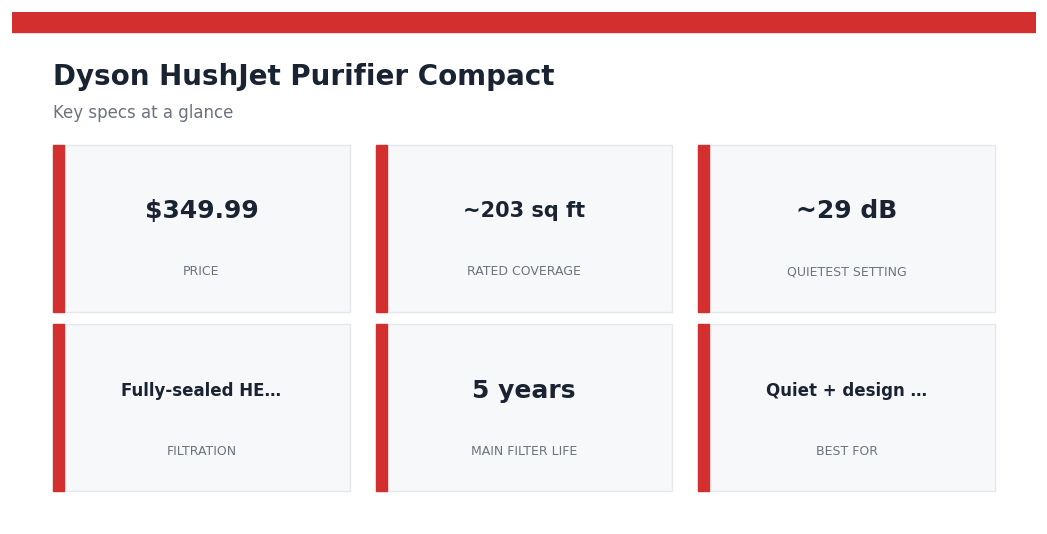
| Dyson HushJet Compact (HJ10) | Levoit Core 300S | |
|---|---|---|
| Price | $349.99 (often ~$297) | ~$150 |
| Rated coverage | ~203 sq ft | ~219 sq ft (141 CFM smoke CADR, AHAM Verifide) |
| Quietest setting | 24 dBA sleep (~29 dB tested) | ~24 dB sleep, louder on high |
| Filtration | Fully-sealed HEPA + carbon | 3-stage HEPA + carbon |
| Main filter life | 5 years (electrostatic) | ~6–8 months |
| Best for | Quiet + design + low upkeep | Best value, cheapest to own |
If you want something between these two — more coverage than the Levoit without the full Dyson premium — a Coway Airmega is the usual mid-tier answer, with strong CADR-per-dollar and a reputation for reliability.
My verdict
The Dyson HushJet Purifier Compact is a real achievement: Dyson finally made a purifier small enough and quiet enough to live on a nightstand, with fully-sealed HEPA filtration and a 5-year filter that removes most of the maintenance annoyance. As a small-room machine — bedroom, office, nursery — it’s the nicest one I’ve seen. If quiet and design are what you’re buying, this delivers, and the running costs soften the sting.
But I won’t pretend the value is universal. You’re paying Dyson money for 203 square feet of coverage, and for a lot of people a roughly $150 Levoit Core 300S cleans a similar room for well under half the price. Buy the HushJet because you want the quietest, best-looking small purifier and the low-upkeep filter — not because you think it’s the cheapest way to breathe cleaner air. It isn’t. It’s the nicest way, and only you can price that difference.
Check the latest HushJet availability on Amazon →
Still out of stock when you click? The in-stock Levoit value pick above covers a similar-size room for less than half the price.
Frequently asked questions
Is the Dyson HushJet worth $350?
It’s worth it if you specifically want the quietest, best-designed small-room purifier with a 5-year main filter, and the premium doesn’t bother you. If you just want a bedroom’s air cleaned as cheaply as possible, it’s hard to justify over a ~$150 Levoit. It’s a want, not a value pick.
What room size does the HushJet actually cover?
Dyson rates it for up to about 203 sq ft — a standard bedroom, small office, study, or nursery. It is not designed for large living rooms or open-plan spaces; for those you want a bigger tower model or a higher-CADR unit.
How quiet is it, really?
Dyson advertises 24 dBA in sleep mode, and early hands-on testing (TechRadar) measured roughly 29 dB on the quietest night setting and around 55 dB flat-out on high. Even the real-world figure is genuinely quiet — this is one of the quietest purifiers you can put in a bedroom.
What do the filters cost to replace?
The main 360° electrostatic HEPA filter is rated to last about five years. Only the activated-carbon filter needs roughly annual replacement (in the ~$35 range). Over several years that’s low upkeep compared with purifiers that need a new cartridge two or three times a year.
How does it compare to a Levoit Core 300S or Coway Airmega?
The Levoit Core 300S (~$150) covers a similar ~219 sq ft, is AHAM Verifide at 141 CFM smoke CADR, and is the clear value winner — cheaper to buy and to run, just not as quiet or as polished. A Coway Airmega sits in between on price and typically offers more coverage than the Levoit. The Dyson wins on silence, design, and filter longevity; the others win on dollars.
Affiliate disclosure: TheHomePicker.com is a participant in the Amazon Services LLC Associates Program, an affiliate advertising program. As an Amazon Associate we earn from qualifying purchases. When you buy through links on our site, we may earn a commission at no extra cost to you. This does not influence our verdicts — we call it as we see it.
This review is based on manufacturer specifications and early expert coverage of a newly launched product; it is not medical advice. Air purifiers reduce airborne particulate but do not diagnose, treat, cure, or prevent any disease. To check the air quality in your area, visit AirNow.gov (US EPA).
You May Also Like
- Dyson Find+Follow Purifier Cool Review 2026: Worth ~$850, or Buy the TP07?
- Dyson Purifier Cool TP07 Review 2026: Is the Premium Price Justified?
- Dyson vs Levoit Air Purifier 2026: Which Brand Wins?
- Best Premium Air Purifiers of 2026: High-End HEPA Picks Actually Worth the Money
- IQAir HealthPro Plus Review (2026): Is the $899 Swiss Air Purifier Worth It?