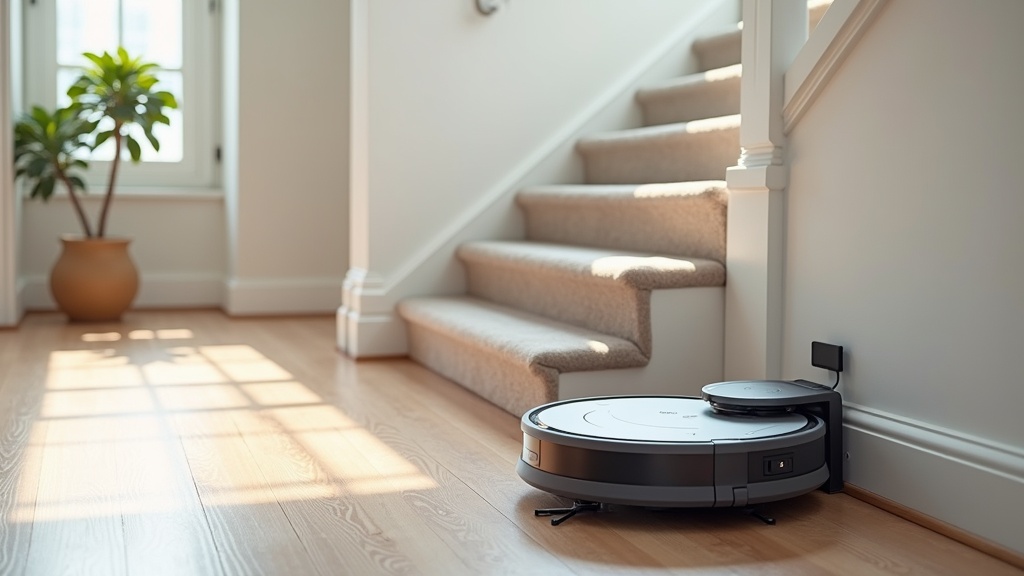
For twenty years, the robot vacuum had one humbling weakness: stairs. You could buy the smartest, most expensive puck on the market and it would still get stranded on the ground floor, spinning helplessly at the bottom step like a Roomba that just remembered it left the oven on. Buy one for every level, we told people. That was the answer. It was a bad answer.
2026 is the year that answer finally changes. At CES this January, Roborock rolled out a robot that literally walks up your staircase on two wheel-legs, and eufy is prepping a platform that hauls your existing robovac up and down a full flight like a tiny robotic elevator. I’ve watched the demos, read every hands-on I could find, and dug through the manufacturer newsrooms. Here’s the honest, no-hype breakdown of both — and, more importantly, what you should actually buy right now if you want a genuinely capable climbing-and-threshold-conquering robot on your floors this week instead of vaguely “someday.”
The honest quick answer (TL;DR): Both the Roborock Saros Rover and the eufy MarsWalker are legitimately exciting — the first real stab at conquering multi-floor cleaning. But as of today, neither has a confirmed US price and neither has a confirmed, firm US on-sale date. They are announced concepts and demos, not products you can add to a cart. Gen-1 hardware at these price tiers is also unproven and, realistically, expensive.
So if you want a superb robot vacuum that already crosses tall thresholds and multi-level room transitions today — and monetizes zero waiting — buy a current flagship: the Roborock Saros 20 (the threshold king), the Roborock Qrevo Curv (the value pick), or the eufy Omni S2 (the exact robot the future MarsWalker is built to carry). Check the Roborock Saros 20 price on Amazon →
See Today’s Best Climbing Robot Vacuums on Amazon →
What we actually know about the Roborock Saros Rover
Roborock announced the Saros Rover at CES 2026 in Las Vegas, and it’s the headline-grabber for one reason: according to the Roborock Newsroom, it’s the world’s first robot vacuum built on a “wheel-leg” architecture. In plain English, it has two independently articulating legs, each ending in a wheel, that can lift, extend, and press down separately — mimicking how a person shifts weight climbing a staircase.
CNN Underscored, which saw it in person on the show floor, described watching the two-legged robot actually climb up a set of stairs — not roll over a lip, but ascend real steps. Vacuum Wars reported that Roborock claims it can handle traditional straight staircases, curved staircases, and even carpeted stairs with rounded (bullnose) fronts, cleaning each step as it goes. T3 and other outlets framed it the same way: this is Roborock’s big robotics swing, not just another flagship puck.
That’s the confirmed part. Here’s what is explicitly not confirmed — and where I’d tell you to keep your wallet closed:
- Price: unknown. Roborock has not announced a US price. Some observers have speculated it will land above the Z70 (which launched at $2,599), but that is speculation, not a number Roborock has confirmed. I won’t quote you a fake price.
- Release date: unknown. There is no confirmed, firm US on-sale date. It was shown as a working product in active development, not a product with a ship date.
- US availability: unknown. A CES demo unit climbing a staged staircase is a long way from a retail unit navigating your actual home’s carpet, pets, and toddler-strewn Lego.
Treat every Saros Rover detail as announced / expected, not shipped. It’s real, it’s coming, but you cannot buy it today and nobody can honestly tell you what it’ll cost.
What we know about the eufy MarsWalker
eufy took a completely different — and honestly, cleverer for most homes — approach. Instead of building legs into the vacuum itself, the MarsWalker is a separate stair-climbing platform. Think of it as a robotic stairlift for your robovac. Your normal robot vacuum drives onto the platform, and the MarsWalker carries it up (or down) the staircase to the next floor, where the robot rolls off and gets back to work.
Per Engadget, Vacuum Wars, Digital Trends, and Cult of Mac, the MarsWalker uses four independently controlled arms paired with a drive-track system to grip and climb the stairs, and it’s designed to handle straight, L-shaped, and U-shaped staircases. The eufy Community and coverage from its IFA 2025 debut confirm the key detail that makes this monetizable and honest: the platform is built to carry the eufy Omni S2 — a robot vacuum you can already buy.
Again, the unknowns are the important part:
- Price: unknown. eufy has not announced an official price for the MarsWalker accessory. Period.
- Firm US release date: unknown. Coverage has pointed to a 2026 window (Engadget and Digital Trends referenced the first half of 2026), but that target is not firm — it remains pre-release, is not available for general purchase, and eufy hasn’t locked in a firm US on-sale date.
So: exciting, sourced, real — but “expected,” not buyable. The one genuinely actionable thing here is that the robot it’s built around, the Omni S2, is on shelves now. More on that below.
Saros Rover vs MarsWalker vs what you can buy now
| Roborock Saros Rover | eufy MarsWalker | What you can buy NOW | |
|---|---|---|---|
| How it climbs | Two wheel-legs; the vacuum itself walks up stairs | Separate platform carries a docked robovac up/down | Auxiliary lift wheels cross tall thresholds & multi-tier steps (not full staircases) |
| Stairs? | Full staircases (claimed): straight, curved, carpeted | Full staircases (claimed): straight, L, U-shaped | No full stairs — but conquers the thresholds that strand most robots |
| US price | Not confirmed | Not confirmed | ~$1,299–$1,599 (Saros 20 / Omni S2), often on sale |
| US release | Not confirmed | Not confirmed (pre-release) | Available today |
| Buy it? | Can’t — concept/demo | Can’t — pre-release | Check price on Amazon → |
What to buy right now instead
This is the part that actually matters. No robot vacuum on the market today climbs a full staircase — I’ll say that plainly. But the gap between “get stranded on a 1-inch door saddle” and “float across your whole main floor including tall transition thresholds and multi-tier steps” is enormous, and the current flagships already own that gap. Here’s what I’d put on my floors this week.
1. Roborock Saros 20 — the threshold king
If your real frustration is a robot that dies on tall thresholds, room-to-room transitions, and those annoying step-downs into a sunken living room, the Saros 20 is the closest thing to a climber you can buy today. Its AdaptiLift Chassis 3.0 pops out auxiliary wheels to physically lift the robot over double-layer thresholds up to about 3.46 inches, and Roborock says it can take consecutive stair-layer transitions (roughly 1.77″ then 1.69″). Pair that with 36,000 Pa of suction and a 212°F hot-water mop wash, and it’s a legitimate flagship, not a gimmick. It typically runs around $1,599 and drops lower on sale.
Why it’s my top pick: it solves the actual daily problem — getting stuck — for the widest range of real homes, right now, without waiting for a gen-1 walking robot to prove itself.
Check Roborock Saros 20 price on Amazon →
2. Roborock Qrevo Curv — the value pick
Not everyone needs to spend flagship money to get the good stuff. The Qrevo Curv brings the same AdaptiLift chassis idea — front wheels that lift to cross thresholds up to roughly 30mm single-tier / 40mm multi-tier — plus strong suction, zero-tangle brushes, and hot-water mop washing, and it frequently sells for less than the top-end Saros models when it’s on promotion. For most multi-room single-floor homes, it’s the sweet spot of “crosses everything I care about” without the flagship premium.
Why I’d grab it: you get the threshold-crossing party trick and a self-cleaning dock for meaningfully less, especially during a sale.
Check Roborock Qrevo Curv price on Amazon →
3. eufy Omni S2 — buy now, add MarsWalker later
Here’s the cleanest, most honest future-proof play in the whole category. The eufy Omni S2 launched in the US in early 2026 (around $1,299–$1,599 depending on sale) and it’s a genuinely strong self-emptying, self-washing robovac on its own merits. But it’s also the exact robot the MarsWalker platform is being built to carry. So if you’re an early adopter who truly wants multi-floor autonomy down the line, the smart move isn’t to wait in limbo — it’s to buy the S2 now, get years of use out of it, and simply add the MarsWalker later if and when it actually ships at a price you like. No gamble, no stranded floors in the meantime.
Why it’s clever: you get a great vacuum today and a clean upgrade path, instead of paying nothing and cleaning nothing while you wait.
Check eufy Omni S2 price on Amazon →
Want the deeper head-to-heads? I compared the flagship threshold-crossers in our Roborock Saros 20 vs Dreame X60 breakdown, rounded up every walking and articulated design in robot vacuums with arms and legs (2026), and pitted the big three brands against each other in Roborock vs Dreame vs Ecovacs 2026.
Should you wait?
My honest verdict: probably not. I love this stuff — a robot that walks upstairs is the coolest thing to happen to home cleaning in a decade. But temper the excitement with three realities. First, neither product has a confirmed price or firm US ship date, so “waiting” means waiting an unknown amount of time for an unknown cost. Second, these are gen-1 products; first-generation climbing hardware carries the most risk of quirks, recalls, and firmware growing pains, and it will almost certainly launch expensive. Third — and this is the kicker — the current flagships already solve the problem 90% of people actually have, which is getting stuck on thresholds and transitions, not literally scaling a staircase unattended.
If you have a genuine multi-floor home and unlimited patience, sure, keep an eye on the Saros Rover and MarsWalker. For everyone else, buy a Saros 20, Qrevo Curv, or Omni S2 today, enjoy clean floors immediately, and let the early adopters beta-test the walking robots for you.
Skip the wait — check today’s prices:
Roborock Saros 20 →
Roborock Qrevo Curv →
eufy Omni S2 →
FAQ
When does the Roborock Saros Rover come out?
There is no confirmed US release date. Roborock announced it at CES 2026 as a working product in active development, but has not committed to a firm on-sale date. Anyone quoting you a specific launch day is guessing.
How much will the Saros Rover and MarsWalker cost?
Unknown for both. Neither Roborock nor eufy has announced an official US price. There’s speculation the Saros Rover could exceed the $2,599 Z70, but that’s speculation — not a confirmed number.
Can any robot vacuum climb full stairs today?
No. As of now, no robot vacuum you can buy climbs a full staircase unattended. Current flagships like the Roborock Saros 20 can cross tall thresholds and multi-tier steps using auxiliary lift wheels, which solves the practical “it keeps getting stuck” problem — but full staircases remain a 2026-and-beyond promise.
Is the eufy MarsWalker worth waiting for?
It’s a genuinely clever concept — a platform that carries your robovac between floors — but it’s pre-release with no confirmed price or firm US date. The smarter play is to buy the eufy Omni S2 it’s designed to carry now, then add the MarsWalker later if it ships at a price you like.
What climbs thresholds best right now?
The Roborock Saros 20, thanks to its AdaptiLift Chassis 3.0 and auxiliary lift wheels that clear double-layer thresholds up to about 3.46 inches. The Qrevo Curv is the value alternative, and the eufy Omni S2 is the pick if you want a MarsWalker upgrade path. Check the Saros 20 price on Amazon →
Disclosure: TheHomePicker.com is a participant in the Amazon Services LLC Associates Program, an affiliate advertising program. As an Amazon Associate we earn from qualifying purchases. If you buy through links on this page, we may earn a commission at no extra cost to you. Upcoming products (Roborock Saros Rover, eufy MarsWalker) are not yet available for purchase and are not affiliate-linked; details are drawn from manufacturer announcements and hands-on reporting and are subject to change.
You May Also Like
- Robot Vacuums With Arms and Legs Are Coming in 2026 (One You Can Already Buy)
- Roborock Saros Z70 Review (2026): The Robot Vacuum With a Real Robotic Arm – Worth $1,300?
- Roborock Saros Z70 vs Dreame X50 Ultra (2026): Robotic Arm vs ProLeap Legs — Which Flagship Wins?
- iRobot’s 2026 Roomba Comeback (Max 705, 715 & 775): Is Roomba Back for Real?
- Dreame Cyber10 Ultra: Release Date, Price & Specs (2026) – Should You Wait?
- Narwal Flow 2 Review (2026): The Robot Vacuum That Finds Your Keys – Worth It?
- Best Robot Vacuums for Large Homes 2026: Top 5 Picks