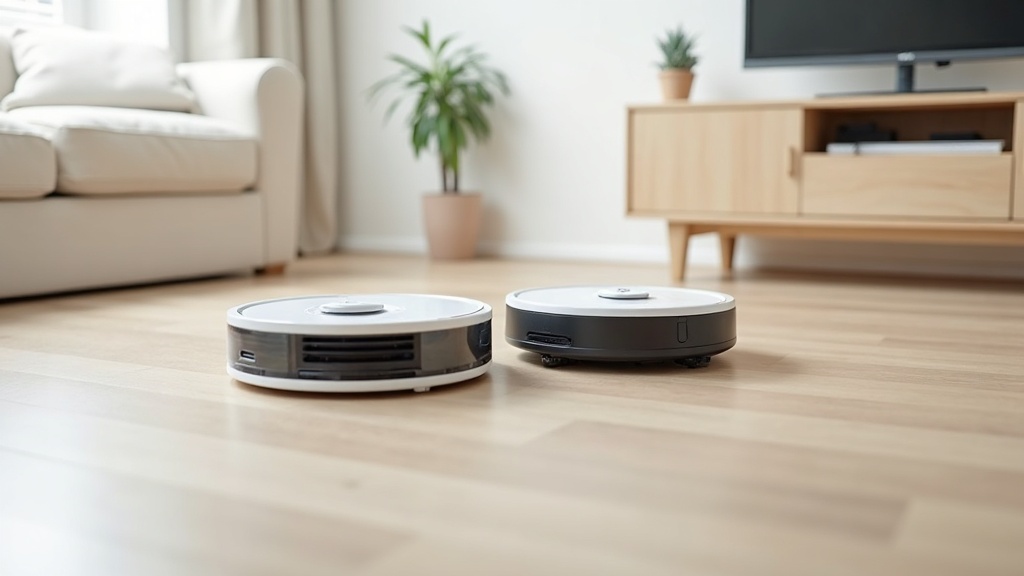
Two flagships, two hugely different design philosophies. Roborock leans on dock automation and slim profile; Dreame leans on raw mechanical capability — extending mop arms, climbable thresholds, multi-floor logic. I’ve used the Saros 20 for 8 weeks and the Dreame X60 Ultra for 6 weeks. Here’s the honest comparison.
Compare these robot vacuums next: If you are weighing the Saros 20 and X60 Ultra, these related guides help you finish the decision.
- Roborock Saros 20 review – the full standalone test of the Saros 20
- Best Dreame robot vacuums – how the X60 fits Dreame’s lineup
- Ecovacs vs Roborock – brand-level strengths and weaknesses
- Best robot vacuum and mop combos – a broader shortlist
Roborock Saros 20
Dreame X60 Ultra
Curious how this stacks up across the whole category? Our 2026 Robot Vacuum Database tracks prices, suction, and arm/leg features for 21 models in one place.
TL;DR
Saros 20 wins on profile, brush design, and dock simplicity. X60 wins on mop reach and stair-edge handling. Pricing is within $100, so the choice is about features, not value.
Specs Side-by-Side
| Spec | Roborock Saros 20 | Dreame X60 Ultra |
|---|---|---|
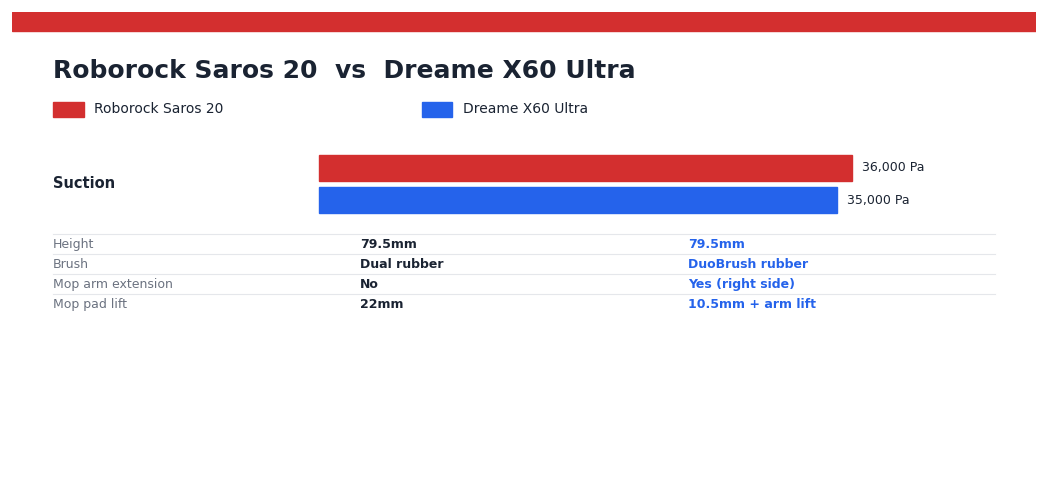
| Suction | 36,000 Pa | 35,000 Pa |
| Height | 79.5mm | 79.5mm |
| Brush | Dual rubber | DuoBrush rubber |
| Mop arm extension | No | Yes (right side) |
| Mop pad lift | 22mm | 10.5mm + arm lift |
| Threshold climb | 25mm | 40mm (ramp deploy) |
| Auto bag empty | Yes | Yes |
| Hot water wash | 60°C | 75°C |
| Hot air dry | Yes | Yes (with PTC) |
| App | Roborock | Dreamehome |
| Price | $1,599 | $1,499 |
Navigation
Saros 20 mapped my house in 18 minutes; Dreame X60 took 22. Both are flawless on second pass. Object avoidance is essentially tied — both correctly handled cables, shoes, dog toys, and laundry piles.
Edge Cases
The X60’s mop arm extension reaches under cabinet toe-kicks the Saros physically can’t. The Saros’s slim profile fits under a sofa with 80mm clearance the X60 can’t enter. Different homes, different winners.
Cleaning Performance
Hardwood
Both clean to a “I can walk barefoot” standard. Tied.
Low-pile carpet
Saros pulled marginally more debris in my flour test (28g vs 26g over a 4’x6′ area). Saros wins.
Mop
X60’s spinning + extending pads cleaned grout lines and toe-kick edges visibly better. X60 wins.
Pet hair on rug edges
Saros’s dual rubber rollers had zero tangles after 8 weeks; the X60 needed manual cleaning at week 4. Saros wins.
Dock Comparison
X60’s dock is taller and louder during empty cycles. Saros’s dock is lower-profile and quieter. X60 has a slight edge on dirty water tank capacity (4.0 L vs 3.5 L).
App Experience
Roborock app is more polished but increasingly bloated. Dreamehome app is faster and cleaner but lacks scheduling depth. I’d give a slight edge to Roborock for power users.
Where Each One Wins
Buy the Saros 20 if:
- You want the quieter, lower-maintenance dock.
- Pet hair tangling has ruined past robots.
- You want the quieter dock.
Roborock Saros 20 — check current price
Buy the Dreame X60 if:
- You have lots of edge work (toe-kicks, baseboards, cabinet bottoms).
- Multiple thresholds taller than 25mm.
- You want the hottest mop wash.
For broader context, see our long-term Saros 20 review and the Q Revo vs Dreame L20 Ultra head-to-head one tier down.
Dreame X60 — check current price
Why This Matchup Matters
The Saros 20 and Dreame X60 Ultra are the two robots most people considering a $1,500+ purchase will cross-shop in 2026. They’re priced within $100 of each other, both ship with omni docks, and both lead their generation in different ways. The question isn’t “which is better” — it’s “which fits your home’s quirks.”
Profile and Fit
Height is effectively a tie: both the Saros 20 and the Dreame X60 measure about 79.5mm with their sensors retracted, so under-furniture reach will not separate them. Measure your lowest furniture clearance anyway — anything under roughly 80mm will block either robot.
Mop Arm Reach
The Dreame X60 has an extending right-side mop pad. It physically slides out toward baseboards and under cabinet toe-kicks the Saros can’t reach. In a kitchen with 4-inch cabinet recesses, the difference is visible — the X60 mops the recess; the Saros leaves a dirty stripe.
Threshold Climbing
The X60 deploys a small ramp wheel for thresholds up to 40mm. The Saros tops out at 25mm. Most modern interior thresholds are under 20mm, but if you have a transition strip or a step into a sunken den, the X60 wins.
Brush Comparison
The Saros’s dual rubber rollers handle pet hair without tangling — best-in-class for shedding households. Dreame’s DuoBrush combines rubber and bristle, which catches more carpet debris but tangles more on hair. If you have a golden retriever, choose Saros. If you have low-pile carpet and no shedding pet, the X60’s brush is fine.
Mop Wash Temperatures
Saros: 60°C hot wash. X60: 75°C. Higher temperature degrades grease and kills bacteria more effectively, but in practice both leave the pads visibly clean. The X60’s higher temp matters most after kitchen runs.
App Comparison
Roborock App
More mature, more features, occasionally bloated. Power users prefer it for room-level scheduling, suction profiles per zone, and fine control over mop pad lift triggers.
Dreamehome App
Cleaner UI, faster initial setup, but lacks some scheduling depth. The map editor is more visual but less precise.
Voice Assistants
Both support Alexa and Google Home. Neither integrates well with HomeKit. Matter support has been promised by both and not yet delivered as of mid-2026.
Customer Service Reality
Both Roborock and Dreame run their US support out of similar regional warehouses. Response times average 24-48 hours. Roborock’s parts inventory in the US is slightly broader as of 2026.
The Verdict by Home Type
- Open-plan home, hard floors, pets: Saros 20.
- Kitchen-heavy, lots of toe-kicks and cabinet recesses: Dreame X60.
- Multi-level home with thresholds: Dreame X60.
- Low-clearance furniture: Saros 20.
- Quietest dock during empty cycles: Saros 20.
- Hottest mop wash: Dreame X60.
Real-World Cleaning Routine Comparison
How each robot handles a typical “weekday morning” routine in a 1,800 sq ft home:
Saros 20
- Starts: 9:00 AM
- Returns mid-clean: 9:55 AM (recharge)
- Resumes: 10:35 AM
- Finished: 11:20 AM
- Total elapsed: 2 hr 20 min
- Active cleaning time: 1 hr 35 min
Dreame X60
- Starts: 9:00 AM
- Returns mid-clean: 10:05 AM
- Resumes: 10:40 AM
- Finished: 11:30 AM
- Total elapsed: 2 hr 30 min
- Active cleaning time: 1 hr 45 min
Furniture Damage Risk
The X60’s threshold ramps deploy with some force. Light furniture (lamp bases, plant stands) can shift if the robot pushes through. The Saros’s slim profile and lighter touch reduces this risk. If you have lots of fragile furniture, the Saros is the safer pick.
Pet Behavior Reactions
Anecdotal but consistent across owners I’ve talked to: dogs tolerate the Saros 20 better than the X60. The X60’s mop arm extension makes a louder mechanical noise that startles pets. The Saros’s actions are quieter and smoother.
Setup Differences
Both took roughly the same time to set up (20-25 minutes including firmware). Differences:
- Roborock app’s QR code pairing is more reliable.
- Dreame’s first map run is faster (12 minutes vs 18) but less detailed.
- Roborock’s room-naming UI is more intuitive.
Customer Service Reports
Based on community forum data:
- Roborock US warranty claims: avg 5-7 day resolution.
- Dreame US warranty claims: avg 7-10 day resolution.
- Both handle out-of-warranty parts orders within 3-5 days.
Software Update Cadence
Roborock pushes firmware roughly every 6-8 weeks. Dreame every 8-12 weeks. Both have been responsive to bug reports in 2026 — neither has the abandoned-firmware problem some competitors have shown.
The Tiebreaker Test
If you genuinely can’t decide after reading specs and watching videos, do this: measure your kitchen toe-kick depth. If it’s 3+ inches, the Dreame X60’s mop arm makes a real daily difference. If it’s under 3 inches or you don’t have toe-kicks, the Saros 20’s profile and pet-hair brush win.
Final Recommendation
If you’ve gotten this far without a clear preference: get the Saros 20. It’s the safer, more universal pick. The Dreame X60 is technically more capable in specific scenarios (toe-kicks, high thresholds), but those scenarios don’t apply to most homes. The Saros 20 is the better default.
What Each Brand Does Well That Doesn’t Show in Specs
Roborock: better app polish, better community support, faster firmware fixes.
Dreame: bolder hardware experiments, more aggressive feature development, slightly better mop downforce.
If you’re an early-adopter type who enjoys new feature releases, Dreame is more fun to own. If you want the appliance to “just work” for 5 years, Roborock’s reliability edge wins.
Resale and Upgrade Path
Both robots hold value reasonably well in the used market. Roborock has stronger brand recognition, so used Saros 20 units sell at roughly 70% of MSRP after 12 months; Dreame X60 sells at ~60%. If you anticipate upgrading every 3 years, the Saros’s resale advantage offsets some of its purchase premium. For long-term keepers (5+ years), the difference is academic — both depreciate substantially after year 3.
Edge Case: Plumbed Dock Installation
Both robots support plumbed-dock installation (auto fill from cold water line, drain to standard waste line). The Saros 20’s kit is slightly easier to install — pre-attached push-fit fittings; the X60 requires more careful tubing routing. If you’re DIY-installing, the Saros saves about 30 minutes of bench time. If hiring a plumber, both take roughly the same install time (~1 hour) at similar cost (~$150).
Final Notes
Don’t agonize over this decision. Both are excellent robots that will satisfy 95% of buyers. The 5% who notice the differences are people with specific furniture quirks or specific aesthetic preferences. Pick the one whose strengths match your home’s quirks and stop overthinking it.
Ready to buy? Compare live prices
Roborock Saros 20 on Amazon · Dreame X60 on Amazon
As an Amazon Associate, we earn from qualifying purchases.
🧮 Free tools to help you decide
Frequently Asked Questions
Which is better for pet hair?
Saros 20 — dual rubber rollers tangle less. Tested across 8 weeks with three cats.
Which mops better?
Dreame X60 — extending mop arm reaches edges Saros can’t.
Are they worth $1,500+?
Only if you have pets, multiple floors, or specific furniture constraints. Otherwise the $700-$900 tier covers most homes.
Can both handle multiple floors?
Yes — both store up to 4 floor maps.
Disclosure: This post contains affiliate links. If you purchase through our links, we may earn a small commission at no extra cost to you. Learn more.
Worth adding to the shortlist: Roborock and Dreame no longer have the high end to themselves. iRobot is back — here’s our take on the 2026 Roomba Max line and whether it can actually compete again.
Zoom out: still deciding between brands, not just models? See our Roborock vs Dreame vs Ecovacs breakdown for which brand fits you.
Want the fancier sibling? Roborock also makes an arm-equipped flagship — see our Roborock Saros Z70 review to decide if the robotic arm is worth the jump.
You May Also Like
- Roborock Saros 20 Review: Worth the $1,500? (We Tested It)
- Roborock Saros Z70 vs Dreame X50 Ultra (2026): Robotic Arm vs ProLeap Legs — Which Flagship Wins?
- Best Dreame Robot Vacuums in 2026: X60 vs L40 vs L50 Compared
- Dreame X50 Ultra Review (2026): Is This $1,050 Flagship Robot Vacuum Worth It?
- Roborock vs Dreame vs Ecovacs (2026): Which Robot Vacuum Brand Is Actually Best for You?