As an Amazon Associate, TheHomePicker.com earns from qualifying purchases. We only recommend products we would evaluate ourselves; affiliate links never affect our rankings.
Quick answer: Humidifiers come in three main types, and they all add the same moisture — the difference is how, how quietly, and how safely. A cool mist ultrasonic humidifier is near-silent, making it best for bedrooms and nurseries (just use distilled water to avoid white dust). A cool mist evaporative model self-regulates and suits larger rooms. A warm mist (steam) humidifier feels cozier in winter and can ease congestion, but its hot water is a burn risk, so keep it away from kids. The big decision is simple: cool mist for safety, warm mist for winter comfort.
Cool mist or warm mist? Start here
Every humidifier is either cool mist or warm mist, and that choice matters more than the brand:
- Cool mist releases room-temperature moisture. It is safer around children and pets (no hot water), uses slightly less energy, and works all year. It splits into two styles — ultrasonic and evaporative — covered below.
- Warm mist boils the water first, so the steam feels cozy in winter, can help with congestion, and is boiled clean of waterborne bacteria. The trade-off is a burn risk from the hot water, so it is best kept out of a child’s room.
Once you have chosen cool or warm, the rest is easy.
Humidifier types compared
Here are the three types side by side, then a short breakdown of each.
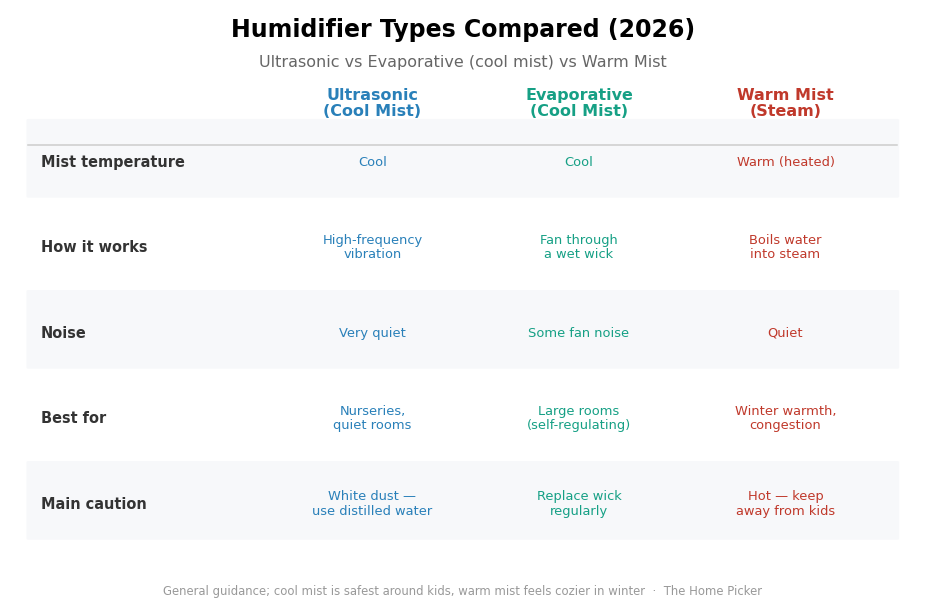
| Type | Mist | Noise | Best for | Main caution |
|---|---|---|---|---|
| Ultrasonic (cool) | Cool | Very quiet | Nurseries, quiet rooms | White dust — use distilled water |
| Evaporative (cool) | Cool | Some fan noise | Large rooms, self-regulating | Replace the wick regularly |
| Warm mist (steam) | Warm | Quiet | Winter warmth, congestion | Hot — keep away from kids |
Ultrasonic cool mist: quietest for bedrooms
An ultrasonic humidifier uses a high-frequency vibrating plate to fling water into a fine cool mist. It is near-silent, which makes it the go-to for bedrooms and nurseries, and it comes in the widest range of sizes and designs. The one quirk is white dust — it disperses the minerals in tap water — which you avoid by filling it with distilled or demineralized water. Clean it regularly and it is a fuss-free, whisper-quiet choice. Shop ultrasonic humidifiers on Amazon.
Evaporative cool mist: self-regulating for big rooms
An evaporative humidifier blows air through a wet wick, so water evaporates naturally into the room. Its big advantage is that it self-regulates: it cannot push humidity past a comfortable level, and it produces no white dust. That makes it a great pick for larger rooms and for anyone who does not want to think about it. The trade-offs are some fan noise and a wick that needs replacing every so often. Shop evaporative humidifiers on Amazon.
Warm mist (steam): cozy winter comfort
A warm mist humidifier heats water to a boil and releases warm steam. It feels cozy in winter, can soothe coughs and congestion, and because the water is boiled it is essentially free of waterborne bacteria and produces no white dust. The catch is the hot water and steam, a genuine burn hazard, so it is best for adult bedrooms and living spaces rather than a child’s room. If winter comfort and congestion relief are your priorities, warm mist delivers. Shop warm mist humidifiers on Amazon.
Which humidifier should you buy?
Choose an ultrasonic cool mist for a quiet bedroom or nursery, an evaporative cool mist for a large room or hands-off use, and a warm mist for cozy winter comfort in an adults-only space. Since all three add the same moisture, decide on cool vs warm and room size first. When you are ready for specific models, our best humidifiers for the bedroom and best budget humidifiers under $50 have tested picks.
Humidifier maintenance and safety
Any humidifier needs upkeep, because a dirty tank can spray bacteria and mold into the air along with the mist. Empty and dry the tank daily, clean it two to three times a week with white vinegar or a diluted bleach solution, and use distilled water to slow mineral buildup and white dust. Keep your room’s humidity between about 30 and 50 percent — over-humidifying encourages mold and dust mites — and with warm mist units, place them out of reach of children to avoid burns.
Frequently Asked Questions
Cool mist or warm mist humidifier — which is better?
Both add the same moisture to the air; the difference is safety and feel. Cool mist is safer around children and pets (no hot water), uses a little less energy, and works well year-round. Warm mist heats the water first, which feels cozier in winter, can ease congestion, and kills waterborne bacteria before it mists — but the hot water is a burn risk, so it is not ideal in a child’s room. For most homes, cool mist is the safer default; choose warm mist for winter comfort in an adults-only space.
Are ultrasonic humidifiers safe?
Yes, and they are the quietest type, which is why they are popular for bedrooms and nurseries. The one caveat is ‘white dust’ — ultrasonic units disperse the minerals in tap water as a fine powder. Using distilled or demineralized water solves it. As with any humidifier, clean it regularly so it does not disperse bacteria or mold along with the mist.
Which humidifier is best for a baby’s room?
A cool mist humidifier, because there is no hot water or steam to cause burns. An evaporative model is a good choice since it self-regulates and cannot over-humidify the room, or an ultrasonic one for near-silent operation (run it with distilled water to avoid white dust). Whichever you pick, empty and dry it daily and clean it a few times a week.
How do I keep my humidifier from growing mold?
Empty the tank and let it dry out every day, and clean it two to three times a week — white vinegar or a diluted bleach solution works for descaling and disinfecting. Use distilled water to slow mineral buildup, replace wicks or filters on schedule, and keep your room’s humidity between about 30 and 50 percent, since over-humidifying encourages mold and dust mites.
Cost check: for the ongoing running cost of home appliances, see our free what appliances cost to run — independent data, no affiliation, free to cite.