As an Amazon Associate, TheHomePicker.com earns from qualifying purchases at no extra cost to you. This article contains affiliate links — see our affiliate disclosure for details.
Two of 2026’s most technically ambitious robot vacuums agree on almost nothing except their general price tier. The Roborock Saros Z70 ships with a five-axis mechanical arm that physically grips and relocates small objects standing in its path. The Dreame X50 Ultra deploys retractable ProLeap legs to step over obstacles up to 2.36 inches tall. Both dock stations self-empty, wash mop pads, and dry them with warm air. Both carry flagship-tier suction ratings. And both regularly trade below their launch MSRPs on Amazon.
If you want to go deeper on either machine individually, our full Roborock Saros Z70 review and Dreame X50 Ultra review have the granular detail. This head-to-head focuses on what actually separates them — and which one fits your home.
Quick Verdict
Choose the Roborock Saros Z70 if: your floors are regularly cluttered with small items — socks, cables, pet toys, shoes — and you want the robot to move them autonomously rather than requiring you to tidy before every run. The mechanical arm is genuinely novel technology, and the ultra-slim 3.14-inch chassis sneaks under furniture most robots can’t reach.
Choose the Dreame X50 Ultra if: you want longer runtime without returning to the dock, prefer an obstacle-clearing solution that handles transitions and thresholds (not just loose objects), need a larger onboard water tank, and want to spend meaningfully less for comparable daily cleaning performance.
Neither machine dominates outright. The headline features — arm and legs — are impressive engineering aimed at two different household problems. The robot that matches your specific floor plan wins.
The Arm vs. The Legs: Two Very Different Solutions to the Same Problem
Roborock’s OmniGrip arm is the flashier innovation. A five-axis mechanism extends from the robot’s body, clamps objects up to roughly 300 grams, lifts them clear of the cleaning path, relocates them to the side of the room, and retracts so cleaning continues. In real-world use, this handles socks, lightweight toys, cables, and small shoes reliably in open floor space. It does not move heavy objects, cannot rearrange furniture, and requires the feature to be enabled in the app. The Z70’s AdaptiLift chassis also keeps the robot body at a consistent 3.14-inch height, allowing it to slide under low sofas and bed frames without arm assistance.
Dreame’s ProLeap legs solve the problem from a different angle: instead of moving obstacles, the X50 Ultra steps over them. Barriers up to 2.36 inches — door thresholds, power strips, thick rug edges, cable bundles — are cleared by raising the body on retractable legs mid-run. The companion VersaLift feature also works in reverse: the robot lowers itself to reach farther under furniture. It is a more general obstacle-handling architecture than the Z70’s arm, applicable to a wider range of home layouts, though it will not relocate a sock from the middle of a room.
Both approaches work well within their intended scope. Which one delivers more daily value depends entirely on what your floors actually look like. For a broader look at how both brands approach 2026 flagship design, our Roborock vs. Dreame vs. Ecovacs 2026 comparison puts the full competitive field in context.
Suction and Real-World Cleaning Performance
The Z70 is rated at 22,000 Pa; the X50 Ultra at 20,000 Pa via Dreame’s 6th-generation TurboForce motor. Both are among the highest specs in the 2026 consumer market. But before you make a purchase decision based on those numbers, it is worth understanding what independent testing consistently finds: in the high-Pa flagship tier, raw suction ratings do not reliably predict proportional real-world cleaning performance. Testing by outlets including RTINGS and Vacuum Wars has shown that brush-roll design, floor contact geometry, and debris type often influence embedded-dirt extraction as much as motor power. Both of these machines deliver strong carpet performance — the 2,000 Pa gap between them is unlikely to be perceptible in everyday cleaning on most floor types.
The X50 Ultra’s DuoBrush system handles hair up to 11.8 inches with anti-tangle design, a meaningful advantage for long-hair pets and households with thick or long human hair. The Z70 uses a conventional main brush arrangement that performs well but does not claim the same anti-tangle engineering. On hard floors, both robots deliver thorough coverage; the Z70’s lower chassis keeps the brush closer to the surface on thin area rugs.
Mopping and Dock Performance
Both robots mop, and both dock stations handle pad maintenance between runs — which is the feature that genuinely separates modern flagships from mid-range robots. The Z70’s dock heats water to 176°F for mop washing, dispenses detergent automatically, and finishes with warm-air drying. The FlexiArm Riser lifts the mop assembly upward to clean edges and baseboards closer than a stationary pad can reach — a detail that matters in rooms with built-in cabinets or appliances pushed to the wall.
The X50 Ultra dock includes auto mop washing, auto detergent dispensing, and air drying as well. Its primary differentiation is the 7-liter dual-tank system: clean and dirty water are kept physically separate throughout the entire cleaning run, not just at the dock. That means the mop pad is always applying fresh clean water — a hygiene advantage during longer sessions in larger homes. For households over 2,000 square feet where a single run can take 90 minutes or more, the X50 Ultra’s water separation is the more practical edge. The Z70’s 176°F wash temperature has a stronger sanitation argument for households with elevated hygiene concerns.
Battery Life and Runtime
This is one of the clearest spec differences between the two machines. The X50 Ultra carries a 6,400 mAh battery rated for approximately 220 minutes of runtime. The Z70 carries a 6,400 mAh battery rated for approximately 180 minutes. That 40-minute difference mainly matters in very large homes: the X50 Ultra can typically complete a full clean of a 2,500–3,000 square foot home in one pass, while the Z70 may need to dock mid-session to recharge.
Both robots support auto-resume — they return to dock, recharge, and pick up where they left off — so neither machine leaves floors permanently half-cleaned. However, longer runtime means faster wall-clock completion and fewer interruptions to your schedule. For homes under 1,500 square feet, the Z70’s battery is unlikely to create meaningful friction. For larger open-plan homes, the X50 Ultra’s battery advantage becomes a practical differentiator.
Price and Value
The Roborock Saros Z70 lists at around $2,599 and is frequently discounted — often to roughly $1,300 on Amazon. The Dreame X50 Ultra typically runs around $1,050–$1,200, with pricier Complete bundles higher. Prices shift with sales and inventory, so the X50 Ultra generally lands several hundred dollars below the arm-equipped Z70. Check current pricing on the Roborock Saros Z70 Amazon listing and the Dreame X50 Ultra Amazon listing before buying.
At a lower price, the X50 Ultra offers more battery runtime, a larger water tank, and a more broadly applicable obstacle-handling system for most homes. The Z70 commands a premium specifically for the arm — justified if clutter management is your primary pain point, less compelling if you are primarily comparing daily vacuum-and-mop performance. For a full view of the self-emptying category at multiple price points, our best self-emptying robot vacuums of 2026 ranks the field.
Head-to-Head Spec Comparison
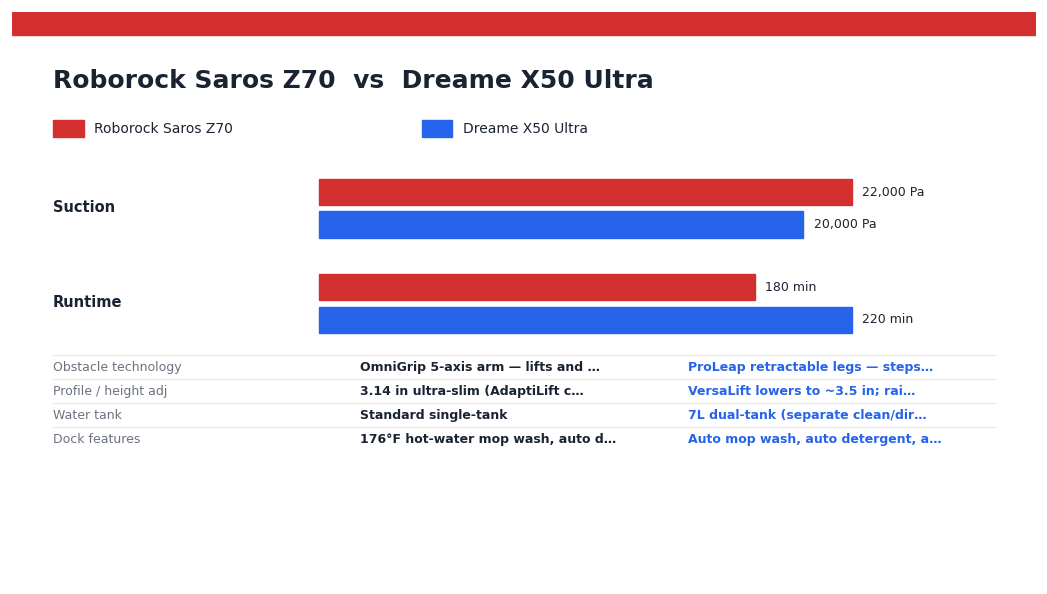
| Feature | Roborock Saros Z70 | Dreame X50 Ultra |
|---|---|---|
| Suction | 22,000 Pa | 20,000 Pa (6th-gen TurboForce) |
| Obstacle technology | OmniGrip 5-axis arm — lifts and relocates objects up to ~300g | ProLeap retractable legs — steps over obstacles up to 2.36 in |
| Profile / height adjustment | 3.14 in ultra-slim (AdaptiLift chassis) | VersaLift lowers to ~3.5 in; raises body to clear transitions |
| Battery / rated runtime | 6,400 mAh / ~180 min | 6,400 mAh / ~220 min |
| Water tank | Standard single-tank | 7L dual-tank (separate clean/dirty water) |
| Dock features | 176°F hot-water mop wash, auto detergent, warm-air drying, FlexiArm Riser edge mopping | Auto mop wash, auto detergent, air drying, dual-tank water separation |
| List price | ~$2,599 | ~$1,050–$1,200 |
| Typical Amazon price | ~$1,300 | ~$1,050–$1,200 |
Which Should You Buy?
Buy the Roborock Saros Z70 if you:
- Have children, pets, or household habits that leave small items on the floor regularly and find pre-vacuuming pickup a recurring chore
- Want the most advanced floor-preparation automation currently available in a consumer robot — the arm genuinely reduces manual effort
- Have low-clearance furniture that benefits from the Z70’s 3.14-inch ultra-slim chassis
- Are buying primarily as a technology enthusiast and want the most novel hardware innovation in the 2026 lineup
Search for the Roborock Saros Z70 on Amazon to see current pricing and availability.
Buy the Dreame X50 Ultra if you:
- Have a larger home (2,000+ sq ft) where 220 minutes of runtime allows a complete clean in a single pass
- Deal primarily with floor transitions, door thresholds, and low fixed obstacles rather than loose items left on the floor
- Want a larger onboard water tank and dual-tank clean/dirty separation for longer mopping sessions
- Have long-hair pets and want the DuoBrush anti-tangle system
- Want the most specification-per-dollar in the 2026 flagship tier — the X50 Ultra typically costs several hundred dollars less than the Z70
Search for the Dreame X50 Ultra on Amazon to see current pricing and availability.
Frequently Asked Questions
Q: Does the Roborock Saros Z70 robotic arm actually work reliably in daily use?
A: Based on available real-world reporting and early adopter feedback, the OmniGrip arm handles lightweight small objects — socks, cables, small toys — reliably in open floor areas. Performance on irregular shapes or items directly against walls can vary. It must be enabled via the app per cleaning session. It is a genuine time-saver for cluttered households, but it functions as an incremental upgrade, not a complete substitute for pre-clean tidying in all situations.
Q: Is the Dreame X50 Ultra good for homes with pets?
A: Yes, notably so. The DuoBrush anti-tangle system handles hair up to 11.8 inches without wrapping, which puts the X50 Ultra among the strongest options in its class for long-hair dogs and cats. Combined with 220 minutes of runtime, it handles larger pet-hair loads across bigger spaces without needing a mid-session dock return. Check the latest deal pricing on the Dreame X50 Ultra on Amazon.
Q: Which robot handles thick rugs and carpet-to-hardwood transitions better?
A: The X50 Ultra has a clearer advantage here. ProLeap legs physically lift the robot over transitions up to 2.36 inches, which covers most threshold and rug-edge scenarios. The Z70’s AdaptiLift chassis adjusts mop height on carpet but does not have the same ability to step over fixed raised surfaces. If floor transitions are your primary concern, the X50 Ultra is the stronger choice.
Q: Which machine has better mopping, and how do the dock systems compare?
A: Both are strong, but they excel in different ways. The Z70’s 176°F hot-water dock wash offers a sanitation edge — particularly relevant for households with illness concerns. The X50 Ultra’s 7-liter dual-tank design keeps clean and dirty water separate throughout each run, meaning mopping water stays fresher over longer sessions and larger homes. For most households running daily cleaning cycles, the X50 Ultra’s ongoing water separation is the more practical advantage. Browse the full flagship mop-vac category with this self-emptying robot vacuum mop search on Amazon to compare options side by side.
You May Also Like
- Roborock Saros Z70 Review (2026): The Robot Vacuum With a Real Robotic Arm – Worth $1,300?
- Dreame X50 Ultra Review (2026): Is This $1,050 Flagship Robot Vacuum Worth It?
- Roborock Saros 20 vs Dreame X60 Ultra: Hands-On Comparison (2026)
- Dreame X40 Ultra vs Roborock S8 Pro Ultra 2026: Flagship Robot Vacuum Showdown
- Roborock vs Dreame vs Ecovacs (2026): Which Robot Vacuum Brand Is Actually Best for You?
- Roborock Saros 20 vs Dreame X50 Ultra (2026): Is the Newer Flagship Worth It?