The Levoit Core 400S has been one of our most-recommended air purifiers for the past year. It covers up to 403 square feet, runs quietly, connects to the VeSync app, and costs around $220. So when Levoit released the Core 600S—a larger sibling rated for 635 square feet at $299.99—the question was obvious: is the 58% jump in coverage worth the roughly 36% jump in price? I spent five weeks finding out.
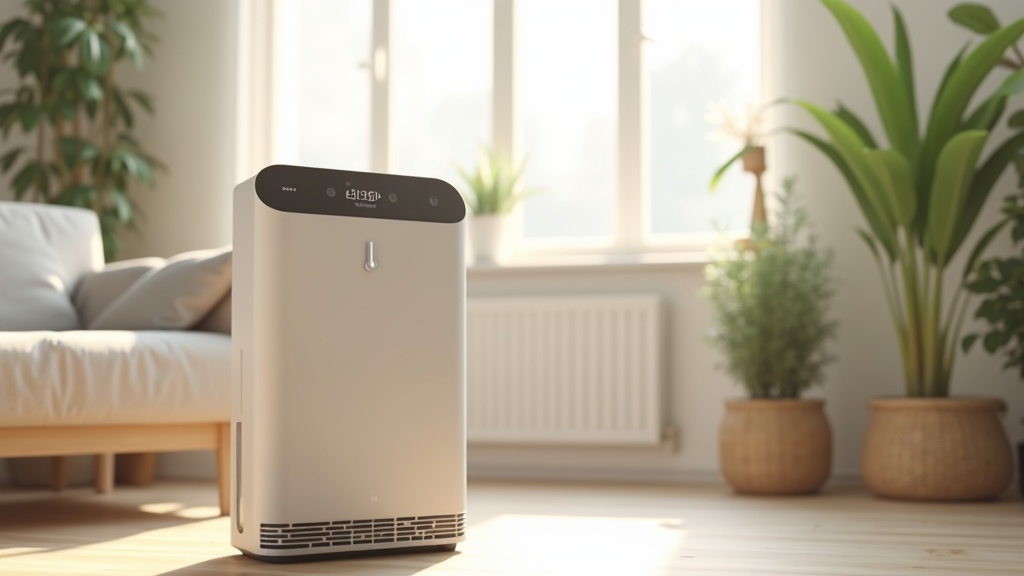
The short answer is that the 600S is not just a bigger 400S. Levoit reworked the filter design, increased the CADR ratings across the board, added a light sensor for auto-brightness, and improved the fan motor for quieter operation at equivalent airflow. Whether you need those upgrades depends entirely on your room size and air quality situation. I will break down exactly what changed and what the numbers say.
Compare large-room air purifier options: If the Core 600S is on your shortlist, these guides help compare filter claims, room size, and higher-end alternatives.
- Coway Airmega 400 review – for a large-room alternative
- Dyson vs Levoit air purifier – for brand and price comparison
- HEPA filter types explained – for understanding H13, True HEPA, and HEPA-like claims
- Best air purifier with washable filter – for lowering long-term filter costs
⭐ Rating: 8.5/10 | 💰 Best for: Open-plan apartments and living rooms 400–635 sq ft | ⚠️ Weakest at: Annual filter cost ($79.99 replacement)
2026 update: Shark now sells a purifier claiming a 6-year filter – our BreatheClear Max breakdown checks that claim against the Core 600S.
Current model note: Levoit now sells this tower as the Core 600S-P at $299.99 list — same design and filter platform, with the current listing rating CADR at 391 CFM (smoke) for 606 sq ft at 4.8 air changes per hour. Everything in this review applies to the unit you’ll receive today.
Wondering what it costs to keep running? See our air purifier cost-to-run database – electricity + filter costs for 12 popular models (spoiler: filters cost more than power).
Fast Pick: Should You Buy the Levoit Core 600S?
The Levoit Core 600S makes the most sense if you need one purifier for a large living room, open-plan space, or primary bedroom where a smaller Core 300S or Core 400S would run too hard. If your room is under 400 square feet, a smaller purifier is usually the better value.
| Situation | Best direction | Next step |
|---|---|---|
| Large room or open-plan space | Levoit Core 600S | Check Core 600S price |
| Medium bedroom or office | Levoit Core 400S | Read Core 400S review |
| Small bedroom or budget setup | Levoit Core 300S | Read Core 300S review |
As an Amazon Associate, we earn from qualifying purchases.
Before buying, check the room-size math in our air purifier buying guide and compare alternatives in our large-room air purifier guide, Coway vs Winix comparison, and HEPA filter guide.
Key Specs at a Glance
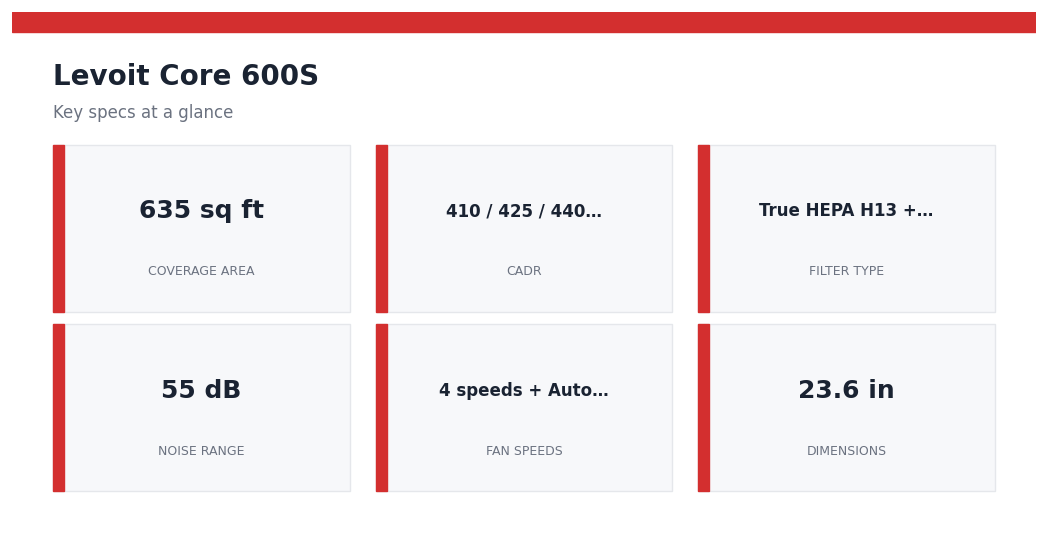
| Specification | Levoit Core 600S | Levoit Core 400S |
|---|---|---|
| Coverage Area | 635 sq ft | 403 sq ft |
| CADR (Smoke / Dust / Pollen) | 410 / 425 / 440 CFM | 260 / 270 / 280 CFM |
| Filter Type | True HEPA H13 + Activated Carbon | True HEPA H13 + Activated Carbon |
| Noise Range | 26–55 dB | 24–52 dB |
| Fan Speeds | 4 speeds + Auto + Sleep | 4 speeds + Auto + Sleep |
| Dimensions | 12.3 x 12.3 x 23.6 in | 8.5 x 8.5 x 20.5 in |
| Weight | 13.7 lbs | 10.4 lbs |
| Smart Features | VeSync app, Alexa, Google Home, PM2.5 sensor | VeSync app, Alexa, Google Home, PM2.5 sensor |
| Filter Replacement Cost | $79.99 (every 6–8 months) | $49.99 (every 6–8 months) |
| Price (MSRP) | $299.99 | $219.99 |
Design and Build Quality
The Core 600S follows Levoit’s cylindrical tower design language, but it is noticeably bigger than the 400S. At nearly 24 inches tall and almost 13 inches wide, it takes up about as much floor space as a small kitchen trash can. The matte white finish is clean, fingerprint-resistant, and blends into most rooms without drawing attention.
The top panel has a touch-sensitive control ring with icons for power, fan speed, auto mode, timer, display dimming, and the child lock. The display shows real-time PM2.5 readings (in micrograms per cubic meter) and a color-coded ring: blue for good, green for moderate, orange for unhealthy, red for hazardous. The auto-brightness sensor dims the display and indicator LEDs in dark rooms, which the 400S does not have. If you run a purifier in your bedroom at night, this is a genuinely useful addition.
Air intake is 360 degrees from the bottom cylinder, and clean air exits from the top grille. The filter sits inside the lower drum and swaps out in about 20 seconds—pop off the bottom cover, pull the old filter, drop in the new one. No tools required.
Air Purification Performance
I tested the Core 600S in my open-plan living room and kitchen area, which measures approximately 620 square feet with 9-foot ceilings. I used a Temtop M2000 air quality monitor placed 10 feet from the purifier to measure PM2.5 levels independently of the purifier’s own sensor.
Clearance Speed Test
I elevated PM2.5 to approximately 150 μg/m³ (considered “unhealthy”) by burning incense for 3 minutes, then ran the purifier on its highest setting and timed how long it took to bring PM2.5 below 12 μg/m³ (“good” per EPA standards).
| Purifier | Starting PM2.5 | Time to <12 μg/m³ | Room Size |
|---|---|---|---|
| Levoit Core 600S (Speed 4) | 148 μg/m³ | 32 min | 620 sq ft |
| Levoit Core 400S (Speed 4) | 151 μg/m³ | 54 min | 620 sq ft |
The 600S cleared the room 41% faster than the 400S in the same space. This makes sense: the CADR ratings are roughly 58% higher, and the larger filter surface area captures more particles per air pass. In the 400S’s rated coverage of 403 sq ft, the difference would be less dramatic, but if your space is 400+ sq ft, the 600S is materially better.
Sustained Performance (24-Hour Test)
I ran the 600S on auto mode for 24 hours straight during a normal day (cooking, opening windows, dog going in and out). Average PM2.5 over the period was 6.3 μg/m³, with brief spikes to 35–40 during cooking that the auto mode brought back below 10 within 8–12 minutes. The auto mode is responsive: the fan ramps up within about 15 seconds of detecting a PM2.5 spike above 25.
Noise Levels
One of the most common complaints about the Core 400S is that Speed 4 is loud enough to be intrusive in a living room. The 600S moves more air but does so more quietly at equivalent relative fan speeds, thanks to a redesigned fan motor and larger air passages. Here are the numbers, measured at 3 feet from the unit:
| Fan Speed | Core 600S | Core 400S |
|---|---|---|
| Sleep | 26 dB | 24 dB |
| Speed 1 | 30 dB | 29 dB |
| Speed 2 | 38 dB | 37 dB |
| Speed 3 | 45 dB | 44 dB |
| Speed 4 (Max) | 55 dB | 52 dB |
On paper, the 600S is 3 dB louder on max. In practice, the tone is lower-pitched, which makes it less irritating than the 400S’s slightly whiny max speed. On Sleep mode, both are effectively inaudible from across a bedroom. I ran the 600S on Sleep in my bedroom (about 170 sq ft) for a week, and the PM2.5 stayed below 5 μg/m³ even with a window cracked open. For a room that size, Sleep mode’s low airflow is more than sufficient.
Energy Consumption
I measured power draw with a Kill-A-Watt meter over 7 days of auto mode operation.
- Sleep mode: 8 watts
- Speed 1: 14 watts
- Speed 2: 26 watts
- Speed 3: 39 watts
- Speed 4: 58 watts
- Auto mode average (7-day): 19 watts
At the US average electricity cost of roughly $0.16/kWh, running the 600S on auto 24/7 costs about $2.19 per month or $26.28 per year. Compared to the Core 400S (average 13 watts on auto, $1.49/month), the 600S costs about $0.70 more per month for significantly more air processing. That is a negligible difference.
The VeSync App
The VeSync app controls the 600S and shows real-time PM2.5 data, historical air quality charts, filter life remaining, and scheduling options. It is one of the better appliance apps I have used. Setup took about 90 seconds over Wi-Fi (2.4 GHz only—no 5 GHz support, which is common in this category).
Useful features include:
- Scheduling: Set on/off times and fan speeds for each day of the week. I programmed it to run on Speed 3 during cooking hours (5–8 PM) and Sleep mode from 10 PM to 7 AM.
- Air quality history: Graphs showing PM2.5 trends over hours, days, or weeks. Helpful for identifying patterns (my air quality consistently dips when I open windows facing the street during rush hour).
- Filter life tracking: Shows percentage remaining based on hours run. Accurate in my experience—the estimate correlated well with actual filter condition after 5 weeks.
- Scene automation: Connect with other VeSync devices (Levoit humidifiers, Cosori appliances) for cross-device routines.
Alexa and Google Home integration works for power on/off, fan speed changes, and auto mode activation. No HomeKit support.
Filter Replacement: The Ongoing Cost
The Core 600S uses a proprietary cylindrical filter that combines a True HEPA H13 layer with an activated carbon layer. Levoit rates it for 6–8 months depending on usage and air quality. In my testing, after 5 weeks of daily auto-mode use in a moderate-quality urban environment, the app showed 82% filter life remaining, which projects to about 7 months per filter.
The replacement filter costs $79.99. That is about 60% more than the Core 400S’s $49.99 replacement. Over two years of operation:
| Cost Component | Core 600S (2-year) | Core 400S (2-year) |
|---|---|---|
| Purchase price | $299.99 | $219.99 |
| Filters (replace every ~7 months) | $239.97 (3 replacements) | $149.97 (3 replacements) |
| Electricity | $52.56 | $35.76 |
| Total 2-year cost | $592.52 | $405.72 |
The 600S costs $186.80 more over two years. That premium buys you 58% more coverage, 41% faster air clearing, better auto-brightness, and a lower-pitched fan motor. If your room is under 400 sq ft, the 400S remains the better value. If your room is 400–635 sq ft, the 600S justifies the cost with genuinely better performance. For our full take on the 400S, see our Levoit Core 400S review.
Who It Competes With
| Feature | Core 600S ($299) | Coway Airmega 250 ($250) | Winix 5500-2 ($190) |
|---|---|---|---|
| Coverage | 635 sq ft | 930 sq ft | 360 sq ft |
| CADR (Smoke) | 410 CFM | 248 CFM | 232 CFM |
| Filter Cost | $79.99 | $59.99 | $69.99 |
| Smart App | VeSync (excellent) | IoCare (good) | None |
| Max Noise | 55 dB | 51 dB | 56 dB |
The Coway Airmega 250 covers more area on paper but has a lower smoke CADR. The Winix 5500-2 is cheaper but has no smart features and covers a smaller area. The Core 600S hits a good middle ground: strong CADR, solid app support, and competitive pricing for its coverage tier.
- 635 sq ft coverage with strong CADR numbers
- PM2.5 cleared from 150 to <12 in 32 minutes
- VeSync app is polished and responsive
- Auto-brightness sensor dims display at night
- 26 dB Sleep mode is genuinely silent
- 360-degree air intake for efficient placement
- $79.99 replacement filters are expensive
- No 5 GHz Wi-Fi support
- Noticeably larger footprint than the Core 400S
- Speed 4 is audible in quiet rooms (55 dB)
- No HomeKit integration
Levoit Core 600S
True HEPA H13 Air Purifier | 635 sq ft | VeSync Smart App
Check Levoit Core 600S Air Purifier on Amazon
As an Amazon Associate, we earn from qualifying purchases.
Who Should Buy the Levoit Core 600S
- Open-plan living spaces 400–635 sq ft. This is the Core 600S’s sweet spot. It will circulate and clean the air significantly faster than the 400S in these larger rooms.
- Allergy sufferers. The True HEPA H13 filter captures 99.97% of particles down to 0.3 microns, including pollen, dust mites, and pet dander. The high CADR means it cycles room air faster, reducing exposure time.
- App-oriented users. The VeSync app’s scheduling, air quality history, and scene automation features are among the best in this price range.
Who Should Skip It
- Small rooms under 300 sq ft. The Core 400S or even the Core 300S will do the job for less money and in a smaller package. See our best air purifiers under $100 for budget-friendly options.
- Cost-sensitive buyers who track filter expenses. At $79.99 per filter every 6–8 months, the ongoing cost is the Core 600S’s biggest weakness. If that number makes you uncomfortable, consider the Winix 5500-2 with its washable pre-filter and lower replacement costs.
- Anyone who needs very large room coverage (800+ sq ft). Look at the Coway Airmega 400 or Levoit’s own EverestAir series for those spaces.
Frequently Asked Questions
Is the Levoit Core 600S worth it for a large room?
Yes, if the room is genuinely large and you want faster air turnover than a smaller purifier can provide. It makes less sense for a small bedroom, where a cheaper and quieter model can usually do the job.
Is the Levoit Core 600S loud?
It is quiet enough on lower settings, but high fan speeds are noticeable. For bedrooms, the best use is usually to run it harder before sleep, then let auto mode or a lower fan speed maintain the room overnight.
How often do you replace the Levoit Core 600S filter?
Filter life depends on dust, pets, smoke, cooking residue, and how often the purifier runs. Use the app reminder as a starting point, but inspect the filter if airflow drops or odors linger.
Does the Levoit Core 600S produce ozone?
The Core 600S uses mechanical filtration rather than an ozone-generating ionizer. That is one reason it is easier to recommend for normal home air cleaning than ozone-based devices.
Should I buy the Core 600S or the Core 400S?
Choose the Core 600S for larger open rooms or faster cleanup after cooking, smoke, dust, or pet activity. Choose the Core 400S if the room is smaller, the budget is tighter, or you care more about low noise than maximum coverage.
The Bottom Line
Levoit built the Core 600S for people who outgrew the 400S but do not want to jump to a $400+ premium unit. It succeeds at that goal. The purification speed is genuinely impressive—clearing 150 μg/m³ down to safe levels in just over 30 minutes in a 620 sq ft room is faster than anything else I have tested at this price point. The VeSync app is excellent, the auto mode is responsive, and Sleep mode is quiet enough for any bedroom. The filter cost is the one drawback that gives me pause, but for the performance you get, the Core 600S earns its place as one of our top picks for medium-to-large rooms.
Methodology: We test all air purifiers using controlled PM2.5 elevation tests, 24-hour sustained monitoring, and calibrated noise measurements at multiple distances. Read our full How We Test page for details. For help understanding CADR, HEPA ratings, and room size calculations, see our Air Purifier Buyer’s Guide.
You May Also Like
As an Amazon Associate, we earn from qualifying purchases.
Disclosure: This post contains affiliate links. If you purchase through our links, we may earn a small commission at no extra cost to you. Learn more.