
As an Amazon Associate, TheHomePicker.com earns from qualifying purchases. We only recommend products we would evaluate ourselves; affiliate links never affect our rankings.
Quick answer: The three space-heater types suit different rooms, not different budgets — almost all draw the same 1,500 watts, so they cost about the same to run. Choose a ceramic heater to warm a small room fast with fan-driven heat, an infrared (radiant) heater to warm people and objects directly in a drafty or open space, and an oil-filled radiator for long, silent, steady heat in an enclosed room — it also has the coolest, safest surface. Match the type to your room, then pick a model with tip-over and overheat protection.
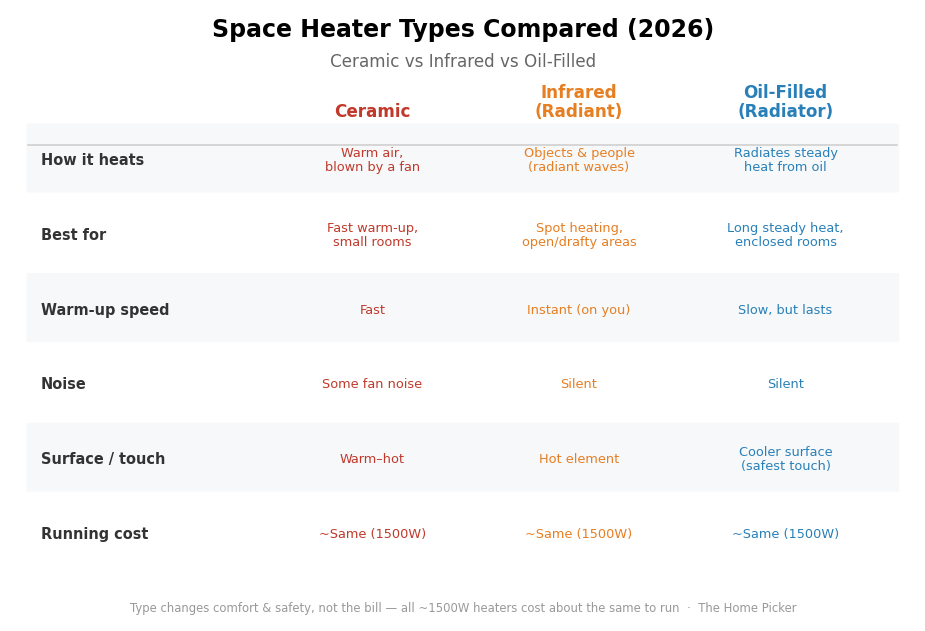
Ceramic vs infrared vs oil-filled: the quick comparison
All three are good heaters — the right one depends on your room and how you like to feel warm. Here is the side-by-side, then a plain breakdown of each.
| Type | How it heats | Best for | Noise | Surface |
|---|---|---|---|---|
| Ceramic | Warm air, blown by a fan | Fast warm-up, small rooms | Some fan noise | Warm–hot |
| Infrared (radiant) | Objects & people directly | Spot heating, open/drafty areas | Silent | Hot element |
| Oil-filled (radiator) | Radiates steady heat from oil | Long steady heat, enclosed rooms | Silent | Cooler (safest touch) |
Ceramic heaters: fast heat for small rooms
A ceramic heater passes air over a heated ceramic element and blows it into the room with a fan, so it warms a small space quickly. They are compact, affordable, and the most common type you will see. Many use self-regulating PTC ceramic elements, which helps them run at a safe temperature. The trade-off is that the fan makes some noise and the warmth fades quickly once it is off, since it heats the air rather than the room. For a home office, bathroom, or bedroom you want warm in a hurry, ceramic is the easy default. Shop ceramic heaters on Amazon.
Infrared (radiant) heaters: heat people, not the air
An infrared heater works like the sun: it emits radiant waves that warm people and objects directly rather than heating the air first. That makes it excellent for drafty rooms, open-plan spaces, or spot heating — you feel warm almost instantly even where warmed air would drift away. Pure radiant models are silent, and because you heat the person instead of the whole room, you can stay comfortable while using less. The catch is that the warmth only reaches what is in the line of sight, and the heating element itself gets hot. For a garage workspace, a chilly corner, or anywhere heating the whole room is wasteful, infrared wins. Shop infrared heaters on Amazon.
Oil-filled radiators: steady, silent, safest surface
An oil-filled radiator heats oil sealed permanently inside its fins, which then radiate steady, even heat long after the element cycles off. It is completely silent, runs with the coolest surface of the three (no exposed element, no fan blowing dust), and holds heat well — ideal for an enclosed room you want warm for hours, like a bedroom or study. The downsides are weight and a slow warm-up: it takes a while to get going. If you value quiet, a safer touch surface around kids and pets, and long steady warmth over instant heat, the oil-filled radiator is the pick. Shop oil-filled radiators on Amazon.
Which space heater type should you buy?
Buy a ceramic heater to warm a small room quickly and cheaply. Buy an infrared heater to spot-heat yourself in a drafty or open area without warming the whole space. Buy an oil-filled radiator for silent, steady, longer-lasting heat in an enclosed room, with the safest surface. Because running cost is roughly the same across types, decide on your room and comfort first. Once you have picked a type, our best energy-efficient space heaters guide has specific tested models to shop.
Space heater safety: read this before you buy
Heaters deserve extra caution. Our analysis of CPSC data shows that while space heaters send fewer people to the ER than kitchen appliances (an estimated ~1,600 visits a year), those injuries are the most severe — nearly 12% end in a hospital admission, about four times the kitchen rate. Heaters also account for 21 recalls covering roughly 2.6 million units in the last decade, almost all for fire or burn hazards (see our Home-Appliance Injury Index and Recall Index). Whatever type you choose:
- Pick a model with both tip-over shutoff and overheat protection.
- Keep at least three feet of clearance from bedding, curtains, furniture, and anything flammable.
- Plug it directly into a wall outlet — never a power strip or extension cord, which can overheat.
- Never leave a heater running unattended or while you sleep.
Frequently Asked Questions
Which type of space heater is most efficient?
None is dramatically cheaper than another, because almost all space heaters draw the same 1,500 watts. Real efficiency comes from matching the type to how you heat: an infrared heater warms you directly, so you can stay comfortable in a drafty room without heating the whole space; an oil-filled radiator holds heat in an enclosed room; a ceramic heater warms a small room quickly. Efficiency is about heating only what you need, not the heater’s wattage.
Are oil-filled heaters safer than ceramic ones?
They have some safety advantages: an oil-filled radiator runs cooler on the surface, has no exposed heating element, and uses no fan to blow dust, which many people prefer around children and pets. It is also silent. The trade-offs are weight and a slow warm-up. That said, any heater is only as safe as its features and placement — choose one with tip-over and overheat shutoff and keep it clear of anything flammable, as covered below.
Which space heater type is best for a bedroom?
An oil-filled radiator, or a ceramic model with strong safety features. For a bedroom you want quiet operation (oil-filled and radiant heaters are silent; ceramics have some fan noise), a surface that is not dangerously hot, and both tip-over and overheat shutoff. As a rule, do not leave any space heater running unattended or while you sleep.
Do space heaters use a lot of electricity?
Yes. A typical 1,500-watt space heater running eight hours a day costs roughly $60 a month at average U.S. electricity rates — and that is about the same whatever type you buy. Heating is one of the largest parts of a winter power bill, which is why it pays to heat only the room you are using rather than the whole house. See our appliance running-cost guide for the full breakdown.
Before you plug one in: space heaters cause the fewest ER visits of any appliance we track, but the highest share of serious ones — and about 2.6 million units have been recalled, almost all for fire. Our space heater safety and recall data lists the models to check, including a June 2026 recall of about 255,000 tower heaters.