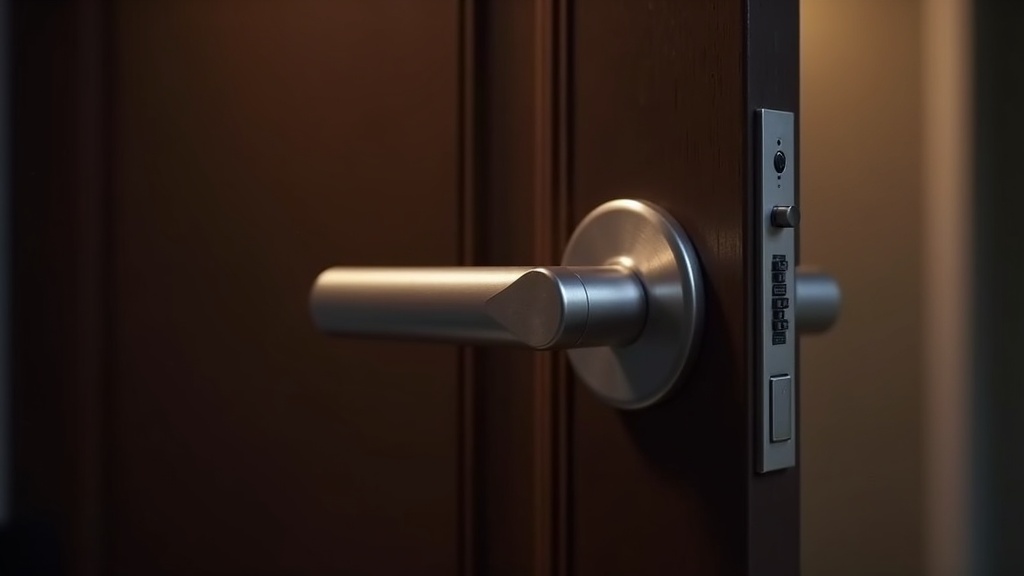
Your front door is about to start judging you. Not metaphorically — literally. The new Schlage Sense Pro uses ultra-wideband radio to clock how fast you’re walking toward it, calculate your trajectory like a tiny bouncer doing physics, and pop the bolt open right as you reach for the handle. Walk up confidently and it unlocks. Shuffle up sideways while doom-scrolling? It’s watching. We’ve officially reached the era where your deadbolt has opinions about your gait.
Announced June 29, 2026, the Sense Pro is Schlage’s first lock to combine Matter-over-Thread with UWB “hands-free” unlocking, and at $399 it is not shy about its ambitions. But here’s the honest question — the one Schlage’s press release politely skips: is a lock that knows your walking speed actually worth $399 when the excellent Schlage Encode Plus and Yale Assure Lock 2 do 95% of the job for a third less? We’ve hands-on compared Yale and Schlage’s current smart locks, so we’ll give it to you straight — no marketing fog.
Comparing today’s top smart locks on Amazon
Check Schlage Sense Pro on Amazon · Schlage Encode Plus · Yale Assure Lock 2
As an Amazon Associate, we earn from qualifying purchases.
2026 update: Considering other walk-up-unlock options? See our three-way UWB lock comparison: Sense Pro vs Aqara U400 vs Ultraloq Bolt Mission.
TL;DR — Sense Pro vs Encode Plus vs Yale
- What it is: The Schlage Sense Pro is the company’s first Matter-over-Thread + UWB smart deadbolt, with “Schlage Converge” hands-free unlocking that reads your approach and opens the door as you walk up. Launched June 29, 2026.
- Price: $399 US / $549 CA. Sold at Amazon, Lowe’s, Home Depot, and Schlage.com. That’s flagship-phone money for a deadbolt.
- Buy the Sense Pro if: you’re an early adopter living deep in Apple Home, you already use Apple Home Key on your phone/watch, and true walk-up-and-it’s-open magic is worth a premium to you.
- Buy the Encode Plus if: you want the best physical security in a smart deadbolt (top marks in 2026 lab tests), Apple Home Key tap-to-unlock, and roughly $100 back in your pocket.
- Buy the Yale Assure Lock 2 if: you want the “best for most people” pick — a sleek, swappable-module lock that adapts to whatever smart home platform you land on.
What’s Actually New in the Sense Pro
Most “new” smart locks are last year’s lock with a fresh faceplate and a $40 markup. The Sense Pro is genuinely different, and it comes down to three letters: UWB.
The headline feature is what Schlage calls Schlage Converge, its ultra-wideband hands-free unlock. Per Schlage’s announcement, the lock uses UWB (the same precise radio tech behind AirTag finding and phone-as-car-key) to sense your phone as you approach, calculate your approach speed and trajectory, and unlock right as you arrive — no tapping, no reaching, no fumbling with grocery bags in each hand. Regular Bluetooth “auto-unlock” locks have done a fuzzy version of this for years, but they’re notoriously twitchy: they’ll unlock your door because you walked past it on the way to the mailbox. UWB is precise enough to know whether you’re actually coming to the door or just wandering near it. Your lock, in other words, finally understands object permanence.
At launch, Converge works via Apple Home Key — so this is very much an Apple-household party for now. The Sense Pro is also Aliro-certified, the new cross-industry standard for phone-and-watch digital keys, which means Samsung and Google Wallet keys are expected later in 2026 (per Schlage — treat that timeline as expected, not promised; “later this year” is the smart-home industry’s favorite phrase).
Underneath the flashy UWB stuff, the Sense Pro is also Schlage’s first Matter-over-Thread lock. In plain English: Matter is the universal smart-home language that lets gadgets from different brands actually talk to each other, and Thread is the low-power, self-healing mesh network it rides on. Translation: fewer “which app do I open again?” moments, better battery life, and a lock that plays nicely with a multi-brand smart home instead of trapping you in one company’s walled garden.
Sense Pro vs Encode Plus vs Yale Assure Lock 2 Plus
Here’s the honest side-by-side. Note that the Sense Pro’s specs are drawn from Schlage’s announcement (it’s brand new), while the Encode Plus and Yale figures reflect widely available current models we and others have tested.
| Spec | Schlage Sense Pro | Schlage Encode Plus | Yale Assure Lock 2 Plus |
|---|---|---|---|
| Price (US, announced) | $399 | ~$300 street | ~$250–280 |
| Hands-free UWB unlock | Yes (Schlage Converge) | No | No |
| Apple Home Key (tap) | Yes | Yes | Yes (Plus model) |
| Protocols | Matter over Thread, UWB, BLE | Wi-Fi + BLE | Swappable module (Wi-Fi / Z-Wave / Matter) |
| Keypad | Yes | Yes | Yes (or key-free version) |
| Aliro / future Android keys | Yes (expected 2026) | No | Varies by module |
| Availability | Amazon, Lowe’s, Home Depot, Schlage.com | Widely available | Widely available |
Should You Pay $399?
Okay, real talk. UWB hands-free unlock is genuinely the coolest thing to happen to deadbolts in years. But “coolest” and “worth $399 of your actual money” are different sports, and for most people the answer is a friendly no, not yet. Three reasons:
- The price gap is real: The Sense Pro costs roughly $100–150 more than an Encode Plus or Yale that already do Apple Home Key tap-to-unlock. You’re paying a premium so you don’t have to lift your phone the last six inches. That’s convenience, not security.
- It’s a first-gen feature: UWB approach-detection is brand new in a shipping lock. Early adopters are, lovingly, beta testers who paid full retail. How well Converge reads your specific walk, door, and phone in a real home — versus a polished demo — is the big unknown until units are out in the wild.
- The magic is Apple-only for now: If you’re not living in Apple Home with Home Key already set up, the marquee feature simply isn’t yours yet. Android keys are expected later in 2026, but you’d be buying on a promise.
The counter-case is short but real: if you’re a committed Apple Home household, you already tap-to-unlock daily, and walking straight through your own front door with zero interaction sounds worth the premium — the Sense Pro is the only lock that does it. Early adopters, this is your moment. Everyone else, read on. For the full head-to-head on Schlage’s current lineup versus Yale, our Yale Assure Lock 2 vs Schlage Encode Plus face-off is where we go deep on the day-to-day differences.
The Smarter Buys Right Now
If you need a great smart lock today — not a promise about later in 2026 — these two are where we’d point almost everyone. Both are proven, both do Apple Home Key, and both leave money in your wallet.
Schlage Encode Plus — the security pick
The Schlage Encode Plus is the one we recommend to most people who want Apple Home Key without the $399 sting. It posted best-in-class physical security in 2026 lab testing (Schlage’s deadbolts are boringly, reliably tough), it taps open with your iPhone or Apple Watch, and it streets for around $300. It won’t read your gait, but for the $100 you save you can practice reaching for your own door — free of charge. It’s a mainstay in our best smart lock for your front door guide.
Schlage Encode Plus — check current price
Check Schlage Encode Plus on Amazon
As an Amazon Associate, we earn from qualifying purchases.
Yale Assure Lock 2 — best for most people
The Yale Assure Lock 2 earns its “best for most people” rep in 2026 roundups thanks to a clever swappable connectivity module — pick Wi-Fi today, snap in Matter later, no new lock required. Grab the Assure Lock 2 Plus and you get Apple Home Key tap-to-unlock too. One note on the Yale ecosystem: Google stopped selling the Nest x Yale Lock on July 2, 2026, a reminder that platform partnerships shift under your feet — which is exactly why Yale’s swap-a-module approach is aging so well. See where it lands in our top 5 smart locks tested and reviewed.
Yale Assure Lock 2 — check current price
Check Yale Assure Lock 2 on Amazon
As an Amazon Associate, we earn from qualifying purchases.
Schlage Sense Pro FAQ
Does UWB hands-free unlock drain your phone battery?
UWB is designed to be low-power and only pings in short bursts when you’re near the lock, so the impact should be minor — similar to how AirTag finding or car-key features already work on your phone. That said, real-world battery numbers for the Sense Pro won’t be clear until units are out and people are living with them. File this under “expected to be fine, but verify.”
Will the Sense Pro work with Android phones?
At launch, the hands-free Converge unlock uses Apple Home Key, so it’s an Apple-first feature. Because the Sense Pro is Aliro-certified, Samsung and Google Wallet digital keys are expected later in 2026 (per Schlage). If you’re on Android and this feature is why you’re buying, it may be worth waiting for that support to actually land.
Is the Sense Pro compatible with Alexa and Google Home?
The Sense Pro supports Matter over Thread, which is the universal smart-home standard designed to work across Alexa, Google Home, Apple Home, and SmartThings for core lock/unlock and status functions. The marquee UWB hands-free trick, however, rides on Apple Home Key for now — so basic control is cross-platform, but the magic is currently Apple’s.
What’s the real difference between the Encode Plus and the Sense Pro?
Both give you Apple Home Key tap-to-unlock and strong Schlage hardware. The Sense Pro adds UWB hands-free unlocking (walk up, door opens) plus Matter-over-Thread and future Android-key support, for about $100 more. If you want tap-to-unlock and top security, the Encode Plus is the value play. If you want true no-touch entry and you’re all-in on Apple, the Sense Pro is the upgrade. Our Yale vs Schlage Encode Plus comparison covers the Encode Plus in more depth.
Disclosure: As an Amazon Associate, The Home Picker earns from qualifying purchases. Schlage Sense Pro details are based on Schlage’s announcement (PRNewswire, June 2026) and the schlage.com launch page; the lock is brand new, so specs, pricing, and future Android-key timing may change — items labeled “expected” are not yet confirmed. Our verdict draws on Schlage’s published specs plus our own hands-on testing of the Encode Plus and Yale Assure Lock 2. We have not independently tested the Sense Pro.
You May Also Like
- UWB Smart Locks Are Here (2026): Schlage Sense Pro vs Aqara U400 vs Ultraloq Bolt Mission
- Yale Assure Lock 2 vs Schlage Encode Plus 2026: Smart Lock Face-Off
- Best Smart Lock for Front Door 2026: 6 Locks Tested Over 4 Months
- Best Smart Lock for Home 2026: Top 5 Picks Tested & Reviewed
- Eufy Smart Lock E31 vs Aqara U200 (2026): Best Smart Lock Under $200?