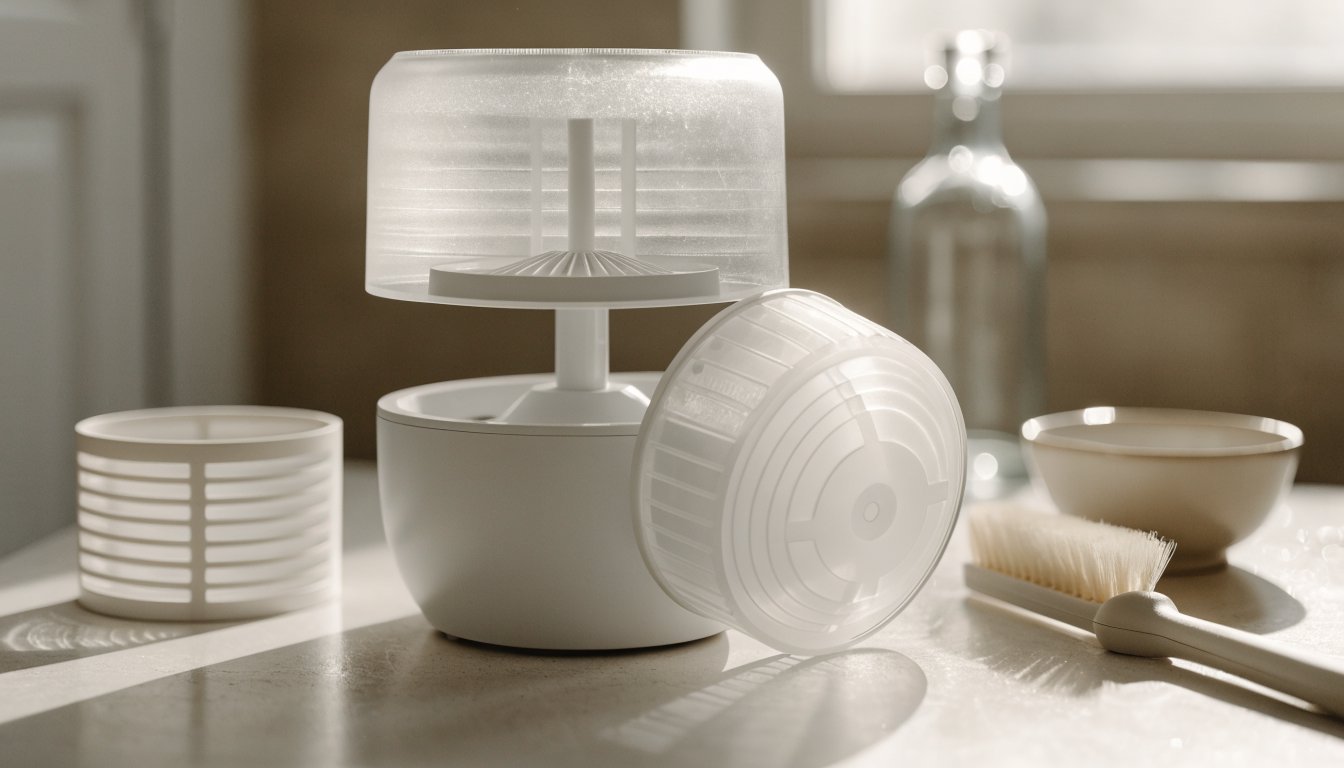
Quick answer: Empty the tank, wipe every surface dry, and refill your humidifier with fresh water every day. Do a deeper clean every third day: unplug the unit, scrub away mineral scale with white vinegar (about a 30-minute soak), disinfect with 3% hydrogen peroxide or a manufacturer-approved solution, then rinse thoroughly so no chemicals get misted into the air. Use distilled or demineralized water instead of tap water to slow scale and “white dust,” and keep indoor humidity between 30–50%. This routine follows U.S. EPA and CPSC guidance and takes only a few minutes at a time.
A humidifier is one of the few appliances that turns whatever is inside it into air you breathe all night. That is exactly why it can quietly become a health problem instead of a comfort. Left sitting with the same water for days, the tank becomes a warm reservoir where bacteria, mold, and mineral scale build up — and then the machine faithfully aerosolizes all of it into your bedroom. The good news: keeping it clean is fast, cheap, and backed by clear guidance from the U.S. Environmental Protection Agency (EPA) and the Consumer Product Safety Commission (CPSC).
If you have read our guides on how to descale a Keurig or how to clean a dishwasher, you already know the enemy: hard-water minerals and biofilm. A humidifier is the same fight — limescale and slime — with one difference. A coffee maker keeps its scale to itself; a humidifier sprays the problem straight into the air you sleep in. That is the reason the cleaning bar is higher here, and why “rinse thoroughly” is the single most important instruction in this guide.
Disclosure: As an Amazon Associate, TheHomePicker earns from qualifying purchases. If you buy through links on this page, we may earn a commission at no extra cost to you. This does not influence our maintenance guidance, which follows EPA and CPSC recommendations.
Why does a dirty humidifier matter?
Two things accumulate in a neglected humidifier, and both end up airborne.
Microorganisms. The EPA notes that microorganisms often grow in humidifier tanks that hold standing water, and that breathing mist containing these pollutants has been implicated in a type of lung inflammation. The CPSC is more concrete: bacteria and fungi grow in the tanks and can be released in the mist, and breathing dirty mist may cause lung problems ranging from flu-like symptoms to serious infection. This is of special concern to people with allergies or asthma, whose symptoms may worsen.
Keep the framing honest: this reaction is real but relatively uncommon, and it is tied to poorly maintained units and to more susceptible people — the EPA specifically names the young, the elderly, and those with lung disease or respiratory allergies. The practical takeaway is reassuring, not alarmist: a clean unit essentially removes the risk. The EPA does add one safety-valve line worth remembering — if you develop respiratory symptoms you associate with using your humidifier, stop and contact your physician, even if you have been following the maintenance directions.
Mineral scale and “white dust.” Tap water carries dissolved minerals. Ultrasonic and impeller (“cool mist”) units are, per the EPA, very efficient at dispersing those minerals into the air, where they settle as a fine white dust on nearby furniture. The CPSC is careful here: the dust particles can be small enough to inhale, but “the health effects from inhaling this humidifier dust are not clear.” So treat white dust as a nuisance and possible irritant, not a proven hazard. Scale matters for another reason too — the CPSC explains that mineral scale creates a surface on which bacteria or fungi can grow. Minerals build scale; scale becomes a home for biofilm. Descaling is hygiene, not just housekeeping.
Know the warning signs. The CPSC says film or scum on the water surface, on the sides or bottom of the tank, or on exposed motor parts may mean the tank contains bacteria or fungi, and a crusty deposit or scale may also form. Translation: if you see film, slime, or crust, clean it immediately — do not wait for your scheduled day.
How often should you clean a humidifier?
There are two cadences, and people usually only remember the second one. The daily rinse is the one that actually prevents microbial growth.
| How often | What to do | Source |
|---|---|---|
| Every day | Unplug, empty the tank, wipe all surfaces dry, refill with fresh water. Never top off old water. | EPA + CPSC |
| Every 3rd day | Full clean: descale scale with vinegar, brush out film/deposits, disinfect, rinse, dry. | EPA |
| More often | Hard-water homes: minerals build scale faster, so descale more frequently. | CPSC |
| Start & end of season | Drain and clean before storage; clean again after storage. Dispose of used demineralization cartridges. | EPA + CPSC |
The EPA’s standard is to clean portable humidifiers every third day; a once-a-week sanitize is the looser minimum you will see in reputable how-to guides. When in doubt, follow the every-third-day rule — and never skip the daily empty-and-refill, because standing water is the root cause of almost every humidifier problem.
How do you deep clean a humidifier step by step?
This is the full every-third-day routine. It takes about ten minutes of hands-on work plus soak time.
1. Unplug and disassemble. The EPA and CPSC both start here: unplug the unit from the wall first, every single time. Separate the tank, the base or reservoir, the mist nozzle or cap, and any removable tray. If it is an evaporative unit, remove the wick or filter and set it aside.
2. Empty and rinse the tank. Dump the old water — do not top it off — give the tank a quick rinse, and (on non-deep-clean days) refill with fresh water. The EPA’s exact tip: empty the tank, wipe all surfaces dry, and refill daily to reduce the growth of microorganisms.
3. Descale with white vinegar. This is the same move as descaling a coffee maker. Pour plain white vinegar into the base and reservoir until the scaled surfaces are covered; for the tank, use undiluted vinegar for heavy scale or a 50/50 vinegar-water mix for light scale. Let it work for about 30 minutes, then scrub the wet base with a soft bottle brush or an old toothbrush, getting into every corner. The CPSC’s caution: do not damage the motor or scratch the inner surface — no metal scouring pads, and do not submerge the electrical base unless the manual allows it. (Our Keurig descaling guide uses this identical vinegar method if you want the step-by-step for scale removal.)
4. Disinfect — follow the EPA’s hierarchy. First choice is always whatever your manufacturer specifies. If the manual gives no guidance, the EPA’s default is to clean all water-contact surfaces with a 3% solution of hydrogen peroxide — the standard brown-bottle drugstore strength. The CPSC also permits chlorine bleach as long as you rinse well; a workable dilution is one teaspoon of bleach per gallon of water, left to sit about 30 minutes. Never mix bleach with vinegar or with hydrogen peroxide — the combination releases toxic, irritant gases. Pick one agent, and rinse it out completely before switching.
5. Rinse thoroughly — the most important step. The EPA is emphatic: if you use any cleaning or disinfecting agent, rinse the tank thoroughly with several changes of water to prevent chemicals from dispersing into the air during use. Remember what this machine does for a living — it aerosolizes whatever is in the tank. Leftover bleach, peroxide, or vinegar gets misted straight into the room. Rinse until there is no smell of cleaner at all.
6. Dry every part, then reassemble. Wipe all surfaces dry and let the disassembled pieces air-dry on a clean towel before putting them back together. Drying denies microbes the moisture they need and stops residual droplets from re-scaling.
Does the type of humidifier change how you clean it?
Yes — the mechanism decides how much scale and how many microbes each unit throws into the air. If you are not sure which kind you own, our breakdown of cool mist vs. warm mist and ultrasonic vs. evaporative humidifiers explains the differences in detail.
Ultrasonic and impeller (“cool mist”) are the dirtiest offenders. The EPA attributes the greatest dispersion of both microorganisms and minerals to these units, so they are the most prone to white dust — which is exactly why distilled water matters most here. Clean the vibrating diaphragm gently with a soft brush and never scratch it.
Evaporative (wick or belt) units blow air through a moistened wick, which traps minerals and releases little to none into the air. The trade-off: the wick itself loads up with scale and must be cleaned or replaced on the manufacturer’s schedule — often every one to three months, or each season. Wicks generally should not be soaked in vinegar long-term, as it can break them down; follow the maker’s instructions.
Warm-mist / steam vaporizers boil the water, so they disperse fewer microbes and few minerals into the air — but scale bakes onto the heating element, so descale it with vinegar. One safety note the EPA stresses: keep steam units out of the reach of children, because the steam and boiling water can cause burns.
How do you stop white dust and mold?
Prevention is cheaper and easier than cleaning, and it comes down to the water you pour in and the humidity you allow.
Use low-mineral water. Both agencies agree: use distilled or demineralized water, not tap water, because tap water carries more minerals. There is a nuance worth knowing — the EPA says distillation is the most effective method for removing minerals, while deionized and reverse-osmosis water are demineralized but somewhat less effective. Do not reach for bottles labeled “spring,” “artesian,” or “mineral” — those have not been treated to remove minerals and will still cause dust.
Consider demineralization cartridges, if your model supports them, but keep expectations honest. The EPA warns their ability to remove minerals varies widely — watch for white dust as a sign they are not working. In high-mineral areas, distilled water may actually be cheaper and more reliable than replacement cartridges.
Do not over-humidify. The EPA says do not exceed 50% relative humidity; the CPSC recommends staying between 30% and 50% and warns that above 60%, moisture condenses on walls and windows where bacteria and mold settle and grow. A cheap hygrometer lets you actually measure it. If water is condensing on your windows, turn the humidifier down or move it.
Empty it when it is not in use, and keep the surrounding area from becoming damp — standing water and wet carpet both breed mold.
What mistakes should you avoid?
- Leaving standing water between uses. This is the number-one cause of microbial growth — both agencies hinge their guidance on it.
- Using tap water in an ultrasonic unit. It guarantees white dust and faster scale.
- Not rinsing after disinfecting. Leftover chemicals get misted into the air you breathe.
- Over-humidifying past 50%. Condensation on walls and windows breeds mold in the whole room, not just the tank.
- Skipping wick or filter replacement on evaporative units — a clogged wick is both ineffective and a biofilm site.
- Adding essential oils to a standard tank. Oils can crack plastic tanks, gum up ultrasonic diaphragms, and void the warranty. Only do it if the manufacturer says the tank is oil-safe; otherwise use a unit with a dedicated aroma tray or a separate diffuser.
- Scrubbing too hard. The CPSC warns against scratching the inner surface — scratches harbor biofilm.
What should you buy to keep a humidifier clean?
You can do the entire job with pantry staples — plain white vinegar (roughly $3–5 a gallon) and 3% hydrogen peroxide (a couple of dollars) are exactly what the EPA and reputable how-to guides cite. If you want purpose-made or preventive products, these are the categories that actually help:
- Humidifier cleaner / descaler. Citric-acid based descalers are designed for humidifier tanks and bases.
- Distilled water by the gallon. The single highest-leverage buy for stopping white dust and slowing scale — especially for ultrasonic units.
- A digital hygrometer. Both the EPA and CPSC recommend measuring humidity; keep it in the 30–50% range.
- Replacement wick filters for evaporative units — match the exact model number for your humidifier.
If your unit is cracked, impossible to disassemble, or simply beyond cleaning, it may be time to replace it — our picks for the best humidifiers for the bedroom under $50 favor models that are easy to take apart and clean, which is the feature that matters most for long-term hygiene.
Frequently asked questions
Can I use vinegar to clean a humidifier?
Yes. Plain white vinegar dissolves the mineral scale that builds up in the tank and base — soak the scaled parts for about 30 minutes, then brush and rinse. Just note that vinegar is a descaler and mild antimicrobial, not an EPA-registered disinfectant; for disinfecting, the EPA suggests a 3% hydrogen peroxide solution when your manual doesn’t specify one. Whatever you use, rinse thoroughly.
How often should I clean my humidifier?
Empty it, wipe it dry, and refill with fresh water every day; do a full clean with descaling and disinfecting every third day, per the EPA. Homes with hard water should clean more often because minerals build scale faster.
What is the white dust around my humidifier?
It’s minerals from tap water that ultrasonic and impeller (“cool mist”) humidifiers aerosolize and deposit as fine dust. It’s mostly a nuisance — the CPSC notes the particles are small enough to inhale but that the health effects “are not clear.” Switching to distilled or demineralized water (or a demineralization cartridge) stops it.
Can a dirty humidifier make you sick?
It can. Bacteria and fungi grow in neglected tanks and get released in the mist; the CPSC says breathing dirty mist may cause lung problems ranging from flu-like symptoms to serious infection, and it can worsen allergy and asthma symptoms. The risk is highest with poorly maintained units and for the young, elderly, and people with lung disease — regular cleaning essentially removes it.
Distilled water vs. tap water — which should I use?
Distilled or demineralized water. Tap water has more minerals, which cause scale and white dust. The EPA notes distillation removes minerals most effectively, while deionized and reverse-osmosis are fine but slightly less effective — and you should avoid “spring,” “artesian,” or “mineral” bottled water, which aren’t demineralized.
Can I use bleach to disinfect it?
Yes, if you rinse extremely well. The CPSC permits chlorine bleach as long as you rinse the tank thoroughly to avoid breathing harmful chemicals; a workable dilution is one teaspoon of bleach per gallon of water, left to sit about 30 minutes, then rinsed. Never mix bleach with vinegar or hydrogen peroxide. Many people prefer 3% hydrogen peroxide, the EPA’s default, precisely to avoid bleach fumes.
Can I put essential oils in my humidifier?
Only if the manufacturer says the tank is oil-safe. Essential oils can crack plastic tanks and clog ultrasonic components, and often void the warranty. If you want scent, use a humidifier with a dedicated aroma tray or a separate diffuser rather than pouring oils into a standard water tank.
What humidity level should I keep at home?
Between 30% and 50% relative humidity. The EPA says don’t exceed 50%; the CPSC says keep it 30–50% and warns that above 60%, moisture condenses on surfaces where mold and bacteria grow. A hygrometer that costs a few dollars lets you check.
The bottom line
A humidifier only helps you if what it sprays into the air is clean. The routine is simple and cheap: empty, wipe, and refill daily; descale with vinegar and disinfect every third day; rinse until there’s no trace of cleaner; and pour in distilled water to keep white dust and scale from coming back. Keep the room between 30% and 50% humidity, and clean the moment you spot film or crust. Do that, and the appliance goes back to doing its one job — comfortable air — without becoming a health risk in the process.
Sources: U.S. Environmental Protection Agency, “Use and Care of Home Humidifiers” (EPA 402-F-22-002, rev. June 2022); U.S. Consumer Product Safety Commission, “Dirty Humidifiers May Cause Health Problems” (Publication 5046). Maintenance guidance in this article follows these primary public-health sources.
Related maintenance guides