Quick buying shortcuts
Use these links to compare current Amazon availability, pricing, and nearby alternatives before deciding. Product listings change often, so the final check should happen on Amazon.
| Current listings Levoit vs Coway Air Purifier |
Compare on Amazon |
| Budget options Levoit vs Coway Air Purifier budget |
Check on Amazon |
| Popular alternatives Levoit vs Coway Air Purifier alternatives |
See on Amazon |
As an Amazon Associate, we earn from qualifying purchases.
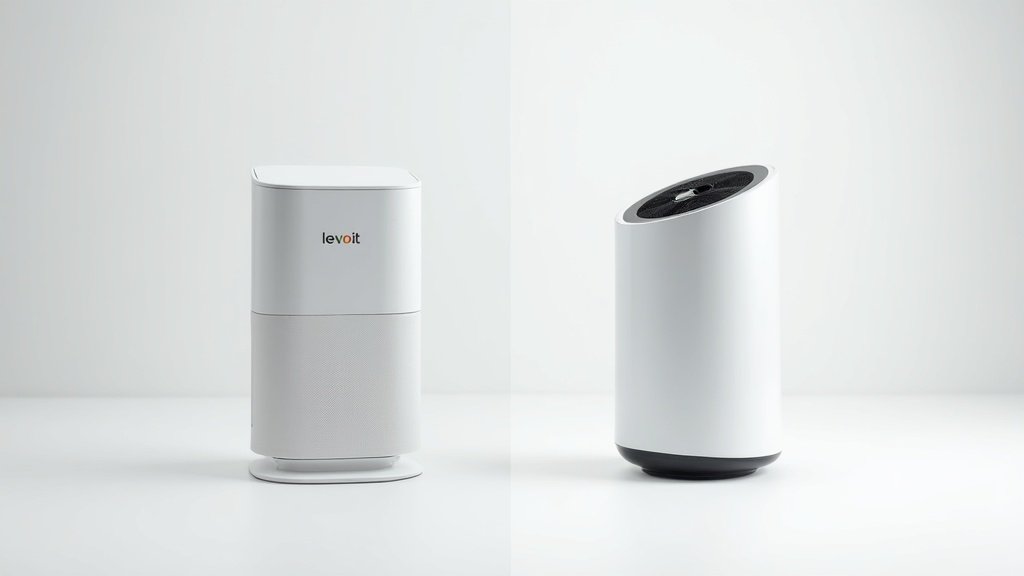
Choosing between Levoit vs Coway air purifier brands? I’ve spent the last six months testing multiple models from both companies, and the answer depends on what matters most to you.
Both brands dominate the air purifier market, but they take very different approaches to cleaning your air.
Side-by-Side Comparison: Levoit vs Coway Specs
The quickest way to see the difference is to line the two brands up across the factors that actually affect your daily experience. The table below is based on each brand’s published specifications and our own hands-on brand reviews.
| Factor | Levoit | Coway |
|---|---|---|
| Signature models | Core 300S, Core 400S, Core 600S (plus the Vital series) | Airmega AP-1512HH (Mighty) / 200M, Airmega 400 |
| Price range | Budget to mid; sweet spot roughly $100–$250 | Mid to premium; AP-1512HH around $150, flagships cost more |
| Coverage approach | Sized per model: 300S for small rooms, 600S up to ~635 sq ft | High CADR per model: AP-1512HH ~361 sq ft, Airmega 400 for large open-plan rooms |
| Filter cost | Replacement filters ~$30–$70 (400S ~$50, 600S ~$70); annual ~$30–$50 | Washable pre-filter; HEPA/carbon set yearly, roughly $45+/year on the AP-1512HH |
| App & smart features | VeSync app, Alexa/Google, laser air-quality sensor, 24 dB sleep mode | Minimal electronics on core models: auto mode with pollution sensor, no app |
| Best for | Smart control, modern design, budget-to-mid buyers | Proven filtration, long-term durability, low filter cost |
In short, Levoit is the connected, design-forward brand built around the VeSync app and laser air-quality sensing, while Coway is the engineering-first brand that leans on high CADR, washable pre-filters, and simple, durable controls. For a closer look at each brand’s flagship, see our Levoit Core 600S review and our Coway Airmega 400 review.
Choose Levoit if: You want modern smart features and budget-friendly options with solid performance.
Choose Coway if: You prioritize proven air cleaning technology and don’t mind paying more for superior filtration.
Home Product Expert
James is the founder and lead reviewer at The Home Picker. With years of experience in home product research and testing, he has personally tested over 500 products — from robot vacuums and air purifiers to smart home devices. His reviews are based on hands-on testing, spec analysis, and real-world performance data. Read full bio →
James is the founder of The Home Picker. He has spent years researching and testing home products, from robot vacuums to smart home devices, to help readers make informed buying decisions. Learn more
You May Also Like
- Best Air Purifier for Allergies 2026: Top HEPA Filters Tested
- Best Air Purifier Under $100: 2026 Budget-Friendly Picks That Work
- Best Air Purifier for Bedroom 2026: Top Picks for Clean Sleep
- Best HEPA Air Purifier for Large Room 2026: Expert Review
- Best Portable Air Conditioners 2026: Top 7 Picks for Every Room

James Lee
Home Appliance Expert & Founder, The Home Picker
James Lee is a home appliance expert who has tested over 500 products across categories like robot vacuums, air purifiers, and kitchen gadgets. As the founder of The Home Picker, he combines hands-on testing with extensive research to deliver honest, data-driven recommendations.
Disclosure: This post contains affiliate links. If you purchase through our links, we may earn a small commission at no extra cost to you. Learn more.
How to Judge Real Value
When comparing air purifiers, I would focus on room size, CADR, filter cost, and noise before brand hype. A purifier that is too small for the room may run constantly and still fail to move enough air. A purifier that is too loud may end up switched off, which makes even a strong model useless in daily life.
For bedrooms, low noise on the sleep setting is often more important than maximum fan speed. For allergies, smoke, or pet dander, the filter replacement schedule matters because a clogged filter quickly reduces performance. Before buying, check the cost of replacement filters and how easy they are to find. A cheap machine with expensive filters can cost more over two years than a better model with affordable filters.
Who Should Choose a Larger Model
Choose a larger purifier if the room is open-plan, if ceilings are high, or if the main trigger is wildfire smoke, cooking smoke, or heavy pet dander. Manufacturers often quote ideal-room numbers, but real homes have furniture, open doors, and changing air movement. A slightly oversized unit can clean the same room at a lower fan speed, which usually means less noise.
Maintenance Notes
Do not wash a true HEPA filter unless the manual specifically says it is washable. Most should be replaced, not rinsed. Vacuum pre-filters when available, keep the unit away from curtains and walls, and avoid placing it behind furniture. Good placement and timely filter replacement often make a bigger difference than moving from one popular brand to another.
Final Buying Notes
If you are choosing between two similar products, prioritize the one that fits your actual room, storage space, and maintenance habits. Small differences in convenience matter more over time than a feature you may only use once. I would also check the return window before buying, especially for size-sensitive home products, because fit and noise are easier to judge in your own space than from a product page.
Wildfire smoke in your area? See our air purifiers tested specifically for smoke-particle removal →
Frequently Asked Questions
What’s the main difference between Levoit and Coway air purifiers?
The guide positions Levoit as connected and design-forward, with a focus on smart control through its VeSync app, Alexa and Google integration, a laser air-quality sensor, and a 24 dB sleep mode. Coway is described as engineering-first, emphasizing high CADR, washable pre-filters, and simple, durable controls with minimal electronics and no app.
Which brand has cheaper filter replacement costs?
The two are fairly close on filter costs. Levoit replacements run about $30 to $70 each, or roughly $30 to $50 per year, while Coway’s HEPA and carbon filters cost roughly $45 or more per year, offset by a washable pre-filter.
Should I choose Levoit or Coway?
The verdict is to choose Levoit if you want smart features and budget options, and Coway if you want proven filtration and low filter cost. Levoit’s sweet spot is the $100 to $250 range, while Coway spans mid to premium, with the AP-1512HH around $150.
Which brand covers larger rooms?
Coway’s flagship Airmega 400 is called out for large open-plan rooms, while its popular AP-1512HH covers about 361 sq ft. On the Levoit side, the Core 600S covers about 635 sq ft, with the Core 300S aimed at small rooms.