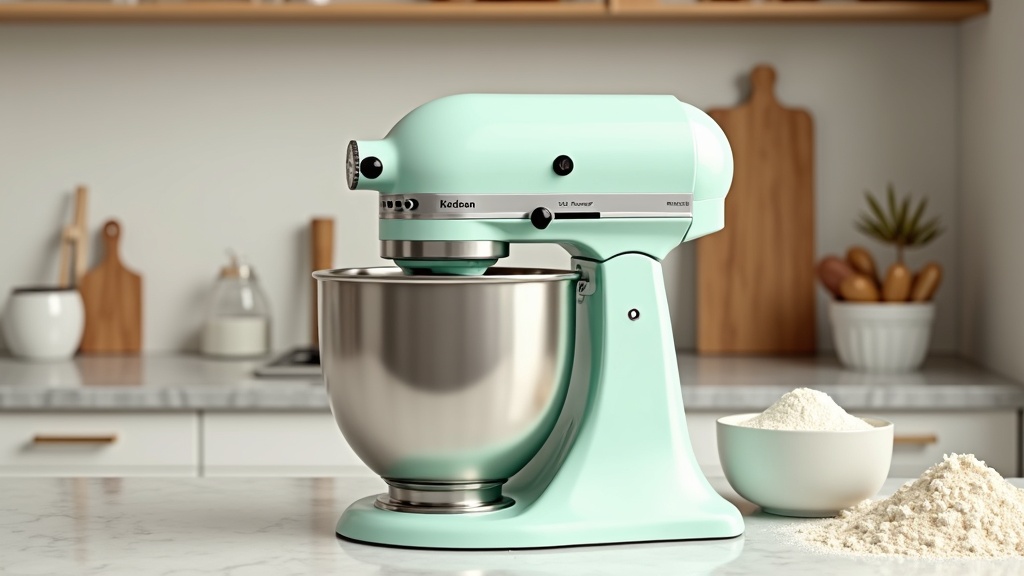
KitchenAid just changed a design that has outlived 14 U.S. presidents. The tilt-head stand mixer — the exact silhouette sitting on your countertop, your mom’s countertop, and roughly every food blog’s countertop since the Eisenhower administration — got its first real overhaul since 1955. The new KitchenAid Artisan Plus adds an LED bowl light, a first-ever half speed, and a “Precision Mode,” which is a genteel way of saying grandma’s mixer just received a software update. It costs $599.99, and the internet has Opinions.

So here’s the question that actually matters for your wallet: is the biggest KitchenAid upgrade in 70 years worth roughly $150 more than the classic Artisan you can buy today — the one that already whips meringue like a champion and takes every pasta-roller attachment on Earth? We dug through KitchenAid’s official announcement and PRNewswire’s press materials, cross-checked the specs, and lined the two up honestly. (Full disclosure up front: we’ve hands-on tested the classic Artisan — see our review below — but the Plus is brand new, so everything about it here comes straight from KitchenAid, not our test kitchen.)
Ready to shop? Compare both on Amazon
Check the Artisan Plus on Amazon · Check the classic Artisan on Amazon
As an Amazon Associate, we earn from qualifying purchases.
TL;DR — Artisan Plus vs. Classic Artisan
- What’s new: The Artisan Plus adds an LED bowl light, a first-ever ½ speed, Precision Mode (smooth speed gliding), Soft Start, and a double flex edge beater — plus all-stainless accessories. KitchenAid calls it the biggest tilt-head change since 1955.
- Price: Artisan Plus is $599.99. The classic Artisan streets around $400–$450. So the “Plus tax” is roughly $150.
- Same DNA: Both are 5-quart tilt-head mixers with the same planetary action and — importantly — the same universal attachment hub. Your pasta roller and meat grinder carry right over.
- Classic owners: Keep your mixer. A light and a half-speed do not justify replacing a machine that runs for 20 years.
- New buyers: Decide on that $150 gap. Want the newest features and don’t mind paying? Plus. Want a proven workhorse and $150 back in your pocket? Classic.
What’s Actually New on the Artisan Plus?
Let’s separate the genuine upgrades from the marketing confetti. Per KitchenAid’s official announcement (March 30, 2026), here’s what the Plus adds over the classic Artisan:
1. An LED bowl light (the headline feature)
This is the first tilt-head KitchenAid with an integrated LED bowl light. It illuminates the bowl so you can actually see whether your batter is smooth or still hiding pockets of flour. KitchenAid says it turns on automatically when the mixer runs and shuts off when you lift the tilt-head or after five minutes of idling. Is it life-changing? No. Is it genuinely nice for anyone who bakes at 6 a.m. under bad kitchen lighting? Honestly, yes. It’s the “backup camera” of stand mixers — you didn’t know you wanted it until every new model has one.
2. A first-ever ½ speed
For the first time on a tilt-head mixer, there’s a ½ speed (KitchenAid calls it a ½ Fold Speed) that sits below the old Speed 1. It’s designed to gently fold in delicate ingredients — egg whites, whipped cream, berries — without deflating them or launching flour across your backsplash. If you’ve ever watched Speed 1 turn a careful meringue into a sad puddle, this is the setting you’ve been wanting since 1955.
3. Precision Mode + Soft Start
The Plus has 11 total speeds (up from 10) and a Precision Mode that lets you glide smoothly from low to high instead of clunking between fixed notches. There’s also Soft Start, which ramps the speed up gradually so ingredients stay in the bowl instead of on your ceiling. Both are refinements, not revolutions — but if you make a lot of dry-ingredient-heavy recipes, less splatter is a real quality-of-life win.
4. Double flex edge beater + all-stainless accessories
The Plus ships with a double flex edge beater — it has scraper edges on both sides, so it wipes the bowl as it mixes and you spend less time stopping to scrape with a spatula. The full accessory set (precision-welded stainless bowl, double flex edge beater, dough hook, wire whisk, and flat beater) is stainless and dishwasher safe. The classic Artisan’s flat beater, by contrast, is typically a coated aluminum piece. It’s a modest but real materials bump.
Artisan Plus vs. Classic Artisan: The Comparison Table
| Feature | Artisan Plus (2026) | Classic Artisan (5-Qt) |
|---|---|---|
| Price | $599.99 | ~$400–$450 street |
| Bowl capacity | 5 quart, stainless | 5 quart, stainless |
| Speeds | 11 (adds a ½ speed) | 10 |
| LED bowl light | Yes (first tilt-head with it) | No |
| Precision Mode / Soft Start | Yes | No |
| Included beater | Double flex edge beater | Coated flat beater |
| Accessories | All stainless, dishwasher safe | Mixed (coated beater) |
| Attachment hub | Universal power hub | Universal power hub |
| Planetary mixing action | Yes | Yes |
Plus specs per KitchenAid’s official announcement and PRNewswire; classic Artisan specs and street pricing per KitchenAid and major retailers as of mid-2026.
The Part Nobody Should Panic About: Your Attachments Still Work
Here’s the reassuring news for anyone who has slowly built a shelf of KitchenAid attachments over the years. Both the Artisan Plus and the classic Artisan use the same universal power hub — the round front port that drives pasta rollers, meat grinders, spiralizers, and the whole ecosystem of 10-plus hub attachments. KitchenAid didn’t reinvent the mount, which means your existing gear carries straight over to the Plus. Nobody is being forced to re-buy a $200 pasta roller because of a bowl light. Crisis averted.
If you’re still building out that collection, our 2026 kitchen appliance buying guide walks through which attachments are actually worth owning versus which ones live in the back of the cabinet forever.
Upgrade or Save? Our Verdict
Time for the honest math. The Plus is a lovely machine, but “lovely” and “worth replacing a mixer that already works” are two very different budget lines. Here’s how we’d break down the decision.
If you already own a classic Artisan: keep it
A KitchenAid tilt-head is famously the appliance that outlives the marriage. If yours still runs — and it almost certainly does — an LED light and a half-speed are not reasons to spend $600 replacing it. Buy a flex edge beater for your existing mixer (around $20), clip a cheap under-cabinet light over your workspace, and you’ve replicated 80% of the “upgrade” for the price of a sandwich. Save the $600.
If you’re buying your first (or a replacement) mixer: mind the $150 gap
This is the only group with a real decision to make, and it comes down to that ~$150 difference:
- Get the Artisan Plus if you bake often, value the half-speed and no-splatter Soft Start, want the nicer double flex edge beater in the box, and simply prefer buying the newest version. For frequent bakers, the daily conveniences add up.
- Get the classic Artisan if you want the proven, decades-refined workhorse and would rather keep $150. It does the same core job — same 5-quart bowl, same planetary action, same attachment hub — and it has a track record measured in generations. For occasional bakers, the Plus features are genuinely nice-to-haves, not need-to-haves.
Our take: for most first-time buyers, the classic Artisan is still the smart-money pick, and the Plus is the “treat yourself / serious baker” option. Either way you’re getting a machine that’ll probably outlast your next three phones.
One more wrinkle: the Spearmint temptation
If you’ve been anywhere near a kitchen corner of the internet lately, you’ve seen KitchenAid’s 2026 Color of the Year, “Spearmint” — a soft, retro mint-green with a sandy matte finish, offered on the classic Artisan for $499.99. It is objectively adorable and will absolutely photograph well on your counter. Just know it’s a color choice on the classic platform, not the Plus feature set. Buy it because you love the look, not because you think it’s the upgrade — those are two separate decisions, and your Instagram grid is not a reason to skip the LED light.
Still torn between whole categories of countertop gear? Our Vitamix vs. Ninja blender breakdown uses the same “is the premium pick actually worth it?” lens on blenders — handy if you’re building out a kitchen and deciding where the money should go.
Check current prices before you decide
Artisan Plus on Amazon · Classic Artisan on Amazon · Spearmint Artisan
As an Amazon Associate, we earn from qualifying purchases.
KitchenAid Artisan Plus FAQ
What’s the difference between the Artisan Plus and the regular Artisan?
The Artisan Plus adds an LED bowl light, a first-ever ½ speed, Precision Mode and Soft Start (11 speeds total vs. 10), a double flex edge beater, and all-stainless dishwasher-safe accessories. Both share the same 5-quart bowl, planetary action, and universal attachment hub. The Plus is $599.99; the classic Artisan streets around $400–$450.
Will my old KitchenAid attachments work on the Artisan Plus?
Yes. The Artisan Plus uses the same universal power hub as the classic Artisan, so existing hub attachments — pasta rollers, grinders, spiralizers and the rest — carry straight over. No re-buying required.
Is the Artisan Plus worth the extra money?
For frequent bakers who want the newest features and don’t mind the ~$150 premium, yes. For occasional bakers, the classic Artisan does the same core job for less. And if you already own a working Artisan, KitchenAid’s new features aren’t a compelling reason to replace it.
Is “Spearmint” the Artisan Plus?
No. Spearmint is KitchenAid’s 2026 Color of the Year, offered on the classic Artisan (around $499.99). It’s a color option, not the Plus feature set — two separate decisions.
Disclosure: As an Amazon Associate, The Home Picker earns from qualifying purchases. Artisan Plus details (LED bowl light, ½ speed, Precision Mode, Soft Start, double flex edge beater, stainless accessories, $599.99 pricing, and the “biggest tilt-head change since 1955” framing) are based on KitchenAid’s official March 2026 announcement and PRNewswire materials — the Plus is newly released and we have not hands-on tested it. Our hands-on experience is with the classic Artisan; see our classic Artisan review. Classic Artisan street pricing reflects major-retailer listings as of mid-2026 and may change.
👉 Thinking about stepping up to the Pro? Read KitchenAid Artisan vs Professional 600.