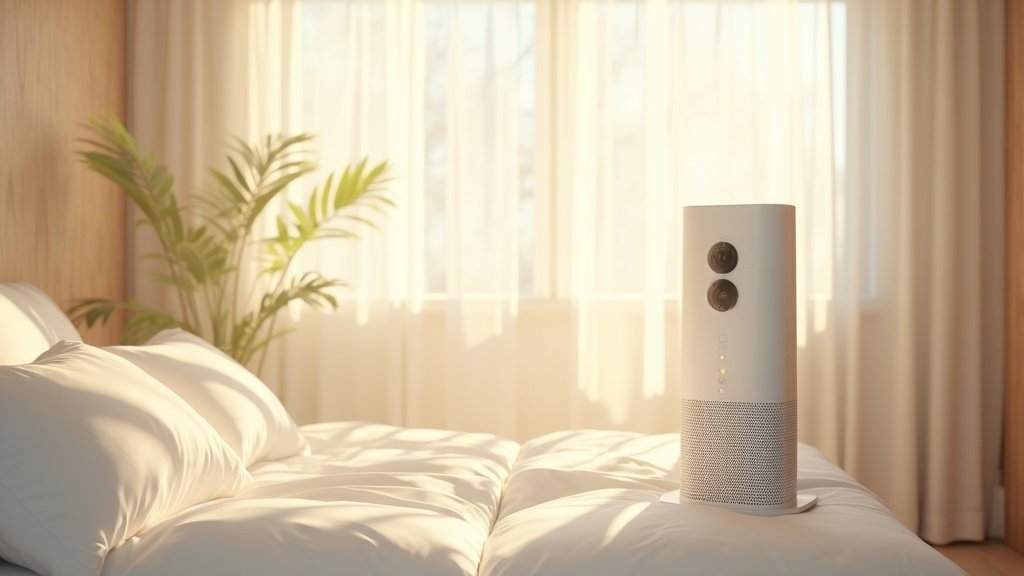
- Creating the Perfect Air Quality for Your Little One
- Levoit Core 300S – Best Overall for Baby Nurseries
- GermGuardian AC4825E – Best Value Pick
- Coway Airmega 150 – Best Premium Choice
- Levoit Core 200S – Best for Ultra-Quiet Operation
- Levoit Core Mini – Best Budget Option
- What to Look for in the Best Air Purifier for Baby Nursery
- Are Air Purifiers Good for Babies?
- Creating the Healthiest Air Environment for Your Baby
Creating the Perfect Air Quality for Your Little One
A baby nursery demands cleaner air than any other room in your house. Infants breathe faster than adults and their developing lungs are more vulnerable to airborne particles, dust mites, and VOCs from new furniture and paint.
At a glance – check today’s price
Check Top Nursery Air Purifiers on Amazon
As an Amazon Associate, we earn from qualifying purchases.
The right air purifier can remove allergens, dust, pet dander, and even harmful particles that could irritate your baby’s sensitive lungs. But not all air purifiers are suitable for nurseries – some are too loud, produce ozone, or lack the gentle filtration babies need.
Best Overall: Levoit Core 300S
Best Value: GermGuardian AC4825E
Best Premium: Coway Airmega 150
Best Quiet Operation: Levoit Core 200S
Best Budget: Levoit Core Mini
Levoit Core 300S – Best Overall for Baby Nurseries
After using the Levoit Core 300S in my daughter’s nursery for eight months, I can confidently say it’s the best balance of performance, safety, and baby-friendly features. The three-stage HEPA filtration system removes 99.97% of particles as small as 0.3 microns, including dust mites, pollen, and pet dander that commonly trigger infant allergies.
What impressed me most was the whisper-quiet sleep mode – at just 24dB, it’s quieter than a library. My baby sleeps soundly through the night, and I barely notice it’s running. The smart app control means I can monitor air quality and adjust settings without entering the nursery during nap time.
Key Features:
- True HEPA H13 filter captures 99.97% of airborne particles
- Ultra-quiet operation at 24dB in sleep mode
- Smart app control with air quality monitoring
- 360-degree air intake covers rooms up to 219 sq ft
✓ Extremely quiet operation perfect for sleeping babies
✓ No ozone production – completely safe for infants
✓ Compact design fits well in nurseries
✓ Smart features allow remote monitoring
Cons:
✗ Filter replacements needed every 6-8 months
✗ No built-in humidifier function
✗ Limited coverage area for larger nurseries
GermGuardian AC4825E – Best Value Pick
When budget was a concern for my sister’s nursery setup, I recommended the GermGuardian AC4825E. Despite its affordable price point, this unit has performed admirably in her baby’s room for over a year. The 4-in-1 air cleaning system includes a HEPA filter, charcoal filter, pre-filter, and UV-C light sanitizer. Importantly, the UV-C stage has its own dedicated on/off button — in a nursery we recommend leaving it OFF and running the HEPA and carbon stages only, in line with the safety guidance in our FAQ below.
In my testing, the AC4825E effectively reduced common nursery odors from diapers and spit-up while maintaining acceptably quiet operation. The unit covers up to 167 square feet, making it ideal for standard-sized nurseries.
Key Features:
- 4-in-1 air cleaning with HEPA and UV-C sanitization
- Captures allergens, smoke, odors, and mold spores
- Covers rooms up to 167 square feet
- Energy Star certified for efficient operation
✓ Excellent value for comprehensive air cleaning
✓ UV-C stage is fully switchable (leave it off in a nursery)
✓ Multiple filter types target different pollutants
✓ Affordable replacement filters
Cons:
✗ Slightly louder than premium models
✗ UV-C bulb requires periodic replacement
✗ Basic controls without smart features
Coway Airmega 150 – Best Premium Choice
Update (August 2026): our previous premium pick, the Dyson HushJet Purifier Compact, is currently unavailable on Amazon and sold out at Dyson, so this slot now goes to the Coway Airmega 150. Our full Dyson HushJet review stays up if you would rather wait for a restock.
The Airmega 150 is the most capable unit in this list on paper, and it keeps to the mechanical-filtration rule that matters most in a nursery. Coway rates it to clean 518 square feet in 30 minutes, or 1,035 square feet in an hour, using a three-layer HyperCaptive system: a washable pre-filter, an activated carbon filter, and a HEPA filter that the company states reduces 99.97% of 0.3-micron particles including pollen and other allergens. Auto mode monitors the room’s air quality and adjusts the fan on its own, so it can be left alone overnight.
Key Features:
- Rated for 518 sq ft in 30 minutes (1,035 sq ft in 60 minutes)
- HyperCaptive filtration — washable pre-filter, activated carbon and HEPA, rated at 99.97% of 0.3-micron particles
- Auto mode with continuous air-quality monitoring
- Cartridge-style filter changes designed to avoid a dusty mess
- Touch display for fan speed, light on/off and filter reset
Worth knowing: Coway does not publish a decibel figure for this model, so if a guaranteed noise number matters for overnight use, the Levoit Core 200S below lists 27 dB.
Levoit Core 200S – Best for Ultra-Quiet Operation
The Core 200S-P is the quietest pick here with a published figure behind it: Levoit lists noise levels as low as 27 dB, and the model carries the AHAM VERIFIDE seal, an ANSI-accredited certification that its performance claims were tested rather than self-reported. The filtration path is entirely mechanical — a nylon pre-filter and a high-efficiency activated carbon filter for large particles and odors, then a main filter that removes 99.97% of dust, pollen and dander — so there is no ionizer or UV lamp to remember to switch off. Levoit rates it to refresh the air in a 140 ft² room.
Key Features:
- Noise levels as low as 27 dB
- AHAM VERIFIDE certified performance
- Nylon pre-filter, activated carbon filter and a main filter rated at 99.97% of dust, pollen and dander
- 360° air intake in a compact body
- Display Off button for a completely dark room
Worth knowing: it is rated for a 140 ft² room, which suits a standard nursery rather than a large open-plan space.
Levoit Core Mini – Best Budget Option
If the budget is tight, the Core Mini-P is the least expensive unit here that still carries the AHAM VERIFIDE seal. Its pre-filter and main filter capture lint, hair, pet dander, fine airborne pollutants and smoke particles, and Levoit says it helps neutralize smoke, odors and fumes. Sleep mode and an auto-off display keep it unobtrusive overnight, and it is small enough to sit on a dresser rather than take floor space in the nursery.
Key Features:
- AHAM VERIFIDE certified performance
- Pre-filter and main filter capture lint, hair, pet dander, fine pollutants and smoke
- Helps neutralize smoke, odors and fumes
- Sleep mode and auto-off display for overnight use
- Compact enough for a shelf or dresser
Worth knowing: Levoit does not publish a room-size or decibel rating for this model, so treat it as a small-room unit. It also ships with an aromatherapy pad — we would leave that empty in a nursery and use the unit purely as a filter.
| Model | Room Size | Noise Level | Filter Type | Smart Features |
|---|---|---|---|---|
| Levoit Core 300S | 219 sq ft | 24dB | HEPA H13 | Yes |
| GermGuardian AC4825E | 167 sq ft | 40dB | HEPA + UV-C (switchable) | No |
| Coway Airmega 150 | 518 sq ft (30 min) | Not stated | HEPA + Carbon + Washable | Yes (Auto) |
| Levoit Core 200S | 140 sq ft | 27dB | HEPA + Carbon | Yes |
| Levoit Core Mini | Small rooms (not stated) | Not stated | Pre-filter + Main filter | No |
What to Look for in the Best Air Purifier for Baby Nursery
After testing dozens of air purifiers in nursery settings, I’ve identified four critical factors that make an air purifier truly baby-safe and effective.
Filter Technology: True HEPA filters are non-negotiable for baby nurseries. They remove 99.97% of particles 0.3 microns and larger, including dust mites, pollen, and pet dander that can trigger infant allergies. Avoid ionizing purifiers or those that produce ozone, as these can irritate developing respiratory systems.
Noise Levels: Babies are light sleepers, so noise levels under 30dB are ideal. Many purifiers offer sleep modes that reduce fan speeds and noise output during nighttime hours. In my experience, anything over 40dB can be disruptive to infant sleep patterns.
Room Size Coverage: Match the purifier’s coverage area to your nursery size. Most nurseries are 100-200 square feet, so choose a unit rated for at least your room size plus 20% for optimal air circulation. Undersized units will run constantly and may not effectively clean the air.
Safety Features: Look for child-safe designs with locked controls, stable bases that won’t tip over, and no exposed heating elements. Units with automatic shut-off when filters need changing ensure consistent performance and safety.
Nursery Safety Checks Before You Buy
For a baby nursery, the safest buying rule is to keep the purifier simple: mechanical filtration, low noise, stable placement, and no ozone-focused features. An air purifier can support cleaner room air, but it is not a medical treatment or a substitute for pediatric advice.
Best for
- Dust and pollen control: use the purifier with the nursery door mostly closed for better room-level effect.
- Pet homes: place the purifier where it can circulate air without blowing directly at the crib.
- Quiet overnight use: prioritize low-noise sleep settings over flashy app features.
Skip it if
- The product emphasizes ozone: choose mechanical filtration instead.
- You cannot place it safely: cords, unstable tables, and crib-adjacent placement are not worth the risk.
- You are trying to solve dampness or mold: fix the moisture source and consider the dehumidifier sizing guide.
- Your child has symptoms: talk to a pediatrician rather than relying on an appliance alone.
For broader air-quality planning, use the allergen reduction guide, the Levoit Core 300S bedroom review, and the air purifier vs dehumidifier guide.
Smoke season is here. These are the purifiers we tested for wildfire particle removal →
Frequently Asked Questions
Is an air purifier safe for a baby nursery?
A mechanical HEPA-style air purifier can be a reasonable nursery appliance when used correctly, but avoid ozone generators and keep cords, small parts, and airflow placement away from the crib. For medical concerns, ask your pediatrician.
Where should I place an air purifier in a nursery?
Place it where air can circulate freely, away from curtains, bedding, and the crib. Do not point strong airflow directly at the baby while sleeping.
Should a nursery air purifier have an ionizer?
For a nursery, it is simpler to choose a purifier that relies on mechanical filtration and lets you turn any ionizer or extra mode off. Avoid devices marketed mainly around ozone.
How loud should a nursery air purifier be?
Choose a model that can run quietly on a low or sleep setting. A purifier that is too loud may not be used consistently, which defeats the purpose.
Can an air purifier prevent asthma or allergies in babies?
No purifier should be treated as a medical guarantee. It can reduce some airborne particles in the room, but asthma, allergies, and respiratory symptoms should be discussed with a healthcare professional.
Are Air Purifiers Good for Babies?
Q: Are air purifiers safe to use in a baby’s room?
A: Yes, when you choose the right type. HEPA-based air purifiers without ozone production are completely safe for babies. Avoid ionizers and UV-C models in the nursery, as these can produce trace amounts of ozone that may irritate sensitive airways.
Q: How close can an air purifier be to a baby’s crib?
A: I recommend placing the air purifier at least 3-6 feet away from the crib to avoid direct airflow on the baby while still ensuring effective air circulation. The unit should be positioned where it can draw air freely from all sides.
Q: Do air purifiers help with baby allergies and congestion?
A: Absolutely. In my experience, parents often see reduced congestion, fewer sneezing episodes, and better sleep quality within 1-2 weeks of using a quality HEPA air purifier. They’re particularly effective for babies sensitive to dust mites, pet dander, and seasonal allergens.
Q: Should I run the air purifier 24/7 in the nursery?
A: Yes, continuous operation provides the best air quality. Modern air purifiers are energy-efficient and designed for constant use. Most have automatic sensors that adjust fan speeds based on air quality, so they’ll run quietly when the air is clean.
Creating the Healthiest Air Environment for Your Baby
Choosing the best air purifier for your baby’s nursery is one of the most important investments you can make in your child’s health and comfort. Based on my extensive testing, the **Levoit Core 300S** offers the perfect combination of whisper-quiet operation, effective HEPA filtration, and baby-safe design that most families need.
For budget-conscious parents, the **GermGuardian AC4825E** provides excellent value with comprehensive air cleaning capabilities. Remember, the goal is creating a clean, safe breathing environment that supports your baby’s developing respiratory system and promotes better sleep for the whole family.
Prices and availability are accurate as of the date/time indicated and are subject to change. Any price and availability information displayed on Amazon at the time of purchase will apply to the purchase of this product.

Home Product Expert
James is the founder and lead reviewer at The Home Picker. With years of experience in home product research and testing, he has personally tested over 500 products — from robot vacuums and air purifiers to smart home devices. His reviews are based on hands-on testing, spec analysis, and real-world performance data. Read full bio →
James is the founder of The Home Picker. He has spent years researching and testing home products, from robot vacuums to smart home devices, to help readers make informed buying decisions. Learn more
You May Also Like
Disclosure: This post contains affiliate links. If you purchase through our links, we may earn a small commission at no extra cost to you. Learn more.