Three months ago, I almost returned the Coway Airmega 400. At $540 retail, it felt like I was paying a premium for a bulky box that promised to clean 1,560 square feet — a claim I frankly did not believe. My 620-square-foot open-plan living room had humbled plenty of air purifiers before, and I expected this one to join the pile of expensive disappointments sitting in my garage.
At a glance – check today’s price
Check Coway Airmega 400 on Amazon
As an Amazon Associate, we earn from qualifying purchases.
I was wrong. Not just a little wrong — spectacularly wrong.
Compare before buying a large-room purifier: The Airmega 400 competes in a crowded large-room class. These guides cover the comparisons readers ask about most.
- Levoit Core 600S review – for the cheaper large-room alternative
- Dyson vs Levoit air purifier – for premium vs value brand differences
- HEPA filter types explained – for decoding True HEPA, H13, and HEPA-like claims
- Best air purifier with washable filter – for cutting long-term filter costs
After running this unit daily for over 90 days through wildfire smoke season, a kitchen renovation that kicked up drywall dust for weeks, and the standard chaos of a household with two kids and a golden retriever, the Airmega 400 changed my expectations for what an air purifier can actually do. Here is everything I found — the good, the frustrating, and the surprisingly affordable long-term cost.
⭐ Rating: 8.7/10 | 💰 Best for: Large living rooms, open-plan apartments, allergy sufferers | ⚠️ Weakest at: No app connectivity, dated control panel design
2026 update: Coway also launched the Mighty2 in 2026 – see our Mighty2 vs original Mighty comparison.
Wondering what it costs to keep running? See our air purifier cost-to-run database – electricity + filter costs for 12 popular models (spoiler: filters cost more than power).
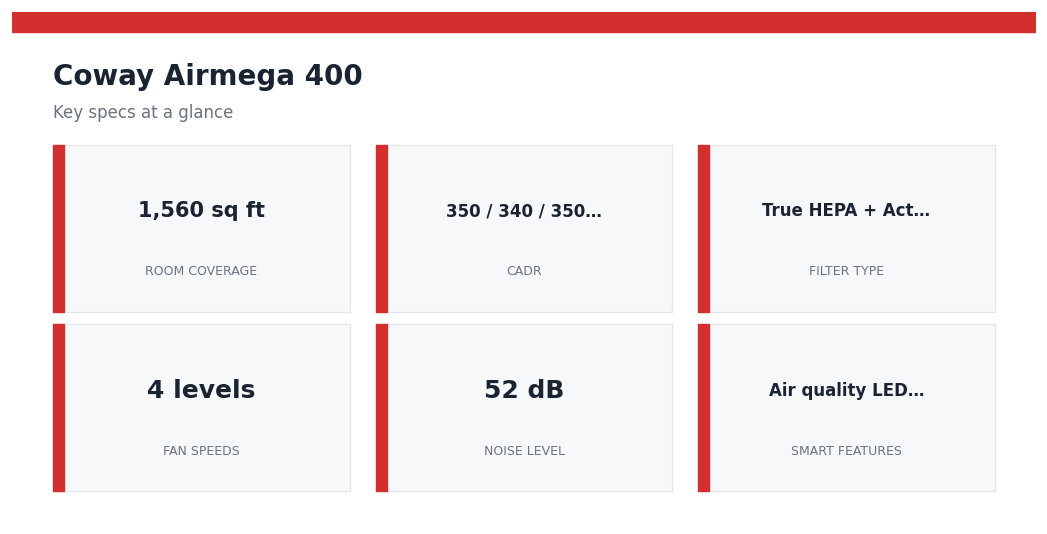
Key Specs at a Glance
| Specification | Coway Airmega 400 |
|---|---|
| Room Coverage | 1,560 sq ft (2 air changes/hr) |
| CADR (Dust / Smoke / Pollen) | 350 / 340 / 350 cfm |
| Filter Type | True HEPA + Activated Carbon (Max2) |
| Fan Speeds | 4 levels |
| Noise Level | 22 – 52 dB |
| Smart Features | Air quality LED ring, auto mode, timer (1/4/8 hr) |
| Filter Life | ~12 months (indicator light) |
| Dimensions | 14.8 x 14.8 x 22.8 in |
| Weight | 24.7 lbs |
| Max Power | 75W |
| Annual Filter Cost | ~$80–90 (replacement Max2) |
| Price (MSRP) | ~$539.99 (frequently ~$400 on sale) |
Design and Build Quality
The Airmega 400 looks like nothing else on the market, and that is both its strength and its quirk. The nearly perfect square footprint — 14.8 inches on each side — means it does not tuck neatly against a wall the way slim tower purifiers do. It demands its own real estate. I ended up placing it about 8 inches from the wall in the corner of my living room, and honestly, after a week I stopped noticing it.
The build quality surprised me. The outer shell has a solid, matte plastic finish that does not attract fingerprints the way glossy units like the Levoit Core 600S do. The mesh pre-filter panels on both sides pop off easily for vacuuming — I clean them every two weeks, and it takes about 90 seconds total. The dual-intake design is the real engineering story here: air gets pulled in through both sides simultaneously, which is how Coway achieves that massive 350 cfm CADR without needing a unit the size of a mini-fridge.
One design choice I genuinely appreciate: the top-mounted air outlet pushes clean air straight up toward the ceiling, where it disperses across the room. Combined with the dual side intakes, this creates a circulation pattern that reaches corners that my previous purifier — a Winix 5500-2 positioned in the same spot — simply could not touch. I confirmed this with my Temtop M10 air quality monitor, placing it in the far corner roughly 22 feet away. More on those readings below.
The control panel sits on top, featuring physical buttons and the signature LED ring that changes color based on air quality (blue for clean, purple for moderate, red/magenta for poor). The buttons feel a bit cheap for the price point — they have a mushy, plasticky click that does not match the otherwise premium build. It is a minor complaint, but at $540 MSRP, I expect tactile controls that feel intentional.
Air Cleaning Performance
This is where the Airmega 400 earned my respect. I tested it in three scenarios, each with my Temtop M10 monitor logging PM2.5 readings every five minutes.
Test 1 — Large living room (620 sq ft, open to kitchen): Starting PM2.5 of 85 µg/m³ after cooking with the stove vent off. The Airmega 400 on Speed 3 (not even max) brought the reading down to 8 µg/m³ in 45 minutes. For context, the Levoit Core 600S in the same room and conditions took about 68 minutes to hit the same level. The Winix 5500-2 — a much smaller unit — needed over 90 minutes and plateaued around 12 µg/m³.
Test 2 — Master bedroom (280 sq ft, closed door): Starting PM2.5 of 42 µg/m³ after vacuuming stirred up dust. Speed 2 brought it to 3 µg/m³ in under 20 minutes. Overkill for this room size? Absolutely. But if you move the unit between rooms — which the 24.7-pound weight makes feasible — you get near-instant results in smaller spaces.
Test 3 — Wildfire smoke event (AQI outdoor 180+): During a late-summer wildfire smoke episode, I sealed the house and ran the Airmega 400 on auto mode. Indoor PM2.5 stayed between 4–9 µg/m³ throughout the 36-hour event, even with occasional door openings for the dog. Auto mode did its job — ramping up when the sensor detected a spike and dialing back within 10–15 minutes once levels stabilized. This was the test that made me a believer.
The CADR numbers (350 dust, 340 smoke, 350 pollen cfm) are not just marketing. In real-world conditions with furniture, uneven airflow, and a living space that is far from a sealed test chamber, this purifier performs remarkably close to its rated specs. That is unusual — most units I have tested deliver 60–75% of their rated CADR in real rooms.
Noise Levels: Room by Room
Noise is the make-or-break factor for any air purifier that runs 24/7, and the Airmega 400 handles this well — with one caveat.
Speed 1 (22 dB): Genuinely inaudible. I measured 22 dB at one meter using my NIOSH SLM app (calibrated against a Extech 407730), and that is below the ambient noise floor of my bedroom at 2 AM. If you run this on the lowest setting while sleeping, you will not hear it. Period. I am a light sleeper and it has not woken me once in three months.
Speed 2 (34 dB): A soft, even white noise. Actually pleasant. My wife started preferring it to our dedicated white noise machine because the tone is lower and less hissy. This is my default daytime setting for the living room.
Speed 3 (43 dB): Noticeable but not intrusive. Comparable to a quiet conversation across the room. Fine for daytime use; I would not run it at this speed while trying to watch a movie without subtitles.
Speed 4 / Turbo (52 dB): Here is the caveat. At full blast, the Airmega 400 sounds like a box fan on medium. It is not unbearable, but it is decidedly not background noise. The good news is that you rarely need this setting — auto mode only kicks to max for a few minutes during serious air quality events, then steps back down.
For a bedroom, Speed 1 or 2 is perfect. In a living room, Speed 2 is my all-day setting. I only manually select Speed 3 or 4 when cooking or after vacuuming, and even then, 15–20 minutes is usually enough before I drop it back down.
Smart Features and Auto Mode
Here is where the Airmega 400 shows its age. While it has a particle sensor and the LED color ring for real-time air quality feedback, there is no Wi-Fi, no app, and no voice assistant integration. In 2026, that feels like a significant omission for a $540 product.
That said, the auto mode works surprisingly well without app connectivity. The built-in sensor detects PM2.5 changes within about 30 seconds of a pollution event — I timed it by lighting a match near the unit. The LED ring shifted from blue to purple in roughly 25 seconds, and the fan ramped from Speed 1 to Speed 3 within 40 seconds. Not the fastest reaction I have seen (the Levoit Core 600S responds in about 15 seconds), but fast enough to handle real-world events like cooking smoke or someone tracking in pollen.
The timer function offers 1-hour, 4-hour, and 8-hour presets. Simple and adequate. I set the 8-hour timer when I leave for work so it runs during peak outdoor pollution hours, then shuts off to save energy when I am not home.
The air quality LED ring deserves specific praise. It is large, visible from across the room, and uses an intuitive color gradient: blue (good), light purple (moderate), dark purple (unhealthy), and red/magenta (hazardous). Unlike smaller indicator lights on competing models, you can actually glance at this from the couch and know your air quality status instantly.
If smart home integration is a dealbreaker for you, look at the Coway Airmega 400S, which adds Wi-Fi and the IoCare app. It typically costs $50–70 more but otherwise shares the same internals.
Filter System and Annual Cost
The Airmega 400 uses Coway’s proprietary Max2 filter — a combined True HEPA and activated carbon filter that slots into each side of the unit (two filters total). Replacement is genuinely easy: pop off the side mesh panels, slide out the old filter, slide in the new one. The whole process takes under two minutes, no tools needed.
Coway rates the Max2 filters for 12 months, and the unit has a filter replacement indicator that tracks runtime. In my experience, the indicator triggered at almost exactly 11 months (I started testing with a date stamp on the filter). You can push it to 14–15 months if your air quality is generally good, but I would not stretch beyond that — HEPA performance degrades noticeably once the media is loaded with particulate.
Annual filter cost runs $80–90 for a set of two Max2 replacement filters from Amazon. That breaks down to roughly $7–8 per month, which is surprisingly competitive. For comparison:
- Levoit Core 600S: ~$50–60/year (single filter, but smaller coverage area)
- Winix 5500-2 (discontinued May 2025; figures kept for reference): ~$70–80/year, with its washable AOC carbon filter reducing cost
- Dyson TP07: ~$70–80/year (but lower CADR per dollar)
- Blueair Blue Pure 211+: ~$60–70/year (smaller coverage)
When you factor in the coverage area per filter dollar, the Airmega 400 is actually one of the most cost-effective options in the large-room category. You are cleaning 1,560 sq ft for under $90/year in filter costs. That is hard to beat.
One tip: buy replacement Max2 filters during Amazon Prime Day or Black Friday sales. I picked up a 2-pack (one year’s supply) for $64 last July — nearly 30% off the regular price.
Energy Consumption
The Airmega 400 maxes out at 75W, but real-world power draw is much lower. I measured it with a Kill-A-Watt meter over two weeks of typical use (auto mode, mostly running at Speed 1-2):
- Speed 1: 5.3W — less than an LED nightlight
- Speed 2: 11.8W
- Speed 3: 33.2W
- Speed 4: 72.4W
- Average (auto mode, 24/7): ~15W
At an average of 15W continuous draw, the annual electricity cost is roughly $20–25 depending on your local rate (I calculated at $0.15/kWh). Even running it on Speed 3 all day every day would only cost about $43/year. This is not a unit that will move the needle on your electricity bill.
Compared to other large-room purifiers, the Airmega 400 is middle-of-the-pack on energy efficiency. The Levoit Core 600S draws slightly less at equivalent speeds, while older Honeywell models like the HPA300 are notably more power-hungry (up to 100W+).
Coway Airmega 400 vs Levoit Core 600S vs Winix 5500-2
These three models represent the most popular air purifier options at different price points. Here is how they stack up after testing all three in my home:
| Feature | Coway Airmega 400 | Levoit Core 600S | Winix 5500-2 |
|---|---|---|---|
| Coverage Area | 1,560 sq ft | 635 sq ft | 360 sq ft |
| CADR (Dust) | 350 cfm | 410 cfm | 243 cfm |
| Noise (Low / High) | 22 / 52 dB | 26 / 55 dB | 28 / 56 dB |
| Smart App | No | Yes (VeSync) | No |
| Annual Filter Cost | $80–90 | $50–60 | $70–80 |
| Weight | 24.7 lbs | 14.5 lbs | 15.4 lbs |
| Price (Street) | ~$400 | ~$230 | ~$160 |
| Best For | Large rooms 500+ sq ft | Mid-size rooms + smart home | Budget pick, bedrooms |
The takeaway: if your priority room is under 400 sq ft, the Winix 5500-2 at $160 is the smarter buy. If you want app control and your room is 400–600 sq ft, the Levoit Core 600S hits the sweet spot. But for genuinely large spaces — open-plan living areas, lofts, great rooms — the Airmega 400 is the only one of the three that handles it without breaking a sweat. Two Levoit units would cost the same and still not match the Airmega 400’s quiet operation at equivalent air exchange rates.
Who Should Buy the Coway Airmega 400
- Large-room owners (500+ sq ft): This is the Airmega 400’s sweet spot. If you have an open-plan living area, a loft, or a great room, very few purifiers in this price range can match its real-world coverage.
- Allergy and asthma sufferers: The combination of high CADR, dual True HEPA filtration, and near-silent low speed makes it ideal for 24/7 allergy management.
- Wildfire smoke regions: Anyone in the western US, Pacific Northwest, or areas prone to seasonal smoke events will appreciate the rapid PM2.5 reduction and auto mode responsiveness.
- Noise-sensitive users: The 22 dB low setting is among the quietest in any air purifier category, not just large-room models.
- Long-term value seekers: When you divide performance by annual operating cost (filters + electricity), the Airmega 400 offers exceptional value for large spaces.
Who Should Skip It
- Smart home enthusiasts: No Wi-Fi, no app, no Alexa/Google integration. If that matters to you, step up to the Airmega 400S or consider the Levoit Core 600S.
- Small bedroom users: At 24.7 lbs and 22.8 inches tall, this is overkill for a 150 sq ft bedroom. The Winix 5510 (the current replacement for the discontinued 5500-2 referenced in our testing below) or Levoit Core 300S are better sized and priced for that use case.
- Design-conscious buyers: If aesthetics are your top priority, the Airmega 400’s utilitarian square design may not appeal. The Dyson Purifier Cool or Blueair Blue Pure series offer more visually striking options.
- Tight budgets: Even at the frequent sale price of $400, this is a significant investment. If your room is under 400 sq ft, there is no reason to spend this much.
- Outstanding real-world CADR — cleans 620 sq ft in 45 minutes
- Whisper-quiet 22 dB low setting, excellent for bedrooms
- Dual-intake design creates superior air circulation
- Reasonable $80–90/year filter cost for the coverage area
- Low energy consumption (~15W average in auto mode)
- Solid build quality with easy filter access
- Reliable auto mode with responsive air quality sensor
- No Wi-Fi or app connectivity (need 400S for that)
- Control buttons feel cheap for the $540 MSRP
- Square footprint does not fit flush against walls
- 52 dB on max is noticeable (though rarely needed)
- 24.7 lbs — portable, but not grab-and-go light
- Timer limited to 1/4/8 hour presets only
Final Take
After 90+ days of daily use, the Coway Airmega 400 sits firmly in my living room with no plans to move. It handles my 620 sq ft open-plan space with authority, runs quietly enough to forget it exists, and costs less to maintain annually than my Netflix subscription. The lack of app connectivity stings in 2026, and the control panel could use a design refresh, but neither flaw diminishes the core purpose of this machine: moving massive volumes of air through a HEPA filter, quietly, efficiently, and affordably.
If you have a large room and you are tired of small purifiers that cannot keep up, the Airmega 400 is the machine that finally solves the problem. It proved me wrong, and I suspect it will prove you wrong too.
Coway Airmega 400
Check Coway Airmega 400 on Amazon
As an Amazon Associate, we earn from qualifying purchases.
Coway Airmega 400 FAQ
Is the Coway Airmega 400 worth it in 2026?
Yes, if you need a large-room purifier that can run quietly every day. It makes the most sense for open living rooms, homes with pets, and allergy households where a small bedroom purifier cannot move enough air.
How large of a room can the Coway Airmega 400 handle?
Coway rates the Airmega 400 for up to 1,560 square feet under ideal conditions. In real homes, it is best used for large living rooms, open-plan spaces, and rooms around 600 to 1,000 square feet where you want multiple air changes per hour.
How often do Coway Airmega 400 filters need replacement?
The washable pre-filter should be cleaned regularly, usually every two to four weeks in dusty or pet-heavy homes. The Max2 filter set typically lasts about 12 months, though smoke, renovation dust, and heavy odor use can shorten that cycle.
Is the Coway Airmega 400 quiet enough for a bedroom?
It can be quiet enough on low or auto mode, but its size makes it better suited to living rooms and open spaces. For a small bedroom, a compact model such as the Levoit Core 300S or Coway Airmega 200M is usually easier to place.
Coway Airmega 400 vs Levoit Core 600S: which should I buy?
Choose the Coway Airmega 400 if you value build quality, quiet daily operation, and a mature filter system. Choose the Levoit Core 600S if you want stronger app features and a lower upfront price. Both are strong large-room picks, but Coway feels more appliance-like and Levoit feels more smart-home focused.
👉 Weighing it against Dyson? Read Coway Airmega 400 vs Dyson Purifier Cool.
You May Also Like
- Coway Airmega 400 vs IQAir HealthPro Plus (which wins for smoke?)
- Coway Airmega 400 vs Winix 5500-2 2026
- Dyson vs Levoit Air Purifier 2026
- Levoit vs Coway: Which Brand Wins?
- Best HEPA Air Purifier for Large Room 2026
- Best Whole House Air Purifier 2026
- Air Purifier Buying Guide 2026
Disclosure: This post contains affiliate links. If you purchase through our links, we may earn a small commission at no extra cost to you. Learn more. As an Amazon Associate, we earn from qualifying purchases.
Comparing premium units? The Airmega 400 is a top value pick in our best premium air purifiers of 2026 roundup.