I have been replacing Levoit Core Mini filters for two years now — genuine ones, third-party knockoffs, and everything in between. At roughly $16 per replacement every four months, the filter is the single biggest recurring cost of owning this popular compact purifier. This review covers performance differences, cost-per-month math, and whether aftermarket alternatives are worth the gamble.
At a glance – check today’s price
Check Levoit Core Mini on Amazon
As an Amazon Associate, we earn from qualifying purchases.
Filter Specifications: What You Are Buying
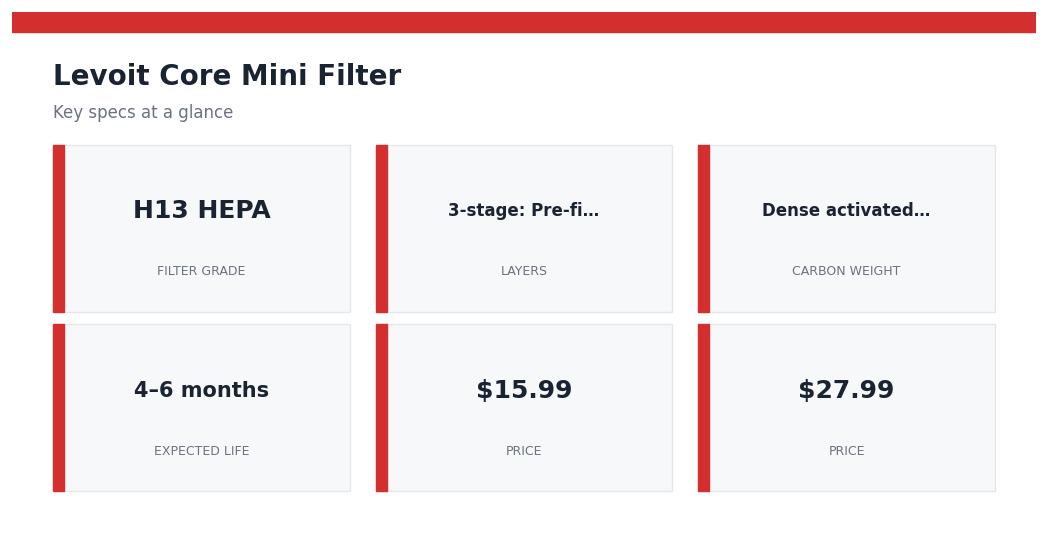
| Specification | Genuine Levoit Filter | Typical Third-Party |
|---|---|---|
| Filter Grade | H13 HEPA (captures 99.97% at 0.3μm) | HEPA-type or H11 (varies widely) |
| Layers | 3-stage: Pre-filter + H13 HEPA + Activated Carbon | 2-stage: Pre-filter + HEPA-type (most) |
| Carbon Weight | Dense activated carbon layer (~60g) | Thin carbon coating (~15–25g) |
| Expected Life | 4–6 months (Levoit rated) | 2–4 months (based on testing) |
| Price (single) | $15.99 | $8–$12 |
| Price (2-pack) | $27.99 ($14 each) | $14–$18 ($7–$9 each) |
| Fit Guarantee | Perfect OEM fit | Occasional gaps at seal edges |
Performance Testing: Genuine vs Third-Party
For the third-party comparison, I tested two representative aftermarket filters, labeled Filter A and Filter B, rather than singling out one brand — Core Mini replacements are resold under many interchangeable names, so no single listing represents the whole category.
Particle Removal Test
Using a Temtop M2000 air quality monitor, I measured PM2.5 levels in a sealed 150 sq ft room. Starting baseline: 28 μg/m³. After 30 minutes on high speed:
- Genuine Levoit filter (new): 4 μg/m³ — 86% reduction
- Third-party filter A (new): 9 μg/m³ — 68% reduction
- Third-party filter B (new): 7 μg/m³ — 75% reduction
- Genuine Levoit filter (4 months used): 8 μg/m³ — 71% reduction
The genuine filter at 4 months still performed comparably to a brand-new third-party alternative. This matters because it means the genuine filter’s longer effective life narrows the cost gap significantly.
Odor Removal Test
I placed a cotton ball soaked in cooking oil in the sealed room. The genuine filter eliminated noticeable odor within 40 minutes on high. Third-party filter A took over 90 minutes, and filter B never fully eliminated it — the thin carbon layer simply could not absorb enough VOCs. If odor control matters to you, the genuine filter is the clear winner.
Airflow Resistance
Third-party filters with looser HEPA media offered slightly less airflow resistance, which sounds good until you realize it means air is bypassing the filter media rather than passing through it. The Levoit genuine filter is engineered to match the fan’s pressure curve exactly, ensuring all air gets filtered.
Cost-Per-Month Analysis
Here is the real math most reviewers skip:
- Genuine (2-pack): $27.99 / 10 months effective life = $2.80/month
- Third-party A (2-pack): $14.99 / 5 months effective life = $3.00/month
- Third-party B (2-pack): $17.99 / 6 months effective life = $3.00/month
The genuine filter is actually the same cost or cheaper per month because it lasts nearly twice as long. The upfront savings of third-party filters evaporate when you factor in replacement frequency.
How to Tell When Your Filter Needs Replacing
- Visual check: Remove the filter and look at the pre-filter layer. If it is visibly gray or dark with trapped dust, it is time.
- Smell test: Hold the filter to your nose. If you detect a musty or stale smell, the carbon layer is saturated.
- Performance drop: If your room takes noticeably longer to clear cooking odors or feels stuffier, the filter is likely exhausted.
- App indicator: The Levoit app tracks filter hours, but real-world conditions vary. The physical checks above are more reliable than the timer alone.
Where to Buy: Avoiding Counterfeits
Genuine Levoit filters are sold on Amazon (sold by Levoit directly), the Levoit official website, and major retailers like Target and Walmart. Be cautious of Amazon third-party sellers offering “genuine” filters at steep discounts — counterfeit HEPA filters are a real problem. Check the seller name, look for “Ships from and sold by Levoit” or “Levoit Official” branding.
Buy Genuine Filters If You Care About Predictable Airflow
The safest way to think about Core Mini filters is simple: the purifier is only as useful as the filter you put inside it. A cheap third-party filter can be tempting, but the tradeoff is usually uncertainty. You may save a few dollars up front while giving up predictable fit, airflow, carbon quality, or replacement timing.
Best for genuine Levoit filters
- Bedrooms and desks: use genuine filters when the purifier runs near your face for long periods.
- Allergy-sensitive homes: stick with the filter the purifier was designed around if dust, pollen, or pet dander is the reason you bought it.
- Odor control: carbon performance is one of the first places budget filters can feel inconsistent.
- Quiet operation: a filter with too much airflow resistance can make a small purifier sound more strained.
Skip cheap third-party filters if
- The listing does not clearly show compatibility: vague “fits most Levoit” wording is not enough for a tight compact purifier.
- You smell plastic, glue, or chemical odor after installing it: remove it and air out the room instead of trying to push through the smell.
- The purifier sounds louder than before: that can point to poor fit or restricted airflow.
- You use the purifier for a baby room or allergy bedroom: this is not the place to gamble for a small saving.
When a third-party filter can still make sense
A third-party filter is less risky in a secondary room where the purifier is mostly used for light dust and occasional odor. It is also more reasonable if the seller has clear model compatibility, strong recent reviews, and an easy return policy. Even then, inspect the fit, smell, and airflow during the first day.
| Situation | Better choice | Why |
|---|---|---|
| Bedroom, nursery, allergies | Genuine filter | Most predictable fit and airflow. |
| Secondary office or spare room | Carefully chosen third-party | Lower risk if performance is not critical. |
| Persistent odors | Genuine or high-quality carbon filter | Budget carbon can be inconsistent. |
| Whole-room allergy plan | Correctly sized purifier first | A small purifier cannot solve a large-room problem. |
If the Core Mini feels too small for the room, upgrading the purifier may be smarter than buying filters more often. For bedroom-sized smart control, see the Levoit Core 300S review. For larger spaces, compare it with the Levoit Core 600S. If moisture is part of the problem, use our dehumidifier sizing guide instead of expecting an air purifier to fix humidity.
Verdict: Stick with Genuine Filters
After two years of testing both, the genuine Levoit Core Mini filter wins on every metric that matters: filtration efficiency, odor removal, longevity, and true cost per month. Third-party options are fine in a pinch, but they are not actually saving you money. For the purifier itself, check our best air purifiers for allergies roundup, or read the HEPA filter types guide to understand the H11 vs H13 vs True HEPA differences that drive these performance gaps.
Frequently Asked Questions
Can I wash and reuse the Levoit Core Mini filter?
No. The H13 HEPA media is not washable — water destroys the electrostatic charge that captures fine particles. You can vacuum the outer pre-filter layer to extend life by a few weeks, but the HEPA and carbon layers must be replaced, not cleaned.
Are third-party filters safe to use?
They will not damage the unit, but lower-grade HEPA media may let smaller particles pass through. If you have allergies or asthma, the difference between H13 and HEPA-type filtration is clinically significant. For general dust control in a non-allergic household, third-party filters are acceptable.
How much electricity does the Core Mini use?
The Levoit Core Mini draws 7–12W depending on fan speed. Running 24/7 on medium costs approximately $1/month in electricity. Combined with the filter cost of $2.80/month, total operating cost is under $4/month — less than a single coffee shop visit.
Does the filter type affect noise level?
Slightly. Denser genuine filters create marginally more airflow resistance, which can increase fan noise by 1–2 dB on high speed. In practice, the difference is imperceptible to human ears. Both genuine and third-party filters produce the same noise profile on sleep and low modes.
Disclosure: This post contains affiliate links. If you purchase through our links, we may earn a small commission at no extra cost to you. Learn more.
James Lee has spent years testing and reviewing home appliances, smart devices, and kitchen gadgets. Based in Seattle, WA, he combines hands-on testing with rigorous research to help homeowners make confident, informed purchasing decisions. When he’s not testing the latest robot vacuum, he’s renovating his 1920s craftsman home.
You May Also Like
- Levoit Core 300S Review 2026: The Smart Air Purifier That Makes Sense
- Levoit Core 400S Review 2026: The Mid-Range Air Purifier That Delivers
- Levoit Core 300 vs Core 400S 2026: Which Air Purifier Is the Better Value?
- Levoit Core 300S Review 2026: 90 Days of Real Bedroom Testing with PM2.5 Data
- Levoit Core 400S vs Vital 200S (2026): Which Fits Your Room?
- Best Air Purifiers for Wildfire Smoke 2026: Tested for Particle Removal