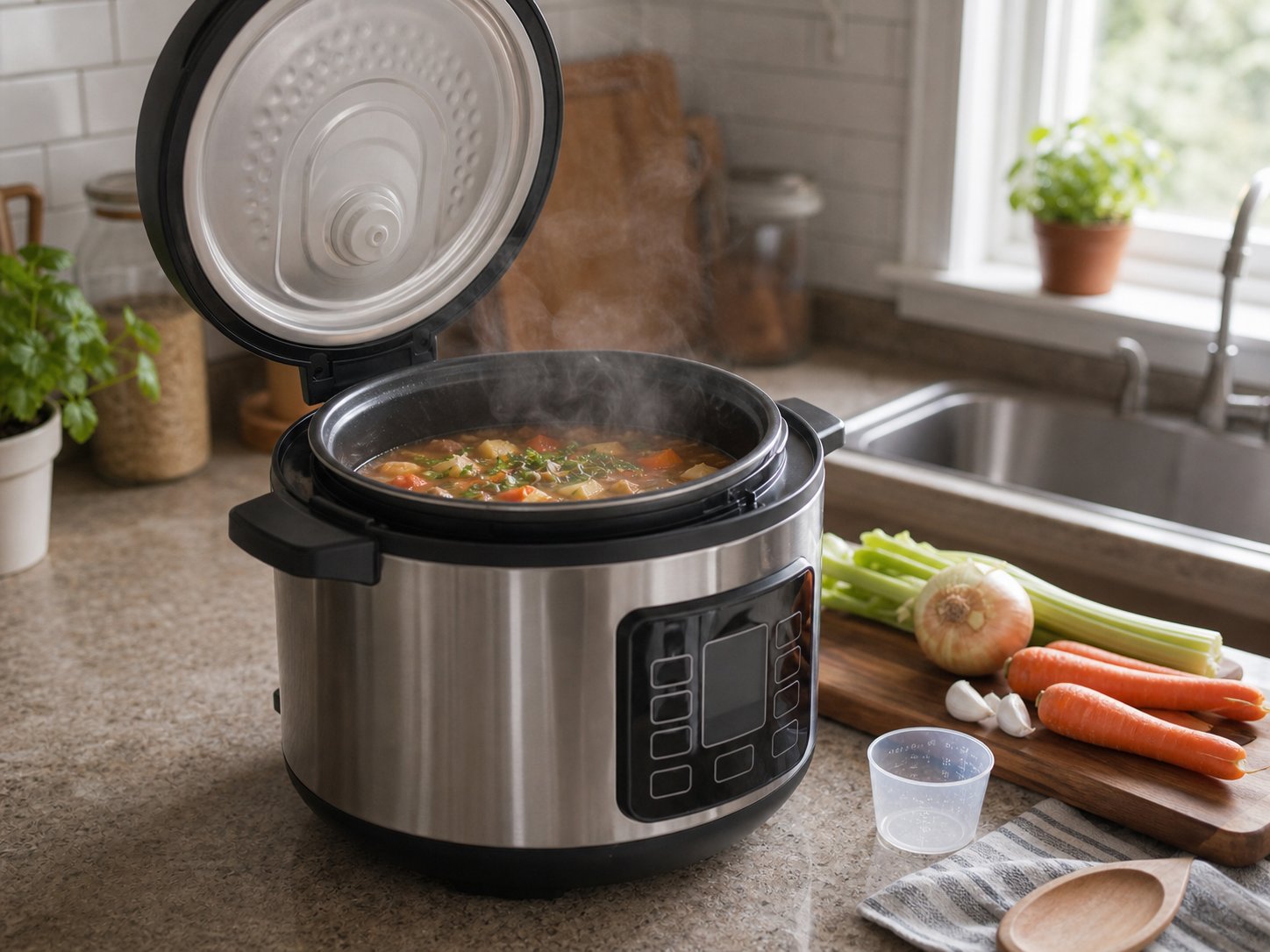
Six months ago, my slow cooker died mid-chili. Instead of replacing it with another single-purpose appliance, I
grabbed the Instant Pot Duo Plus off Amazon during a lightning deal for $72. That was 180-something dinners ago. The Duo Plus has since cooked everything from weeknight chicken breasts (done in 12 minutes flat) to Sunday beef short ribs that fall apart with a fork. It has also made yogurt at 2 AM, steamed tamales for a party of twelve, and once served as an emergency bottle sterilizer when my sister visited with her newborn.
I am not going to pretend every one of its nine functions is a home run. Some are genuinely life-changing; others collect dust. After half a year of near-daily use, here is exactly what works, what disappoints, and whether the Duo Plus is worth choosing over the cheaper Duo or the pricier Pro.
At a glance – check today’s price
Check Instant Pot Duo Plus on Amazon
As an Amazon Associate, we earn from qualifying purchases.
Pressure Cooking: The Main Event
This is why most people buy an Instant Pot, and the Duo Plus absolutely delivers. Pressure cooking is where this appliance earns its keep, and six months of data backs that up.
Here is what I have actually timed, start to finish, including the pressurization phase that most reviewers conveniently ignore:
| Dish | Cook Time | Total Time (incl. pressurize + release) | Stovetop Equivalent |
|---|---|---|---|
| Chicken breast (2 lbs, frozen) | 12 min | ~28 min | 45+ min (thaw + cook) |
| Beef chili (3 lbs ground beef) | 25 min | ~45 min | 2-3 hours |
| Korean short ribs (galbi-jjim) | 35 min | ~55 min | 2.5 hours |
| White rice (3 cups) | 4 min | ~18 min | 20-25 min |
| Whole chicken (4.5 lbs) | 25 min | ~50 min | 90 min (oven) |
| Hard-boiled eggs (12) | 5 min | ~20 min | 15 min |
| Bone broth (beef bones) | 120 min | ~150 min | 12-24 hours |
| Dried black beans (no soak) | 30 min | ~50 min | 3+ hours (with overnight soak) |
The biggest time savings come with dishes that traditionally require hours of low-and-slow cooking. Bone broth in 2.5 hours instead of an entire day is genuinely transformative for home cooking. And cooking frozen chicken directly without thawing has saved me countless times when I forgot to defrost dinner.
The dual pressure settings (high and low) matter more than you might think. High pressure works for most things, but low pressure is the move for eggs, delicate fish, and vegetables where you want them cooked through but not turned into mush. The Duo (non-Plus) also has dual pressure, but some budget competitors only offer high, which limits your range.
One thing pressure cooking cannot do well: anything crispy. You will not get a sear or a crust. I use the sauté function to brown meat before pressure cooking, which partially solves this, but the results are never quite as good as a proper cast iron skillet. This is a universal pressure cooker limitation, not a Duo Plus problem.
The Other 8 Functions: Which Ones Actually Matter
The Duo Plus markets itself as 9-in-1, but not all nine functions are created equal. After six months, here is my honest tier list:
Tier 1 — Use weekly, genuinely replaces a separate appliance:
Sauté: Essential. Being able to brown onions, sear meat, and deglaze the pot before switching to pressure mode means one-pot meals are truly one pot. The heating element gets hot enough for a decent sear (not screaming hot like cast iron, but good enough). I use this function almost every time I pressure cook.
Rice Cooker: Surprisingly excellent. Three cups of jasmine rice with a 1:1 water ratio comes out perfectly fluffy every time. The 4-minute cook time is faster than my old dedicated rice cooker, though the total time (including pressurization) is about the same at 18 minutes. If you already own a great rice cooker, this will not convince you to switch. If you do not, it is one less appliance on the counter.
Steamer: Works great with the included stainless steel rack. Vegetables, fish, dumplings, tamales — all come out properly steamed. The sealed environment actually produces better results than a stovetop steamer basket because the steam cannot escape.
Tier 2 — Use monthly, nice to have:
Slow Cooker: It works, but with a caveat. The Instant Pot slow cooker mode runs slightly hotter than a dedicated slow cooker like a Crock-Pot. My grandmother’s pot roast recipe that calls for 8 hours on low was done in about 6.5 hours. You will need to adjust recipes downward by roughly 20%. For someone who already owns a slow cooker, this is not a strong enough reason to switch. For someone who does not, it is adequate.
Yogurt Maker: I was shocked by how well this works. Homemade yogurt costs about $0.80 per quart compared to $4-6 at the grocery store. The process takes 8-12 hours but is almost entirely hands-off. Heat the milk, add starter, press Yogurt, and walk away. I make a batch every two weeks now. The Duo Plus yogurt mode maintains a more consistent temperature than the basic Duo, which is one of the genuine upgrades.
Warmer: Keeps food at serving temperature after cooking. Not exciting, but genuinely useful when dinner finishes before everyone is home. It holds temperature for up to 10 hours without overcooking.
Tier 3 — Rarely use, checkbox features:
Sterilizer: I used this exactly once when my sister needed to sterilize baby bottles. It works fine — high-temperature steam kills bacteria effectively — but how often does the average person need to sterilize things? If you have an infant, this is a nice bonus. Otherwise, it will sit unused.
Sous Vide: This is the weakest function on the Duo Plus. True sous vide requires precise temperature control within 0.5 degrees, and the Instant Pot can only hold temperature within about 2-3 degrees. For basic tasks like cooking a steak to medium-rare, it kind of works. For anything requiring real precision, you need a dedicated immersion circulator like an Anova. I tried it four times and went back to my standalone sous vide stick every time. This function feels like it was added to inflate the “9-in-1” number.
Instant Pot Duo Plus vs Other Instant Pot Models
If you are choosing inside the Instant Pot lineup, the Duo Plus sits in the practical middle: more convenient than the basic Duo, but less expensive and less customizable than the Pro.

| Feature | Duo Plus | Duo | Pro |
|---|---|---|---|
| Best fit | Most home cooks | Budget first-timers | Tinkerers and heavy users |
| Main appeal | Better display and auto-seal lid | Lower price | More control and premium features |
| Learning curve | Moderate | Simple | Highest |
| Who should skip it? | People who only pressure-cook basics | People who want the nicer screen | People who want the lowest price |
Who Should Buy the Instant Pot Duo Plus?
Buy it if you want…
- A pressure cooker that is easier to use than the original Duo.
- A 6-quart cooker for family meals, batch cooking, soups, rice, beans, and weeknight proteins.
- The auto-sealing lid and progress display, which reduce the two most common beginner mistakes.
- A machine that can slow cook, saute, steam, make yogurt, and keep food warm without adding more appliances to the cabinet.
Skip it if you…
- Only need basic pressure cooking. The standard Duo usually covers that for less.
- Want precise sous vide performance. A dedicated immersion circulator is still better.
- Cook for one person and have limited storage space. The 6-quart and 8-quart versions are not tiny.
- Prefer a true air-fryer lid or crispy results. This model is a pressure cooker first, not an air fryer.
Maintenance and Running Costs
The Duo Plus is not expensive to maintain, but it does have a few wear items. The sealing ring is the one most owners should watch. If it smells, stretches, cracks, or stops sealing consistently, replace it. Many people also keep one ring for savory meals and a separate ring for oatmeal, yogurt, or desserts.
After each use, wash the stainless inner pot, rinse the lid area, and check that the steam valve and float valve are clear. The cooker base should only be wiped with a damp cloth. Do not submerge it, because the heating element and controls are inside the base.
Electricity cost is usually modest because pressure cooking shortens many recipes compared with oven or stovetop cooking. Actual cost depends on your local electric rate and recipe length, but the bigger practical cost is replacement accessories: sealing rings, an extra inner pot, or a glass lid if you often use slow-cook mode.
Instant Pot Duo Plus FAQ
What size Instant Pot Duo Plus should most people buy?
The 6-quart size is the safest default for most households because many Instant Pot recipes are written around that capacity. The 3-quart version is better for singles, couples, and small kitchens. The 8-quart version makes sense if you batch cook or regularly feed a larger family.
Is the Duo Plus worth it over the basic Duo?
It is worth it if you care about the auto-sealing lid, clearer display, and extra convenience modes. If you only want to pressure-cook beans, rice, soup, and simple proteins, the basic Duo can be the better value.
Can the Instant Pot Duo Plus replace a slow cooker?
For many households, yes. It can slow cook and keep food warm, and it also adds pressure cooking for faster meals. If you make very large slow-cooker recipes every week, check the pot size carefully before replacing a dedicated slow cooker.
Is the Duo Plus good for sous vide?
It is acceptable for casual experiments, but it is not the best choice for precise sous vide cooking. If sous vide is a major reason you are buying, a dedicated immersion circulator is the better tool.
How often should the sealing ring be replaced?
Replace it when it smells strongly, looks damaged, becomes loose, or no longer seals reliably. For frequent users, keeping a spare ring on hand is a small but useful upgrade.
Disclosure: This post contains affiliate links. If you purchase through our links, we may earn a small commission at no extra cost to you. Learn more.
You May Also Like
- Instant Pot vs Ninja Foodi 2026: Which Multi-Cooker Should You Buy?
- Ninja HyperHeat Pressure Cooker (2026): Is the 2X-Faster Multicooker an Instant Pot Killer?
- Best Instant Pot 2026: Top Multi-Cookers for Every Kitchen
- Slow Cooker vs Instant Pot: Which Should You Buy?
- Best Bread Maker 2026: Zojirushi vs Cuisinart (Tested)