Two months ago, my 11-year-old asked if we could “make ice cream at home.” I assumed she meant the bag-of-ice-and-salt science experiment from her school. She meant a Ninja Creami. Specifically the Deluxe model, because—and I am quoting directly—”it does eleven things, Dad.” She was right about the number. The Ninja Creami Deluxe has 11 preset programs: ice cream, lite ice cream, sorbet, gelato, milkshake, smoothie bowl, lite smoothie bowl, frozen yogurt, Italian ice, frozen drink, and something Ninja calls “Creamify” that re-processes any of the above for a softer texture. At $229.99, it is $30 more than the standard Creami. We tested every single program over three weeks. Some results were excellent. Some were baffling. Here is the complete breakdown.
At a glance – check today’s price
Check Ninja CREAMi Deluxe on Amazon
As an Amazon Associate, we earn from qualifying purchases.
⭐ Rating: 8.3/10 | 💰 Best for: Families who want variety and are willing to plan ahead | ⚠️ Weakest at: Requires 24-hour freeze and some trial-and-error
2026 update: How does the Deluxe stack up against the new 2026 Swirl? See our three-way CREAMi comparison.
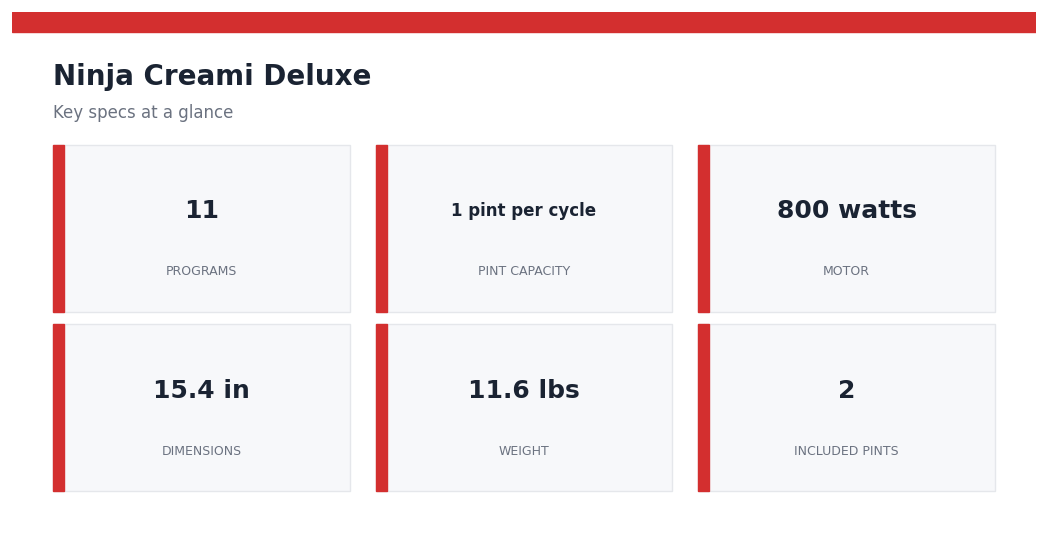
Key Specs at a Glance
| Specification | Ninja Creami Deluxe |
|---|---|
| Programs | 11 (Ice Cream, Lite Ice Cream, Sorbet, Gelato, Milkshake, Smoothie Bowl, Lite Smoothie Bowl, Frozen Yogurt, Italian Ice, Frozen Drink, Creamify) |
| Pint Capacity | 1 pint per cycle (24 oz max) |
| Motor | 800 watts |
| Dimensions | 6.5 x 12.1 x 15.4 in |
| Weight | 11.6 lbs |
| Included Pints | 2 (with lids) |
| Dishwasher Safe Parts | Pints, lids, outer bowl (top rack) |
| Pre-Freeze Requirement | 24 hours minimum |
| Price (MSRP) | $229.99 |
How the Ninja Creami Actually Works
If you are not familiar with the Creami concept, it is different from a traditional ice cream maker. Traditional machines churn liquid while cooling it. The Creami does the opposite: you freeze a solid block of your base mixture first (24 hours in a standard freezer), then the machine uses a powerful blade to shave and process that frozen block into a creamy texture. Ninja calls this process “Creamify Technology.”
The 800-watt motor spins a blade that descends into the frozen pint container, shaving microscopically thin layers off the top and processing them against the walls. Each program adjusts blade speed, pressure, and the number of passes. The ice cream program, for example, makes more aggressive passes than the sorbet program, which preserves a slightly icier texture.
This approach has a major advantage: because the base is already frozen solid, there is no churning time. A pint of ice cream goes from frozen block to scoopable in about 2–3 minutes. The trade-off is that 24-hour pre-freeze. You cannot decide at 3 PM that you want ice cream at 4 PM. You need to have planned yesterday.
We Tested All 11 Programs: Here Is How Each Performed
I ran at least two batches on each program using standard recipes (some from Ninja’s included recipe book, some from popular community recipes). Here is a program-by-program breakdown.
1. Ice Cream (A)
Base: heavy cream, whole milk, sugar, vanilla extract. Result: Rich, dense, and remarkably smooth. Comparable to premium store-bought ice cream. The texture was scoopable immediately after processing and held up in the freezer for 5 days before developing ice crystals. This is the program you will use most, and it delivers.
2. Lite Ice Cream (B+)
Base: 2% milk, a little cream, sugar substitute, vanilla. Result: Lighter and slightly icier than full ice cream, but still good. Calorie counters will appreciate this—my batch came out to roughly 130 calories per serving versus 280 for the full ice cream. The texture is closer to soft-serve than hard ice cream.
3. Gelato (A)
Base: whole milk (more milk than cream), sugar, egg yolks. Result: This was the surprise star. The gelato program processes at a different speed that produces a denser, silkier texture with less air incorporation. The result was genuinely close to what you get at a gelato shop—dense, flavorful, and slightly elastic when scooped. My daughter declared it “better than Costco gelato,” which in our household is high praise.
4. Sorbet (A-)
Base: mango puree, sugar, lime juice, water. Result: Clean, bright flavor with a texture between granita and smooth sorbet. Running the Creamify program afterward brought it to a perfectly smooth consistency. Mango and strawberry-basil were our two best flavors.
5. Frozen Yogurt (B+)
Base: full-fat Greek yogurt, honey, vanilla. Result: Tangy and creamy. The texture is slightly softer than ice cream and has a pleasant tartness. It melts faster than ice cream after scooping, so eat it promptly.
6. Milkshake (B)
Base: frozen ice cream pint + milk added through the lid hole during processing. Result: Thick and drinkable, but not as good as making ice cream and blending it separately in a regular blender. The Creami cannot add mix-ins uniformly during the milkshake program, so chunks of cookie or candy do not distribute evenly.
7. Smoothie Bowl (B+)
Base: frozen acai blend, banana, blueberries. Result: Thick, spoonable, and solid for a quick breakfast. The texture is chunky-smooth—more textured than store-bought smoothie bowls, which some people prefer.
8. Lite Smoothie Bowl (B)
Base: frozen spinach-banana-almond milk blend. Result: Similar to the smoothie bowl but thinner. Honestly, the difference between this and the regular smoothie bowl program was subtle. I am not sure the separate program is necessary.
9. Italian Ice (A-)
Base: lemon juice, sugar, water. Result: Exactly what you would expect—icy, sweet, and refreshing. The Creami produced a fine, consistent ice crystal structure. Better than any store-bought Italian ice I have had.
10. Frozen Drink (C+)
Base: frozen margarita mix. Result: The weakest program. It produces a slushy consistency that melts quickly. A regular blender with ice does this job better and does not require 24 hours of freezing. I used this program twice and have not gone back.
11. Creamify (A)
This is not a standalone program but a re-processing step. After any other program finishes, you can run Creamify to add another pass, which makes the result smoother and incorporates slightly more air. For ice cream and gelato, one Creamify pass was the difference between “good” and “great.” For sorbet, it transformed a slightly granular result into restaurant-quality smooth.
The 24-Hour Freeze: Practical Implications
This is the single biggest factor in whether you will love or abandon the Creami. The base must be frozen solid—24 hours minimum. In practice, I found 22 hours was sometimes sufficient if my freezer was set to 0°F (-18°C), but under-frozen bases produce chunky, uneven results. Overfreezing (36+ hours) is fine; the machine handles rock-solid bases without issue.
My solution: batch prep. Every Sunday, I prepared 4–5 pint bases with different flavors, sealed them, and put them in the freezer. By Monday evening, they were all ready. We went through 2–3 pints per week as a family of four, which meant I always had frozen pints ready to process. Ninja includes 2 pint containers; I bought a 4-pack of extras for $20, which I would call essential if you plan to use this machine regularly.
Build Quality and Noise
The Creami Deluxe is a solid, compact machine. It takes up about as much counter space as a large coffee maker. The locking lid mechanism is secure—you twist the outer bowl into place and the lid locks down before the motor will engage. It feels safe and well-engineered.
Noise is significant. During processing, the blade generates about 80–85 dB measured at 2 feet. That is louder than a blender but lasts only 2–3 minutes per pint. It is not the kind of appliance you run while someone is sleeping in the next room, but it is brief enough that it never bothered us.
Cleanup
The pints, lids, and outer bowl are top-rack dishwasher safe. The blade assembly wipes clean with a damp cloth. Cleanup takes about 2 minutes total. After three weeks and roughly 20 batches, I have no complaints about the cleaning process. The pint design is simple—no crevices or seals that trap residue.
Cost Per Serving vs. Store-Bought
I tracked ingredient costs for our most-made recipes:
| Treat | Creami Cost/Pint | Store Equivalent/Pint | Savings |
|---|---|---|---|
| Vanilla ice cream | $2.10 | $5.99 (H-D) | $3.89 |
| Mango sorbet | $1.85 | $4.99 (Talenti) | $3.14 |
| Protein ice cream | $2.80 | $6.49 (Halo Top) | $3.69 |
| Gelato | $2.40 | $5.49 (Talenti) | $3.09 |
At roughly $3.50 savings per pint, the $229.99 machine pays for itself after about 66 pints. At our family’s rate of 2–3 pints per week, that is 22–33 weeks—roughly 5 to 8 months. After that, every pint is pure savings (and better ingredients, since you control exactly what goes in).
- Ice cream and gelato programs produce genuinely excellent results
- 11 presets offer real variety (Italian ice and sorbet were standouts)
- Creamify re-processing step is a game-changer for texture
- Pint-at-a-time format reduces waste
- Easy cleanup—dishwasher-safe parts, 2-minute process
- Controls ingredient quality (no stabilizers, gums, or additives)
- 24-hour pre-freeze is inflexible and requires planning
- Learning curve of 3–4 batches to get ratios right
- Loud during processing (80–85 dB for 2–3 minutes)
- Frozen drink program is underwhelming
- Only 2 pint containers included (need extras for regular use)
- Cannot add solid mix-ins during processing (must fold in after)
Ninja Creami Deluxe
11-Program Frozen Treat Maker | Creamify Technology | 800W
As an Amazon Associate, we earn from qualifying purchases.
Who Should Buy the Ninja Creami Deluxe
- Families with kids. Making ice cream together became a weekly activity in our house. Kids love choosing flavors, and the short processing time (2–3 minutes) keeps their attention. The 24-hour freeze teaches a little delayed gratification too.
- Health-conscious dessert lovers. The lite ice cream and protein ice cream recipes let you control calories, sugar, and ingredients precisely. No guar gum, no artificial stabilizers, just what you put in.
- Anyone who eats 2+ pints of ice cream per week. The math works: at that rate, the machine pays for itself in under 6 months, and you get better ice cream than most grocery store brands.
Who Should Skip It
- Spontaneous snackers. If you want frozen treats on impulse, the 24-hour freeze requirement will frustrate you. A traditional churn-style ice cream maker (like the Cuisinart ICE-21) can produce ice cream in about 25 minutes without pre-freezing a base—though it requires a pre-frozen bowl.
- People who rarely eat frozen desserts. If you buy one pint of ice cream a month, the Creami will sit unused. The savings math does not work at low volume, and counter space is valuable.
- Anyone who wants large batches. The Creami processes one pint at a time. For parties or large gatherings, a traditional 2-quart ice cream maker is more practical.
Frequently Asked Questions
What are the biggest Ninja Creami Deluxe pros and cons?
The biggest pros are texture control, low-sugar recipe flexibility, and the ability to turn frozen bases into ice cream, sorbet, gelato, and smoothie bowls. The biggest cons are the 24-hour freeze time, noise during processing, extra pint storage, and the fact that bad base recipes still taste bad after spinning.
Is the Ninja Creami Deluxe worth it if I already own a blender?
Yes, if you want scoopable frozen desserts rather than smoothies. A blender can crush frozen fruit, but the Creami shaves and re-spins a frozen base into a different texture. Skip it if you only make shakes or smoothie bowls occasionally.
Do you really have to freeze the pint for 24 hours?
For best texture, yes. Shorter freezes can leave the center soft and produce uneven results. The machine works best when you treat it like meal prep: make two or three pints ahead, freeze overnight, then spin only what you want to eat.
Is the Ninja Creami Deluxe loud?
Yes. It is not a quiet appliance. The noise is short-lived, but it is closer to a high-powered blender than a normal countertop mixer. If you cook late at night in an apartment, that matters.
Can the Ninja Creami make healthy ice cream?
It can make lower-sugar, higher-protein, dairy-free, or fruit-heavy frozen desserts, but the result still depends on the recipe. The machine improves texture; it does not automatically make every base healthy or delicious.
Three Weeks Later: Would I Buy It Again?
Yes, and I would buy the Deluxe over the standard model. The Italian ice and frozen yogurt programs (exclusive to the Deluxe) became regular favorites, especially the Italian ice in summer heat. The gelato program alone justified the purchase for me—getting near-shop-quality gelato at home for $2.40 a pint was something I did not expect from a countertop appliance. The frozen drink program is the only genuine miss, and even that is not terrible—just unnecessary.
The 24-hour freeze is the filter that separates Creami converts from Creami returns. If you can build the habit of prepping bases on the weekend, the machine rewards you with genuinely excellent frozen treats at a fraction of store prices. If planning ahead sounds like work, this is not the appliance for you.
Methodology: We test kitchen appliances over multiple weeks of real household use, tracking performance consistency, cleanup effort, and cost per serving. Read our full How We Test page for details. For help choosing between kitchen gadgets, see our Kitchen Appliance Buyer’s Guide.
You May Also Like
As an Amazon Associate, we earn from qualifying purchases.
Disclosure: This post contains affiliate links. If you purchase through our links, we may earn a small commission at no extra cost to you. Learn more.