As an Amazon Associate, TheHomePicker earns from qualifying purchases. This page contains affiliate links, which means we may earn a commission if you buy through them, at no extra cost to you.
What the Spot+Scrub Ai actually is
Dyson has built robot vacuums before – the 360 Eye and the 360 Vis Nav – but both only vacuumed. The Spot+Scrub Ai, announced March 12, 2026, is the company’s first machine that vacuums and wet-cleans in one pass, which drops it straight into the most competitive corner of the robot market: the wet-dry combo category that Roborock, Dreame, and Narwal have been iterating on for years. If you want the broader landscape first, our Roborock vs Dreame vs Ecovacs comparison maps it.
Dyson’s list price is $1,199. At the time of writing, the Amazon listing sits at $849.98 – a significant gap worth knowing about before you buy direct. Prices move; check the current one.
Specifications (from Dyson’s published spec sheet)
| Spec | Dyson Spot+Scrub Ai |
|---|---|
| Suction | 18 kPa (18,000 Pa) motor |
| Navigation | Embedded DToF LiDAR + AI camera vision |
| Stain detection | Vision-based AI + high-contrast green LED beam; dual laser |
| Object avoidance | Recognizes roughly 200 everyday object types |
| Mop system | Full-width 10.6″ self-cleaning microfiber roller; extends to edges; lifts 0.4″ on carpet |
| Water tanks | 0.6 gal clean / 0.55 gal dirty |
| Mop hygiene | Washed at 140°F, dried at 113°F in dock |
| Detergent | Auto-dosed, 0.3 oz Dyson probiotic solution per water fill |
| Dock | Bagless cyclonic self-empty; holds up to 100 days of debris (Dyson internal test) |
| Filtration | Captures particles to 0.1 micron (tested to EN 1822-1:2019) |
| Charge time | 3 hours full charge |
| Runtime | Not published by Dyson |
| Robot size / weight | 14.69″ W × 14.57″ D × 4.33″ H; 14.5 lb |
| Dock size / weight | 17.32″ W × 20″ D × 17.91″ H; 19.8 lb |
| Price | $1,199 list (Dyson); $849.98 on Amazon at time of writing |
Everything above comes from Dyson’s launch announcement and the current Amazon listing – we have not yet put this machine through our own testing, and we would rather say so plainly than pretend otherwise.
The three ideas that separate it from the pack
1. The mop never re-uses dirty water
This is the engineering headline. On most wet-dry robots, one tank of water washes the pad at the dock between runs, and during the run the same pad gets progressively dirtier. Dyson’s roller is rinsed continuously: dirty water is extracted and clean water applied on every rotation, so only clean water ever touches the floor. If you have ever smelled a robot mop pad two weeks in, you understand why this matters. It is the same argument that made dedicated wet-dry floor washers popular – see our wet-dry vacuum mop guide – now packaged into an autonomous robot.
2. It hunts stains instead of driving a grid
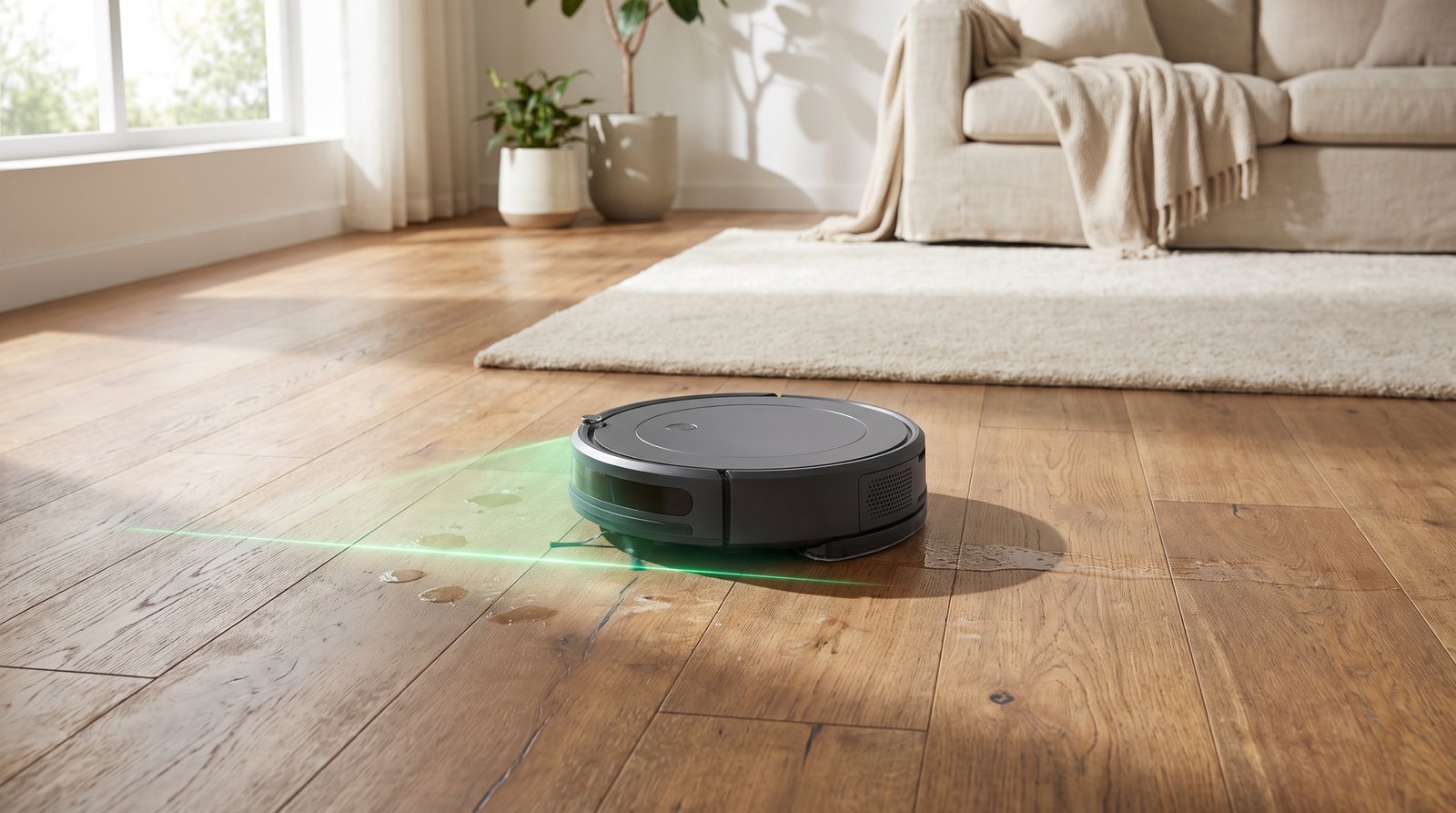
The green LED beam is borrowed thinking from Dyson’s laser-equipped stick vacuums, such as the V16 Piston Animal: light the floor at an angle and the invisible becomes visible. Here the beam feeds an AI vision system that identifies a stain, scrubs it, re-inspects, and goes again if residue remains. Dyson claims recognition of about 200 object types for avoidance as well. First-generation AI claims deserve skepticism until third parties test them – but the re-inspect-and-repeat loop is a genuinely different behavior from the mop-everything-once pattern of most rivals.
3. A bagless dock, because of course it is
Dyson refused to put a bag in the dock. Ten root cyclones spin dust into a bin the company says holds up to 100 days of debris. The practical consequence is cost of ownership: robots with bagged docks quietly cost $20 to $40 a year in bags forever. This one costs you thirty seconds at the trash can instead. The recurring consumable is Dyson’s cleaning solution, auto-dosed at 0.3 oz per fresh-water fill, plus eventual filters.
What Dyson is not saying
Two omissions stand out on the spec sheet. First, runtime: there is no minutes-per-charge figure anywhere in Dyson’s materials, only the 3-hour charge time. For large homes that is the single most important unknown. Second, 18 kPa of suction reads modest next to the 20,000+ Pa numbers Roborock and Dreame advertise – though cross-brand suction claims are not measured identically, so we would not disqualify it on that number alone. Our position: on paper this is the most original robot of the year; the burden of proof for reliability sits with Dyson, because it is a first-generation product in a category where Roborock and Dreame are on their fifth or sixth iteration.
Who should buy it – and who should wait
Buy it if: your floors are mostly hard surface, you are bothered by the dirty-pad problem that plagues conventional mop robots, you want out of the dust-bag subscription, and the roughly $850 street price fits. The hygiene-first design – clean water every rotation, 140°F pad washing, hands-off detergent dosing – is aimed squarely at people who actually care whether the mop is clean.
Wait if: your home is large and runtime matters (unpublished), you are carpet-dominant (the wet roller lifts 0.4″, but this machine’s reason to exist is washing hard floors), or you prefer a proven platform – in which case the mature flagships in our three-way comparison are the safer money. And if you are curious where robots are heading next, our look at robots with arms and legs shows what the category is racing toward.
Before it arrives: placement and upkeep, by the numbers
Three practical notes hiding in the spec sheet. The dock is genuinely large – 17.32″ wide and 20″ deep, nearly 20 lb – and it plumbs nothing, so you will refill the 0.6-gallon clean tank and empty the 0.55-gallon dirty tank by hand; plan a spot near an outlet with clearance rather than a shallow alcove. Budget the consumables honestly: no dust bags ever, but the auto-doser draws 0.3 oz of Dyson’s solution per fresh fill, so a bottle is a recurring line item the way detergent is for a washing machine. And the MyDyson app tracks filter and roller maintenance for you – the same app handles mapping, room labels, zones, and schedules, so the setup hour is mostly walking the robot through its first LiDAR map.
Proven alternative: Not ready to pay $1,199 for a first-generation Dyson robot?
The current model we would point most buyers to instead is the eufy X10 Pro Omni ($479.99 on Amazon when we checked – confirm the live price on the listing). It is the wet-dry robot we have pointed the most readers to this year: dual mops with auto-lift, a self-washing dock, and a price that is less than half of the Spot+Scrub Ai.
Frequently asked questions
Is the Dyson Spot+Scrub Ai worth it at $849?
If you want one machine that vacuums and genuinely washes hard floors, it makes a strong case at Amazon’s current price, which sits well below Dyson’s own $1,199 list price. The self-cleaning roller and bagless dock also remove two recurring costs most rivals carry: replacement mop pads and dust bags.
Does the Dyson Spot+Scrub Ai mop with clean water?
Yes, and this is its defining feature. Dirty water is extracted and fresh water is applied on every rotation of the microfiber roller, so the pad never spreads yesterday’s mess. Most competing mop-robots re-dip a pad into progressively dirtier water between dock washes.
How strong is 18 kPa of suction compared to other robot vacuums?
On paper it trails headline numbers from Roborock and Dreame flagships, which now advertise 18,000 to 22,000 Pa. In practice suction specs between brands are not measured identically, so treat the number as one input rather than a verdict. What is verifiable: the filtration is tested to capture particles down to 0.1 microns per EN 1822-1.
Does the dock use bags?
No. The dock empties the robot with Dyson’s root cyclones into a bagless bin that Dyson says holds up to 100 days of debris. No bags means no recurring bag cost, but you empty the bin yourself into the trash.
How long does the battery last?
Dyson has not published a runtime figure for the Spot+Scrub Ai, which is unusual for this category. The spec sheet lists a 3-hour full charge but no minutes-per-clean claim. Until independent testing fills that gap, buyers with very large homes should treat runtime as an open question.
What does the green light on the robot do?
A high-contrast green beam illuminates the floor so the camera can see stains that are nearly invisible in normal light. Paired with the AI vision system, the robot identifies the stain, scrubs it, then re-inspects and repeats if it still detects residue.
Sources
Dyson launch announcement and specification sheet (PR Newswire, March 12, 2026) · Amazon product listing for the Dyson Spot+Scrub Ai, retrieved August 31, 2026. Prices verified on the retrieval date and subject to change.