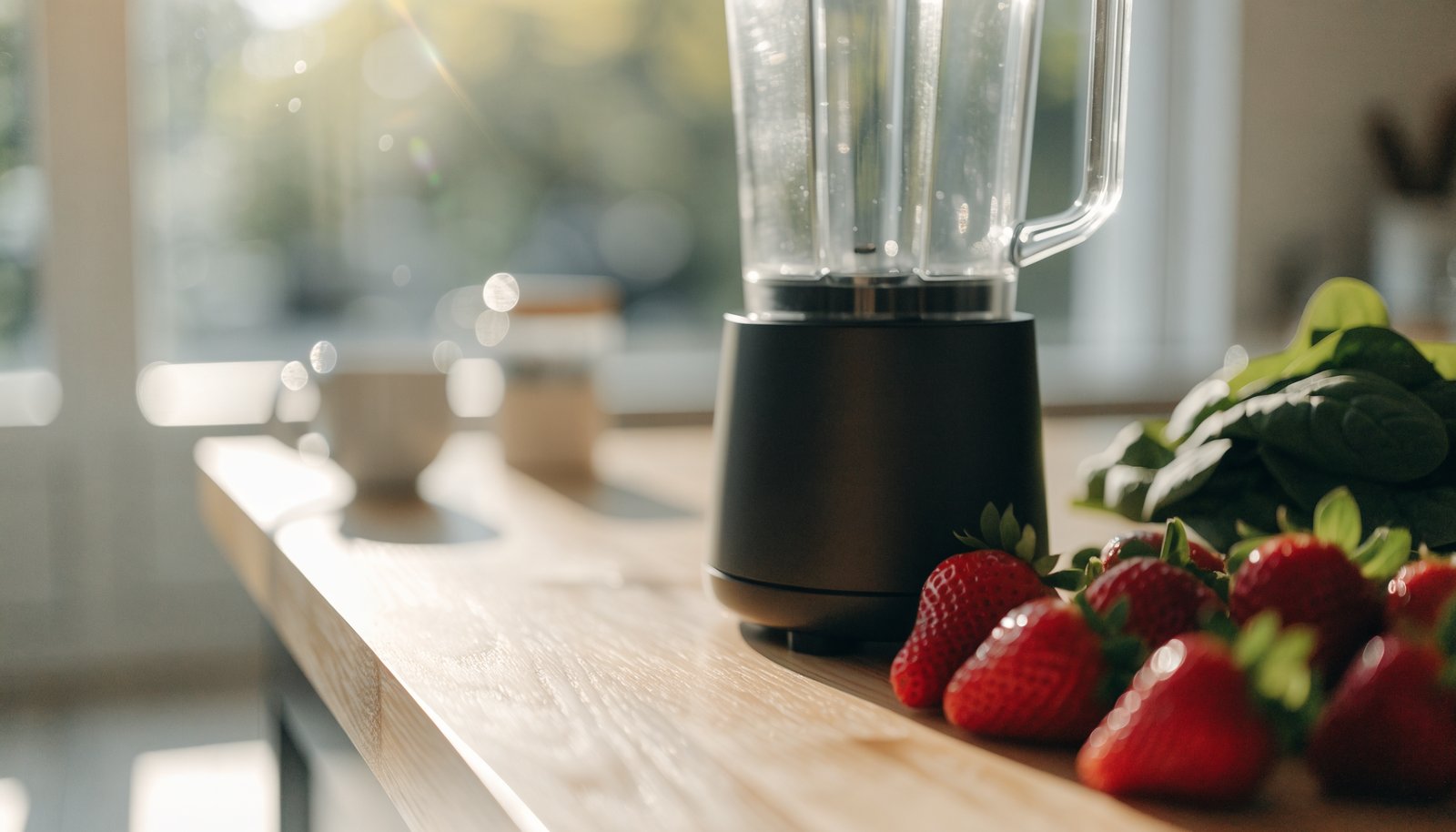
You can’t put 72 ounces of liquid in this 72-ounce pitcher.
The marketing line says “72-OZ. PITCHER: Great for making large batches of smoothies for the family.” Open the Owner’s Guide, though, and the same part is labeled “72-oz. * Full-Size Pitcher,” with a footnote dangling off that asterisk: “*64-oz. max liquid capacity.” Then, in capitals: “DO NOT add ingredients past the MAX LIQUID line.” Eight ounces of the headline number is air, at least for liquids; the guide keeps a separate MAX FILL line for everything else and never puts a number on it. Sixty-four ounces is four 16-oz. smoothies, not the four and a half that 72 implies.
The other label worth straightening out is the “Amazon Exclusive” in this listing’s title. It’s the paint. Amazon sells TB201IVBRN in Bone & Champagne, and Ninja sells the TB201 in Cloud Silver on its own store for $129.98, down from $149.99. Same TB201 underneath, same pitcher, same crushing-and-chopping blades, same 72-that-means-64. So is it a good $130 blender? Mostly, yes. You’ve already met the first asterisk, and the fine print has a few more.
TL;DR — Should You Buy the Ninja Detect Power Blender Pro?
- What it is: model TB201, a pitcher blender rated at 1,200 watts (1,800 peak) with 11 manual programs, 4 automatic ones and speeds 1–10. Ninja’s price on September 18, 2026: $129.98, down from $149.99.
- The “exclusive” is a color. Bone & Champagne on Amazon (TB201IVBRN), Cloud Silver on Ninja’s store. It’s a TB201 either way, so cross-shop both.
- The catch: the 72-oz. pitcher holds 64 oz. of liquid, and the manual bans dry ingredients and grinding in the pitcher, in writing, twice.
- Buy it only if the pitcher’s the only vessel you’ll use. Ten dollars more gets the TB301: the same published motor ratings, plus two to-go cups.
Cross-shopping the Bone & Champagne colorway? Here’s the Amazon listing
Check the Ninja Detect Power Blender Pro on Amazon
As an Amazon Associate, we earn from qualifying purchases.
The “Amazon Exclusive” Is a Paint Color
Here’s what that means at checkout. Amazon’s model number is TB201IVBRN, and both listings describe a 72-oz. pitcher, 120 volts and an 1800-peak-watt motor base. So if the Bone & Champagne price sits above $129.98, the difference is buying you a finish. If it sits below, you’re getting the same model for less. You’re choosing paint, not specs.
The two pages do part ways on size, and that matters if it’s going under a cabinet. Ninja lists 8.73 lbs and 16.93 in. L x 10.63 in. W x 12.13 in. H. Amazon says 8.6 pounds and 6.88″D x 8.38″W x 17.5″H. Neither page says which figure is the assembled height, so plan for the taller 17.5 inches to be safe.
The wattage is a small mess too. The product page shouts “1800-PEAK-WATT MOTOR,” and Amazon says “Wattage 1800 watts” without printing a rated figure. But the replacement base for this model is titled “Ninja Detect™ (TB201) 1700-Peak-Watt Blender Motor Base with BlendSense™ Technology,” at $89.95. The matching listings for the TB301 and TB401 bases both say 1800. That’s two of the company’s own pages arguing about the peak number. The rated number is the steady one: 1,200 watts on the product page, “Power: 1200 Watts” in the manual. Carry that one into any comparison; no page lists a different rated figure, and Amazon’s lone “Wattage 1800 watts” field matches the number its own title calls “1800 peak watts,” so it’s the peak under a plain label, not a competing rating.
BlendSense Gets 15 Seconds to Make Up Its Mind
“Detect” sounds like a marketing word. The manual says otherwise, and it’s specific: “In the first 15 seconds, actively adjusts speed and time based on ingredients and recipe size.” Fifteen seconds of sizing things up, then a decision. The guide files the outcomes under BLENDING POSSIBILITIES:
- CRUSH AND MAX-CRUSH: “detects tougher and frozen ingredients, then adjusts the pulsing pattern for a smooth blend.” It’s the frozen-fruit mode you didn’t have to pick.
- BLENDING: “blends continuously without pulsing.” No stutter, just a steady run.
- THICK MODE: “creates thick spoonable results.” Smoothie bowls, basically.
The guide’s own label for that first 15-second sizing-up is INITIAL BLENDING; once it’s over, the program settles on one of those three. Runtime counts up on the display, and the ceiling’s stated plainly: “Total time varies from seconds up to almost two minutes.” The company fences the feature in itself, too: “BlendSense is best used for smooth blends such as smoothies, drinks, smoothie bowls, dips, purees, and sauces.” It’s a one-press program for liquid-forward blends, not a do-everything mode. And one-press doesn’t mean walk away. The same guide says “NEVER leave the appliance unattended while in use,” so those two minutes are yours to stand through.
It’s on by default. You press the dial and it goes. It won’t share the wheel, either: “Manual programs do not work in conjunction with the BlendSense program or Processing Mode programs.” If you’d rather drive, you get speeds 1 through 10, where “each speed runs continuously for 60 seconds,” a PULSE button that runs only while it’s pressed, and three chop presets: LARGE CHOP, SMALL CHOP and MINCE. Ninja’s spec table says 11 manual programs; the guide describes speeds 1 through 10 and never says what the eleventh is.
The chop presets are why salsa keeps turning up on the product page, which promises blades that “will chop veggies for a chunky salsa” and chop programs that “process foods in the pitcher for salsa and more!” If you make salsa more often than smoothies, those three buttons matter more to you than BlendSense does.
Four Things This Blender Flatly Refuses to Do
Each of these decides whether the thing fits your kitchen, so don’t skim them.
- No dry ingredients. No grinding. Two numbered safety instructions, back to back: “DO NOT process dry ingredients with the pitcher and Stacked Blade Assembly” and “DO NOT perform grinding operations with the pitcher and Stacked Blade Assembly.” Then the pitcher-use page says it once more: “DO NOT process or grind dry ingredients.” You’ve been told no, in print, three times.
- No extension cord. “Extension cords should NOT be used with this appliance,” and the cord’s 31.5 inches. Measure to your outlet before you order.
- No heated dry. “Accessories are top-rack dishwasher safe but should NOT be cleaned with a heated dry cycle.” Top rack, heat-dry off.
- No overfilling. Overload it and “the motor will be temporarily disabled” until you unplug it, wait about 15 minutes, then empty the pitcher and make sure nothing’s jamming the blades. The guide calls exceeding the max capacity “the most typical cause of appliance overload.” Overheat it and a thermal switch makes you wait roughly 30.
Two handling notes the Amazon listing skips. The blades “are loose and sharp and are NOT locked in place in their containers,” so the guide tells you to hold the assembly only by the top of the shaft, and to pull it out before you pour anything with the lid off. Thinner blends can go out through the spout with the lid locked; thicker ones that won’t fit through the spout mean lid off, blades out, then pour. And the base’s suction feet “will not stick on some surfaces such as wood, tile, and non-polished finishes.” Butcher-block owners, take note.
One gap is worth flagging for soup people. The Owner’s Guide has nothing on hot liquid, soup, boiling or steam; the closest it gets is a warning not to “expose the container and accessories to extreme temperature changes.” If hot soup’s the plan, you’re on your own.
TB201 vs. TB301 vs. TB401: What the Extra $10 and $70 Buy
Ninja’s store sells three Detect blenders, and all three list the same published motor ratings: 1,200 watts rated, 1,800 peak, 12.5 amps, 120 volts. So moving up the line doesn’t buy you more published power. It buys what else is in the box.
| TB201 (this one) | TB301 Duo | TB401 Kitchen System | |
|---|---|---|---|
| Price on Ninja’s store, Sept 18, 2026 | $129.98 (from $149.99) | $139.99 (from $179.99) | $199.99 (from $249.99) |
| Rated / peak watts | 1,200 / 1,800 | 1,200 / 1,800 | 1,200 / 1,800 |
| Manual / automatic programs | 11 / 4 | 14 / 4 | 14 / 6 |
| Also in the box | Just the pitcher and its blades | (2) 24-oz. cups, (2) spout lids, Hybrid Edge™ Blades | 64-oz. food processor bowl, chopping blade, dough blade, slicing/shredding disc, (1) 24-oz. cup, Hybrid Edge™ Blades |
| Weight | 8.73 lbs | 10.82 lbs | The page says 104.72 lbs. We don’t believe it either. |
| Rating on Ninja’s store | 3.8 out of 5 | 4.9 out of 5 | 5 out of 5 |
| Buy this one if… | The pitcher is all you’ll use ✅ | Someone takes a smoothie out the door ✅ | You want a food processor too ✅ |
Get the TB201 if the pitcher is the only vessel you’ll touch
It’s the cheapest of the three Detect blenders on Ninja’s store, and it ships with the same 72-oz. pitcher and Stacked Blade Assembly the pricier two carry. At 8.73 lbs it’s also lighter than the TB301’s 10.82 lbs, which you’ll notice if it lives in a cabinet. Check the Bone & Champagne price on Amazon against the Cloud Silver $129.98 before you commit.
Get the TB301 Duo if anyone takes a smoothie out the door
Ten dollars more buys the to-go kit in the table, a second blade set, and three more manual programs, 14 against 11. The pitch is simple: “Blend and enjoy drinks in the to-go cups with spout lids.” You blend in the thing you carry, so there’s no pouring and no extra glass in the sink, which is the whole appeal on a weekday morning. The trade-off is bulk. It’s heavier at 10.82 lbs and taller at 17.72 inches. Ninja sells the Duo on its own store: Ninja Detect Duo (TB301). If portability’s the whole point, our best portable blenders for smoothies on the go roundup covers machines built for exactly that.
Get the TB401 if you actually want a food processor
At $199.99 this stops being a blender purchase. The extra $70 buys the processor kit in the table, plus one to-go cup, and Ninja rates the bowl for “chopping, purees, and processing up to 2 lbs. of dough.” At 18.11 x 11.81 x 18.7 inches, it’s also the biggest of the three. If a food processor’s already on your list, that’s one base doing two jobs. If it isn’t, you’re paying $70 for a bowl you’ll mostly store. It’s on Ninja’s store too: Ninja Detect Kitchen System (TB401). Before paying for a combo, see what a standalone machine costs in our best food processors of 2026 guide.
Settled on the pitcher-only TB201? Here’s the Bone & Champagne listing
Ninja Detect Power Blender Pro (TB201) on Amazon
As an Amazon Associate, we earn from qualifying purchases.
The $20.95 You Find Out About After It Breaks
The coverage is a “One (1) Year Limited Warranty” against defects in material and workmanship. It then excludes “Normal wear and tear of wearable parts (such as blending vessels, lids, cups, blades, blender bases…).” In plain terms, it skips normal wear on the pitcher, lid, blades and even the base. The unit, or a non-wearable part, that SharkNinja deems defective at its “sole discretion” gets repaired or replaced within the first year. Ordinary wear on those parts doesn’t.
Then there’s the return trip. SharkNinja pays to get your unit to them, but “a fee of $20.95 (subject to change) will be charged when SharkNinja ships the repaired or replacement unit.” A replacement doesn’t reset the clock, either: coverage ends “six (6) months following the receipt date of the replacement unit or the remainder of the existing warranty, whichever is later.” Keep the receipt, too. You’ll need it as proof of purchase.
And if anyone pitches this as the company’s newest blender, the manual’s stamped “© 2023 SharkNinja Operating LLC.”
The Verdict: A Good $130 Blender With One Asterisk
The TB201 is a straightforward pitcher blender with unusually clear paperwork: a big pitcher, speeds that each run a full minute, three chop presets and an automatic mode scoped to smoothies, dips, purees and sauces. Being able to price-check it on Ninja’s own store is a genuine plus.
The reasons to pause are just as concrete. The manual bars grinding or processing anything dry in the pitcher. The warranty skips normal wear on the pitcher, lid and blades. The blades sit loose, so they have to come out before you pour anything with the lid off. And if a to-go cup’s anywhere in your routine, the TB301 has the same published motor ratings for ten dollars more, which makes the TB201 the wrong pick by a rounding error.
On September 18, 2026, Amazon ranked it “#361 in Countertop Blenders,” and Ninja’s store showed a 3.8 out of 5 rating with no count attached. Mid-pack, fairly priced, not a cult object. Weighing it against a premium machine? Our Vitamix Ascent X5 vs. Ninja Professional Plus breakdown asks whether the premium tier earns it.
My pick: if the pitcher’s all you’ll use, the Bone & Champagne TB201 on Amazon is a fair buy at or under that $129.98, and you can ignore the “Amazon Exclusive” framing entirely. It describes a color.
Ninja Detect Power Blender Pro FAQ
Is the Amazon “Bone & Champagne” version a different blender?
No. Amazon lists model TB201IVBRN; Ninja sells the TB201 in Cloud Silver. Both describe a 72-oz. pitcher, 120 volts and an 1800-peak-watt base. They disagree on weight and dimensions, and neither page says which height is the assembled one, so plan for the taller 17.5 inches to be safe. The real difference is finish and store.
How much can you actually put in the 72-oz. pitcher?
Sixty-four ounces of liquid. The Owner’s Guide footnotes the pitcher “*64-oz. max liquid capacity” and says not to add ingredients past the MAX LIQUID line.
Can it grind coffee beans or spices?
Not in the pitcher, going by the manual. It never names coffee or spices, but it says “DO NOT process dry ingredients with the pitcher and Stacked Blade Assembly” and, in a separate numbered instruction, “DO NOT perform grinding operations with the pitcher and Stacked Blade Assembly.” Dry beans run into both rules.
Is the motor 1,200 watts or 1,800 watts?
Both. Ninja lists 1,200 watts rated and 1,800 watts peak, at 12.5 amps and 120 volts. One wrinkle: the replacement base for the TB201 is listed as “1700-Peak-Watt,” while the TB301 and TB401 base listings say 1800.
How loud is the Ninja Detect Power Blender Pro?
Ninja doesn’t publish a decibel rating, on the product page or in the manual, and neither does Amazon. Anyone quoting you a number didn’t get it from Ninja’s product page or manual.
Specs, prices and quotes: SharkNinja’s product and parts pages, the TB200 Series Owner’s Guide and Amazon’s listing, checked September 18, 2026.