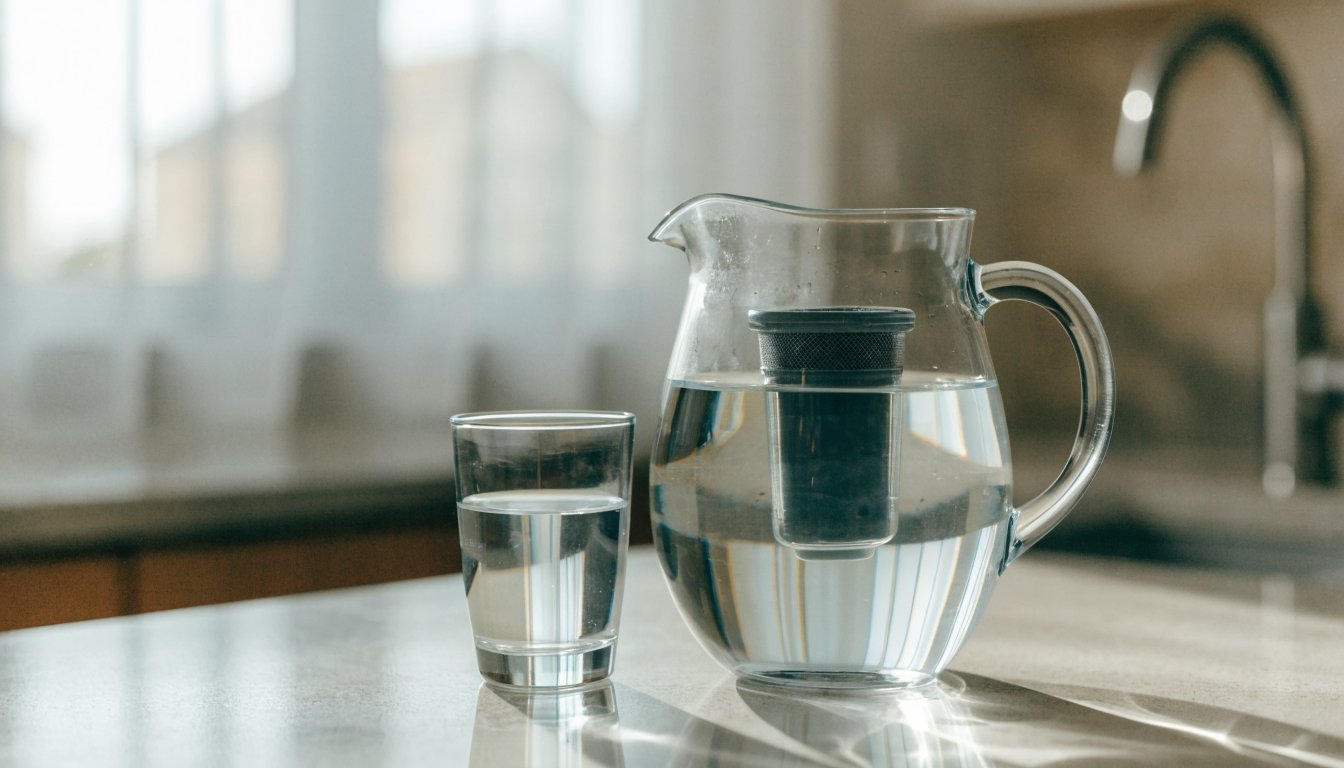
Quick answer: For most US households the best water filter pitcher in 2026 is a Brita pitcher fitted with the Brita Elite filter — one of the few pitcher filters that is genuinely NSF-certified for lead (NSF/ANSI 53), lasts a long 120 gallons, and uses cheap, easy-to-find filters. Need more? ZeroWater for the lowest dissolved solids and bad-tasting/well water, Clearly Filtered or Epic Pure for the broadest removal (fluoride, arsenic, PFAS), and LifeStraw Home if you need to filter bacteria and parasites. The one rule: buy for what a pitcher is certified to remove, not what the box implies.
A water filter pitcher is the cheapest way to improve your drinking water — but it’s also the product where marketing blurs the truth the most. Nearly every pitcher makes water taste better; only some are certified to reduce lead; and only specific models touch PFAS or fluoride. The difference is written in the NSF certifications, and reading them correctly is the whole game. This guide sorts seven current pitchers by what they actually remove — honestly — so you buy the right protection for your water, not the prettiest jug.
As an Amazon Associate, we earn from qualifying purchases. This doesn’t affect which products we recommend. This article is general information, not water-safety advice — if you suspect a serious contamination problem, test your water and consult your local utility.
What do water filter pitchers actually remove?
Pitchers fall into roughly three tiers of protection, and the NSF/ANSI certification a filter holds tells you which tier it’s really in.
- Tier 1 — Taste & odor (NSF/ANSI 42). Almost every pitcher reduces chlorine, taste, and odor. This makes tap water taste better. It is not a health claim and says nothing about lead or PFAS.
- Tier 2 — Health contaminants (NSF/ANSI 53). Reducing lead, mercury, cadmium, chromium, VOCs, and cysts (Giardia, Cryptosporidium) is covered here. This is the certification that matters if lead is your concern (old pipes, pre-1986 plumbing, lead service lines). PFAS reduction (PFOA/PFOS) is also certified under Standard 53.
- Tier 3 — Emerging compounds (NSF/ANSI 401). Covers incidental compounds like pharmaceuticals and pesticides.
| Standard | What it means |
|---|---|
| NSF/ANSI 42 | Aesthetic — taste, odor, chlorine |
| NSF/ANSI 53 | Health — lead, cysts, VOCs, mercury, PFOA/PFOS |
| NSF/ANSI 401 | Emerging — pharmaceuticals, pesticides |
| ⚠️ NSF/ANSI 372 | The product’s materials are lead-free — NOT lead removed from your water |
The single most common trap: a pitcher advertised with “NSF 42 + 372” only cleans up taste and is made of lead-free plastic — it does not remove lead from the water. And there’s a real difference between “NSF certified” (an independent body audits and re-tests the product) and “tested to NSF standards” (the brand paid a lab to run the protocol once, but the product isn’t enrolled in ongoing certification). Both can be legitimate; certification is the stronger guarantee. We flag which is which for every pick below.
How we chose
- What it reduces + how it’s verified — NSF/WQA/IAPMO certified ranks above brand-commissioned “tested to” claims.
- Capacity & fridge fit — cup rating versus real footprint; measure your shelf.
- Filter life & cost-per-gallon — the pitcher is cheap; the filters are the real lifetime cost.
- Filtration speed & usability — aggressive filters pour slower.
- Value & availability — currently sold, restockable filters.
The best water filter pitchers of 2026
Brita Everyday Elite — Best overall
Fitted with the Brita Elite filter, this is the safe default for anyone on treated municipal water. It’s genuinely NSF-certified to NSF/ANSI 42, 53, and 401, reduces 99% of lead plus mercury, cadmium, and 30-plus contaminants, and the filter lasts a long 120 gallons (about 6 months) — three times the old Standard filter — with the cheapest, most available replacements anywhere (pitcher approximately $27–40, Elite filters ~$13–17, as of 2026, subject to change). Two honest notes: it does not claim to remove PFAS or fluoride, and don’t confuse the Elite with Brita’s cheaper Standard filter (NSF 42 only, no lead reduction).
Best for: the default choice for verified lead reduction and better taste without effort.
ZeroWater 10-Cup — Best for bad-tasting or well water
ZeroWater’s 5-stage filter removes nearly all total dissolved solids (TDS) — it even includes a TDS meter so you can watch it hit “000.” It’s IAPMO-certified (to NSF/ANSI 53) to reduce PFOA/PFOS, lead, chromium, and mercury, plus NSF 42 for chlorine (pitcher approximately $28–38). The trade-off is real: the filter dies fast — roughly 15–40 gallons depending on your water — so it has the highest long-term cost here, pours slowly, and the full-TDS removal can taste flat to some. Buy it for genuinely bad water, not everyday municipal supply.
Best for: high-TDS, well, or bad-tasting water where you want maximum reduction.
LifeStraw Home — Best for bacteria and parasites
The only pitcher here that tackles microbes. A two-stage design pairs a 0.2-micron hollow-fiber membrane — which physically removes bacteria and parasites plus microplastics — with a carbon/ion stage that reduces lead, PFAS, mercury, and chlorine. It’s independently lab-tested to NSF/ANSI 42, 53, and 401 standards (pitcher approximately $65). It’s a smaller 7-cup capacity with two separate filter schedules to track (membrane ~264 gallons/1 year; carbon ~40 gallons/2 months), and it isn’t a substitute for reverse osmosis or boiling if your water is known to carry viruses.
Best for: emergency prep, travel, older wells, or anyone wanting microbe plus chemical coverage.
Clearly Filtered — Best for maximum contaminant removal
Clearly Filtered publishes the widest contaminant list here — fluoride, lead, PFAS, arsenic, microplastics, and more — but read the certification carefully. It is NSF-certified only to NSF/ANSI 42 and 372 (taste plus lead-free materials); its headline “380+ contaminants” claims rest on independent third-party lab testing, not NSF certification of those broader claims. That testing is transparent and legitimate, but it’s not the same as enrolled certification, so we state it plainly. Expect a premium price and slower pour (pitcher approximately $99, filters ~$50, ~100 gallons/4 months).
Best for: buyers who want the most thorough filtration (fluoride, arsenic, PFAS) and will pay for it.
Epic Pure — Best premium value for PFAS and fluoride
A US-made solid carbon block that’s independently tested to NSF/ANSI 42, 53, 401, and P473 (third-party lab-tested, not NSF-enrolled) to reduce 200-plus contaminants including PFAS, fluoride, lead, and pharmaceuticals. It gives you Clearly-Filtered-style breadth at a lower cost per gallon, with a longer 150-gallon (about 4-month) filter life (pitcher approximately $79, filter ~$36). As with any dense block, flow slows as the filter loads, and remember the claims are “tested to,” not NSF-certified.
Best for: shoppers who want PFAS and fluoride coverage for less than Clearly Filtered.
PUR Plus — Best budget lead reduction
The PUR Plus filter is NSF-certified for microplastics, chlorine, and mercury and WQA-certified for lead reduction — certified lead reduction at a lower entry price than the Brita Elite (pitcher approximately $20–35, filters ~$8–12). The catch is a short 40-gallon (about 2-month) filter life, which raises the long-term cost, and there’s no fluoride or PFAS claim. But if certified lead reduction on a budget is the goal, it delivers.
Best for: budget shoppers who specifically want certified lead reduction.
Aquagear — Best for fluoride plus lead on a mid-budget
A US-made dense media block, independently tested to NSF/ANSI 42, 53, 401, and P473 (third-party tested, not NSF-certified) to reduce lead, fluoride, chlorine, PFOA/PFOS, chromium-6, and microplastics. Its long 120–150-gallon filter life means far fewer changes than ZeroWater, and it’s backed by a lifetime guarantee (pitcher $69.95 official; third-party listings vary widely, so verify the current price). Like the other premium blocks, it pours slowly and its broad claims are “tested to,” not certified.
Best for: buyers wanting fluoride and PFAS reduction with fewer filter changes.
A buyer-beware note on cheap “lead-free” pitchers
Popular budget pitchers like the Waterdrop Lucid and Chubby carry NSF 42 + 372 only — that’s chlorine/taste plus lead-free materials, not lead or PFAS removed from your water. Their 200-gallon filter life is excellent and they make water taste great, but despite occasional PFAS-adjacent marketing language, don’t buy them for lead or PFAS protection. They’re fine as a taste-only pitcher — just know what you’re getting.
The real cost is the filter, not the pitcher
The pitcher’s sticker price is a rounding error; replacement filters are the true long-term cost, and cost-per-gallon swings a lot by filter life. Long-life filters (Brita Elite, Epic, Aquagear) work out to roughly $0.15–$0.25 per gallon; ZeroWater runs much higher because a filter may last only 15–40 gallons. Bottled water, by comparison, runs about $1–$2 per gallon, and the average US household spends around $216 a year on it. So a ~$30 pitcher with long-life filters typically pays for itself within weeks — just compare pitchers on cost-per-gallon, not sticker price, and match the spend to your actual water problem. Better water also means less limescale in your electric kettle and better-tasting coffee.
Common mistakes when buying a water filter pitcher
- Assuming every pitcher removes lead. Only NSF 53 (or WQA-lead) certified filters do — Brita Standard and taste-only pitchers don’t.
- Confusing NSF 372 with contaminant removal. 372 means lead-free materials, not lead removed from water.
- Reading “tested to NSF standards” as “NSF certified.” Third-party testing is meaningful but isn’t enrolled certification.
- Ignoring filter life and cost-per-gallon. A cheap pitcher with a 40-gallon filter can cost more over a year than a pricier one with a 150-gallon filter.
- Expecting fluoride or PFAS from a basic carbon pitcher. Most (including Brita Elite) don’t claim fluoride, and only specific models claim PFAS.
- Using a pitcher for microbiologically unsafe water. Only a membrane system (LifeStraw) addresses bacteria and parasites; for known contamination, use reverse osmosis or boil.
- Forgetting to replace the filter on schedule. A spent filter can perform worse than none.
Frequently asked questions
Do water filter pitchers remove lead?
Only if the filter is certified for it under NSF/ANSI 53 (or WQA-certified for lead). Brita Elite, PUR Plus, ZeroWater, LifeStraw, Clearly Filtered, Epic, and Aquagear all address lead; Brita Standard and taste-only pitchers (like the Waterdrop Lucid and Chubby) do not.
Do they remove PFAS (forever chemicals)?
Some do. ZeroWater (IAPMO-certified for PFOA/PFOS), Clearly Filtered, Epic, Aquagear, and LifeStraw all claim PFAS/PFOA-PFOS reduction (certified or third-party tested). Brita Elite does not claim PFAS. PFAS reduction is certified under NSF/ANSI 53.
Brita or ZeroWater — which is better?
Different jobs. Brita Elite is NSF-certified for lead, tastes clean, and has a long, cheap 120-gallon filter — best for everyday municipal water. ZeroWater strips far more dissolved solids (includes a TDS meter, IAPMO-certified for PFOA/PFOS and lead) but the filter dies fast and costs more per gallon — best for high-TDS, well, or bad-tasting water.
How often should I change the filter?
By model: Brita Elite about 120 gallons/6 months; PUR Plus and LifeStraw’s carbon stage about 40 gallons/2 months; Clearly Filtered about 100 gallons; Epic about 150 gallons/4 months; Aquagear 120–150 gallons; ZeroWater 15–40 gallons (change when the meter reads 006). A spent filter filters poorly, so don’t stretch it.
Are pitchers worth it versus bottled water?
Almost always. At roughly $0.15–$0.25 per gallon versus $1–$2 for bottled, a pitcher usually pays for itself within weeks and cuts plastic waste.
Do pitcher filters remove fluoride?
Most standard carbon pitchers (including Brita and PUR) do not meaningfully reduce fluoride. For fluoride, look at Clearly Filtered, Epic, or Aquagear, which are third-party tested for it.
Do they make unsafe water safe to drink?
No — standard carbon pitchers don’t remove bacteria or viruses. Only a membrane system like LifeStraw Home (0.2-micron) removes bacteria and parasites. For known-unsafe water, use reverse osmosis or boil.
Does a TDS reading of zero mean the water is pure or safe?
No. TDS measures total dissolved solids, including harmless minerals, not specific toxins. A low reading shows heavy reduction but isn’t a safety certificate — check the specific certified claims for the contaminants you care about.
The bottom line
Buy for what a pitcher is certified to remove, not what the box implies. For most homes on municipal water, the NSF-certified-for-lead Brita Elite is the right default. Step up to ZeroWater for bad-tasting or well water, Clearly Filtered or Epic Pure for fluoride, arsenic, and PFAS, or LifeStraw Home if you need to filter microbes — and if a filter only lists NSF 42 and 372, treat it as a taste upgrade, nothing more. For more kitchen essentials, see our guides to the best electric kettles and best coffee makers under $50.
Related: the best kitchen gadgets under $50 — what earned a spot on our counter and what did not.