As an Amazon Associate, TheHomePicker.com earns from qualifying purchases. We only recommend products we would evaluate ourselves; affiliate links never affect our rankings.
Quick answer: Both mix — the difference is power, convenience, and price. Buy a stand mixer if you bake often or make bread and stiff cookie dough: it is powerful, hands-free, and handles heavy dough with ease (and takes attachments). Buy a hand mixer if you bake occasionally and mostly whip cream, beat eggs, or mix cake batter: it costs a fraction as much and stores in a drawer. Simple rule — frequent baker or dough → stand mixer; occasional and light → hand mixer.
The quick rule: how often, and how heavy?
Before comparing features, answer two questions and the choice usually makes itself:
- How often do you bake? Most weeks → a stand mixer pays off. A few times a year → a hand mixer is plenty.
- What do you make? Bread, stiff cookie dough, big batches → you need a stand mixer’s power. Whipped cream, cake batter, eggs, mashed potatoes → a hand mixer handles it.
Both do the basics. You are really paying for power and hands-free convenience with a stand mixer, and low price and compact storage with a hand mixer.
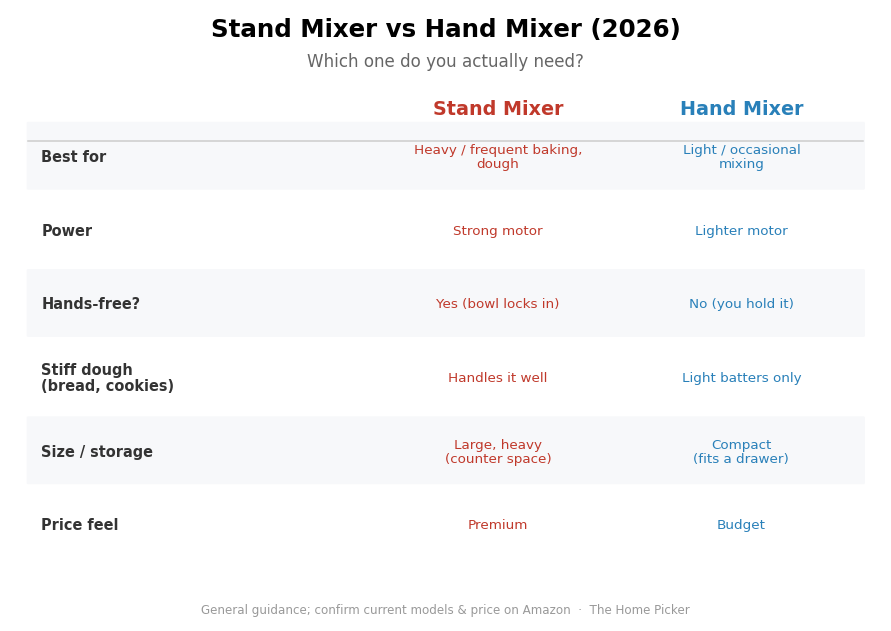
Stand mixer vs hand mixer: the comparison
| Factor | Stand Mixer | Hand Mixer |
|---|---|---|
| Best for | Heavy/frequent baking, dough | Light/occasional mixing |
| Power | Strong motor | Lighter motor |
| Hands-free | Yes (bowl locks in) | No (you hold it) |
| Stiff dough (bread, cookies) | Handles it well | Light batters only |
| Size & storage | Large, heavy (counter space) | Compact (fits a drawer) |
| Price feel | Premium | Budget |
Stand mixer: the baker’s workhorse
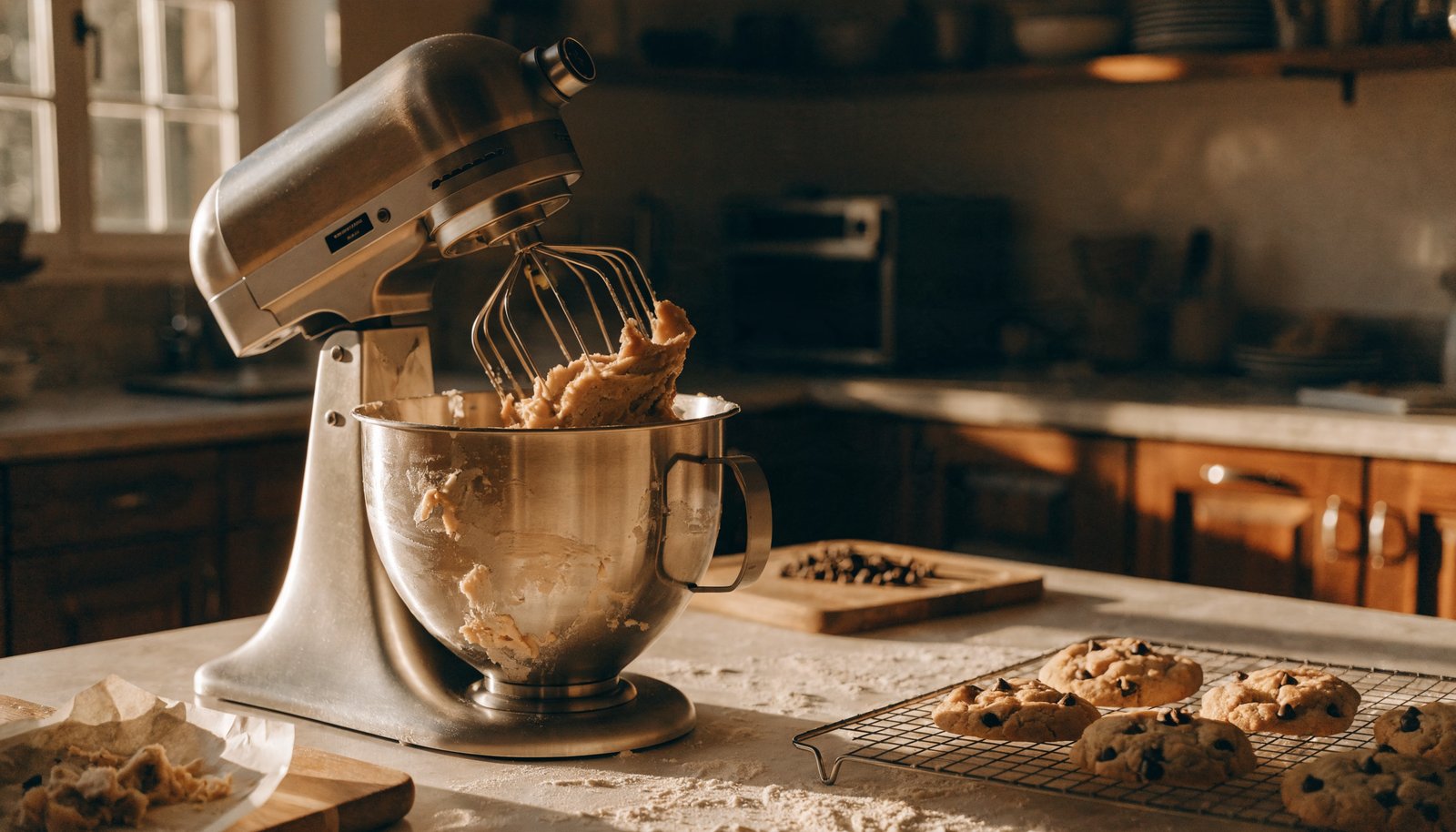
A stand mixer is the pick if you bake seriously. Its powerful motor and locking bowl let it knead bread dough and mix stiff cookie batter hands-free while you measure the next ingredient, and it powers a whole range of attachments — pasta rollers, grinders, spiralizers — that turn it into a do-everything kitchen tool. The trade-offs are price and a permanent spot on your counter. If you bake often or make dough, this is the one that saves you real effort — and the model we cover in depth is in our KitchenAid Artisan stand mixer review. Shop stand mixers on Amazon.
Hand mixer: cheap, light, and enough for most
A hand mixer is the smart buy for casual bakers. It costs a fraction of a stand mixer, weighs almost nothing, and stores in a drawer — and for whipping cream, beating eggs, mixing cake batter, or mashing potatoes, it does the job just fine. What it can’t do is knead stiff bread or dense cookie dough (the smaller motor bogs down) or run hands-free. If you bake occasionally and mostly do light mixing, a hand mixer is all you need. Shop hand mixers on Amazon.
Which should you buy?
Buy a stand mixer if you bake often, make bread or stiff dough, want hands-free mixing, or plan to use attachments. Buy a hand mixer if you bake occasionally, stick to light batters and whipping, or want to save money and counter space. If you are torn, be honest about how often you actually bake — most people bake less than they think, and a hand mixer covers it. Outfitting a kitchen more broadly? Our kitchen appliance buying guide and bread maker vs stand mixer comparison pair well with this decision.
Frequently Asked Questions
Do I really need a stand mixer, or is a hand mixer enough?
It comes down to how often and how heavily you bake. If you bake bread, big batches of cookies, or bake most weeks, a stand mixer earns its keep — it is powerful, hands-free, and handles stiff dough a hand mixer would strain on. If you bake occasionally and mostly whip cream, beat eggs, or mix cake batter, a hand mixer does the job for a fraction of the price and tucks into a drawer. Most casual bakers are perfectly happy with a hand mixer.
Can a hand mixer make bread or cookie dough?
For thick cookie dough or bread dough, not really — a hand mixer’s smaller motor can bog down or overheat with stiff dough, and it has no dough hook. It is fine for cake batter, whipped cream, meringue, and mashed potatoes. If you regularly make bread or dense doughs, that is exactly the job a stand mixer is built for.
Is a stand mixer worth it for occasional baking?
If you only bake a few times a year, a stand mixer is a lot of money and counter space for the use it gets — a hand mixer is the smarter buy. A stand mixer becomes worth it when you bake often enough that the hands-free convenience and dough-handling power save you real effort, or when you want the attachments (pasta, grinder) that turn it into a kitchen workhorse.
What can a stand mixer do that a hand mixer can’t?
Three things mainly: knead stiff bread and cookie dough without straining, run hands-free while you do something else, and power a whole ecosystem of attachments (pasta rollers, meat grinders, spiralizers). A hand mixer is lighter, cheaper, and better for quick, small jobs, but it can’t match a stand mixer on heavy dough or hands-free mixing.
Related: affordable kitchen gadgets we actually recommend — tested picks under $50.