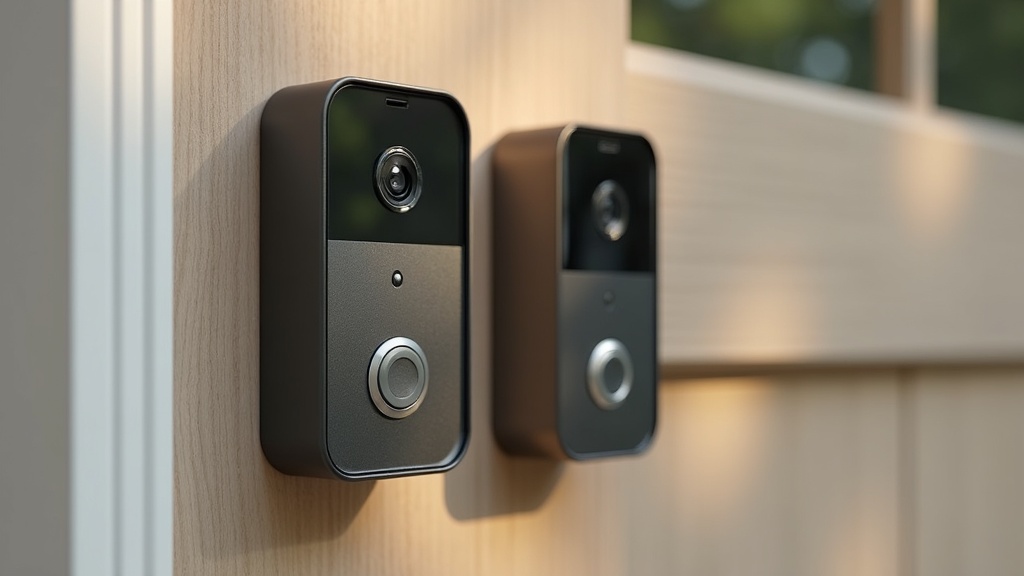
I’ve installed, wired, and argued about more video doorbells than I care to admit, so when Ring dropped a battery-powered 4K doorbell in spring 2026, it landed squarely on my radar. The Ring Battery Doorbell Pro takes the sharpest sensor Ring makes and cuts the cord — no more fishing wires through your doorframe to get premium video. On the other side of the ring is the doorbell a lot of people already own or covet: the Google Nest Doorbell (battery). It’s cheaper, it’s smarter about what you get for free, and it’s the natural pick if your house runs on Google.
So which one should you actually buy in 2026? The honest answer isn’t about megapixels — it’s about which voice assistant lives in your house and how you feel about paying a monthly subscription. Let me break down exactly where each doorbell wins, and where the fine print bites.
Quick Verdict
Buy the Ring Battery Doorbell Pro (4K) if you live in an Alexa/Echo house and want the best-looking video money can buy on a battery doorbell — but budget for a subscription, because a Ring records essentially nothing without one.
Buy the Google Nest Doorbell (battery) if you live in a Google Home house, want to spend less up front ($180 vs $250), and want a doorbell that stays genuinely useful for free — Nest gives you 3 hours of event history plus person, package, and vehicle alerts with no monthly bill.
The subscription truth: both companies want your recurring money. But Ring punishes you far harder for skipping it — no subscription means live-view-only. Nest hands you real functionality out of the box.
Check Ring Battery Doorbell Pro Price → Check Nest Doorbell Price →
What’s New: Ring Finally Put 4K on a Battery
Here’s why this matchup is suddenly interesting. For years, if you wanted Ring’s sharpest video, you had to hardwire it. The Battery Doorbell Pro (2nd Gen) changes that: Ring says it packs Retinal 4K — their top-end sensor — into a fully wireless, battery-powered body you can stick “virtually anywhere,” in Ring’s words. That’s a genuinely new capability, and it launched in the first half of 2026 at $250.
On paper the spec sheet is loaded: a 140° by 140° field of view (both horizontal and head-to-toe vertical), up to 10x Enhanced Zoom, true-color night vision, Audio+ two-way talk, Wi-Fi 6, and a Quick Release battery pack so you can swap and recharge without pulling the whole unit off the wall. Reviewers at Tom’s Guide called it “Ring’s top-end video doorbell, untethered” — and that untethered part is the whole story. If you rent, or your front door has no existing doorbell wiring, this is the first time you can get Ring’s flagship image quality without an electrician.
The Nest Doorbell (battery), by contrast, isn’t new — it’s the mature, refined option Google has been selling and quietly improving. It shoots at 960×1280 (a tall 3:4 aspect ratio), has a 145° diagonal field of view, HDR, and night vision. It’s not 4K, and it’s not trying to be. What it is, is smart, generous with free features, and $70 cheaper.
See the New Ring 4K Battery Doorbell on Amazon →
Head-to-Head: Where Each Doorbell Wins
Round 1: Video Quality — Winner: Ring
This one isn’t close on the spec sheet. Ring’s Retinal 4K is the highest-resolution sensor in either lineup, and with 10x Enhanced Zoom you can push in on a license plate or a face at the curb and still get usable detail. Reviewers consistently note that Ring’s 4K clarity is a real, visible step up when you zoom. Nest’s 960×1280 is sharp and perfectly good for identifying who’s at the door — but it’s HD, not 4K, and Nest maxes out at 6x digital zoom. If pixel-peeping detail is what you care about, Ring takes this round.
Round 2: Field of View & Package View — Winner: Tie (with an edge to Nest for packages)
Both doorbells are built to show you a person head-to-toe and the package on your step — that’s the whole point of a tall aspect ratio. Ring’s 140° vertical FOV and Nest’s 3:4 orientation both nail it. I give Nest a slight nod here only because its tall 3:4 frame was purpose-built for the “see the person and the package” job and does it beautifully, but honestly, either will show you what’s on your porch.
Round 3: Smart Detection & What’s Free — Winner: Nest (decisively)
This is where the gap gets wide, and it’s the single most important thing most buyers miss. Nest gives you smart alerts for free. Out of the box, with no subscription, the Nest Doorbell distinguishes people, packages, animals, and vehicles, lets you set activity zones, and stores 3 hours of event history so you can scroll back and see what triggered an alert.
Ring? Without a subscription, the Battery Doorbell Pro gives you live view and a real-time ring notification — and that’s basically it. Ring cameras without a plan won’t record clips, won’t store video, and won’t do person detection. You’ll get a chime and a live feed, but if you miss it, there’s no footage to review. That’s a massive functional difference, and it makes the sticker price misleading.
See the Nest Doorbell’s Free Features on Amazon →
Round 4: Subscription Cost Over Time — Winner: Nest
Let’s talk money you’ll actually spend. Ring’s plans were renamed in 2026 (Ring Home / Ring Protect), and they start at $4.99/month or $49.99/year for a single device with 180-day video history. Step up to the multi-device Plus/Standard tier and you’re at $10/month or $100/year. Because a Ring is close to useless without recording, that subscription is effectively mandatory — so factor it into the price.
Nest’s paid tier, Google Home Premium (formerly Nest Aware), runs $10/month or $100/year for the Standard plan and $20/month for Advanced, and it unlocks 30 days of event history plus 24/7 recording on wired setups. But here’s the kicker: you can skip it entirely and still get detection plus 3 hours of history. With Ring, skipping the plan means skipping the whole reason you bought a smart doorbell.
Round 5: Ecosystem & Voice — Winner: Whichever You Already Own
This is the real fork in the road. Ring is an Amazon company, so it plugs into Alexa natively — ask an Echo Show to “show the front door” and it just works, and doorbell announcements roll through your Echo speakers seamlessly. Nest is Google’s, so it lives inside Google Home (now with Gemini), pops up on Nest Hubs, and answers to “Hey Google.” Yes, Nest technically works with Alexa through a skill, and you can cobble Ring into other systems — but the native, no-friction experience only happens inside each doorbell’s home turf. Don’t fight your own smart home. Match the doorbell to the assistant you already talk to.
Round 6: Install & Power — Winner: Tie
Both are battery doorbells, so installation is renter-friendly and wire-free — mount the bracket, clip in the unit, done in 15 minutes. Ring’s Quick Release battery pack is a nice touch: you pop out just the battery to recharge instead of taking the whole doorbell down, which is genuinely more convenient than Nest’s fully integrated battery. Both can also be hardwired to existing doorbell wiring for constant power if you have it. Call it a tie, with a small quality-of-life point to Ring’s swappable battery.
Ring Battery Doorbell Pro vs Nest Doorbell: Spec Comparison
| Feature | Ring Battery Doorbell Pro (4K) | Google Nest Doorbell (battery) |
|---|---|---|
| Price | ~$250 | ~$180 |
| Resolution | Retinal 4K | 960×1280 (HD, 3:4) |
| Field of view | 140° × 140° | 145° diagonal |
| Zoom | Up to 10x Enhanced | 6x digital |
| HDR / Night vision | Yes / true-color night vision | Yes / IR night vision |
| Free smart detection | No (subscription required) | Yes (person/package/animal/vehicle) |
| Free video history | None (live view only) | 3 hours event history |
| Subscription | Ring from $4.99/mo | Google Home Premium from $10/mo |
| Voice ecosystem | Alexa (Amazon) | Google Home / Gemini |
| Battery | Quick Release swappable pack | Integrated rechargeable |
The Subscription Reality: What It Really Costs Over 3 Years
Let me do the math I wish more reviews did, because the doorbell you buy is only part of the bill. Here’s a realistic 3-year cost of ownership:
- Ring Battery Doorbell Pro + Ring Home Basic: $250 hardware + ~$70/year × 3 = ~$460 over three years. And that’s the entry plan for a single device. Drop the subscription and you drop recording entirely — so realistically, this is what a Ring costs to actually use.
- Nest Doorbell, free tier only: $180 hardware + $0 = $180 over three years, and you still keep smart detection and 3-hour history. This is the budget champion.
- Nest Doorbell + Google Home Premium Standard: $180 + $100/year × 3 = ~$480 over three years — but only if you want 30-day history and 24/7 recording, which many people genuinely don’t need.
The takeaway: if you’re subscription-averse, Nest is the obvious call — it’s the only one of the two that stays smart for free. If you’re going to pay for a plan anyway, then the decision swings back to ecosystem and whether you want that 4K image.
The Verdict: Buy the Ring If… Buy the Nest If…
Buy the Ring Battery Doorbell Pro (4K) if: you’re an Alexa household with Echo Shows, you want the sharpest possible video and best zoom on a battery doorbell, you value the swappable Quick Release battery, and you’re comfortable paying $5–$10/month for the subscription that makes it worthwhile. This is the premium pick, and it earns the “Pro” name on image quality alone.
Buy the Google Nest Doorbell (battery) if: your home runs on Google Home, you want to spend $70 less up front, and — most importantly — you want a doorbell that keeps detecting people and packages and saving a few hours of clips without a monthly bill. For the value-focused buyer, Nest is the smarter total-cost pick, full stop.
My honest bottom line: I’d steer most subscription-shy buyers toward the Nest, because a smart doorbell that goes dumb the moment you stop paying is a hard sell. But if you’re already deep in Amazon’s world and you want the best video on the block, the Ring Battery Doorbell Pro is a legitimately impressive piece of hardware — just go in knowing the subscription is part of the deal.
Buy the Ring Battery Doorbell Pro → Buy the Google Nest Doorbell →
Still weighing your options? If you’re comparing Ring against other brands, my Ring vs Blink security camera breakdown is worth a read, and I also put Ring head-to-head with a rising challenger in my Aqara G400 vs Ring doorbell comparison. And if you’re building out your whole setup, start with my complete guide to setting up a smart home in 2026.
Frequently Asked Questions
Is the Ring Battery Doorbell Pro 4K worth it?
If you want the sharpest video on a wire-free doorbell and you live in an Alexa household, yes — the Retinal 4K sensor and 10x zoom are the best in Ring’s battery lineup. But at $250 plus a near-mandatory subscription, it’s a premium buy. If you don’t care about squeezing out 4K detail, you can save real money elsewhere, including with the Nest.
Can I use Ring or Nest without a subscription?
You can, but the experiences are night and day. A Nest Doorbell without a subscription still detects people, packages, animals, and vehicles and keeps 3 hours of event history — genuinely usable. A Ring without a subscription is live-view-only: it rings and shows a live feed, but records nothing and won’t do person detection. That’s the biggest practical difference between these two.
Does Nest work with Alexa, and does Ring work with Google?
Nest works with Alexa through Google’s smart home skill — you can get doorbell announcements and two-way talk on Echo devices. Ring, being an Amazon product, doesn’t integrate natively with Google Home. In both cases the native experience is best inside the doorbell’s own ecosystem, so buy the one that matches the assistant you already use.
Which has better free features?
Nest, without question. Its free tier includes smart detection (person, package, animal, vehicle), customizable activity zones, two-way talk, and 3 hours of event history. Ring’s free tier gives you live view and real-time notifications only — no recording, no history, no smart alerts. For anyone who wants to skip the monthly fee, Nest is the clear winner.
Should I get a battery or wired doorbell?
Both of these are battery models, which makes them ideal for renters or doors without existing wiring — you can install them in about 15 minutes with no electrician. If you already have doorbell wiring, both can be hardwired for constant power so you never recharge. Ring’s Quick Release battery pack is the more convenient choice if you expect to recharge, since you pull just the battery instead of the whole unit.
Disclosure: TheHomePicker.com is a participant in the Amazon Services LLC Associates Program, an affiliate advertising program. As an Amazon Associate we earn from qualifying purchases. When you buy through links on our site, we may earn a commission at no additional cost to you. Prices and specifications are accurate as of publication and subject to change.
Once you’ve picked your doorbell, TechNestDecor’s step-by-step guide to installing a Ring doorbell walks through the setup.
You May Also Like
- Ring Battery Doorbell 2nd Gen (2026): Which One Should You Actually Buy?
- Ring Video Doorbell 4 vs Google Nest Doorbell 2026: 30-Day Test
- Aqara G400 vs Ring (2026): The No-Subscription Doorbell That Has Ring Worried?
- Best Video Doorbell Cameras in 2026: Ring vs Nest vs Eufy
- Ring Video Doorbell 4 Review 2026: What Worked After 4 Months
- Arlo Pro 5S Review 2026: 2K HDR Security Without the Monthly Fee