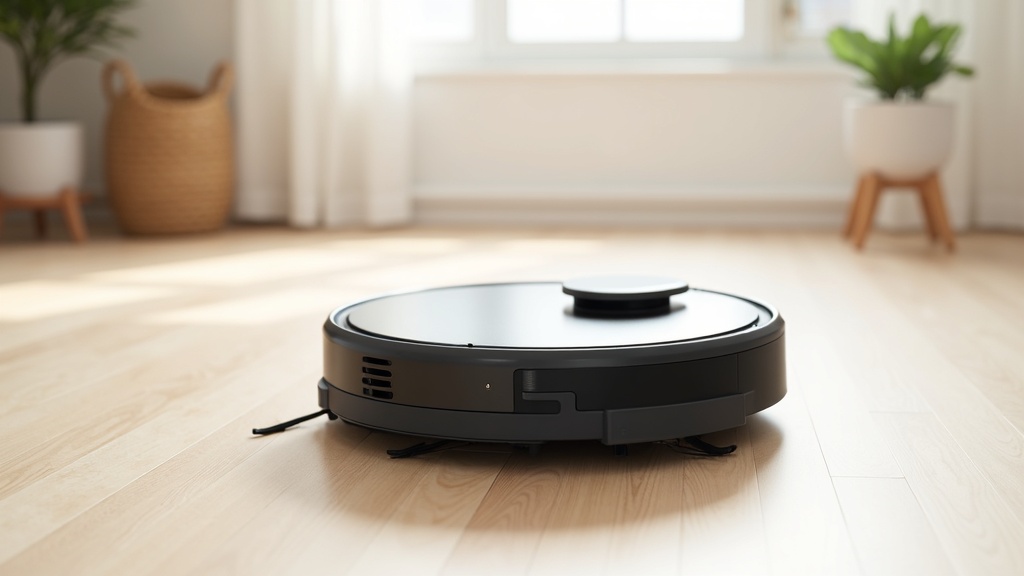
I’ve been reviewing robot vacuums since “obstacle avoidance” meant the thing panicked and drove into a wall slightly slower than before. So when Roborock shipped a vacuum with an actual five-axis robotic arm bolted to the top — one that reaches out, grabs your dropped sock, and drops it in a bin — my first reaction wasn’t excitement. It was suspicion. Every brand loves a party trick, and most end up buried three menus deep in an app, never touched again.
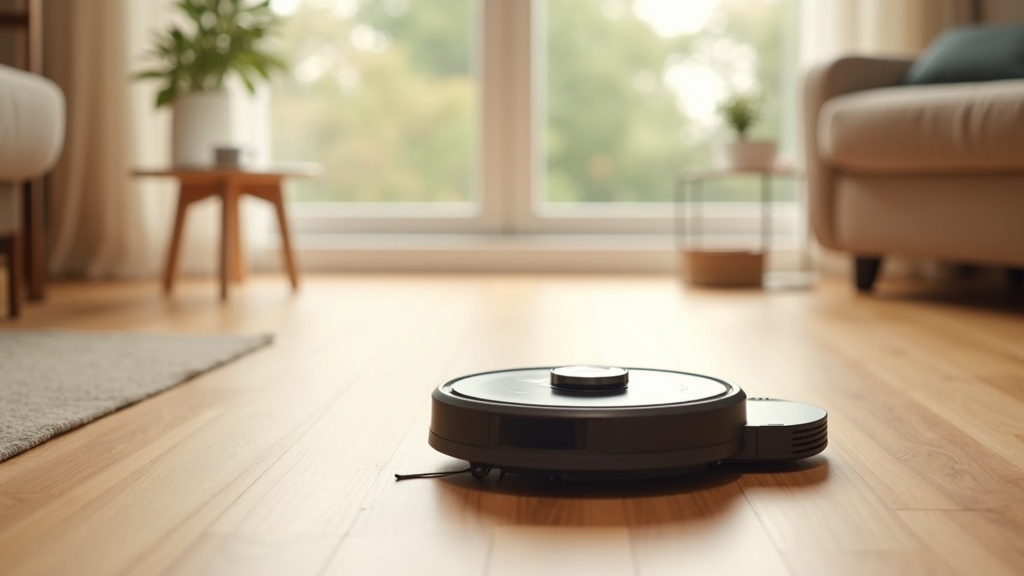
The Roborock Saros Z70 is different, in both the good and the annoying way. It’s the first mass-produced robot vacuum with a genuine mechanical arm, it’s also a ferociously good cleaner, and the arm itself is exactly the half-baked, occasionally magical, frequently frustrating first-generation gadget you’d expect. At a street price hovering around well below its $2,599 launch MSRP — as low as ~$1,299 at some retailers, though Amazon has often listed it nearer ~$1,999, the real question isn’t “is the arm cool.” It obviously is. It’s whether you should pay flagship-plus money for it. Let me save you some reading if you’re in a hurry.
The 15-Second Verdict
Buy the Saros Z70 if you are a gadget-forward early adopter who wants the best-mopping, best-obstacle-avoiding Roborock on the market and you think a robotic arm that tidies socks is worth a premium — even knowing it works maybe half the time. As a vacuum and mop, this thing is flagship-elite. That part is not a gimmick.
Skip it if you are buying the arm expecting a butler. Early reviews are unanimous: the OmniGrip arm is slow, picky about what it grabs, and successful roughly 50% of the time on a short list of objects (socks, tissues, small towels, slides). It is a real innovation and a real science project. If you just want the strongest cleaner for the dollar, a cheaper Roborock beats it.
Is the arm a gimmick or real? Honest answer: it’s a real feature that behaves like a gimmick today. The hardware is legit; the software isn’t ready to make it a daily-driver reason to buy. Buy it for the vacuum, treat the arm as a fun bonus, and you’ll love it.
Check Today’s Roborock Saros Z70 Price on Amazon →
What’s Actually New: The OmniGrip Robotic Arm
Let’s talk about the thing you came here for. Tucked into the top of the Z70’s chassis is the OmniGrip — a foldable, five-axis mechanical arm with a soft gripper and a camera on the end. When the robot finishes a cleaning pass, it can go back and physically pick up small objects it identified along the way, then carry them to a predesignated drop spot (a corner, a basket, wherever you tell it). Roborock claims it can handle items up to 300g, thanks to a built-in weight sensor that stops it from trying to deadlift your cat.
Here is the honest version, assembled from the early expert reviews rather than a fantasy. On paper the arm recognizes a handful of object categories — fabric clumps, paper/tissue balls, and shoes (specifically slides). In practice, reviewers report it reliably deals with about four things: socks, tissues, small towels, and slides. That’s it. It will avoid plenty of other obstacles (Roborock’s obstacle library is 100+ objects deep), but it will only try to grab that short list.
And the grabbing is… a journey. Multiple hands-on reviews describe the arm as “really, really slow.” The whole choreography — spot the sock, rotate, unfold the arm, lower, grip, lift, drive to the drop zone, release — is a patient, almost meditative process. Vacuum Wars and others clocked a success rate around 50%. One reviewer ran 40-plus attempts with paper balls and the occasional sock and got exactly one clean deposit into the sorting box. There are real physical limits too: the arm needs vertical clearance to operate, so a sock trapped under a low couch is safe forever, and a sock lying dead flat on the floor is often invisible or ungrippable because there’s nothing to pinch.
So is it useless? No. When it works, watching a vacuum tidy the floor before cleaning it is genuinely a little bit of the future arriving early. But if you’re picturing coming home to a robot that has folded your laundry, recalibrate. This is version one of a hard robotics problem, and it shows.
See the OmniGrip Arm in Action — Saros Z70 on Amazon →
Cleaning, Suction & Navigation: This Is Where It Earns the Money
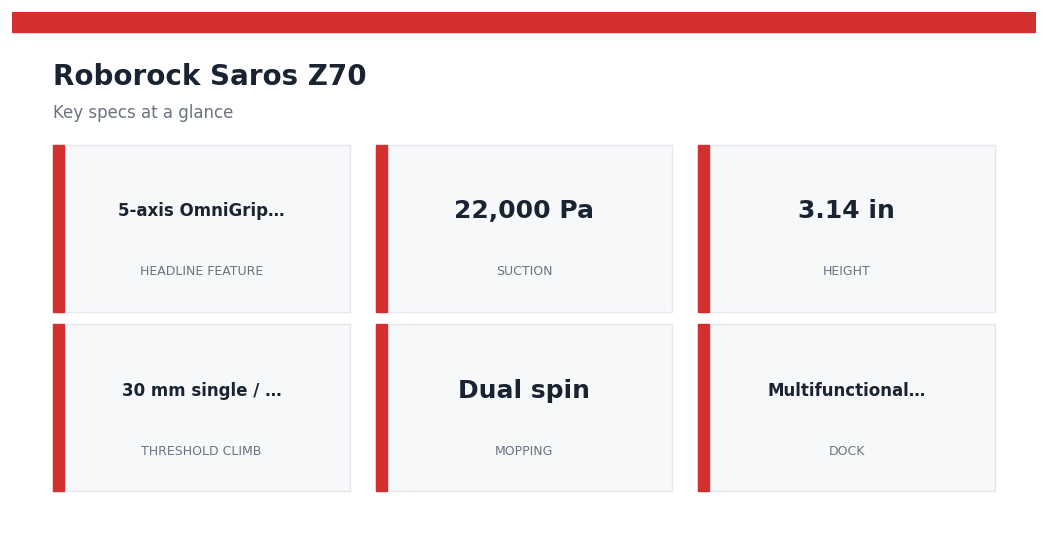
Strip the arm off and the Saros Z70 is still one of the most capable cleaners Roborock has ever built — which is the part I want people to internalize before they dismiss it as a novelty. It runs 22,000 Pa of HyperForce suction, dual all-rubber anti-tangle brushes, and an auto-extending side brush that pokes into corners and along baseboards. In independent testing it sweeps up fine dust, cereal, and pet hair from both hard floors and carpet about as well as anything on the market. Hair tangle resistance is excellent, which matters enormously if you live with long hair or a shedding dog.
Navigation is handled by Roborock’s StarSight Autonomous System 2.0, a solid-state, LiDAR-free setup that recognizes 100-plus obstacle types and — crucially — is one of the best obstacle-avoiders reviewers have tested. It threads around charging cables, pet bowls, and stray shoes with the kind of confidence that means you stop pre-tidying before every run. The Z70 is also freakishly slim at 3.14 inches (7.98 cm) tall, so it slides under couches and vanities that choke taller flagships.
One honest nuance: because the arm assembly lives on top, the Z70’s suction (22,000 Pa) and threshold-climbing sit a step below Roborock’s non-arm flagships like the Saros 20. If raw power is your religion, know that going in — though in real-world debris pickup, “extremely powerful” versus “even more powerful” is mostly a spec-sheet flex. The Z70 cleans beautifully.
The Dock & Mopping: Genuinely Best-in-Class
The Z70 ships with Roborock’s Multifunctional Dock 4.0 — the boring feature that actually changes your life. It auto-empties the dustbin, washes the mop pads, dries them with warm air so they don’t get funky, refills the clean-water tank, and drains the dirty water. In practice you top up detergent and swap the dust bag every couple of months and otherwise ignore it. This is what “self-sufficient” is supposed to mean.
Mopping is a legitimate high point. The Z70 uses dual spinning mop pads with an AdaptiLift chassis that raises them up to 22 mm to keep carpet dry, and it scored second-best in Vacuum Wars’ dried-on-stain mopping test — 139 points, notably ahead of Roborock’s own Saros 10R at 103. Translation: on real, crusted-on kitchen messes, this thing scrubs. Between the elite mopping, the flawless dock, and the top-tier obstacle avoidance, the Z70 would be an easy recommendation at flagship money even if the arm didn’t exist.
The Arm: Gimmick or Game-Changer? My Balanced Take
Here’s where I plant a flag. The OmniGrip is both, and pretending otherwise is dishonest reviewing.
The case for game-changer: This is the first time a consumer robot vacuum has manipulated the physical world instead of just mapping and avoiding it. That’s a real milestone. When the arm clears a sock out of its own path and then cleans where the sock was, you’re watching a category evolve in real time. Roborock will iterate the software, the object library will grow, and the speed will improve. Early adopters get to ride that curve.
The case for gimmick (for now): A feature that works half the time, on four object types, achingly slowly, and only with clearance around the object, isn’t one most people will use after week two. Reviewers who loved the robot as a vacuum were consistently lukewarm on the arm as a daily tool. The “remote control the arm from your phone” mode is charming for one demo and never again — too slow to be practical.
My verdict: buy the Z70 because it’s an elite vacuum and mop, and let the arm be the fun, occasionally-magic bonus that it is. If the arm is the only reason you’re reaching for your wallet, wait for gen two — or spend less on a Roborock without it. For a fuller cross-shop, I keep an updated Roborock vs Dreame vs Ecovacs comparison for 2026, and if the arm is genuinely what excites you, my roundup of robot vacuums with arms and legs tracks everything coming in this weird new category.
Saros Z70 vs Saros 20 vs Dreame X60: How It Stacks Up
The Z70’s toughest competition isn’t some off-brand — it’s Roborock’s own Saros 20 and Dreame’s flagship X60. Here’s the honest breakdown.
| Feature | Roborock Saros Z70 | Roborock Saros 20 | Dreame X60 Max Ultra |
|---|---|---|---|
| Headline feature | 5-axis OmniGrip robotic arm | Highest-power Roborock, no arm | Heated mop + max suction |
| Suction | 22,000 Pa | 36,000 Pa | 35,000 Pa |
| Height | 3.14 in (7.98 cm) | ~3.1 in | 3.13 in (7.95 cm) |
| Threshold climb | 30 mm single / 40 mm tiered | 45 mm single / 88 mm tiered | ~51 mm |
| Mopping | Dual spin, 22 mm lift, elite scores | Dual spin, top-tier | Heated (up to 104°F), 15N downforce |
| Dock | Multifunctional Dock 4.0 (all-in-one) | All-in-one | All-in-one, hot-water wash |
| Street price | ~$1,299—$1,999 (MSRP $2,599) | ~$1,599 | ~$1,699–1,999 |
| Best for | Early adopters who want the arm | Max power / high thresholds | Pet homes wanting heated mopping |
The read is clear: if you don’t care about the arm, the Saros 20 is arguably the smarter Roborock — more suction, dramatically better threshold climbing, and a lower price. The Z70 trades some raw spec muscle for its party trick. Whether that’s a good trade is entirely about how much the arm delights you. I dig deeper into the non-arm flagship fight in my Saros 20 vs Dreame X60 breakdown.
Saros Z70 Price on Amazon →
Cheaper Pick: Saros 20 on Amazon →
Who Should Buy It — And Who Should Skip It
Buy the Saros Z70 if you are:
- A genuine early adopter. You want to own the first robot vacuum with a working arm and you understand you’re funding a v1 experiment. The novelty is real and the underlying cleaner is excellent, so you’re not overpaying for a bad vacuum.
- Someone who values mopping and obstacle avoidance above all. Even ignoring the arm, this is one of the best moppers and best obstacle-dodgers Roborock makes.
- A low-clearance household. That 3.14-inch body plus elite navigation makes it a monster under furniture.
Skip it and save money if you are:
- Buying primarily for the arm’s utility. It works ~50% of the time on four object types, slowly. As a chore-solver today, it will disappoint. Wait for gen two.
- Chasing max power or high thresholds. The Saros 20 out-suctions and out-climbs it for less.
- Value-focused. Vacuum Wars itself notes most people are better served by a cheaper Roborock like the Qrevo Edge or Saros 10R, which deliver most of the cleaning for meaningfully less.
My bottom line: The Saros Z70 is a spectacular vacuum with a fascinating, unfinished robotic arm attached. Buy it for the former, enjoy the latter, and you’ll be thrilled. Buy it purely for the arm and you’ll be writing a grumpy review in three weeks. Priced well under its absurd $2,599 launch MSRP — it’s actually fair value as a flagship cleaner, with the arm as the cherry on top. Just know which one you’re really paying for.
Check the Latest Saros Z70 Deal on Amazon →
Frequently Asked Questions
Does the Roborock Saros Z70’s robotic arm actually work?
Yes — but with big caveats. In hands-on testing by outlets like Vacuum Wars and others, the OmniGrip arm successfully picks up and relocates designated objects roughly 50% of the time, and only for a short list of items (socks, tissues, small towels, and slides). It’s slow, it needs vertical clearance to operate, and it struggles with objects lying flat or tucked under low furniture. It’s a genuine engineering first, but it behaves like a first-generation feature — impressive in demos, inconsistent in daily life.
Saros Z70 vs Saros 20 — which should I buy?
If you want the robotic arm and top-tier mopping, get the Z70. If you want more raw cleaning power (36,000 Pa vs 22,000 Pa), better threshold climbing, and a lower price, the Saros 20 is the smarter buy for most people. The 20 is the better pure cleaner; the Z70 is the better gadget. You can compare current Saros 20 pricing on Amazon here.
Is the Saros Z70 worth $1,300?
As a flagship vacuum and mop? Genuinely, yes — the mopping, dock automation, and obstacle avoidance are best-in-class, and it now sells for a fraction of its $2,599 launch price. As a robotic-arm butler? Not yet. Judge the value on the cleaning and treat the arm as a bonus, and it’s a fair deal. Judge it on the arm alone and it’s overpriced for what the arm currently delivers.
What can the OmniGrip arm actually pick up?
Roborock claims it handles objects up to 300g across categories like fabric clumps, paper/tissue balls, and shoes (slides). In real-world reviews, the reliable list is essentially socks, tissues, small towels, and slides. It won’t grab larger items, won’t reach into tight or low-clearance spots, and currently only recognizes custom objects for avoidance, not pickup.
Is the Roborock Saros Z70 available on Amazon?
Yes. The Saros Z70 is listed on Amazon and has sold well below its $2,599 MSRP — often around ~$1,999, with some retailers as low as ~$1,299, with occasional deeper promotional drops. Because pricing on premium robot vacuums swings a lot, it’s worth checking the live Amazon price before you buy — I’ve seen it dip well below its usual sale price during major sale events.
Affiliate disclosure: TheHomePicker.com is a participant in the Amazon Services LLC Associates Program, an affiliate advertising program. As an Amazon Associate we earn from qualifying purchases. If you buy through links on this page, we may earn a commission at no additional cost to you. This never affects our verdicts — our assessments of the Roborock Saros Z70 are based on published specifications and independent expert reviews, and we call out both strengths and weaknesses honestly. All prices and availability are accurate as of publication and subject to change.
Beyond the arm: Roborock and eufy are chasing stairs next — see our stair-climbing robot vacuum preview and what to buy today.
You May Also Like
- Roborock Saros Z70 vs Dreame X50 Ultra (2026): Robotic Arm vs ProLeap Legs — Which Flagship Wins?
- Roborock Saros 20 Review: Worth the $1,500? (We Tested It)
- Roborock Saros 20 vs Dreame X60 Ultra: Hands-On Comparison (2026)
- Roborock S8 MaxV Ultra Review 2026: Robot Vacuum That Does Everything
- Dreame X40 Ultra Review 2026: The Most Capable Robot Vacuum We Tested