I get some version of this email almost every week: “James, I’m ready to spend real money on a robot vacuum that also mops well. It’s down to the Eufy X10 Pro Omni and the Roborock Qrevo Curv. Which one do I actually buy?” It’s a great matchup, because these two are chasing the exact same buyer — someone who wants a self-washing, self-emptying, mop-and-vac combo without stepping into $1,400 flagship territory. But they get there in very different ways, and the price gap between them is bigger than most people expect. I’ve dug through the published specs, the lab-style testing from the reviewers I trust, and the current retail pricing to settle this the way I’d settle it for a friend. Here’s my honest call.
Quick verdict: For most buyers, the Eufy X10 Pro Omni is the smarter purchase — it delivers 90% of the experience for roughly half the money. It routinely sells around $450–$500 (down from its $799 launch price), mops aggressively with 1 kg of downward pressure, and its app is dead simple. Buy the Roborock Qrevo Curv — typically $799–$999 — if you have a larger, messier, carpet-heavy home and you want the stronger raw suction, the extendable edge brush, hot-water mop washing, higher thresholds it can climb, and a far more powerful app. You’re paying roughly $350–$500 more for that headroom. If your budget is the deciding factor, the Eufy wins. If capability is, the Roborock does.
Check Eufy X10 Pro Omni Price →
Check Roborock Qrevo Curv Price →
The specs, side by side
Before we go round by round, here’s the shorthand on paper. The single biggest number people fixate on — suction — is not close, but as you’ll see, it also isn’t the whole story.
- Suction: Eufy X10 Pro Omni claims 8,000 Pa. Roborock Qrevo Curv rates it at 18,500 Pa. On paper, that’s a blowout for Roborock.
- Mopping: Both use dual spinning mop pads. Eufy applies 1 kg of downward pressure and auto-lifts the mops 12 mm over carpet. Roborock lifts its mops up to 17 mm and washes them in hot water at the dock.
- Obstacle avoidance: Eufy’s AI.See uses a front camera plus lasers to ID 100+ objects. Roborock uses structured light plus an RGB camera to recognize 108 object types.
- Dock: Both self-empty, wash and dry the mops, and refill the water tank. Roborock adds hot-water washing; Eufy keeps it simpler.
- Chassis: Roborock’s AdaptiLift chassis climbs thresholds up to ~4 cm; the Eufy sticks to standard clearance.
- Price: Eufy commonly ~$450–$500. Roborock Qrevo Curv commonly ~$799–$999.
Round 1 — Suction and vacuuming: Roborock
Let’s be fair about the headline number first. Roborock rates the Qrevo Curv at 18,500 Pa versus Eufy’s 8,000 Pa, and reviewers consistently note that on paper the Roborock has far more raw pulling power. That extra suction matters most in two situations: deep pile carpet and heavy pet-hair households. If your home is carpet-dominant, the Roborock’s headroom is genuine, not just marketing.
Here’s the honest nuance, though. Vacuum Wars flagged that the Eufy’s raw power numbers came in below average in their bench testing — yet its real-world carpet cleaning results were excellent. Pa is a lab figure measured at the nozzle, not a promise of pickup on your floors. So while I give this round to Roborock without hesitation for pure capability, don’t read the 2.3x suction gap as “the Eufy can’t clean carpet.” It can. The Roborock simply has more margin, plus a DuoDivide anti-tangle brush design that reviewers praise for pet-hair homes where long hair strangles the roller.
Winner: Roborock Qrevo Curv — more suction, better anti-tangle brush, more carpet headroom.
Round 2 — Mopping: a genuine toss-up, edge to Eufy on value
This is where the Eufy earns its reputation. Both robots use twin spinning pads, but the Eufy leans on 1 kg (nearly 2 lb) of downward pressure spinning at 180 rpm, and reviewers were genuinely impressed — Vacuum Wars watched it clear dried coffee and grape juice stains in minimal passes. For a robot at this price, that’s a standout mopping result, not a checkbox feature.
The Roborock counters with two things the Eufy doesn’t have: a taller 17 mm mop lift (versus Eufy’s 12 mm), which keeps carpet drier when it transitions from hard floor, and hot-water mop washing at the dock (around 140°F/60°C on the standard Curv; the step-up Curv variants run hotter). Hot water genuinely gets the pads cleaner between runs, and that’s a real hygiene advantage over time if you mop daily.
So who wins? On pure scrubbing performance, they’re close enough that I call it a draw — the Eufy’s pressure-based scrubbing is that good. On dock hygiene and carpet-lift, the Roborock edges ahead. But when you factor in that the Eufy delivers near-parity mopping for roughly half the price, the value verdict tilts hard toward Eufy.
Winner: Tie on performance, Eufy on value.
See the Eufy X10 Pro Omni on Amazon →
Round 3 — Obstacle avoidance: close, but neither is flawless
Both companies talk a big game here, and both fall a little short of the hype. Eufy claims its AI.See system is the number-one obstacle avoidance on the market, and in Vacuum Wars’ obstacle testing, AI.See-equipped machines did land in the top two. That’s a legitimately strong showing. The catch: reviewers also saw false positives, where the Eufy got erratic trying to dodge larger debris it should have just vacuumed, and it still occasionally catches on cables or shaggy rugs.
Roborock’s structured-light-plus-RGB-camera system recognizes 108 object types and generally navigates confidently in both lit and dark rooms. But one reviewer put it bluntly: the Qrevo Curv’s obstacle avoidance is “decent but still a long way from perfect.” So this isn’t a clean sweep for either side. In practice, both will occasionally bump a sock or nudge a cable. I give a slight edge to Roborock for its low-light consistency and mapping intelligence, but if you pick up cables before you run it — which you should with any robot — you’ll rarely notice a difference.
Winner: Slight edge to Roborock, but honestly a near-tie in daily use.
Round 4 — Dock and hands-off experience: Roborock
Both docks do the core jobs: empty the dustbin, wash the pads, dry them with warm air, and refill the clean-water tank. This is table stakes at this tier, and both deliver it. Where the Roborock pulls ahead is the details — hot-water washing for cleaner pads, and the FlexiArm extendable side brush plus AdaptiLift chassis that lets it climb thresholds up to about 4 cm. If your home has raised transitions between rooms or a step up into a bathroom, that climbing ability is the difference between “cleans the whole floor” and “gets stuck at the doorway.”
The Eufy’s dock is excellent and truly hands-off for most people, but reviewers noted it isn’t a perfectly hands-off experience: it can’t clean behind doors, in some tight spaces, or around its own station, and the edge-hugging feature underperforms expectations. The Roborock’s extending FlexiArm brush was built specifically to attack that edge-and-corner weakness, and it shows.
Winner: Roborock Qrevo Curv — better edges, better thresholds, hotter wash.
See the Roborock Qrevo Curv on Amazon →
Round 5 — The app: Roborock for power users, Eufy for everyone else
The Roborock app is one of the most capable in the category — 3D map visualization, furniture labeling, granular room and zone customization, and deep control over suction and mop levels per room. If you love tinkering, it’s a playground.
The Eufy app deliberately does less. It lacks 3D maps and furniture labeling. But here’s the thing reviewers keep pointing out: for what most people actually do — scheduling, zone cleaning, checking history — everything you need is reachable in three taps or fewer. Simplicity is a feature for a lot of buyers. So this round genuinely depends on who you are. Gadget-tinkerer? Roborock. Set-it-and-forget-it? The Eufy won’t frustrate you.
Winner: Roborock on depth, Eufy on ease.
Round 6 — Value: Eufy, and it isn’t close
Now we settle it on price. The Eufy X10 Pro Omni launched at $799 but has spent most of 2026 selling around $450–$500. The Roborock Qrevo Curv typically runs $799–$999 depending on the exact variant and the day’s deal. That’s a gap of roughly $350–$500 for two robots aimed at the same buyer.
Ask yourself what that extra money buys: more raw suction, a better edge brush, hot-water washing, higher climbing, and a deeper app. Real advantages — but for a small-to-mid-size apartment with mostly hard floors and a few rugs, most of them are headroom you’ll rarely tap. That’s exactly why the Eufy keeps winning “best overall value” nods for 2026. It gives the majority of buyers what they came for at a price that stings a lot less.
Winner: Eufy X10 Pro Omni — the value math is lopsided.
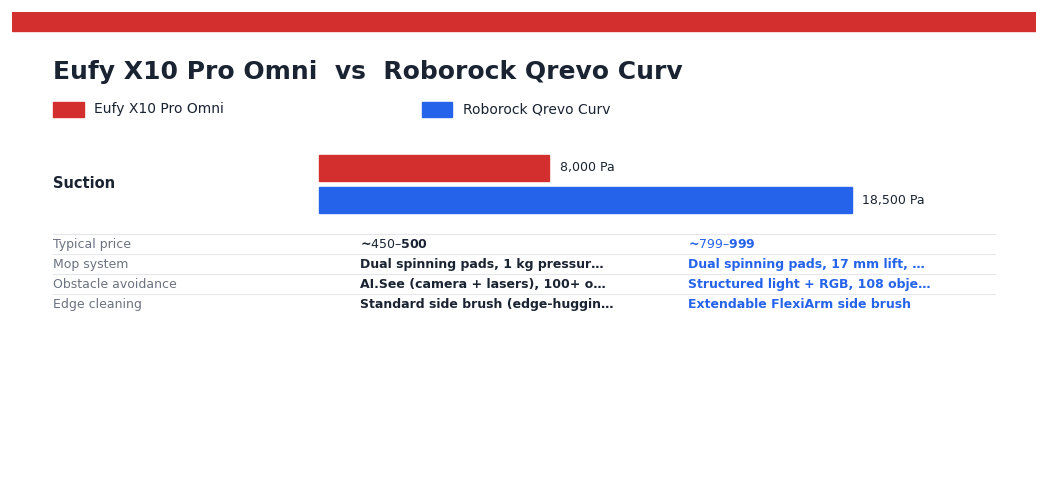
Eufy X10 Pro Omni vs Roborock Qrevo Curv: the full comparison
| Feature | Eufy X10 Pro Omni | Roborock Qrevo Curv |
|---|---|---|
| Typical price | ~$450–$500 | ~$799–$999 |
| Suction (claimed) | 8,000 Pa | 18,500 Pa |
| Mop system | Dual spinning pads, 1 kg pressure, 12 mm lift | Dual spinning pads, 17 mm lift, hot-water wash |
| Obstacle avoidance | AI.See (camera + lasers), 100+ objects | Structured light + RGB, 108 objects |
| Edge cleaning | Standard side brush (edge-hugging is weak) | Extendable FlexiArm side brush |
| Threshold climbing | Standard clearance | AdaptiLift chassis, up to ~4 cm |
| Dock | Self-empty, wash, dry, refill | Self-empty, hot-water wash, dry, refill |
| App | Simple, easy, no 3D map | Deep, 3D maps, furniture labels |
| Best for | Value seekers, apartments, hard floors + rugs | Larger, carpet-heavy, pet homes; power users |
Check Eufy Price →
Check Roborock Price →
My verdict: who should buy which
Buy the Eufy X10 Pro Omni if:
- You want the best mid-range value in 2026 — full stop. Near-flagship features at roughly half the price.
- Your home is a small-to-mid apartment or house with mostly hard floors and a few area rugs.
- You care most about aggressive mopping and a truly hands-off dock, and you want an app that stays out of your way.
- You’d rather bank the $350–$500 difference than pay for suction headroom you may never need.
Buy the Roborock Qrevo Curv if:
- You have a larger, carpet-heavy home and want the extra 18,500 Pa of suction margin.
- You live with a heavy shedder and want the anti-tangle brush plus stronger deep-carpet pickup.
- You have raised thresholds between rooms — the AdaptiLift chassis climbing ~4 cm genuinely matters.
- You want the best edges (FlexiArm), hot-water mop washing, and the most powerful app in the category, and the price gap doesn’t scare you.
My bottom line: I’d hand most people the Eufy X10 Pro Omni and tell them to spend the savings on something else. It’s the value champion of this matchup, and the mopping is legitimately excellent. But if your home is big, carpeted, and full of pet hair — or you simply want the more capable machine and the deeper app — the Roborock Qrevo Curv is the stronger robot, and I won’t talk you out of it. Both are good. The right one depends on your floors and your budget, not on which spec sheet looks scarier.
Want to see how these two stack up against the rest of the field? Compare the broader lineup in our Roborock vs Dreame vs Ecovacs 2026 breakdown, dig into the full spec sheet in our robot vacuum database, or if you’re in a smaller space, see our picks for the best robot vacuum-mop combos for small apartments.
Frequently asked questions
Is the Roborock Qrevo Curv worth almost double the Eufy X10 Pro Omni?
Only for the right home. If you have lots of carpet, a heavy-shedding pet, or raised thresholds between rooms, the Roborock’s extra suction, anti-tangle brush, and AdaptiLift climbing justify the premium. For a mostly-hard-floor apartment, the Eufy does 90% of the job for roughly half the price, so most buyers won’t feel the difference in daily cleaning.
Does the Eufy’s lower 8,000 Pa suction mean it cleans carpet poorly?
No. Pa is a nozzle-level lab figure, not a direct measure of pickup. Reviewers noted the Eufy’s raw power numbers were below average yet its real-world carpet results were excellent. The Roborock has more headroom for deep pile and heavy pet hair, but the Eufy handles typical low-and-medium-pile rugs well.
Which one mops better?
It’s close. The Eufy scrubs hard with 1 kg of downward pressure and cleared dried coffee and grape-juice stains in minimal passes in testing. The Roborock adds a taller 17 mm mop lift and hot-water pad washing at the dock, which keeps carpets drier and the pads more hygienic over time. Call it a tie on scrubbing, with a dock-hygiene edge to Roborock.
Do both robots empty and wash themselves?
Yes. Both docks self-empty the dustbin, wash and dry the mop pads, and refill the water tank, so day-to-day they’re genuinely hands-off. The main difference is the Roborock washes with hot water, while the Eufy keeps the process simpler.
Which has better obstacle avoidance?
It’s a near-tie in real use. Eufy’s AI.See scored in the top tier in obstacle testing but shows occasional false positives; Roborock’s system is confident in low light but was described by one reviewer as “decent but a long way from perfect.” With either, clear cables and small clutter before a run and you’ll rarely have an issue.
Affiliate disclosure: The Home Picker is a participant in the Amazon Services LLC Associates Program, an affiliate advertising program. As an Amazon Associate, we earn from qualifying purchases. When you buy through links on this page, we may earn a commission at no additional cost to you. This never affects our verdicts — our recommendations are based on published specifications and independent expert reviews. Prices and availability are accurate as of publication and subject to change.
You May Also Like
- Dreame L40 Ultra Gen 2 vs Roborock Qrevo S Pro (2026): Best Self-Emptying Robot Vacuum Under $500?
- Roborock Q Revo vs Dreame L20 Ultra 2026: 8-Week Side-by-Side Test on Mixed Floors
- Roborock Q Revo MaxV Review 2026: A Mid-Range Robot Vacuum That Delivers
- Roborock Qrevo CurvX Review 2026: Ultra-Slim Robot Vacuum Tested
- Best Robot Vacuum Mop Combo for Small Apartments 2026: 6 Compact Picks Tested
- Eufy vs Roborock: Which Robot Vacuum Brand Should You Buy in 2026?
- Best Dreame Robot Vacuums in 2026: X60 vs L40 vs L50 Compared