As an Amazon Associate, TheHomePicker.com earns from qualifying purchases. We only recommend products we would evaluate ourselves; affiliate links never affect our rankings.
Quick answer: For pure air-cleaning value, the Coway Airmega 400 wins easily — it covers up to 1,560 sq ft with a 350 CADR at around $350, roughly matching the cleaning power of Dyson units that cost two to three times more. The Dyson Purifier Cool (~$550–700, and up to $999 for the Big Quiet) justifies its price only if you want one device that also cools, monitors air quality on an LCD, and looks like a design piece. Buy the Coway for the most clean air per dollar; buy the Dyson if the fan, sensors, and styling matter as much as filtration.
The Core Difference: Value Workhorse vs. Design All-in-One
These two brands sit at opposite ends of the air-purifier market. The Coway Airmega 400 is a dedicated, AHAM-verified purifier built to move a lot of clean air for as little money as possible. The Dyson Purifier Cool is a multi-function lifestyle device — it filters, but it also works as a bladeless cooling fan with real-time air-quality sensing and app control.
That framing decides almost everything below. If your only goal is clean air in a big room, the math favors Coway by a wide margin. If you want a single gadget that replaces a fan and looks striking in a modern living room, Dyson makes a case despite the premium.
Clean Air Delivery Rate (CADR) and Coverage
CADR is the number that actually measures how fast a purifier cleans a room, and here the Coway is remarkable for the price. The Airmega 400 delivers a 350 CADR and covers up to 1,560 sq ft — genuinely whole-room, open-plan performance. Its ratings are AHAM-certified, meaning they are independently verified rather than estimated.
Dyson’s numbers are strong but come at a cost. The premium Big Quiet reaches an estimated 373 CFM CADR — slightly higher than the Coway — but sits near $849–$999. The more common Purifier Cool models land closer to an estimated 170–200 CFM and cover up to about 800 sq ft. In other words, to beat the $350 Coway on raw CADR, you have to buy Dyson’s most expensive model.
Filtration
Both use true HEPA-grade sealed filtration. The Coway runs a 4-stage system (pre-filter, deodorization, True HEPA, and a toggleable ionizer you can switch off) and is ENERGY STAR certified. Dyson uses a fully sealed HEPA H13 system with activated carbon, and its selling point is that the whole airflow path is sealed so nothing leaks back out. On captured-particle performance they are close; the Coway simply delivers that filtration far more cheaply.
The Extras: Where Dyson Earns Its Price
This is Dyson’s territory. A single Purifier Cool purifies, blows cooling air, monitors pollutants in real time, and reports air quality on an LCD screen, all controllable from your phone. Some models add heating and humidifying. If you would otherwise buy a purifier and a fan, the all-in-one design closes part of the price gap and saves counter space.
The Coway has smart app connectivity and an auto mode with a pollution sensor, but it does not cool, heat, or double as a fan. It is a purifier — a very good, very affordable one.
Noise and Running Costs
Dyson leans on quiet operation as a headline, with the Big Quiet rated around 22 dB on its lowest setting. The Coway is also quiet on low speeds and, being ENERGY STAR certified, is inexpensive to run around the clock. Replacement filters are where long-term cost diverges: Dyson filters generally cost more per year than Coway’s, so the Coway’s value lead widens the longer you own it.
Head-to-Head Spec Comparison
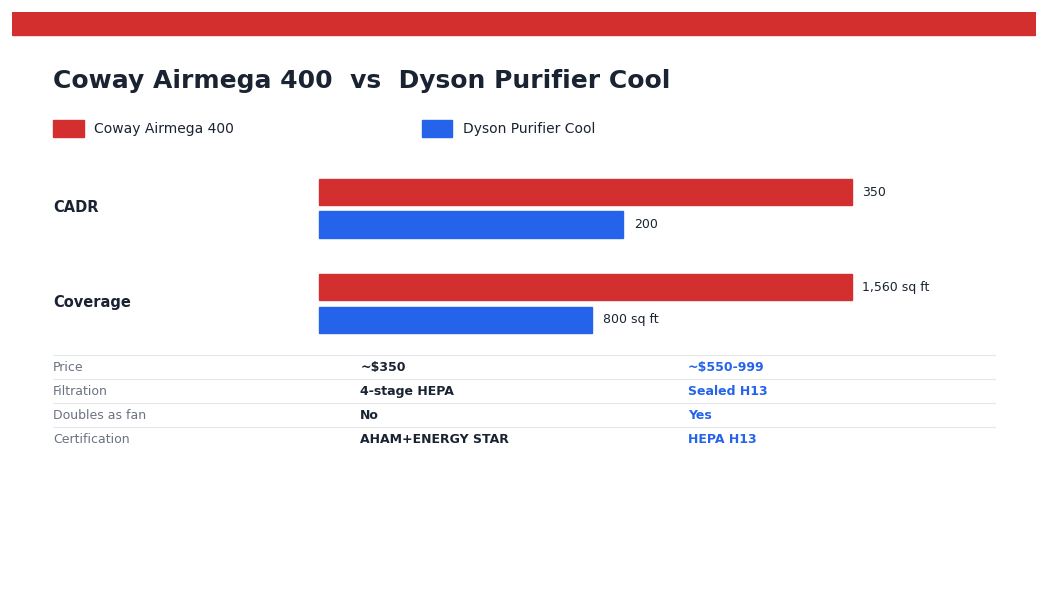
| Feature | Coway Airmega 400 | Dyson Purifier Cool |
|---|---|---|
| Typical price | ~$350 | ~$550–$999 |
| CADR | 350 (AHAM-certified) | ~170–373 (est., by model) |
| Coverage | Up to 1,560 sq ft | Up to ~800 sq ft |
| Filtration | 4-stage + True HEPA + ionizer | Sealed HEPA H13 + carbon |
| Doubles as a fan | No | Yes (cooling airflow) |
| Air-quality display | App + auto sensor | LCD + app + live sensors |
| Certification | AHAM + ENERGY STAR | Sealed HEPA H13 |
Which Should You Buy?
Buy the Coway Airmega 400 if you want the most clean air per dollar, you need to cover a large or open-plan space, and you do not need a built-in fan or screen. At around $350 it delivers flagship-level CADR for a fraction of Dyson’s price, and its filters cost less over time.
Check Coway Airmega 400 Price on Amazon →
Buy the Dyson Purifier Cool if you want one device that also cools the room, shows live air-quality data on an LCD, and doubles as a design statement — and you are willing to pay two to three times more for that convenience and styling.
Check Dyson Purifier Cool Price on Amazon →
Frequently Asked Questions
Does the Dyson clean air better than the Coway?
Only its most expensive model (the Big Quiet) edges out the Coway 400 on CADR. The common Purifier Cool models actually clean more slowly than the $350 Coway.
Is the Coway Airmega 400 good for large rooms?
Yes — its 1,560 sq ft coverage and AHAM-certified 350 CADR make it one of the strongest whole-room purifiers at any price, let alone its cost.
Is a Dyson purifier worth the money?
Only if you value the extras — cooling fan, LCD air-quality display, and design. For filtration alone, the Coway delivers similar results for far less.