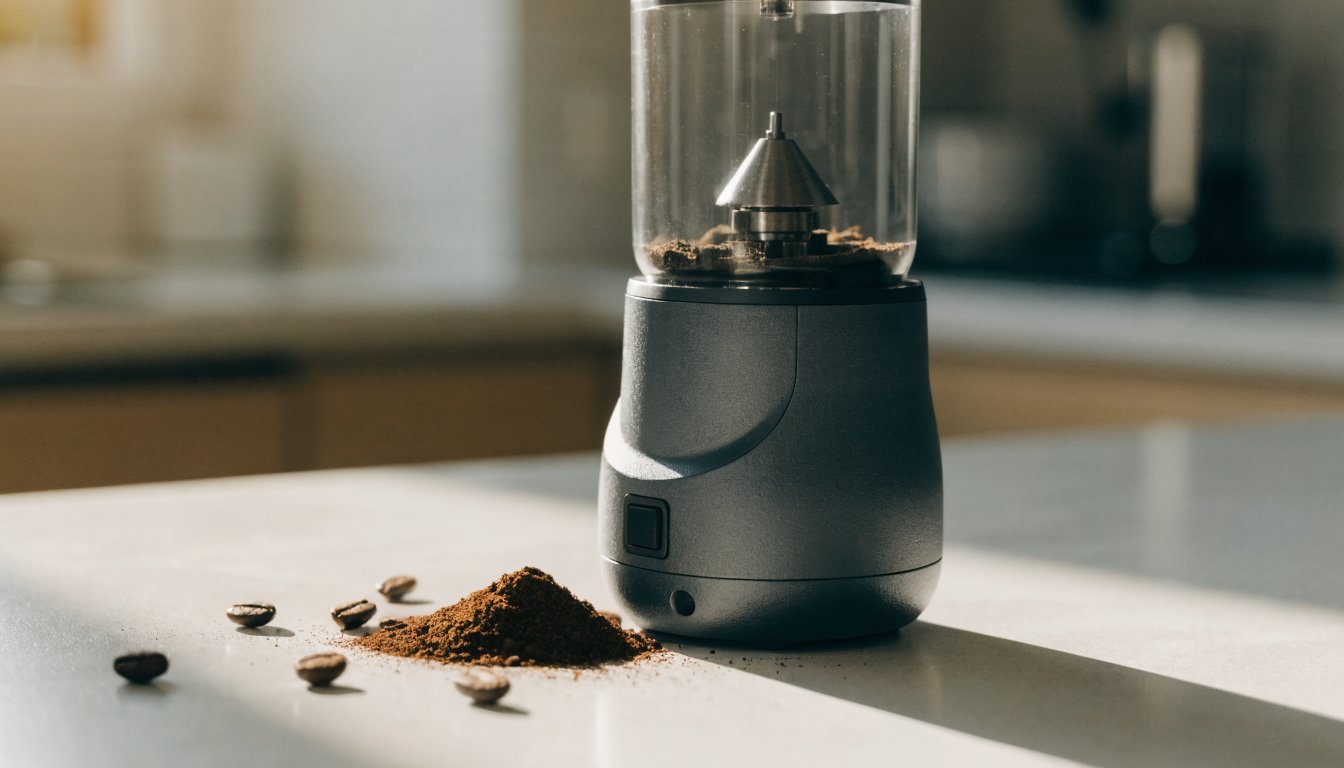
Quick answer: For most home brewers the best coffee grinder in 2026 is the Baratza Encore ESP — a 40mm conical burr grinder with 40 settings that handles everyday filter coffee and entry-level espresso, backed by Baratza’s repair support. Pure pour-over drinkers who want the most uniform grind should look at the flat-burr Fellow Ode Gen 2; budget shoppers get a real burr grind from the SHARDOR; and travelers should consider a manual 1Zpresso. Whatever you pick, a burr grinder is the single biggest upgrade in home coffee.
Here’s the counterintuitive truth about better coffee at home: the grinder matters more than the brewer. A great machine fed unevenly ground coffee still makes mediocre cups, because uneven particles extract unevenly — the fine dust turns bitter while the big chunks stay sour and weak, all in the same mug. Grind consistency fixes that, and it’s the reason a burr grinder is the upgrade seasoned coffee people recommend first. This guide explains burr versus blade, what actually matters when you shop, and seven current grinders for every budget from about $55 to $400.
As an Amazon Associate, we earn from qualifying purchases. This doesn’t affect which products we recommend.
Burr vs. blade: what’s the difference?
This is the decision that determines whether grinding your own beans is actually worth it.
Blade grinders spin a single blade that chops beans at random, like a tiny blender. The result is a bimodal grind — a mix of fine powder and large chunks — and the only way to control size is how long you hold the button, which is neither precise nor repeatable. Those uneven particles brew unevenly, the friction can scorch the grounds, and you never quite get the same cup twice. At $15–30 they’re genuinely fine for grinding spices or for a very casual drip drinker on the tightest budget, but that’s about it.
Burr grinders crush beans between two abrasive surfaces set a fixed distance apart. That gap sets the grind size, so you get uniform particles, even extraction, and repeatable settings — pick a number, get the same grind every time. It’s the single biggest flavor upgrade in home coffee, bigger than upgrading the brewer itself.
Within burr grinders you’ll see two shapes. Conical burrs (a cone spinning inside a ring) are the most common: quieter, more affordable, and excellent all-around. Flat burrs (two parallel toothed rings) can produce a marginally tighter, more uniform grind prized for “clarity,” but they’re often louder and pricier. The honest takeaway: grinder quality matters more than burr shape — a good conical beats a mediocre flat.
What matters when choosing a coffee grinder?
- Grind consistency — the whole point. Even particles, minimal fines.
- Settings range, not just count — does it reach espresso-fine and French-press-coarse? Range beats raw click count. Stepless adjustment helps for espresso; stepped is fine for filter.
- Espresso capability — espresso needs a fine grind and fine adjustment. Many filter grinders explicitly don’t do espresso.
- Static, mess, and retention — cheap grinders spray static-charged grounds and hold stale coffee; anti-static features and single-dosing help.
- Dosing workflow — a hopper grinds on demand and holds beans; single-dose means you weigh each batch for maximum freshness.
- Noise — matters in apartments; manual and slower electric grinders are quieter.
- Repairability — Baratza is the benchmark for parts and repair, which keeps a grinder alive for years.
The best coffee grinders of 2026
Baratza Encore ESP — Best overall
The Encore ESP is the best default for most people. Its 40mm conical burrs and 40 stepped settings span a dual range that grinds fine enough for entry-level espresso and coarse enough for French press — genuinely versatile in one affordable machine (approximately $200, as of 2026, subject to change). Backing it all is Baratza’s well-known repair and parts ecosystem. The stepped (not stepless) adjustment is a minor limit for espresso perfectionists, but for anyone who brews filter coffee and might dabble in espresso, nothing at this price does more.
Best for: almost everyone, especially drip-and-occasional-espresso households.
Baratza Virtuoso+ — Best premium all-around electric
A step up from the Encore, the Virtuoso+ pairs the same 40mm conical burrs with a faster motor and a 40-second digital timer for precise, repeatable dosing. It’s a refined choice for drip, pour-over, and French press. Note it grinds fine but isn’t ideal for true espresso — treat it as a premium filter grinder (approximately $250).
Best for: serious filter-coffee drinkers who want to step up without going manual or flat-burr.
Fellow Ode Gen 2 — Best for pour-over and filter
If your coffee is pour-over, drip, AeroPress, or French press, the Ode Gen 2 delivers near-commercial clarity. Its 64mm flat burrs produce outstanding uniformity, and thoughtful touches — anti-static tech, a magnetic catch cup, single-dose freshness, and quieter operation — make it a joy to use (approximately $400). One firm caveat: Fellow states the Ode is not intended for espresso, so pair it with the right method. Learn which brew styles suit it in our guide to coffee maker types.
Best for: filter-coffee enthusiasts chasing maximum grind uniformity.
SHARDOR Conical Burr Grinder — Best budget electric
Proof that a real burr grind doesn’t require a big spend: the SHARDOR (model CG026) brings 40mm stainless conical burrs, 51 settings, a large 12.5-oz hopper, a precise timer, and anti-static parts for well under $60. It’s a filter-first grinder — it reaches fine settings, but consistency at true espresso-fine can’t match a dedicated espresso grinder — yet for someone upgrading from a blade, it’s a night-and-day improvement (approximately $57).
Best for: first-time burr buyers on a budget.
OXO Brew Conical Burr Grinder — Best around $100
The OXO Brew is the dependable, name-brand pick in the middle of the range. Its stainless conical burrs, 15 settings plus micro-adjustments, and sturdy build make it a reliable all-purpose grinder for drip, pour-over, and French press (approximately $100, often on sale). It isn’t aimed at espresso precision, but as a no-fuss everyday grinder it’s widely loved and easy to find.
Best for: buyers who want a solid brand-name burr grinder around $100.
1Zpresso Q2 S — Best budget and travel manual
Tiny, light, and silent, the Q2 S is a manual grinder that punches far above its price. Its 38mm conical burrs and roughly 90 adjustment positions produce excellent grind quality for pour-over, AeroPress, and French press, and it’s compact enough to pack for trips (approximately $45–60). It isn’t built for espresso — the adjustment doesn’t go fine enough — and small burrs mean slower grinding, but for a quiet single-cup routine it’s hard to beat.
Best for: travelers, campers, and quiet-kitchen single-cup drinkers.
1Zpresso J-Ultra — Best espresso-capable manual
The J-Ultra is widely rated the best all-round manual grinder of 2026. A 48mm coated conical burr set with an external numbered dial adjusting in 8-micron steps gives fine, repeatable control for both espresso and filter, and the “find-zero” dialing makes it easy to live with. It costs as much as some electrics (approximately $199) and grinding an espresso dose by hand is real effort, but the grind quality rivals pricier machines. If you want espresso, see our espresso machine types guide for the brewer side.
Best for: manual purists and hand-grinding espresso drinkers.
Also worth a look: the Baratza Sette 270 if electric espresso is your priority, the classic filter-only Baratza Encore for a lower price, and the Timemore Chestnut C3 as another strong budget manual.
What grind size for each brew method?
Match the grind to the brew time: finer grinds extract faster (and turn bitter if too fine), coarser grinds extract slower (and go sour or weak if too coarse).
| Brew method | Grind size | Texture |
|---|---|---|
| Espresso | Fine | Powdery, like table salt or finer |
| Moka pot | Fine–medium | Between espresso and drip |
| AeroPress | Fine to medium | Varies by recipe |
| Pour-over (V60, Chemex) | Medium-fine to medium | Table salt to sand |
| Automatic drip | Medium | Like sand |
| French press | Coarse | Like sea salt |
| Cold brew | Extra coarse | Coarsest setting |
Common mistakes when buying a coffee grinder
- Buying a blade to save money and getting uneven, disappointing coffee — the uniform grind is the entire reason to grind fresh.
- Mismatching grinder to method — expecting espresso from a filter-only grinder like the Fellow Ode, or buying an espresso grinder for drip only.
- Chasing “more settings” — range and consistency matter more than click count.
- Ignoring static and retention — cheap grinders spray grounds and hold stale coffee.
- Overpaying for features you won’t use, or underbuying a blade and re-buying later.
- Buying no-support brands — repairability keeps a grinder running for years.
- Upgrading the brewer before the grinder — the grinder has the bigger impact on your cup. If convenience is the goal instead, a single-serve coffee maker may fit better than a grind-and-brew setup.
Frequently asked questions
Is a burr grinder worth it?
Yes — it’s the single biggest upgrade for home coffee. Uniform particle size gives even extraction, which means sweeter, more balanced, repeatable coffee, unlike the random chop of a blade grinder.
Can I grind espresso with a blade grinder?
Not reliably. Espresso needs a very fine and very uniform grind with fine adjustability. A blade produces uneven dust and chunks that can’t be dialed in, leading to channeling and a harsh, unbalanced shot.
Manual or electric — which should I get?
Manual grinders like the 1Zpresso deliver excellent grind quality for the money, run silently, and travel well, but require effort (an espresso dose by hand is a workout). Electric grinders win on convenience and speed, especially for multiple cups a day or for espresso.
Conical or flat burr — which is better?
Both make great coffee. Flat burrs can yield a marginally more uniform grind prized for clarity, while conical burrs are typically quieter, cheaper, and excellent all-around. Grinder quality matters more than burr shape.
How many grind settings do I need?
Focus on range over count. Around 40 stepped settings, like the Baratza Encore ESP, covers most brewing. Espresso benefits from finer micro-adjustment to dial in shots precisely.
Do I need a separate grinder for espresso?
Espresso demands fine grinding plus fine adjustment, so choose an espresso-capable grinder such as the Baratza Encore ESP, the Sette 270, or a manual 1Zpresso J-Ultra. Filter-focused grinders like the Fellow Ode Gen 2 aren’t built for it.
What about static, mess, and grind retention?
It’s a real daily annoyance. Look for anti-static features (the Fellow Ode and SHARDOR have them) and consider single-dose grinders, which hold fewer stale grounds between uses.
How much should I spend on a coffee grinder?
About $55–60 gets a legitimate entry burr grinder (SHARDOR); around $100 buys a dependable OXO; roughly $200 hits the sweet spot with the Baratza Encore ESP; and $250–400 gets premium filter (Fellow Ode Gen 2) or dedicated espresso grinding.
The bottom line
If you do one thing to improve your coffee, make it a burr grinder. The Baratza Encore ESP is the best all-around pick for most people, the Fellow Ode Gen 2 is the filter specialist, the SHARDOR proves you don’t need to overspend, and the 1Zpresso manuals are superb for travel and espresso on a budget. Pair the right grinder with the right method and every cup gets noticeably better. Next, dial in your brewer with our guides to coffee maker types and keeping it clean with how to descale a coffee machine.
Related: our favorite kitchen gadgets under $50 — 7 tested tools worth the drawer space.