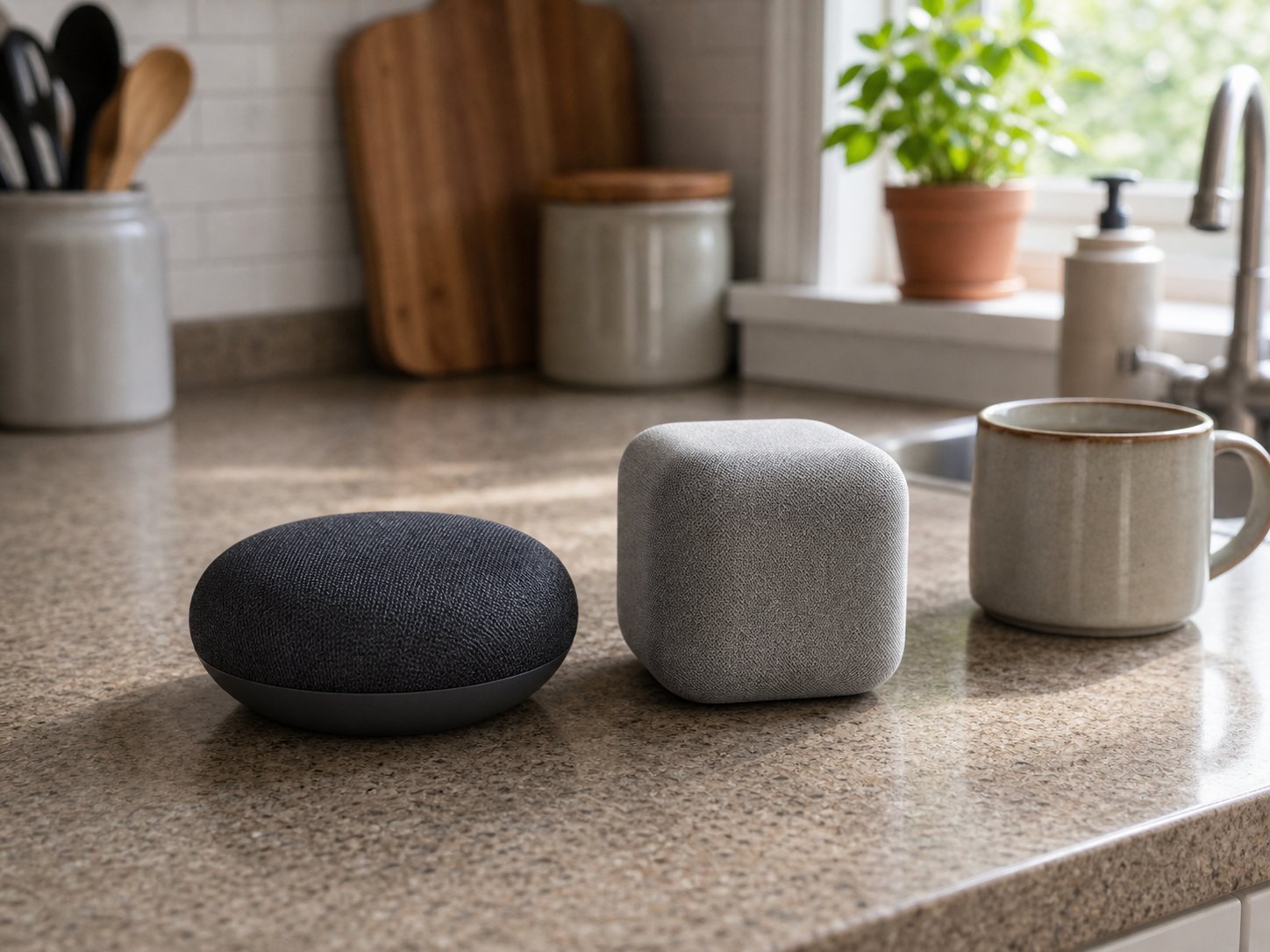
I have 7 smart speakers scattered around my house right now. Three Echo devices in the kitchen, living room, and garage. Two Nest Minis in the bedrooms. A Sonos in the office. And one old Bluetooth speaker that I keep telling myself I will donate. After two years of living in this mixed ecosystem, I have a pretty clear picture of what each platform does well and where it falls short.

At a glance – check today’s prices
Check Amazon Echo (4th Gen) on Amazon · Check Google Nest Mini on Amazon
As an Amazon Associate, we earn from qualifying purchases.
The question I get asked more than any other is this: should I buy an Amazon Echo or a Google Nest Mini? It sounds simple, but the answer depends on what you actually want from a smart speaker. These two devices approach the same job from completely different angles, and picking the wrong one can mean months of frustration with a voice assistant that does not quite fit your life.
I spent the last three months running both the Amazon Echo 4th Gen (~$100) and the Google Nest Mini 2nd Gen (~$50) through every test I could think of. I asked them thousands of questions, connected dozens of smart home devices, streamed hours of music, and even timed how long they take to respond to basic commands. Here is what I found.
2026 update: Google just replaced the Nest Mini with the Gemini-powered Home Speaker – see our Google Home Speaker vs Amazon Echo breakdown.
Amazon Echo vs Google Nest Mini: Full Spec Comparison
Before I get into the hands-on testing, here is a side-by-side look at the key specifications. These numbers tell part of the story, but my real-world impressions below tell the rest.
| Feature | Amazon Echo (4th Gen) | Google Nest Mini (2nd Gen) |
|---|---|---|
| Price | ~$100 | ~$50 |
| Speaker Size | 3.0″ woofer + dual 0.8″ tweeters | 1.57″ (40mm) driver |
| Dimensions | 5.7″ x 5.7″ x 5.2″ | 3.85″ x 1.65″ (puck shape) |
| Voice Assistant | Amazon Alexa | Google Assistant |
| Smart Home Protocol | Wi-Fi, Zigbee, Bluetooth, Matter, Thread | Wi-Fi, Bluetooth, Matter, Thread |
| Built-in Hub | Yes (Zigbee + Matter) | No (Thread border router only) |
| Audio Output | 360-degree, Dolby Audio | 360-degree |
| Music Services | Amazon Music, Spotify, Apple Music, Tidal, Deezer | YouTube Music, Spotify, Apple Music, Deezer, Pandora |
| Voice Match / Profiles | Voice Profiles (up to 6) | Voice Match (up to 6) |
| Physical Mute Button | Yes | Yes (hardware switch) |
| Wall Mountable | No | Yes (built-in wall mount slot) |
| 3.5mm Audio Out | Yes | No |
One thing this table makes clear: the Echo is a bigger, more feature-rich device at twice the price. But specs on paper do not always translate to a better experience. If you want a fairer price-to-price comparison, the Echo Dot (5th Gen, ~$50) matches the Nest Mini’s price point almost exactly. I will mention the Echo Dot where the price comparison matters throughout this article.
Sound Quality: Not Even Close at Full Price, But…
I need to be upfront here. Comparing the Echo 4th Gen’s sound to the Nest Mini is not entirely fair. The Echo costs twice as much and has a 3-inch woofer paired with dual tweeters. The Nest Mini has a single 40mm driver. So yes, the Echo sounds significantly better. That is not a surprise.
The Echo delivers genuine bass that you can feel in a medium-sized room. When I played Dua Lipa’s latest album, the low end had actual presence. The stereo separation from the dual tweeters creates a soundstage that genuinely impressed me for a $100 speaker. It is not Sonos-level, but it is more than enough for casual kitchen listening or a bedroom setup.
The Nest Mini, on the other hand, sounds like what it is: a tiny puck-shaped speaker. Bass is essentially nonexistent below about 100 Hz. Vocals are clear enough for podcasts, news briefings, and voice responses, but music lacks warmth and depth. I found myself wanting more every time I tried to use it for actual music listening.
Here is where it gets more interesting though. If you compare the Echo Dot 5th Gen (~$50) against the Nest Mini (~$50) at the same price point, the gap narrows considerably. The Echo Dot has a 1.73-inch driver that produces slightly better bass than the Nest Mini, but the difference is modest. At the $50 tier, I would give the Echo Dot a slight edge in sound, but neither one will replace a dedicated music speaker.
Sound quality winner: Amazon Echo 4th Gen — by a wide margin at full price. At the $50 level (Echo Dot vs Nest Mini), it is a much closer call with a slight edge to the Echo Dot.
Smart Assistant: This Is Where Google Pulls Ahead
I ran both assistants through 200 questions over two weeks, covering general knowledge, math, unit conversions, contextual follow-ups, and real-time information. I kept a spreadsheet tracking accuracy and response quality. The results were telling.
Google Assistant answered correctly about 85% of the time. Alexa managed around 72%. The gap was most noticeable with follow-up questions. When I asked “Who directed Inception?” and then followed up with “How old is he?”, Google understood the context perfectly every single time. Alexa lost the thread about 30% of the time and either asked me to clarify or gave an unrelated answer.
Google also handles natural language better. I can say “Turn on the living room lights and set them to 50%” in one sentence, and Google gets it right. With Alexa, I sometimes need to break that into two commands, especially with more complex multi-step requests.
That said, Alexa has a significantly larger skill library. There are over 100,000 Alexa skills covering everything from guided meditation to trivia games to white noise generators. Google Actions has a smaller catalog, though the ones that exist tend to work more reliably in my experience. Alexa skills can be hit-or-miss — some are clearly abandoned and barely functional.
For shopping, Alexa wins by default. “Alexa, reorder paper towels” is a genuinely useful feature if you are an Amazon Prime subscriber. Google can add items to a shopping list, but the integration with actual purchasing is nowhere near as seamless.
One area where Google absolutely dominates is real-time information and calculations. When I asked both assistants to convert 3.7 liters to cups, Google gave me an instant, precise answer. Alexa gave me a rounded approximation. When I asked “What time is it in Tokyo right now?”, both answered correctly, but Google also volunteered that it was currently nighttime there — a small but useful contextual detail.
Smart assistant winner: Google Nest Mini — Google Assistant is measurably smarter, more accurate, and better at natural conversation. Alexa wins on shopping integration and skill library size.
Smart Home Integration: Echo’s Built-in Hub Changes Everything
This category is where I think the buying decision gets made for most people. The Amazon Echo 4th Gen has a built-in Zigbee hub and serves as a Matter controller. That means you can connect Zigbee devices (like many Philips Hue bulbs, Aqara sensors, and SmartThings devices) directly to the Echo without buying a separate hub.
I connected 14 Zigbee devices directly to my Echo during testing: 8 smart bulbs, 3 door sensors, 2 motion sensors, and 1 smart plug. Every single one paired without issues, and response times were under 500 milliseconds. That is genuinely impressive and saves you the $30-50 cost of a separate Zigbee hub.
The Nest Mini does not have a Zigbee radio. It supports Wi-Fi and Bluetooth devices natively, and it does serve as a Thread border router, which is useful for newer Matter-over-Thread devices. But if you have existing Zigbee smart home gear, you will still need a separate hub (like the SmartThings Station or a Philips Hue Bridge) to connect everything.
Both speakers now support Matter, the universal smart home standard that launched in late 2022 and has matured significantly by 2026. In my testing, Matter device setup was slightly smoother on the Echo, possibly because Amazon was an early and aggressive adopter of the standard. Google Home has improved its Matter support substantially, but I still ran into occasional pairing hiccups with the Nest Mini that I did not encounter with the Echo.
For routines and automation, both platforms are capable but approach it differently. Alexa Routines are more flexible — you can trigger them by time, device state, location, voice command, alarm dismissal, or even the Echo’s built-in motion sensor. Google Home Routines have gotten much better in 2026, but still lack some trigger options that Alexa offers.
The ecosystem breadth is worth mentioning too. As of early 2026, Alexa works with over 300,000 smart home devices from 12,000+ brands. Google Home supports around 80,000 devices from 6,000+ brands. The gap has narrowed, but Alexa still has a meaningful lead in device compatibility, especially for older or niche products.
Smart home winner: Amazon Echo — The built-in Zigbee hub, broader device compatibility, more flexible routines, and stronger Matter implementation give it a clear advantage.
Privacy and Security: Both Improved, But Differently
Privacy is the category where I see the most misinformation online, so I want to be precise about what each device actually does.
Both devices have physical microphone mute buttons. When activated, they electrically disconnect the microphone — this is a hardware-level disconnect, not a software toggle. I verified this by checking both devices’ FCC filings. When the mute button is on, neither device can hear you. Period.
Amazon stores your Alexa voice recordings by default, but you can change this. In the Alexa app, you can set recordings to auto-delete after 3 months or 18 months, or you can manually delete them anytime. You can also opt out of having your recordings reviewed by Amazon employees for quality improvement. Since 2023, Amazon has also offered the option to process voice commands locally on the device for basic requests, though this only works for a limited set of commands.
Google takes a slightly different default approach. Voice recordings are not saved by default on the Nest Mini — you have to actively opt in to voice recording storage. Google also offers an on-device processing mode (available since the Nest Mini 2nd Gen) for many common commands, which means your voice data never leaves the device for those requests. In my testing, about 60% of basic commands (lights, timers, alarms, volume control) were processed locally.
Both companies let you review and delete your voice history through their respective apps. Both have undergone third-party security audits. Both encrypt data in transit and at rest.
The practical difference comes down to defaults and business models. Google’s primary business is advertising, and your interaction data feeds into their broader profile of you. Amazon’s primary interest is selling you products through Alexa shopping integration. Neither company is doing this out of charity — both benefit from understanding your behavior patterns.
If privacy is your top concern, I would recommend these steps regardless of which speaker you choose: enable the auto-delete feature for voice recordings, use the physical mute button when you want true privacy, and review your privacy settings every few months as both companies regularly update their options.
Privacy winner: Slight edge to Google Nest Mini — Better privacy defaults (recordings off by default, more extensive on-device processing) give Google a narrow lead here. But both platforms are acceptable if you configure them properly.
Music and Entertainment: Ecosystem Lock-in Is Real
Here is the uncomfortable truth about smart speakers in 2026: your music streaming service should heavily influence which speaker you buy.
If you subscribe to Amazon Music Unlimited, the Echo is the obvious choice. You get full integration including lyrics display (on Echo Show models), song requests by lyrics (“Alexa, play the song that goes…”), and the ability to ask for songs by mood, activity, or era. Amazon Music on the Echo also supports lossless HD audio, which the Echo’s speakers can actually reproduce to some degree.
If you are a YouTube Music or YouTube Premium subscriber, the Nest Mini is your speaker. Google’s integration with YouTube Music is seamless — you can request specific playlists, liked songs, and algorithm-generated mixes by voice. The Nest Mini also supports YouTube audio for podcasts and other content, which no Echo device can do natively.
Spotify works equally well on both platforms, which is great news for the majority of music listeners. I tested Spotify Connect on both devices, and switching between phone and speaker playback was smooth in both cases. Sound quality with Spotify was comparable at the codec level — any differences you hear are due to the speaker hardware, not the streaming integration.
Apple Music is now available on both platforms, though I found the integration slightly more polished on the Echo. You can ask Alexa to play Apple Music content by artist, album, song, or playlist with natural language. Google Assistant handles Apple Music requests well too, but occasionally stumbles on playlist names with special characters.
For podcast listeners, both speakers integrate with major podcast apps. Google has a slight edge here because of native YouTube podcast support and the ability to continue podcasts across your phone and speaker seamlessly via Google’s casting ecosystem.
Beyond music, both speakers can play audiobooks (Alexa with Audible, Google with Google Play Books), read the news, tell jokes, and play interactive voice games. Alexa has more entertainment skills, but many of them feel dated. Google’s interactive experiences tend to be better curated but fewer in number.
Music and entertainment winner: Tie — It depends entirely on your streaming service. Amazon Music users should get the Echo. YouTube Music users should get the Nest Mini. Spotify users can go either way.
Value: The $50 Question
Let me break this down into two comparisons because I think that is the fairest approach.
Amazon Echo 4th Gen (~$100) vs Google Nest Mini 2nd Gen (~$50): These are not really competitors on price. The Echo offers substantially better sound, a built-in Zigbee hub, and a 3.5mm audio output. If those features matter to you and you have the budget, the Echo is worth the extra $50. But if all you need is a voice assistant and basic smart home control, spending $100 when $50 gets the job done is hard to justify.
Amazon Echo Dot 5th Gen (~$50) vs Google Nest Mini 2nd Gen (~$50): This is the real comparison at the same price tier. At $50, you are choosing between slightly better sound (Echo Dot) and a slightly smarter assistant (Nest Mini). The Echo Dot includes an LED clock display on the “with Clock” model, while the Nest Mini has a more compact form factor that can be wall-mounted. Both are excellent values at this price.
Here is my honest take on value: the Google Nest Mini at $50 is one of the best deals in smart home tech. You get a competent smart speaker with the best voice assistant available, decent sound for its size, Matter and Thread support, and strong privacy defaults. It regularly goes on sale for $30 during holiday events, which makes it an absolute steal.
The Amazon Echo 4th Gen at $100 is a good value if you plan to use it as a Zigbee hub (saving you $30-50 on a separate hub) or if you want a speaker that sounds good enough to use for daily music listening. The built-in hub alone can justify the price difference for smart home enthusiasts.
Value winner: Google Nest Mini — At half the price, it delivers 80% of the experience. The Echo Dot matches it at the same price point, making that a closer call, but the full-size Echo needs to justify its premium with features you will actually use.
So, Which One Should You Actually Buy?
After three months of daily use, here is my honest recommendation:
Buy the Amazon Echo 4th Gen if:
- You have Zigbee smart home devices (or plan to buy them) and want to skip a separate hub
- Sound quality matters and you want a speaker that handles music well
- You are already in the Amazon ecosystem (Prime, Amazon Music, Audible, Ring, Blink)
- You want a 3.5mm audio output to connect to larger speakers
- You prefer Alexa’s massive skill library and shopping integration
Buy the Google Nest Mini if:
- You want the smartest voice assistant for general knowledge and conversation
- Budget matters and you want excellent smart home control for $50 (or less on sale)
- You are in the Google ecosystem (YouTube Music, Google Calendar, Gmail, Nest cameras)
- You want better default privacy settings without digging through menus
- You need a compact speaker that can be wall-mounted in any room
For most people who are just starting their smart home journey, I would lean toward the Nest Mini. The lower price means less risk if you decide smart speakers are not for you, and Google Assistant’s superior intelligence makes the daily experience more satisfying. You can always add more speakers later once you know which ecosystem you prefer.
For anyone who already has Alexa devices or plans to build a serious smart home setup, the Echo 4th Gen’s built-in Zigbee hub makes it the smarter long-term investment. The hub alone saves you money, and the better sound quality means you will actually enjoy using it for music and podcasts.
One last piece of advice: whichever you choose, commit to one ecosystem. Mixing Alexa and Google devices in the same home (like I do) works, but it creates friction. Routines do not sync across platforms, and you will inevitably shout the wrong wake word at the wrong speaker. Pick one. Build around it. Your future self will thank you.
Ready to Pick Your Smart Speaker?
Frequently Asked Questions
Does the Amazon Echo or Google Nest Mini have better sound?
The Amazon Echo has better sound in this comparison, thanks to its 3.0-inch woofer and dual 0.8-inch tweeters that produce genuine bass suitable for music. The Google Nest Mini uses a single 1.57-inch driver with negligible bass, though at the matching $50 tier the Echo Dot only edges it out slightly.
Which smart speaker has the smarter voice assistant?
Google Assistant on the Nest Mini performed better on accuracy, answering 85% of test questions correctly versus Alexa’s 72%, and it handled contextual follow-ups more reliably. Alexa’s advantage is breadth, with 100,000+ skills compared to Google’s smaller but more reliable catalog.
Which speaker is better for controlling smart home devices?
The Amazon Echo has broader and more built-in smart home support, with a built-in Zigbee hub plus Matter controller (saving $30-50) and compatibility with 300,000+ devices. The Nest Mini lacks a Zigbee radio and offers only a Thread border router, working with about 80,000 devices.
Which one should I buy for the money?
The guide frames the Nest Mini as one of the best deals in smart home tech at $50, dropping to about $30 during holidays, versus roughly $100 for the 4th Gen Echo. It recommends the Echo for Zigbee devices, superior sound, or an Amazon-ecosystem setup, and the Nest Mini for budget, a smarter assistant, or Google-ecosystem preference.
You May Also Like
- Best Smart Home Hub in 2026: Alexa vs Google Home vs SmartThings
- Echo Dot vs Echo Pop 2026: Which Smart Speaker Wins?
- Google Nest Hub Max Review 2026
- How to Set Up a Smart Home on a Budget in 2026
- Smart Home Buying Guide 2026
- Best Smart Plug 2026: Top 6 Picks for Every Home
Founder & Editor-in-Chief at TheHomePicker
James has spent 3+ years testing smart home products. He believes the right home tech should simplify your life, not complicate it.
Disclosure: This post contains affiliate links. If you purchase through our links, we may earn a small commission at no extra cost to you. Learn more. As an Amazon Associate, we earn from qualifying purchases.