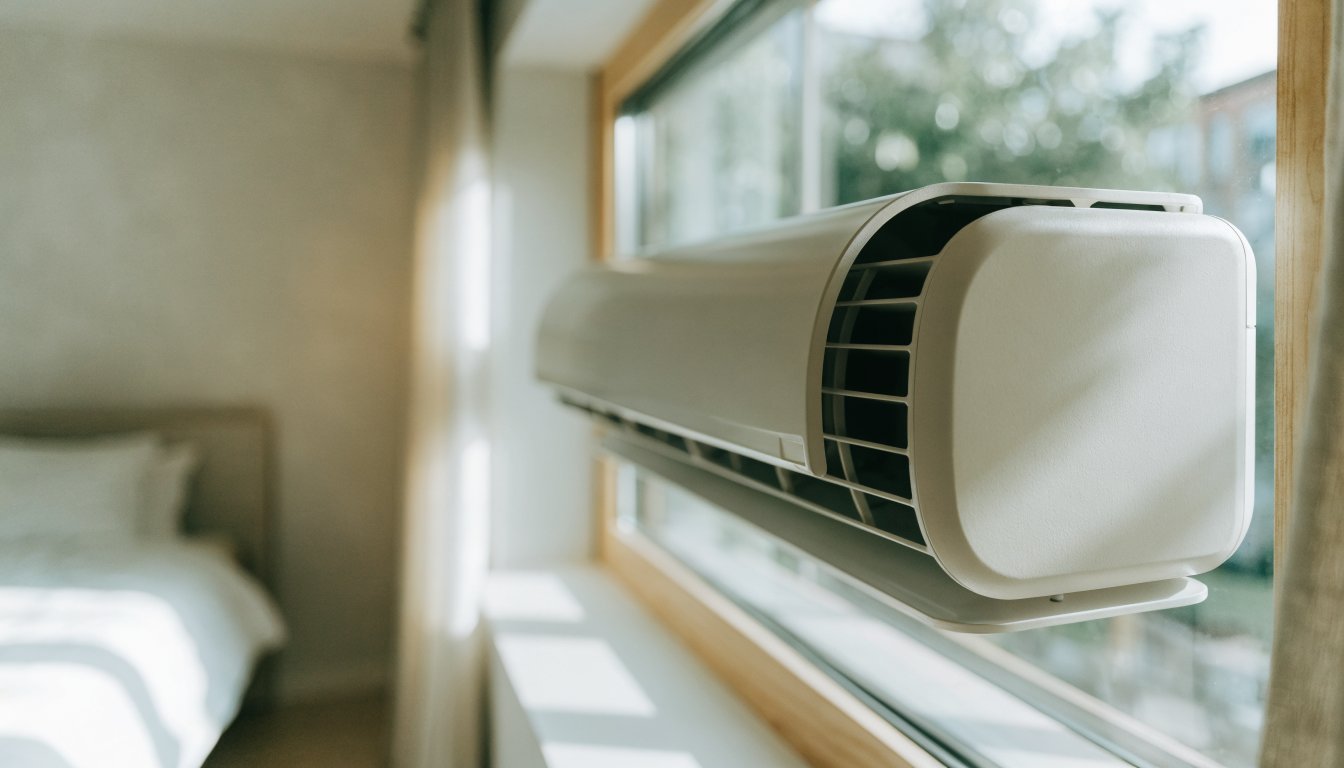
Quick answer: The best window air conditioner for most people in 2026 is the Midea U-Shaped Inverter (8,000 BTU) — its U-shaped design lets the window close through the middle, dropping noise to as low as ~32 dBA while inverter efficiency cuts running costs, cooling rooms up to ~350 sq ft. Bigger room? Step up to the 10,000 BTU version. Want to keep your view? The GE Profile ClearView. Large space? The LG Dual Inverter (14,000 BTU). Tight budget? The Amazon Basics 8,000 BTU. Size it to your room first — bigger is a mistake, not an upgrade.
A window air conditioner is still the most cost-effective way to cool a room: it vents heat straight outside, so it delivers more cooling per BTU (and per dollar) than a portable, and the newest inverter and U-shaped models are quiet enough for a bedroom. The two things people get wrong are sizing (bigger is worse, not better) and buying a loud budget box when an inverter would pay for itself. This guide gives you a BTU sizing chart, the window-versus-portable truth, and seven current units for every room and budget.
As an Amazon Associate, we earn from qualifying purchases. This doesn’t affect which products we recommend.
What size window AC do you need?
Sizing is the single most important decision — and “bigger to be safe” is the classic mistake. An oversized unit cools the air fast, then shuts off before it pulls the humidity out, leaving the room cold and clammy while the compressor short-cycles. An undersized unit runs non-stop and never catches up. Use this ENERGY STAR / DOE guideline (for 8-ft ceilings):
| Room size | Cooling needed |
|---|---|
| 100–150 sq ft | 5,000 BTU |
| 150–250 sq ft | 6,000 BTU |
| 250–300 sq ft | 7,000 BTU |
| 300–350 sq ft | 8,000 BTU |
| 400–450 sq ft | 10,000 BTU |
| 450–550 sq ft | 12,000 BTU |
| 550–700 sq ft | 14,000 BTU |
Then adjust: add ~10% for a very sunny room (subtract ~10% if heavily shaded), add ~4,000 BTU for a kitchen, and ~600 BTU per extra regular occupant. Inverter units modulate their output, so they tolerate being right-sized far better than a fixed-speed box — another reason not to oversize.
Window AC vs. portable AC: which is better?
They solve different problems. A window unit wins on efficiency, cost, and quiet-in-the-room: it vents heat directly outside through the sealed back, so it delivers more usable cooling per BTU, and its compressor sits outside the sash (on U-shaped models the closed window muffles it further). A single-hose portable keeps the whole compressor inside and re-heats itself by exhausting already-cooled air, so real-world cooling lags the label — but it’s the answer when your window can’t take a box unit (casement or narrow sliding windows), your building bans window units, or you need to roll it room to room. For the full portable rundown, see our guide to the best portable air conditioners.
What matters when buying a window AC?
- BTU sizing (above) — right-size, don’t oversize.
- Inverter vs. standard compressor — a standard compressor is full-on or off, so it cycles loudly and swings the temperature; an inverter varies its speed to hold steady, running ~25–35%+ more efficiently and much quieter. Every premium pick below is an inverter.
- U-shaped vs. traditional — a U-shaped unit straddles the sash so the window closes through the middle, blocking outdoor and compressor noise (the quietest window ACs are all U-shaped) and letting you keep the window operable. It needs a standard double-hung window with enough sill depth.
- Noise (dBA) — anything at or under ~45 dBA is bedroom-friendly; the quietest inverters advertise low-40s to low-30s on low, while budget standard units run low-to-mid 50s.
- Smart / WiFi — app scheduling and Alexa/Google are now standard mid-range and up; nice for pre-cooling, not essential.
- Window fit — measure your window width against the unit’s side-panel range and confirm double-hung vs. casement before buying.
The best window air conditioners of 2026
Midea U-Shaped Inverter (8,000 BTU) — Best overall and quietest
The Midea U is the window AC to beat. Its U-shaped saddle design lets the window sash close through the middle of the unit, blocking outside noise and dropping the compressor to as low as ~32 dBA on its quietest setting — dramatically quieter than a traditional box. Add inverter efficiency (Midea claims ~35% savings over a standard unit), Energy Star certification, and WiFi with Alexa and Google, and it’s the best all-around choice for a bedroom, office, or apartment room up to ~350 sq ft (approximately $300–380, as of 2026, subject to change). It needs a standard double-hung window with adequate sill depth.
Best for: bedrooms and offices where quiet and efficiency matter most.
GE Profile ClearView — Best for keeping your view
Tired of a tall box blocking the window? The ClearView installs low in the sash with a see-through design that preserves most of your view and natural light, runs as low as ~40 dB, and packs a full smart-home feature set (WiFi, voice, geofencing, timers). Its inverter compressor cools rooms up to ~450 sq ft (approximately $430–530). You pay a premium for the design and there’s really only one mainstream size in the line, but nothing else disappears into a window like this.
Best for: buyers who hate how a box unit blocks the window.
Windmill WhisperTech — Best design and eco-refrigerant
The best-looking unit here, with a soft-white front, no vents facing into the room, and 45-degree upward airflow so it doesn’t blast you directly. It’s a variable-speed inverter starting around 42 dB, up to 15.0 CEER efficient, and uses low-GWP R32 refrigerant — a real plus for eco-minded buyers (approximately $379–469 across 8K–12K BTU). It’s sold mainly direct with an easy pre-assembled install kit; the trade-off is fewer in-store options and a fairly standard 1-year warranty.
Best for: renters and design-conscious buyers who want quiet, efficient, and good-looking.
LG Dual Inverter (LW1522IVSM, 14,000 BTU) — Best for large rooms
When you need to cool a big living room, studio, or open-plan space up to ~700 sq ft, LG’s Dual Inverter is the proven pick. It’s remarkably quiet for its capacity (~44 dB in sleep mode), Energy Star certified with LG advertising up to ~35% savings beyond the minimums, and app-controlled via ThinQ (approximately $500–600). It’s a traditional box that blocks the window and it’s heavy, so size it correctly — it’s overkill and clammy in a small room.
Best for: large bedrooms, living rooms, and studios up to ~700 sq ft.
Frigidaire Gallery Inverter — Best for smart auto-cooling
The Gallery inverter line runs notably quieter than a standard compressor and adds a built-in temperature/air-quality sensor that auto-adjusts cooling, plus a strong app ecosystem with Alexa and Google (approximately $560–620 for the 12,000 BTU covering ~550 sq ft; 8K and 10K sizes exist too). It’s pricey for the capacity and it’s a traditional box, and the “air-quality sensor” is a comfort feature rather than a true purifier — but for set-and-forget automation across a range of sizes, it delivers.
Best for: smart-home users who want auto-adjusting cooling in a medium-to-large room.
Amazon Basics Window AC (8,000 BTU) — Best budget
If you want the lowest upfront price, this no-frills 8,000 BTU unit cools up to ~350 sq ft for roughly half the cost of an inverter model (approximately $230–280). It uses a standard fixed-speed compressor, so it’s noticeably louder (low-to-mid 50s dBA), less efficient, and swings temperature as it cycles — but it’s simple, reliable, and cheap to replace. For a guest room or a short season, that trade can make sense.
Best for: renters, guest rooms, and anyone prioritizing the lowest price over quiet and efficiency.
Midea U-Shaped Inverter (10,000 BTU) — Best quiet unit for medium rooms
The step-up sibling of our top pick brings the same class-leading quiet (mid-30s dBA on low) and inverter efficiency, sized for a bigger bedroom or living room up to ~450 sq ft (approximately $400–460). Same U-shape benefits — the window still closes and locks — and the same requirement for a standard double-hung window with sill depth.
Best for: anyone who loves the Midea U but needs to cool a medium room.
Common mistakes when buying a window AC
- Buying too many BTUs “to be safe.” Oversizing means clammy, humid air and short-cycling. Match the chart, then adjust only for sun, kitchen, or occupancy.
- Not measuring the window. Check width against the unit’s side-panel range and confirm double-hung — most window ACs (especially U-shaped) won’t fit casement or narrow sliding windows.
- Ignoring sill depth and weight. U-shaped and large units need adequate sill depth and sometimes a support bracket; a 60–80 lb unit is a two-person install.
- Forgetting the seal. Gaps around the side panels waste cooling and let bugs in — use the foam and add weatherstripping.
- Choosing standard to save $40, then paying it back in electricity. If the unit runs all summer, an inverter’s efficiency and quiet usually justify the premium.
- Assuming any unit fits any outlet. Most 5,000–14,000 BTU units use a standard 115V outlet, but larger 18,000+ BTU units may need a dedicated or 230V circuit.
Frequently asked questions
What size window AC do I need?
Match BTUs to room size: about 5,000 BTU for 150 sq ft, 8,000 for ~350 sq ft, 10,000 for ~450 sq ft, 12,000 for ~550 sq ft, and 14,000 for ~700 sq ft. Add ~10% for a sunny room, ~4,000 BTU for a kitchen, and ~600 BTU per extra occupant. Don’t oversize — it leaves the room cold and humid.
Are inverter window ACs worth it?
For most people, yes. An inverter varies its compressor speed instead of cycling on and off, so it’s ~25–35%+ more efficient, holds a steadier temperature, and is much quieter — the quietest units are all inverters. If the AC runs most of the summer, the savings and comfort usually repay the higher upfront cost. For a rarely used guest room, a cheaper standard unit can make sense.
Window AC or portable AC — which is better?
For a standard double-hung window, a window unit is more efficient, cools more per BTU, is quieter inside, and costs less. Choose a portable only if your window can’t take a box unit, your building bans them, or you need to move it between rooms. See our portable AC guide for that route.
How noisy are window air conditioners?
It varies widely. Premium inverter and U-shaped units advertise as low as ~32–44 dBA on low — whisper to library quiet. Budget standard-compressor units typically run low-to-mid 50s dBA, a hum you’ll notice. For a bedroom, prioritize a low dBA rating and an inverter.
What is a U-shaped window AC and why is it quieter?
A U-shaped unit straddles the window sash so the window closes through the middle of the “U.” The closed glass sits between you and the compressor, blocking both outdoor and compressor noise — which is why U-shaped models are the quietest window ACs. Bonus: you can still open the window, and a closed, locked window is more secure. It needs a standard double-hung window with enough sill depth.
Do window air conditioners need to be drained?
Most modern units evaporate condensate out the back automatically, so day-to-day draining usually isn’t needed. On very humid days some models can accumulate water and may have a drain port — check your manual. Always install with the slight outward tilt the maker specifies so water flows outside, not onto your floor.
Can a window AC cool a whole apartment?
One unit cools one open space well — a 14,000 BTU unit can handle a large room or studio up to ~700 sq ft — but it won’t cool through walls into separate closed rooms. For a multi-room apartment, cool the main living area with a right-sized unit and add a smaller one in the bedroom. Our cooling gadgets for apartments guide covers the extras.
How much does it cost to run a window air conditioner?
It depends on BTUs, your electricity rate, and hours of use, but efficiency (CEER) is the lever. A high-CEER inverter model can cut running cost meaningfully versus a budget standard unit over a full season — often enough to offset the higher sticker price. Look for the Energy Star label and the yellow EnergyGuide estimate.
The bottom line
Size the unit to your room first, then pick the format: the Midea U-Shaped Inverter is the best all-around choice for quiet, efficient cooling (8,000 BTU for small rooms, 10,000 for medium), the GE Profile ClearView preserves your view, the LG Dual Inverter handles large spaces, and the Amazon Basics keeps costs down. Whatever you choose, right-size it and seal it well. If a window unit won’t work for your space, compare the best portable air conditioners instead.
Want a cheaper, low-power way to feel cooler that needs no window at all? See our guide to the best tower fans — just remember a fan cools you, not the room.
Cost check: for the ongoing running cost of home appliances, see our free appliance running-cost data — independent data, no affiliation, free to cite.