As an Amazon Associate, TheHomePicker.com earns from qualifying purchases. We only recommend products we would evaluate ourselves; affiliate links never affect our rankings.
Quick answer: There are three types of home espresso machine, and the right one depends on how much you want to do versus how much you want the machine to do. For most people, a semi-automatic is the best buy — it controls water pressure while you grind, tamp, and steam, giving real espresso quality at a fair price (about $300–1,500). Choose a super-automatic ($500–4,000+) if you want one-touch, hands-off lattes and will pay for the convenience. Choose a manual or lever machine ($100–700) only if espresso is a hobby you want to master. If you just want great coffee at home with a short learning curve, start semi-automatic.
The three types of espresso machine, explained
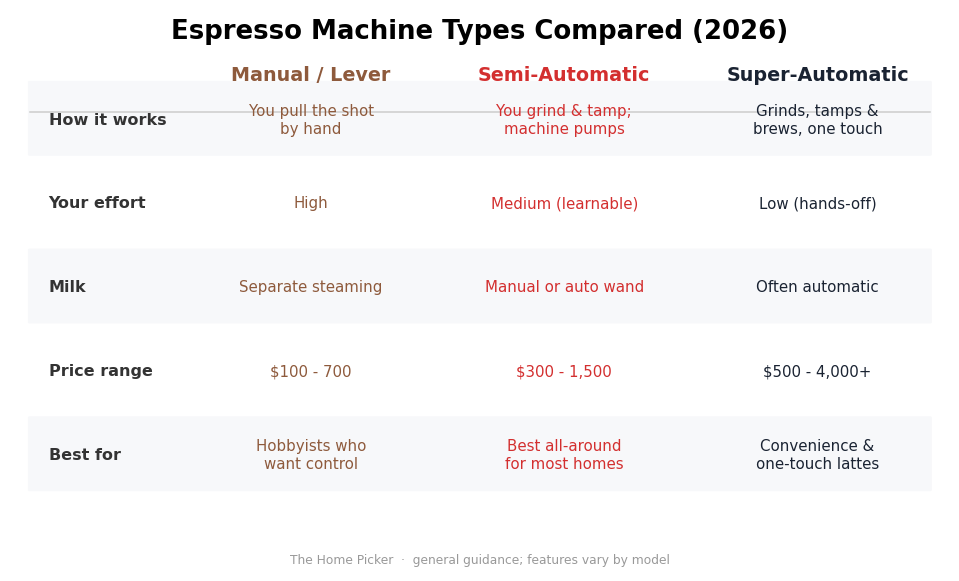
Every home espresso machine falls into one of three families, defined by how much of the process is automated. Understanding the difference is the single most useful thing you can do before spending money, because the “best” machine is really the one that matches how involved you want to be. Here is the quick comparison, then a plain-English breakdown of each.
| Type | How it works | Your effort | Price range | Best for |
|---|---|---|---|---|
| Manual / lever | You control pressure by hand | High | $100–700 | Hobbyists who want control |
| Semi-automatic | You grind & tamp; machine pumps water | Medium (learnable) | $300–1,500 | Best all-around for most homes |
| Super-automatic | Grinds, tamps & brews at one touch | Low (hands-off) | $500–4,000+ | Convenience & one-touch lattes |
What is a semi-automatic espresso machine? (best for most people)
A semi-automatic machine automates the hard part — delivering water at the correct espresso pressure — while leaving you in charge of grinding, dosing, tamping, and (on many models) steaming milk. That balance is why it is the most popular choice for home baristas: you get genuine control over shot quality without needing to master pressure by hand. Some semi-automatics include a built-in grinder and steam wand; others expect a separate grinder. If you want to learn real espresso technique without a steep wall, this is the category to start in. Our hands-on pick comparison, the Breville Bambino Plus vs Barista Express, walks through two of the most popular entry points — a compact model with automatic milk versus an all-in-one with a built-in grinder.
What is a super-automatic espresso machine? (best for convenience)
A super-automatic, also called a bean-to-cup machine, does everything at the push of a button: it grinds the beans, doses and tamps them internally, brews the shot, and on most models froths milk automatically for one-touch lattes and cappuccinos. You trade away fine control over grind and tamp, so a super-automatic generally will not hit the absolute peak a skilled user can reach on a good semi-automatic — but it is dramatically more convenient and endlessly consistent. If nobody in your house wants to learn technique, or you want café drinks in under a minute every morning, this is the category to buy in. Expect to pay more: capable models start around $500–1,000 and premium machines climb past $4,000.
What is a manual or lever espresso machine? (best for hobbyists)
Manual and lever machines put you fully in control of the shot: you generate or regulate the brewing pressure yourself, usually with a lever or a hand-driven mechanism. In skilled hands they can pull exceptional espresso, and many enthusiasts love the ritual and the connection to the process. But they demand real practice, a quality separate grinder, and a tolerance for the occasional bad shot while you learn. Unless espresso is a hobby you actively want to pursue, most home buyers are happier with a semi-automatic or super-automatic.
Which type is best for beginners?
If you want the shortest possible learning curve, a super-automatic removes almost all of it. If you want to actually learn espresso but not struggle, a semi-automatic with an automatic milk wand and a fast heat-up is the sweet spot — you get the fundamentals (grind, dose, tamp) without also having to master milk steaming on day one. What we would not recommend for a beginner is a bare manual machine, unless the craft itself is the point.
Do super-automatic machines make good espresso?
Yes — a good super-automatic makes consistently solid espresso with essentially no effort, which is exactly what most people want. The honest caveat is that giving up control of grind, dose, and tamp puts a ceiling on peak quality compared with a well-dialed semi-automatic. For daily lattes and cappuccinos where convenience matters most, that ceiling rarely bothers anyone. For chasing the perfect shot as a hobby, a semi-automatic gives you more room to improve.
How much should you spend?
Budget honestly by category. A capable semi-automatic starts around $300–500; a good entry super-automatic runs $500–1,000, with premium models well past $4,000; manual machines span $100–700 depending on build. The one thing to avoid is a sub-$100 “espresso maker,” which usually cannot reach true espresso pressure and leads most buyers to upgrade within a year. Spend once in the right category and you will be far happier.
👉 Prefer everyday coffee over espresso? Read Drip vs pour-over vs French press vs cold brew.
Frequently Asked Questions
What is the difference between a semi-automatic and a super-automatic espresso machine?
A semi-automatic machine handles the water pressure, but you grind, dose, and tamp the coffee and steam the milk yourself, so you control the result. A super-automatic (bean-to-cup) does all of that at the push of a button, grinding, tamping, brewing, and usually frothing milk automatically. Semi-automatics reward technique; super-automatics reward convenience.
Which type of espresso machine is best for beginners?
For most beginners, a semi-automatic with an automatic milk wand or a super-automatic is the easiest start. A super-automatic removes almost all the learning curve. A semi-automatic like the Breville Bambino Plus is beginner-friendly too, because it heats fast and steams milk automatically while still teaching you the basics.
Do super-automatic espresso machines make good espresso?
Yes, good super-automatics make consistently solid espresso with almost no effort, which is their whole appeal. They generally will not match the peak quality a skilled user can pull on a quality semi-automatic, because you give up control over grind, dose, and tamp. For most households the convenience is well worth that trade-off.
How much should you spend on an espresso machine?
Plan for at least $300-500 for a capable semi-automatic, or $500-1,000 for an entry super-automatic; premium super-automatics run to $4,000 or more. Very cheap sub-$100 espresso makers rarely produce true espresso pressure, so they are usually a false economy.
Is a manual or lever espresso machine worth it?
Only if espresso is a hobby you want to master. Manual and lever machines give you the most control and can pull outstanding shots, but they demand skill, a good separate grinder, and patience. For everyday coffee without the learning curve, a semi-automatic or super-automatic is the better buy.