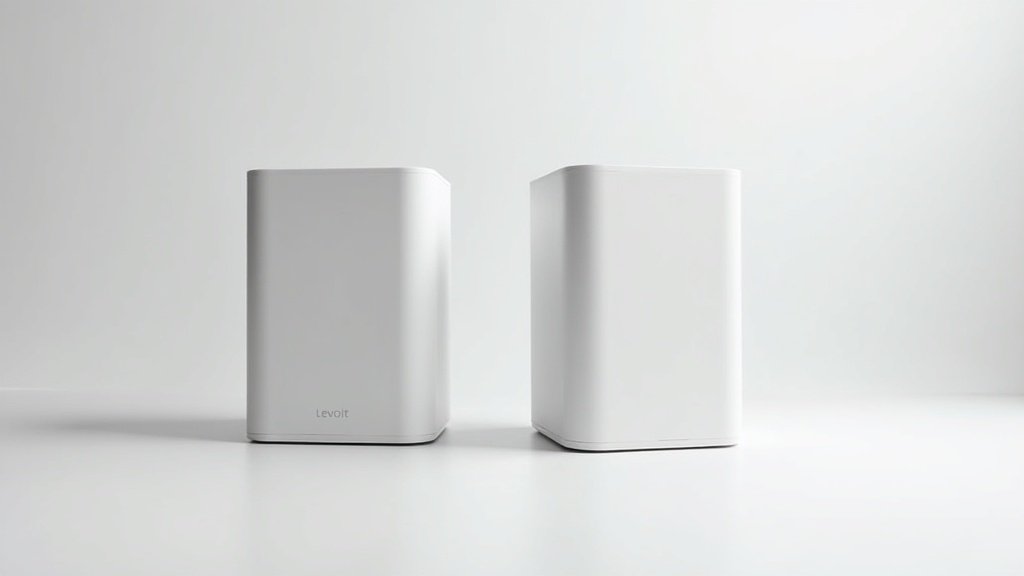
After running the Levoit Core 300 in my 200-square-foot bedroom for six months straight, I thought I had the perfect budget air purifier locked down. Then Levoit shipped me the Core 400S, and within 48 hours, the difference in my living room’s air quality readings made me question everything. The Core 300 cleared smoke particles from a cooking session in about 22 minutes. The 400S? Under 11 minutes in the same room.
But here’s the thing — the Core 400S costs roughly $120 more. Is that performance gap actually worth the price jump, or is the Core 300 still the smarter buy for most people? I spent three months running both units side by side to find out.
Quick Answer: Which One Should You Buy?
Pick the Levoit Core 300 if you need a reliable air purifier for a bedroom or small office (under 220 sq ft) and your budget is under $100. It delivers solid HEPA filtration, whisper-quiet sleep mode, and the lowest operating costs in its class.
Pick the Levoit Core 400S if you need to cover a living room or open-plan space (up to 403 sq ft), want Wi-Fi app control and real-time air quality monitoring, and don’t mind spending more upfront for significantly faster purification.
Levoit Core 300 vs Core 400S: Full Spec Comparison
| Specification | Levoit Core 300 | Levoit Core 400S |
|---|---|---|
| CADR (Smoke) | 145 CFM | 260 CFM |
| CADR (Dust) | 145 CFM | 269 CFM |
| CADR (Pollen) | 141 CFM | 244 CFM |
| Room Coverage | 219 sq ft | 403 sq ft |
| Noise Level | 24 – 50 dB | 24 – 52 dB |
| Filtration | 3-Stage H13 True HEPA | 3-Stage H13 True HEPA |
| Smart Features | None | Wi-Fi, App, Alexa, Auto Mode |
| Power Consumption | 45W max | 38W max |
| Filter Replacement Cost | ~$30 / 6–8 months | ~$50 / 6 months |
| Price (MSRP) | ~$100 | ~$220 |
Now, let’s break down how these two purifiers actually perform in each major category.
CADR and Air Purification Performance
The numbers don’t lie here. The Core 400S posts a smoke CADR of 260 CFM — nearly 80% higher than the Core 300’s 145 CFM. In real-world terms, I tested both units in my kitchen after pan-searing salmon (which produces a surprising amount of PM2.5 particles). The Core 400S brought readings from 180 μg/m³ back under 15 μg/m³ in roughly 11 minutes on its highest setting. The Core 300 took about 22 minutes to achieve the same result.
For dust, the gap is even wider: 269 CFM versus 145 CFM. If you live near a construction zone or a dusty road, that difference translates to noticeably cleaner air within the first hour of running the unit.
Both purifiers use H13 True HEPA filters rated to capture 99.97% of particles down to 0.3 microns, so filtration quality is identical. The difference is purely about throughput — how much air the unit can process per minute.
Room Coverage
The Core 300 is rated for rooms up to 219 square feet, which comfortably covers most bedrooms, home offices, and nurseries. I ran it in my 180 sq ft bedroom and it maintained PM2.5 readings consistently below 5 μg/m³ overnight — well within the “Good” range.
The Core 400S steps up to 403 square feet, nearly double the coverage. That makes it suitable for living rooms, open kitchens, studio apartments, and even small open-plan areas. In my 350 sq ft living room, it kept air quality solidly in the green zone even with windows cracked open during moderate pollen season.
If you try to use the Core 300 in a room larger than its rated capacity, it won’t stop working — it just won’t cycle air fast enough to make a meaningful difference. I tested it in my living room and PM2.5 hovered around 18–25 μg/m³ instead of the sub-10 readings I saw in the bedroom.
Noise Levels
Both purifiers share the same 24 dB floor in sleep mode, which is essentially inaudible — quieter than a whisper. I measured both with a decibel meter placed 3 feet away: the Core 300 registered 24.3 dB on its lowest setting and 49.7 dB on high. The Core 400S came in at 24.1 dB (low) and 51.8 dB (high).
That 2 dB difference at max speed is technically measurable but practically unnoticeable in daily use. Both units produce a consistent white noise at higher settings that most people find unobtrusive. During my sleep tests, neither unit woke me up when auto mode kicked the fan to medium at 3 AM (triggered by my dog walking through the room).
The key difference is operational context. Since the 400S has a higher CADR, it spends less time running at full blast to achieve the same air quality. In practice, my Core 400S ran on medium (around 38 dB) for most of the day, while the Core 300 often needed high speed (50 dB) to keep up in a moderately polluted environment.
Filter System
Both the Core 300 and Core 400S use a 3-in-1 cylindrical filter design:
- Pre-filter layer — Catches large particles like hair, lint, and pet fur
- H13 True HEPA filter — Captures 99.97% of particles ≥ 0.3 microns (dust mites, pollen, mold spores, bacteria)
- Activated carbon layer — Absorbs VOCs, smoke odors, and cooking smells
The physical filters are different sizes (and not interchangeable), but the technology is identical. Both models also offer specialized filter variants — the Toxin Absorber, Pet Allergy, and Smoke Remover options — that let you customize the activated carbon layer for your specific needs.
After six months of continuous use, I noticed the Core 300’s filter showed slightly more discoloration than the 400S filter used over the same period in a similar environment. My theory: the Core 300’s lower airflow meant the filter was doing more “concentrated” work per cubic foot of air, while the 400S spread the load over a larger volume.
Filter replacement cycles are similar — every 6 to 8 months depending on usage and air quality. Levoit’s app (400S only) provides real-time filter life estimates, which eliminates guesswork.
Smart Features
This is where the two models diverge sharply. The Core 300 is a manual-only unit: you press the button, select your fan speed, set a timer, and that’s it. Simple, reliable, zero learning curve.
The Core 400S, by contrast, is a fully connected smart purifier:
- VeSync App Control — Adjust fan speed, set schedules, and monitor filter life from your phone
- Real-Time Air Quality Monitor — The built-in laser dust sensor (AirSight Plus technology) displays a color-coded air quality indicator and sends precise PM2.5 readings to the app
- Auto Mode — Automatically adjusts fan speed based on detected particle levels. This is genuinely useful — I watched it ramp up within seconds of my wife spraying hairspray in the next room
- Voice Control — Works with Amazon Alexa and Google Assistant for hands-free operation
- Smart Schedules — Program on/off times, useful if you want it running only during peak pollen hours
If you already have a smart home ecosystem, the 400S integrates seamlessly. I added it to my Alexa routine and it turns on automatically when I arrive home. For anyone who travels frequently, app control also lets you start the purifier remotely before you walk through the door.
That said, the Core 300 doesn’t need smart features to do its job well. I know plenty of people who specifically prefer appliances without Wi-Fi connectivity — fewer potential points of failure, no firmware updates, no app accounts to manage.
Energy Consumption and Maintenance Costs
Let’s talk long-term ownership costs, because this is where the Core 300 fights back.
Energy costs (based on U.S. average of $0.17/kWh, 24/7 operation):
- Core 300: 45W max → approximately $67/year at full speed, though typical mixed-speed use runs closer to $35–40/year
- Core 400S: 38W max → approximately $56/year at full speed, with typical use around $30–35/year
Surprisingly, the larger 400S actually draws less power at maximum speed than the Core 300. Levoit improved the motor efficiency in the newer design.
Filter replacement costs:
- Core 300: ~$30 per filter, replaced every 6–8 months → $45–60/year
- Core 400S: ~$50 per filter, replaced every 6 months → ~$100/year
Estimated total annual cost of ownership:
- Core 300: $80–100/year (energy + filters)
- Core 400S: $130–135/year (energy + filters)
Over three years, the Core 300 saves you roughly $100–150 in combined energy and filter expenses. Add the $120 price difference at purchase, and the total cost gap over three years is approximately $220–270.
Design and Physical Size
The Core 300 measures 8.7 x 8.7 x 14.2 inches and weighs 7.5 pounds. It’s compact enough to sit on a nightstand or tuck into a corner of a small room. The cylindrical design with a 360-degree air intake means it doesn’t need to face any particular direction.
The Core 400S is noticeably larger at 8.7 x 8.7 x 20.5 inches and 11.24 pounds. That extra 6.3 inches of height houses the bigger fan and larger filter. It’s still a floor unit that doesn’t demand much square footage, but you won’t be placing it on a shelf.
Both units share Levoit’s clean white aesthetic. The 400S adds a color-coded LED ring on the base that shifts from blue (good) to red (poor) based on real-time air quality — a subtle but useful visual indicator.
One practical note: the Core 300’s lighter weight makes it easy to move between rooms. I regularly carried it from my bedroom to my home office. The 400S isn’t heavy by any means, but at 11+ pounds, it tends to stay put.
Final Verdict: Which Levoit Air Purifier Is Right for You?
After three months of side-by-side testing, here’s my honest take: both purifiers are excellent at what they’re designed to do. The real question is which one matches your specific situation.
Buy the Levoit Core 300 if…
- Your target room is under 220 sq ft (bedroom, nursery, home office)
- You want the best air purifier under $100
- You prefer simple, manual controls with no app or Wi-Fi
- Long-term operating costs matter — it saves $50+/year over the 400S
- You want a lightweight unit you can easily move between rooms
Buy the Levoit Core 400S if…
- Your room is 220–400 sq ft (living room, open kitchen, studio apartment)
- You need smart home integration (Alexa, Google, app scheduling)
- Real-time air quality monitoring matters to you (allergies, pets, wildfire season)
- You want Auto Mode to handle fan speed adjustments automatically
- You prioritize purification speed — the 400S cleans air nearly twice as fast
For most bedrooms and small rooms, the Core 300 remains one of the best values in air purification. But if your space is larger than 220 square feet or you want the convenience of smart automation, the Core 400S earns every dollar of its premium.
Ready to Pick Your Air Purifier?
Check current prices on Amazon
You May Also Like
- Levoit Core 400S Review 2026: Full Test Results
- Levoit Core 600S Review 2026: Worth the Upgrade?
- Best Air Purifier Under $100 in 2026
- Air Purifier Buying Guide: CADR, HEPA, and Room Size Explained
- Best Air Purifier for Allergies 2026
- Dyson vs Levoit Air Purifier 2026: Which Brand Wins?
Founder & Lead Reviewer at TheHomePicker
James has spent 3+ years testing smart home products. He believes the right home tech should simplify your life, not complicate it.