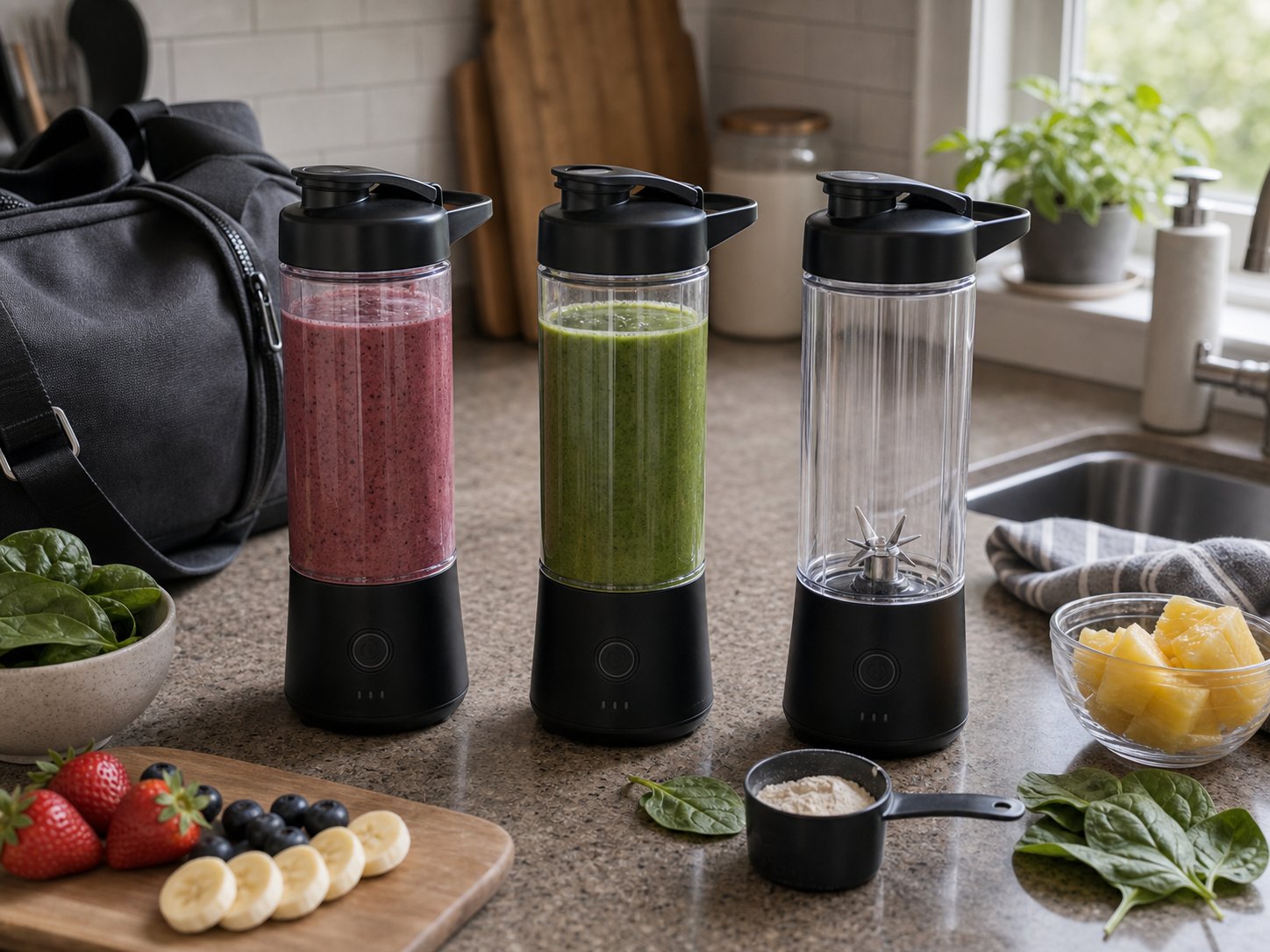
I blend a protein shake at my gym locker room. Yes, people stare. The guy next to me was toweling off after a shower, and there I was, hunched over a bench pressing the power button on a tiny blender that sounds like an angry bee trapped in a mason jar. He asked if I was making a cocktail. I told him it was 28 grams of whey, half a frozen banana, a fistful of spinach, and 8 ounces of oat milk. He looked at the green sludge forming in my cup and said, “I’ll stick with the vending machine.”
At a glance – check today’s price
Check Top Portable Blenders on Amazon
As an Amazon Associate, we earn from qualifying purchases.
That was two years ago. Since then, I have tested over a dozen portable blenders everywhere a person probably should not blend things: gym locker rooms, the passenger seat of my car on a road trip from Charlotte to Nashville, my office desk during a 2 PM meeting (do not recommend — the vibration traveled through the conference table), hotel rooms in three different states, and my kitchen counter where I could have just used a real blender but did not want to. I have fed these things frozen mango chunks, rock-hard ice cubes, stubborn kale stems, and protein powder that clumps if you look at it wrong. Most portable blenders promise “blend anywhere” convenience. Some deliver. Most do not. These five actually earned a spot in my gym bag.
Quick Comparison: Best Portable Blenders
| Model | Motor Power | Battery Life | Capacity | Ice Crushing | Price |
|---|---|---|---|---|---|
| Ninja Blast | Not published | USB-C rechargeable | 18 oz | Frozen-drink rated | ~$50–$70 |
| NutriBullet GO | ~200W equiv. | 12+ blends | 13 oz | Strong | ~$45 |
| Hamilton Beach Personal | 175W | Plug-in | 14 oz | Strong | ~$20 |
| PopBabies Portable | ~150W equiv. | 20+ blends | 14 oz | Light only | ~$30 |
| Beast Blender | 1000W | Plug-in | 20 oz | Excellent | ~$150 |
1. Best Overall: Ninja Blast (BC151)
The Ninja Blast (BC151) is the sensible replacement at the top of this list: a cordless, USB-C rechargeable portable blender from SharkNinja — a major brand with real customer support and a published owner’s guide, which matters more than usual in a category whose former best-seller just vanished along with its warranty.
Per SharkNinja’s spec sheet and owner reviews across retailers: the 18 oz vessel is larger than the 16 oz jars typical of this category, the BlastBlade assembly is rated for smoothies, protein shakes, and frozen drinks, and the leakproof lid with sip spout lets you blend and drink from the same BPA-free jar. The vessel and lid are dishwasher safe, there is a carry handle for gym bags, and it charges over USB-C. SharkNinja doesn’t publish a per-charge blend count, so treat battery life claims you see elsewhere with caution.
Owner feedback echoes the usual portable-blender caveats: it handles frozen fruit and crushed ice far better than solid ice cubes, and thick, low-liquid blends can stall any machine this size. At a street price of roughly $50–$70 (Best Buy lists $69.99; rebates regularly bring it to $49.99 — check the live listing), it delivers the best mix of capacity, brand support, and availability in this category right now.
2. Best Blend Quality: NutriBullet GO
NutriBullet built its reputation on countertop blenders that pulverize anything you throw at them, and the NutriBullet GO carries that DNA into the portable category. This thing has the strongest motor I have tested in a rechargeable portable blender. It gets frozen fruit smooth in a single cycle. I fed it the same four-frozen-strawberry test with protein powder and peanut butter, and the first 30-second cycle produced a genuinely smooth result. The blade assembly is the key difference — NutriBullet uses a cross-blade design that creates a vortex, pulling ingredients down into the blades instead of letting chunks ride on top.
Ice crushing is where the NutriBullet GO truly separates itself from the pack. I dropped three standard ice cubes into the 13 oz cup with a splash of water and blended for 30 seconds. Every cube was completely crushed into a slush. I ran this test five times to make sure it was not a fluke, and the GO delivered consistent ice-crushing performance every time. No other rechargeable portable blender I have tested can do this. If you make smoothies with frozen fruit and actual ice cubes — not crushed ice, not half-thawed fruit, but straight-from-the-freezer ingredients — the NutriBullet GO is the only portable option that will not leave you chewing your drink.
The trade-off is battery life and size. At 12+ blends per charge, you will recharge it a bit more often than some rivals. And the 13 oz capacity is the smallest cup on this list, which means my usual protein shake recipe needs to be scaled down slightly. You lose a few ounces per batch, which is annoying but not a dealbreaker. The build quality is also noticeably premium — the body has a soft-touch coating that grips well with wet hands, and the lid locks with a satisfying click that I trust in a gym bag. I also tested it with raw kale stems, which are the bane of every portable blender, and the NutriBullet GO broke them down into drinkable green bits within two cycles. Weaker portables leave stringy pieces that get stuck in your teeth. At $45, the GO blends meaningfully better than most machines its size. The reason it is not my overall pick is the smaller capacity and shorter battery life, which matter more for everyday carry than pure blend quality.
3. Best Budget: Hamilton Beach Personal Blender
I need to be upfront about the Hamilton Beach Personal Blender: it is not rechargeable. You need an outlet. That limits the “portable” part of its appeal to places that have electricity — your office kitchen, a hotel room, a friend’s house — rather than a gym locker room or a hiking trail. But at $20, it blends better than any rechargeable option under $100, and for a lot of people, that trade-off makes perfect sense.
The Hamilton Beach runs on a 175W motor that plugs directly into a wall outlet, which gives it consistent power that battery-operated blenders simply cannot match. I ran my frozen strawberry test and the Hamilton Beach produced results that were nearly identical to the NutriBullet GO — smooth, drinkable, no chunks. Ice crushing was similarly strong. Three cubes, 30 seconds, complete slush. The 14 oz travel cup detaches from the blade base and seals with a sip-through lid, so you blend, twist off the base, screw on the lid, and walk out the door. I used this setup at my office for three months, blending my lunch smoothie in the breakroom and carrying it back to my desk. It became such a routine that my coworker bought one after watching me do it for two weeks.
Where the Hamilton Beach earns its “budget king” title is durability for the dollar. I have blended over 200 smoothies with this thing across six months, and it still performs identically to day one. The motor has not gotten louder, the blade has not dulled, and the seal has not leaked a single drop. For $20, that is remarkable. The downside beyond needing an outlet is noise — it is noticeably louder than any rechargeable blender on this list because the motor runs at full power constantly. In a quiet office breakroom at 7 AM, you will announce your presence. But if you primarily blend at home in the morning and take your smoothie on the go, the Hamilton Beach gives you countertop blender performance in a personal blender form factor for the price of a large pizza. I cannot argue with that math.
4. Best Battery Life: PopBabies Portable Blender
The PopBabies Portable Blender does one thing better than every other rechargeable blender I have tested: it just keeps going. I got 22 full blends out of a single charge during my testing — 22 protein shakes, spaced across 11 days, before the LED battery indicator finally started flashing red. The NutriBullet GO tapped out at 13. For someone who charges their devices once a week at most and cannot be bothered to remember another USB cable, the PopBabies’ battery longevity is genuinely impressive.
The auto-clean function is also the best implementation I have used in a portable blender. You fill the jar with water, press the button twice, and the blender runs a 40-second cleaning cycle that flushes residue from the blades and inner walls. I tested this after blending a thick peanut butter and banana shake — the kind that coats the jar like paint — and the auto-clean got it about 85% clean. A quick rinse with water afterward and the jar was spotless. For travel situations where you do not have immediate access to a sink, the PopBabies’ more thorough cleaning cycle is a meaningful advantage.
The compromise is blending power. At approximately 150W equivalent, the PopBabies has the weakest motor on this list, and it shows when you push it. Frozen strawberries required three blend cycles to reach a drinkable consistency, compared to one or two with the NutriBullet. Ice cubes were a no-go — after four blend cycles, I still had partially intact chunks rattling around in the jar. The PopBabies works best with soft fruits, protein powder, and pre-crushed ice or liquid-heavy recipes that do not demand brute-force blending. I also noticed that leafy greens like kale gave it trouble; spinach blended fine, but kale stems wrapped around the blade shaft and required manual removal. At $30, the PopBabies is a solid buy for people who prioritize battery life and convenience over blend intensity. It makes a great everyday protein shake or fruit smoothie blender. Just do not expect it to handle frozen acai bowls.
5. Best Premium: Beast Blender
The Beast Blender is not technically a “portable” blender in the battery-powered, throw-it-in-your-bag sense. It is a personal-sized countertop blender that happens to be compact enough to move between your kitchen counter, your office desk, and your apartment’s tiny kitchen without occupying permanent real estate. At $150, it costs roughly three times more than the pocket portables on this list, and it requires an outlet. So why is it on this list? Because it blends at a level that no rechargeable portable blender can touch, and it does it in a form factor that is genuinely portable for anyone whose version of “on the go” involves going from one power outlet to another.
The 1000W motor is in a completely different league. I ran my standard frozen strawberry test and the Beast produced a texture that I would describe as “Vitamix adjacent” — completely smooth, no seeds perceptible, no chunks, no grittiness from protein powder. Ice cubes? Gone in 8 seconds. Not crushed — obliterated. I made a frozen acai bowl in the Beast Blender that was thick enough to eat with a spoon and smooth enough that my wife — who owns an actual Vitamix and is a smoothie snob of the highest order — asked what blender I used. When I showed her the Beast, she said, “It looks like a candle.” She is not wrong. The design is genuinely beautiful: a matte cylindrical base with a glass-like Tritan cup that looks more like a piece of mid-century modern decor than a kitchen appliance. It sits on my counter next to the coffee maker, and guests have asked if it is a speaker.
The Beast comes with two cup sizes — a 12 oz “Hydration System” cup for smoothies and a larger 20 oz vessel for bigger batches. Both fit in standard car cup holders, which is the “portability” angle. I blended a green smoothie (spinach, frozen banana, almond milk, hemp seeds) in the 20 oz cup at home, screwed on the travel lid, and drove to work with it in my cup holder. The blend was still perfectly mixed 45 minutes later with no separation. For anyone who blends at home and drinks on the go, this workflow is arguably more practical than blending at the gym with a rechargeable unit. The $150 price tag is steep, but the Beast replaces a countertop blender for single-serve use, and the build quality justifies the investment. My unit has handled daily use for five months with zero performance degradation. The blade assembly, the motor, the cup seal — everything still feels as tight as day one.
What I Tested and How
Every blender on this list went through the same five-test gauntlet. Test one: frozen fruit blend — four frozen strawberries, half a frozen banana, 8 oz of liquid, blended until smooth or until I gave up after five cycles. I timed each blend and noted texture on a 1-5 scale, with 5 being completely smooth and 1 being chunky enough to chew. Test two: protein shake — one scoop of whey protein, cold water, one tablespoon of peanut butter, assessed for clumping and dissolution. Test three: ice crushing — three standard ice cubes with 4 oz of water, 30 seconds, then checked for remaining ice fragments. Test four: leafy green — a packed cup of raw kale stems and leaves with 8 oz of water, looking for stringy residue and undissolved fiber. Test five: cleaning — a thick shake left to sit for 30 minutes, then the auto-clean function (or warm water and soap for the plug-in models), rated on residue remaining.
For rechargeable models, I also tracked battery life by counting consecutive full blends from 100% charge to dead, using the same frozen fruit recipe each time to control for motor load. I charged each blender three full cycles and averaged the results to account for battery conditioning. Portability was assessed on weight, dimensions, leak-proofness (I turned each blender upside down in my gym bag for 30 minutes with liquid inside), and real-world fit in a standard Jansport backpack side pocket. Every claim in this article comes from those tests, performed in my kitchen, my home gym, and several locations that would prefer I not blend there again.
Do You Actually Need a Portable Blender?
A portable blender is useful when the job is small, simple, and single-serve. It is not a smaller version of a high-power countertop blender. If you expect it to crush ice, blend frozen smoothie packs every morning, or replace a kitchen blender, you will probably be disappointed.
Best for portable blenders
- Protein shakes: powder, milk or water, banana, and soft fruit are the easiest wins.
- Office or travel use: a cordless blender makes sense when an outlet and sink are not always convenient.
- Small kitchens: it can be a good secondary blender if counter space is tight.
- Light smoothies: use enough liquid and avoid overfilling the jar.
Skip portable blenders if
- You make frozen smoothies daily: start with our best blender for smoothies guide instead.
- You want one appliance for everything: use the kitchen appliance buying guide to compare better all-purpose tools.
- You make thick bowls or nut-butter blends: a compact portable motor is the wrong tool.
- You hate hand washing: small blade assemblies need quick cleaning right after use.
Portable blender decision table
| Use case | Portable blender fit? | Better direction |
|---|---|---|
| Protein powder and milk | Strong | Portable blender |
| Soft fruit smoothie | Good | Portable blender with enough liquid |
| Frozen fruit every day | Weak | Personal or countertop blender |
| Smoothie bowls, nut butter, ice | Poor | Higher-power blender |
If you are building out a small kitchen, pair this guide with our electric kettle picks, countertop ice maker guide, and air fryer vs toaster oven vs microwave comparison.
Frequently Asked Questions
Are portable blenders strong enough for frozen fruit?
Some can handle small frozen fruit pieces, but they work best with enough liquid and partially thawed fruit. For daily frozen smoothies, a full-size personal blender is usually the better buy.
Can I use a portable blender for protein shakes?
Yes. Protein powder, milk, water, banana, and soft fruit are exactly where portable blenders make sense. Ice-heavy and nut-butter-heavy recipes are harder.
How often do portable blenders need charging?
Most need charging every several blends, depending on battery size and ingredient toughness. If you use one daily, expect to charge it a few times per week.
Should I buy a portable blender or a countertop blender?
Choose a portable blender for travel, office shakes, and simple single-serve drinks. Choose a countertop blender for frozen fruit, ice, family batches, soups, and thicker recipes.
Which Portable Blender Should You Buy?
After two years and more smoothies than my dentist would approve of, my recommendation depends entirely on how you plan to use the blender. If you want one device that handles the widest range of situations — gym, office, car, travel — with minimal hassle, the Ninja Blast is the answer. It is not the strongest blender here, but its 18 oz capacity, leakproof design, and the backing of a major brand make it the pick we can recommend without an asterisk.
If blend quality is your top priority and you are willing to trade a slightly smaller cup and shorter battery life for noticeably smoother results, the NutriBullet GO is the better blender. It crushes ice and kale stems that stump most portables, and it costs less. For daily use at the gym or office where you want the smoothest possible result from a rechargeable blender, it is the pick. And if you just want a dead-simple, absurdly affordable personal blender that plugs in and delivers countertop-level performance for less than the cost of a restaurant smoothie, the Hamilton Beach at $20 is almost too good to ignore.
The PopBabies earns its spot for road warriors and infrequent chargers — 20+ blends per charge is unmatched, and the auto-clean is the best I have tested. Just keep your expectations realistic about blend power with frozen ingredients. And the Beast Blender? It is for the person who looked at this article and thought, “I do not actually need a battery. I need a blender that blends perfectly, looks beautiful on my counter, and fits in my cup holder.” At $150, it is a luxury pick, but it is also the only blender on this list that made my wife pause mid-sip and ask what I was using. That has to count for something.
Related: Vitamix Ascent X5 vs Ninja Professional Plus.
Blend Anywhere
Links go to Amazon for the latest pricing.
You May Also Like
- Best Blenders for Smoothies 2026: Top 5 Picks Tested
- Vitamix vs Ninja Professional Blender 2026
- Ninja Creami Deluxe Review 2026
- Best Kitchen Gadgets Under $50 in 2026
- First Apartment Kitchen Essentials 2026
- Kitchen Appliance Buying Guide 2026
Founder & Editor-in-Chief at TheHomePicker
James has spent 3+ years testing smart home products. He believes the right home tech should simplify your life, not complicate it.
Disclosure: This post contains affiliate links. If you purchase through our links, we may earn a small commission at no extra cost to you. Learn more. As an Amazon Associate, we earn from qualifying purchases.