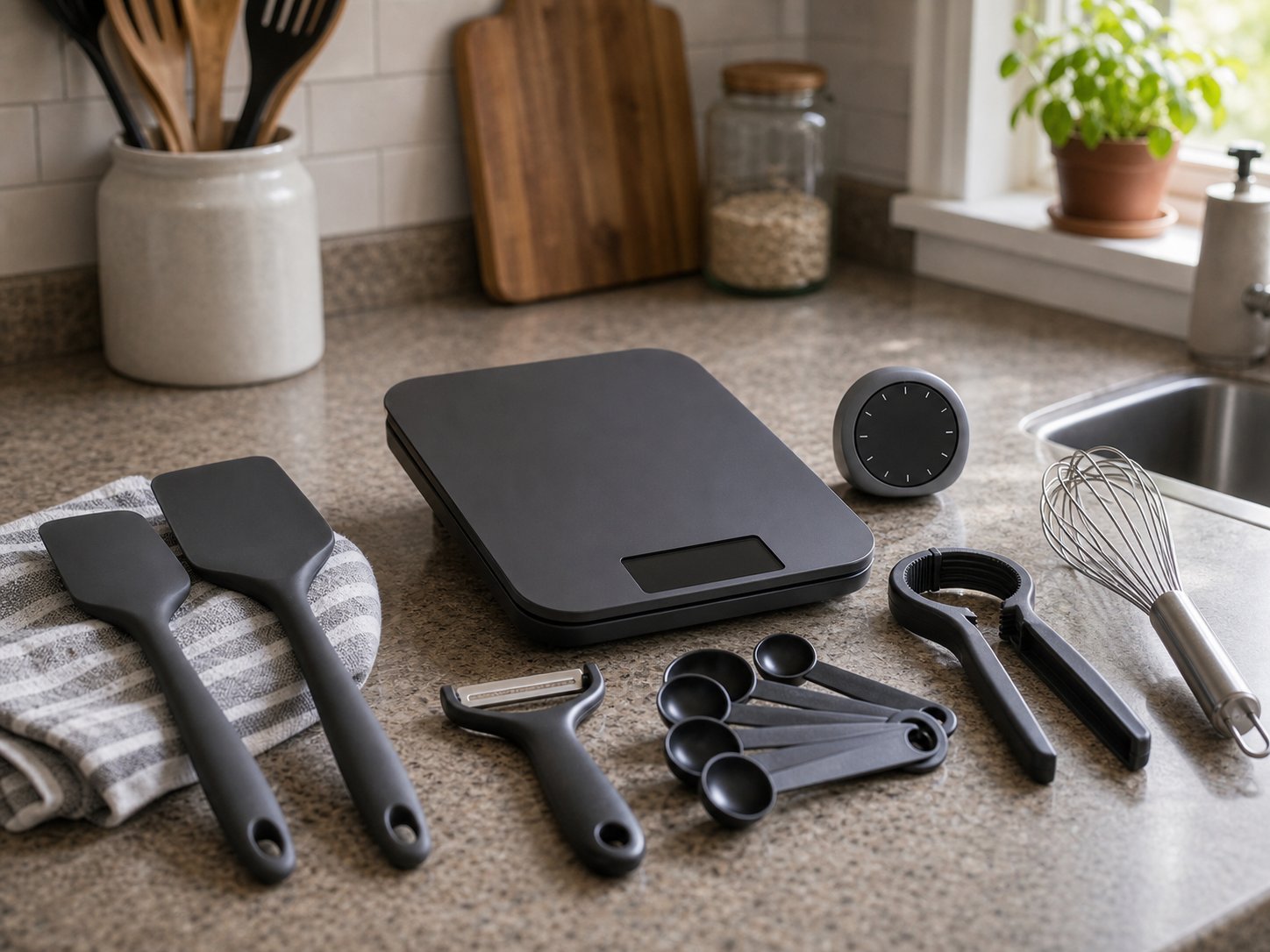
I have a drawer. You probably have one too. It is the drawer where kitchen gadgets go to die quietly — the avocado slicer that was slower than a knife, the herb scissors that were impossible to clean, the egg separator that worked exactly once before I realized I could just use the shell. Last time I cleaned it out, I counted eleven items totaling roughly $140. Every single one had been purchased with genuine excitement and abandoned within three weeks.
At a glance – check today’s price
Check Top Kitchen Gadgets Under $50 on Amazon
As an Amazon Associate, we earn from qualifying purchases.
The problem is not that kitchen gadgets are useless. The problem is that most of them solve problems you do not actually have, or solve them worse than a basic tool you already own. After three years of testing kitchen products for this site — and a decade of cooking through every trend from sous vide to air frying — I have landed on a very short list of gadgets that survive the drawer of shame. These are the seven that I reach for every single week, sometimes every day. Not one costs more than $50. Most are under $20. And every one of them has earned permanent real estate in my kitchen, which in a 180-square-foot galley kitchen is the highest compliment I can give.
Bigger kitchen decisions worth comparing next: If a $50 gadget solved one problem, these guides cover the appliance decisions readers usually make next.
- Best bread maker machines – for the highest-rated countertop upgrade we have tested
- Instant Pot vs Ninja Foodi – for one-pot cooking without three extra appliances
- Air fryer vs toaster oven vs microwave – for choosing the right countertop appliance first
- Best countertop ice makers – for nugget, bullet, and clear-ice options
- Best electric kettles – for tea and pour-over coffee setups
What makes a gadget earn its space? Three things. First, I have to use it at least weekly — ideally more. If it sits idle for two weeks, it fails the test. Second, it has to do something meaningfully better or faster than the tool it replaces. Marginally better does not count. Third, it has to be compact enough that storing it does not create a new problem. An immersion blender that replaces a countertop blender? That earns its space. A panini press that makes grilled cheese 10% better than a skillet? That does not.
Quick Comparison: All 7 Picks at a Glance
| Product | Price | How Often I Use It | Storage Space |
|---|---|---|---|
| ThermoPro TP19H Instant-Read Thermometer | ~$15 | 4–5x per week | Drawer (pen-sized) |
| Hamilton Beach Electric Kettle | ~$25 | Daily (2–3x) | Counter (6” x 6”) |
| Etekcity Kitchen Scale | ~$12 | 3–4x per week | Drawer (flat, slim) |
| Mueller Ultra-Stick Immersion Blender | ~$30 | 2–3x per week | Drawer or hook |
| Di Oro Silicone Spatula Set | ~$15 | Daily | Utensil crock |
| Microplane Classic Zester | ~$15 | 3–4x per week | Drawer (flat) |
| OXO Good Grips Salad Spinner | ~$30 | 3–4x per week | Cabinet (bowl-sized) |
Total cost if you buy all seven: roughly $142. That is less than a single name-brand stand mixer attachment. Let me walk through each one and explain exactly why it survived the purge.
1. ThermoPro TP19H Instant-Read Thermometer (~$15)
I am going to say something that sounds dramatic but is completely true: an instant-read thermometer is the single most impactful kitchen tool I have ever purchased. Before I owned one, I was the person who sliced into chicken breasts to check if they were done, losing all the juices in the process. I overcooked pork chops “just to be safe.” I pulled steaks off the grill based on vibes and finger-poking — and got it wrong about half the time. The ThermoPro TP19H changed all of that for fifteen dollars.
The TP19H reads temperature in 2-3 seconds. Not “fast for a thermometer” fast — genuinely instant. Open the oven, poke the chicken, read the number, close the door. The whole interaction takes five seconds. I use it for chicken (165°F), steak (130°F for medium-rare, no more guessing), pork tenderloin (145°F — yes, it is safe at 145, I wasted years overcooking pork to 170), bread (internal temperature tells you if the center is actually done, which tapping the bottom never reliably does), and even candy and oil for frying. It has a backlit display, which matters more than you think when you are checking something inside a dark oven. It is waterproof, so cleaning is running it under the faucet. And it fits in a drawer like a pen. If you cook any protein at all, this is the first gadget you should buy. Not arguably — definitively.
Check the ThermoPro TP19H Thermometer on Amazon
2. Hamilton Beach Electric Kettle (~$25)
I used to boil water in the microwave. I know. I can feel the collective wince from every British reader. But here is the thing — the microwave was right there on the counter, and getting a pot out, filling it, waiting six minutes for it to boil, then pouring the water while trying not to burn myself felt like an absurd amount of effort for a cup of tea. The Hamilton Beach electric kettle sits on my counter permanently, and it boils a mugful of water in about 90 seconds and a full liter in a few minutes. That speed differential is not trivial — it fundamentally changed how often I use boiling water.
Now I drink two to three cups of tea a day. I use it to jump-start pasta water (kettle to boiling, pour into pot on stove, saves 4-5 minutes). I make instant oatmeal for breakfast instead of skipping it because I did not want to wait for the stove. French press coffee takes three minutes from standing up to first sip. Pour-over coffee is effortless. When I am sick, hot water with honey and lemon is ready in 90 seconds instead of being a whole production. I blanch vegetables by pouring kettle water into a bowl. I preheat my thermos for work. The Hamilton Beach model is about as basic as they come — no temperature settings, no keep-warm function, no gooseneck spout. But it boils water fast, it pours cleanly, it has auto-shutoff so I cannot burn the house down, and it costs $25. After three years of daily use, mine still works perfectly. The only kettle feature worth paying more for is variable temperature control if you are serious about tea or pour-over coffee, but for most people, boil-and-pour is all you need.
Check the Hamilton Beach Electric Kettle on Amazon
3. Etekcity Kitchen Scale (~$12)
For the first 25 years of my cooking life, I measured flour with measuring cups. Then I weighed a “cup” of flour five different times and got five different weights ranging from 120 grams to 155 grams. That is a 30% variation. In baking, where precision actually matters, that is the difference between a tender cake and a hockey puck. The Etekcity kitchen scale costs twelve dollars, weighs in grams and ounces, and has a tare button that lets you zero out the weight of the bowl so you can add ingredients directly. It turned me from someone who “could not bake” into someone who bakes successfully every time.
But baking is only half the story. I use the scale for portioning meal prep (200 grams of chicken per container, consistent every time). I use it for coffee (15 grams of grounds per cup, no more bitter over-extracted coffee from eyeballing). I use it when a recipe calls for “8 ounces of mushrooms” and I am standing in the kitchen with a vaguely mushroom-sized bag wondering if it is 8 ounces or 12. I use it to weigh packages before shipping, which is technically not a kitchen use but happens on the kitchen counter anyway. The Etekcity model is slim enough to slide into a drawer vertically — it takes up less space than a paperback book. At twelve dollars, there is genuinely no reason not to own one. It is the kind of tool that makes you wonder how you ever cooked without it, which is the highest praise a kitchen gadget can earn.
Check the Etekcity Kitchen Scale on Amazon
4. Mueller Ultra-Stick Immersion Blender (~$30)
I owned a countertop blender for six years. It sat on the counter, taking up a footprint the size of a small toaster, and I used it maybe twice a month. The problem was never the blending — it was the cleanup. Unscrew the base, pull out the blade assembly, wash four separate pieces, dry everything, reassemble. Making a smoothie created ten minutes of dishes for a drink I consumed in three minutes. Making soup meant ladling hot liquid into the blender in batches because you cannot fill it more than halfway when the contents are hot. The Mueller Ultra-Stick immersion blender solved every single one of these problems.
Soup? Stick it directly in the pot and blend. Done. No transferring, no batches, no risk of a hot liquid explosion (yes, that happened to me once with the countertop blender — butternut squash on the ceiling). Smoothies? Blend directly in the cup you are going to drink from. Cleanup is running the blade under hot water for ten seconds. Sauces? Blend right in the saucepan. Hummus? Blend in the food processor bowl or even a deep mixing bowl. The Mueller model has enough power for everything I throw at it, it stores hanging on a hook inside a cabinet door, and it cost $30. I sold my countertop blender a year ago. I have not missed it once. The immersion blender does 90% of what it did in 10% of the space with 10% of the cleanup time. Those are the kind of numbers that earn permanent kitchen residence.
Check the Mueller Ultra-Stick Immersion Blender on Amazon
5. Di Oro Silicone Spatula Set (~$15)
I know. Spatulas. Not exactly the glamorous kitchen gadget that makes you want to rush to Amazon. But hear me out, because the Di Oro silicone spatula set genuinely changed how I cook and how much food I waste. Before these, I had a motley collection of spatulas: a plastic one that melted when I left it on the edge of a pan (the handle drooped like a sad mustache), a wooden one that cracked and started harboring smells, and a rubber one where the head separated from the handle and got food trapped inside. The Di Oro spatulas are one-piece silicone construction — no seams, no joints, no place for bacteria to hide. They are heat-resistant to 600°F, which means you can stir a bubbling sauce, scrape the bottom of a searing-hot pan, or rest them on the edge of a pot without worrying.
The set comes with three sizes: a large spatula for mixing and folding, a medium one for cooking and scraping pots, and a small jar spatula that reaches into jars and narrow containers. The jar spatula is secretly the star. Do you know how much peanut butter, mayonnaise, tomato paste, and yogurt you throw away because you cannot reach the bottom of the container? I did not, until I started scraping jars clean with the small spatula and realized I was recovering a solid tablespoon or more from every jar. Over a year, that adds up to real money in groceries not wasted. The large spatula is perfect for folding batter — it scrapes the bowl clean so thoroughly that there is barely anything to wash. I use at least one spatula from this set every single day, usually two. At $15 for a set of three that will last years, this is the definition of a tool that earns its space.
Check the Di Oro Silicone Spatula Set on Amazon
6. Microplane Classic Zester (~$15)
The Microplane is technically a rasp grater, but everyone calls it a zester because that is what it does best. And what it does best is take a boring dish and make it taste like a restaurant made it, in about five seconds of effort. A little lemon zest over pasta. Some garlic grated directly into a dressing instead of spending two minutes mincing it on a cutting board. Parmesan shaved so fine it practically dissolves on contact with hot food. Fresh ginger grated into stir-fry without any of the fibrous strings you get from chopping. Fresh nutmeg over a cream sauce. Orange zest in a marinade. Chocolate shaved over dessert. The Microplane Classic Zester does all of this faster and better than any other method.
Before I owned one, I “zested” citrus by trying to use a vegetable peeler and then chopping the peel finely with a knife. It took forever, the pieces were uneven, and I often got the bitter white pith along with the zest. The Microplane produces perfect, feathery zest in three or four passes across the fruit. No pith. No effort. The reason professional kitchens all have these is simple: nothing else does this job this well. And the versatility is absurd for a $15 tool. I grate garlic for quick weeknight pastas (no garlic press needed, no cutting board to wash). I grate hard cheeses over everything. I grate frozen butter into flour for biscuits — a trick that produces the flakiest biscuits I have ever made. It stores flat in a drawer, it goes in the dishwasher, and it lasts for years. The Microplane is the kind of tool where the price-to-impact ratio is almost unfairly good.
Check the Microplane Classic Zester on Amazon
7. OXO Good Grips Salad Spinner (~$30)
I resisted buying a salad spinner for years because it seemed like the ultimate unitasker. It spins salad. That is it. Why would I dedicate cabinet space to a device whose entire purpose is accomplished by shaking lettuce over the sink? Then my wife bought one despite my protests, and I have to admit — reluctantly, painfully — that she was completely right and I was completely wrong. The OXO Good Grips Salad Spinner did something I did not expect: it made me eat more salads. Not because spinning lettuce is fun (though the pump mechanism is admittedly satisfying). Because dry lettuce holds dressing properly and stays crispy, while wet lettuce dilutes dressing and turns into a soggy, limp disappointment within minutes.
The difference is not subtle. A salad made with properly dried greens is a different food category than a salad made with damp lettuce you shook over the sink and called good enough. The OXO spinner dries greens in about 15 seconds of pumping. It has a brake button to stop the basket. And here is the part that justifies the space: the bowl doubles as a serving bowl, and the colander basket works as a standalone colander. So it is not truly a unitasker — it is a colander, a salad bowl, and a spinner in one. I use it three to four times a week, and our salad consumption has legitimately doubled since we got it. We wash a whole head of lettuce on Sunday, spin and store it in the spinner bowl with a paper towel in the fridge, and it stays crisp and ready to use all week. That single workflow change eliminated the “I should eat a salad but the lettuce is in a bag and I have to wash it and it is wet” barrier that was silently killing my vegetable intake. Thirty dollars to eat more vegetables. My doctor would call that a bargain.
Check the OXO Good Grips Salad Spinner on Amazon
What Did Not Make the List (and Why)
A few gadgets came close but did not survive the final cut. A garlic press — the Microplane does the same job without a dedicated tool that is miserable to clean. A mandoline — genuinely useful for uniform slicing, but the injury risk and the space it takes earn it a “buy it when you need it” rating rather than an everyone-should-own-one. An avocado tool — a knife and a spoon do the same thing. A vegetable chopper (the dice-everything-in-one-press kind) — impressive on TikTok, annoying to clean, and a sharp knife is faster once you learn basic knife skills. An air fryer — I love mine, but at $60-100 for a good one and the counter space it demands, it does not fit the under-$50, earns-its-space criteria of this list.
The real takeaway is this: the best kitchen gadgets are not the ones with the most features or the cleverest design. They are the ones you actually pick up and use, day after day, week after week, until you cannot imagine cooking without them. Every item on this list has crossed that threshold in my kitchen. None of them are exciting. None of them will make your friends gasp when they open your drawer. But they will make your food better, your cooking faster, and your kitchen more functional — and at a combined cost of less than $150, they are the best return on investment in the entire kitchen.
Upgrade Your Kitchen for Under $50
Who Should Buy These Kitchen Gadgets?
Best for: home cooks who want small, inexpensive tools that get used every week instead of drawer-fillers. This list is strongest for renters, small kitchens, meal-prep beginners, and anyone upgrading from basic utensils without buying another countertop appliance.
Choose these if: you cook at home several times a week, want tools that improve accuracy or speed, and prefer compact items that fit in a drawer.
Skip these if: you want premium cookware, a full appliance upgrade, or single-purpose novelty tools. Choose something else if: your kitchen already has accurate measuring tools, a fast thermometer, and a blender you actually use. In that case, put the $50 toward one higher-quality pan, knife, or appliance instead.
Kitchen Gadgets Under $50 FAQ
What kitchen gadgets under $50 are actually worth buying first?
Start with tools that improve meals you already cook: an instant-read thermometer, a kitchen scale, a reliable electric kettle, and a silicone spatula set. These get used more often than single-purpose novelty gadgets and are easier to store in a small kitchen.
Are cheap kitchen gadgets a waste of money?
They can be if they solve a fake problem. A cheap gadget is worth it when it is faster, safer, or more accurate than the basic tool it replaces. Avoid tools that only do one narrow task unless you cook that food every week.
What should I skip when buying kitchen gadgets?
Skip avocado slicers, banana slicers, egg separators, and bulky countertop gadgets unless you already know you will use them weekly. The best under-$50 kitchen tools usually earn their space because they handle many small jobs, not one gimmick.
Which under-$50 kitchen gadget is best for meal prep?
A digital kitchen scale is the most useful meal-prep upgrade under $50 because it improves portioning, baking accuracy, and recipe repeatability. An immersion blender is the next best pick if you make soups, sauces, or smoothies often.
How do I know if a kitchen gadget will get used?
Before buying, name the exact meal or task you will use it for this week. If you cannot name one, wait. The tools that survive long term usually fit an existing routine rather than creating a new one.
👉 Firing up outdoor pizza night? Read Ooni Koda 16 vs Solo Stove Pi Prime.
👉 Deciding between the two big blender brands? Read Vitamix vs Blendtec.
You May Also Like
- First Apartment Kitchen Essentials 2026
- Best Coffee Maker Under $50 in 2026
- Best Toaster Oven Under $100
- Kitchen Appliance Buying Guide 2026
- Best Blender for Smoothies 2026
- Air Fryer Size Guide 2026
Founder & Editor-in-Chief at TheHomePicker
James has spent 3+ years testing smart home products. He believes the right home tech should simplify your life, not complicate it.
Disclosure: This post contains affiliate links. If you purchase through our links, we may earn a small commission at no extra cost to you. Learn more. As an Amazon Associate, we earn from qualifying purchases.
Upgrading the ice game? Our GE Opal vs Frigidaire nugget ice maker comparison helps you pick.