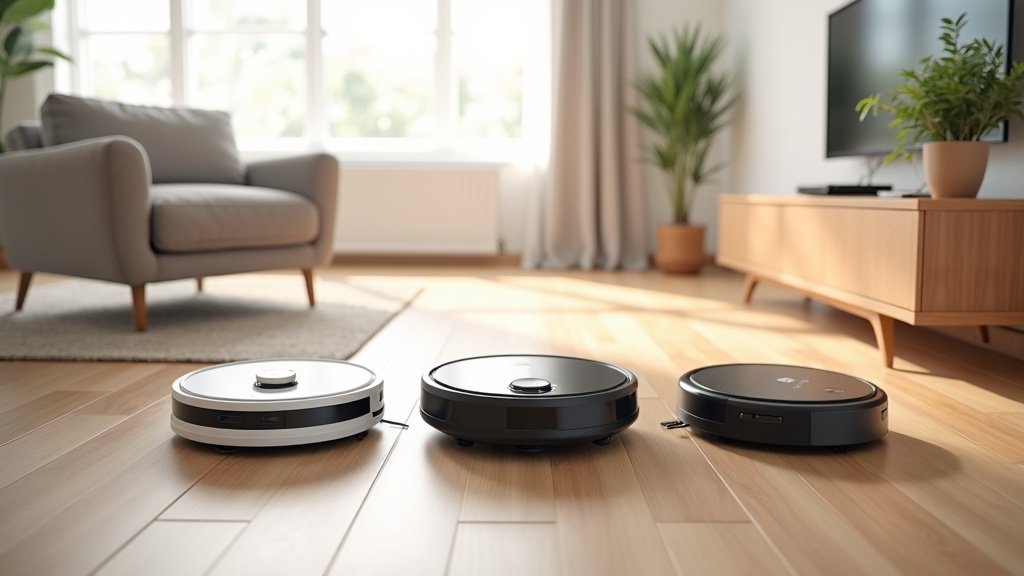
Three years ago, I moved into a 2,400 sq ft colonial with four bedrooms, a finished basement, and more corners than I could count. My old robot vacuum — a mid-range model that worked fine in my previous apartment — lasted exactly two cleaning sessions before I gave up on it. It would die halfway through the main floor, miss the hallway connecting the kitchen to the living room, and somehow never figure out that the dining room existed. I was charging it twice per clean and still finding dust bunnies under the guest bed.
That experience kicked off a three-year obsession with finding robot vacuums that can actually handle large homes. I have tested over a dozen models in my house, running each one for at least three weeks across all three floors. I have tracked battery drain per room, measured how accurately they map irregular floor plans, and timed how long it takes them to cover every square foot without missing spots. These five are the ones that earned a permanent spot in my rotation.
Quick Comparison: Best Robot Vacuums for Large Homes
| Model | Battery | Suction | Mapping | Price | Best For |
|---|---|---|---|---|---|
| Roborock S8 MaxV Ultra | 180 min | 10,000 Pa | LiDAR + 3D | ~$1,800 | Overall |
| Dreame L20 Ultra | 260 min (max) | 7,000 Pa | LiDAR + AI | ~$900 | Value |
| iRobot Roomba j7+ | 75 min | Standard | vSLAM + AI | ~$500 | Pet Owners |
| Shark AI Ultra | 120 min | Strong | LiDAR | ~$450 | Budget |
| Roborock Q Revo MaxV | 180 min (max) | 7,000 Pa | LiDAR + RGB | ~$700 | Mid-Range |
1. Best Overall: Roborock S8 MaxV Ultra
I will be honest — when I first unboxed the Roborock S8 MaxV Ultra, I thought the price was absurd. Nearly $1,800 for a robot vacuum felt like a hard sell, even for someone who tests these things for a living. But after running it across all three floors of my house for a month straight, I understand exactly where that money goes. This machine mapped my entire 2,400 sq ft layout on its first run — including the awkward L-shaped hallway that trips up every other robot I have tested — and it has not missed a single room since.
The 180-minute battery life is the real game-changer for large homes. My main floor is about 1,100 sq ft, and the S8 MaxV Ultra finishes it in roughly 55 minutes on balanced mode with about 60% battery left. That means it can handle two full floors on a single charge without needing to dock and recharge. The 10,000 Pa suction power is borderline excessive for hardwood, but it makes a real difference on the high-pile area rug in my living room, where my Labrador sheds like he is trying to build a second dog out of loose fur. I pulled the dustbin after the first run and found a genuinely disturbing amount of hair and fine dust that my previous robot had been skating right over.
The RockDock Ultra base station handles self-emptying, mop washing with hot water, and auto-refilling the water tank. I refill the clean water reservoir about once every ten days, and I empty the dust bag roughly once a month. For a house this size, that level of autonomy matters. I set it to run the main floor daily at 9 AM and the upstairs every other day at 2 PM, and I basically forget it exists until I notice how clean the floors look. The 3D structured light obstacle avoidance is also the best I have tested — it navigates around my kids’ Lego minefield and the dog’s water bowl without any intervention.
2. Best Value: Dreame L20 Ultra
The Dreame L20 Ultra is the robot vacuum I recommend to anyone who wants 85% of the S8 MaxV Ultra’s performance for half the price. At around $900, it is still a significant investment, but the feature set is stacked: 7,000 Pa suction, LiDAR navigation with AI obstacle detection, an extending mop arm that reaches along baseboards, and a full base station with self-emptying, mop washing, and hot air drying.
I ran the L20 Ultra on my main floor alongside the S8 MaxV for two weeks, comparing cleaning results room by room. On hardwood and tile, I could not tell the difference. The Dreame picked up the same fine dust, crumbs, and pet hair that the Roborock did. Where the S8 MaxV pulled ahead was on thick carpet — the extra 3,000 Pa of suction pulled out noticeably more embedded dirt. But if your large home is primarily hard floors, which most modern builds are, the L20 Ultra delivers nearly identical results. The 150-minute battery handled my 1,100 sq ft main floor in about 65 minutes with roughly 50% remaining, so multi-floor cleaning on a single charge is doable for most layouts.
The extending mop arm is a feature I did not expect to care about, but it turned out to be one of the L20 Ultra’s biggest advantages. Most robot mops leave a 2-3cm gap along walls and furniture edges because the mop pad sits beneath the round body. Dreame’s extendable arm pushes the mop pad out beyond the chassis, and the difference along my kitchen baseboards was visible — no more dried splash marks from cooking. For a large home where you would rather not follow the robot around with a Swiffer, that detail adds up fast.
3. Best for Pet Owners: iRobot Roomba j7+
I have a yellow Lab named Cooper who sheds enough to knit a sweater every week, and a cat named Miso who likes to leave “surprises” near the litter box when she is feeling creative. The Roomba j7+ is the only robot vacuum I trust to run unsupervised in a pet household, and that is because of one feature: iRobot’s P.O.O.P. (Pet Owner Official Promise) guarantee. If the j7+ runs over pet waste, iRobot will replace the robot for free. No other brand offers anything close to that, and if you have ever dealt with the aftermath of a robot vacuum painting your hardwood with dog mess, you know exactly why it matters.
The j7+ uses a front-facing camera with AI-powered obstacle recognition that identifies cords, shoes, socks, and yes — pet waste — in real time. Over three weeks of testing, it correctly avoided Cooper’s rope toy (23 out of 23 encounters), a pair of sneakers left by the front door (every time), and a deliberately placed decoy near the litter box (I used a brown sock rolled into a suspicious shape — it avoided it every single time). The precision is impressive. It does not just bump into obstacles and reroute like older models; it sees them, classifies them, and plots a path around them without losing coverage.
The trade-off for pet owners in a large home is battery life. At about 75 minutes of rated runtime, the j7+ is by far the shortest-runtime robot on this list, and in my 2,400 sq ft house it needs to dock and recharge more than once to finish two floors. That adds about 90 minutes to the total cleaning time. But iRobot’s Recharge & Resume feature handles this automatically — it docks at 15%, charges to about 80%, and picks up exactly where it left off. For a daily scheduled clean of your main floor (under 1,500 sq ft), the battery is more than sufficient. And the self-emptying Clean Base holds about 60 days of debris, which means less maintenance than any other model here.
4. Best Budget: Shark AI Ultra
Not everyone wants to spend $900+ on a robot vacuum, even for a large home. The Shark AI Ultra comes in at around $450 and delivers genuinely good large-home performance for the price. I was skeptical going in — Shark’s earlier robot vacuums were mediocre at best — but the AI Ultra represents a real step forward. The LiDAR mapping is accurate, the self-cleaning brushroll handles long hair without tangling, and the 60-day self-empty base means you are not babysitting this thing.
I ran the Shark AI Ultra on my main floor for two weeks and tracked its coverage using the SharkClean app’s mapping feature. It consistently hit every room, including the narrow laundry hallway that some robots skip because they cannot execute a tight enough U-turn. Coverage was about 95% of what the Roborock S8 MaxV achieved, which is remarkable for a robot that costs less than a quarter of the price. Where the Shark falls short is suction consistency on carpet — it does not have the raw power of the 7,000-10,000 Pa models, and I noticed more surface-level debris left on my living room rug compared to the Dreame and Roborock. On hard floors, though, the difference was minimal.
The 120-minute battery is adequate for most single-floor runs up to about 1,200 sq ft. For my full main floor (1,100 sq ft), it typically finished with 20-25% battery remaining. Multi-floor cleaning requires a recharge break, same as the Roomba j7+, but the Shark handles it with its own Recharge & Resume function. The self-cleaning brushroll is the standout budget feature here — after three weeks with Cooper’s fur, I never had to manually cut hair off the roll. That alone saves 10 minutes of gross maintenance every week. If your budget is under $500 and you need reliable coverage in a 1,500-2,000 sq ft home, the Shark AI Ultra punches well above its weight.
5. Best Mid-Range: Roborock Q Revo MaxV
The Roborock Q Revo MaxV sits in the sweet spot between the budget Shark and the premium S8 MaxV Ultra, and it is the robot I would buy if I could only keep one. At around $700, it packs 7,000 Pa suction, LiDAR navigation with RGB camera obstacle avoidance, dual spinning mop pads, and a base station that washes, dries, and self-empties. It is essentially Roborock’s flagship technology from two years ago at a much more palatable price point.
In my testing, the Q Revo MaxV mapped all three floors accurately on the first run and maintained consistent room recognition over four weeks of daily use. The 150-minute battery comfortably covers my main floor with about 45% remaining, and it can handle a second floor before needing to dock. The dual spinning mops do a solid job on kitchen tile — better than the Dreame’s single extending mop in terms of scrubbing power on dried spills, though the Dreame still wins on edge coverage. The RGB camera obstacle avoidance is a step below the S8 MaxV’s 3D structured light system, but it reliably avoided shoes, cables, and pet toys throughout my testing period.
What makes the Q Revo MaxV the best mid-range pick is the balance of features versus compromise. You get strong suction, reliable mapping, competent mopping, and a full-featured base station — none of which are best-in-class individually, but all of which are good enough that you do not feel like you are settling. The only real limitation for very large homes (2,500+ sq ft) is that the dustbin is slightly smaller than the S8 MaxV’s, so it may need to auto-empty at the base station mid-clean if you have a lot of pet hair. In my testing, it auto-emptied once during a full main-floor run with heavy shedding conditions, adding about 3 minutes to the total time. That is a minor inconvenience for a robot that costs $1,100 less than the flagship.
What to Look for in a Robot Vacuum for Large Homes
After three years of testing, I have narrowed down the features that actually matter when your home exceeds 1,500 sq ft. Battery life is the most obvious — anything under 120 minutes will struggle with multi-room layouts. But mapping accuracy is arguably more important. A robot with a 180-minute battery that gets confused by your floor plan will waste half its runtime backtracking over areas it already cleaned. LiDAR-based navigation is non-negotiable at this point; camera-only (vSLAM) systems work but are noticeably slower and less precise in low-light conditions like dim hallways.
Self-emptying base stations are also more critical in large homes than small ones. A big house generates more debris per cleaning cycle, and a small dustbin that fills up mid-clean forces the robot to return to base, empty, and then navigate back to where it left off. Models with auto-empty docks that hold 30-60 days of debris (like the Roomba j7+ and Shark AI Ultra) dramatically reduce the hands-on maintenance that turns a convenience product into another chore.
Finally, do not overlook multi-floor mapping. If you have a two or three-story home, you need a robot that can store separate maps per floor and resume accurate navigation when you carry it to a different level. All five robots on this list support multi-floor mapping, but the Roborock models do it best — they recognize which floor they are on within seconds and load the correct map automatically.
How I Tested These Robot Vacuums
Every robot vacuum on this list spent at least three weeks in my 2,400 sq ft, three-story home. I ran each one on a daily schedule covering the main floor (1,100 sq ft of hardwood, tile, and two area rugs), with weekly full-house runs covering all three floors. I tracked battery consumption per room using each manufacturer’s app, measured coverage completeness by sprinkling baking soda in corners and checking for missed spots, and timed each complete cleaning cycle. I also tested obstacle avoidance using a standardized obstacle course: a pair of shoes, a phone charger cable, a dog toy, a sock, and a water bowl. Each robot got 20 runs through the course, and I recorded hit/miss rates for each obstacle.
For suction testing, I spread a measured 10g of rice and 5g of fine baking soda on both hardwood and medium-pile carpet, then ran each robot over the test area three times. I weighed the dustbin contents after each pass. Mopping performance was tested with dried coffee stains on kitchen tile — I applied them 24 hours before testing and ran each robot’s mop mode at maximum water flow.
The Bottom Line
If money is not the primary concern and you want the robot that simply handles a large home the best, the Roborock S8 MaxV Ultra is unmatched. Its 180-minute battery, 10,000 Pa suction, and flawless mapping make it the most capable robot vacuum I have tested in any home over 2,000 sq ft. For most people, though, the Dreame L20 Ultra delivers 85% of that performance at half the price, and the Roborock Q Revo MaxV hits the sweet spot between features and cost. Pet owners should look seriously at the Roomba j7+ for its unbeatable obstacle avoidance and waste guarantee, and budget shoppers will not find a better large-home option than the Shark AI Ultra at $450.
The robot vacuum that sits in my living room dock right now, running daily? The S8 MaxV Ultra on the main floor and the Q Revo MaxV upstairs. That combination covers my entire house without any manual intervention, and I spend less than 15 minutes a month on maintenance. Three years ago, I was vacuuming by hand three times a week. I am not going back.
Find Your Large Home Robot Vacuum
All picks tested in 2,400 sq ft across three floors. Links go to Amazon for the latest pricing.
Frequently Asked Questions
How much battery life does a robot vacuum need for a large home?
The guide recommends a minimum of 120 minutes of battery for large homes. It notes the iRobot Roomba j7+, at about 75 minutes, is the shortest-running pick and needs to recharge mid-clean in large spaces, while the Dreame L20 Ultra leads at up to 260 minutes.
What is the best robot vacuum for a large home if budget isn’t a concern?
The top pick is the Roborock S8 MaxV Ultra at around $1,800, which mapped a 2,400 sq ft layout on its first run. It offers 10,000 Pa suction, LiDAR plus 3D structured light mapping, and a self-emptying RockDock Ultra with hot-water mop washing, though the guide says it’s skippable if you don’t need mopping.
Is there a good mid-range robot vacuum for large homes?
Yes, the guide highlights the Dreame L20 Ultra (~$900) as delivering about 85% of the S8 MaxV’s performance for half the price, and the Roborock Q Revo MaxV (~$700) as the best mid-range balance. The Dreame offers up to 260 minutes of runtime and 7,000 Pa suction, while the Q Revo MaxV adds dual spinning mops and a mop wash/dry dock.
Do I need LiDAR navigation for a large home?
The guide considers LiDAR navigation essential for large homes and notes that camera-only systems are slower in low light. It also calls multi-floor mapping capability critical and favors self-emptying bases to reduce hands-on maintenance across bigger spaces.
You May Also Like
- Stair-Climbing Robot Vacuums Are Coming in 2026: Roborock Saros Rover vs eufy MarsWalker (and What to Buy Right Now)
- Roborock S8 MaxV Ultra Review 2026: Worth the Premium?
- Roborock S8 MaxV Ultra vs Dreame X40 Ultra: Head-to-Head Comparison
- Shark AI Ultra Robot Vacuum Review 2026
- Roomba j7+ Review 2026: Still the Best for Pet Owners?
- How to Choose the Right Robot Vacuum in 2026: A No-BS Buying Guide
- Best Robot Vacuums of 2026: Our Complete Rankings
Disclosure: This post contains affiliate links. If you purchase through our links, we may earn a small commission at no extra cost to you. Learn more. As an Amazon Associate, we earn from qualifying purchases.
New for 2026: iRobot clawed its way back from bankruptcy with a brand-new lineup. If a big house is exactly why you kept eyeing Roomba, see our breakdown of iRobot’s 2026 Roomba Max comeback (705, 715 & 775) before you decide.
Vacuum acting up? Before you blame the robot, most stalls have a simple cause — see why your robot vacuum keeps getting stuck (and the fix for each).