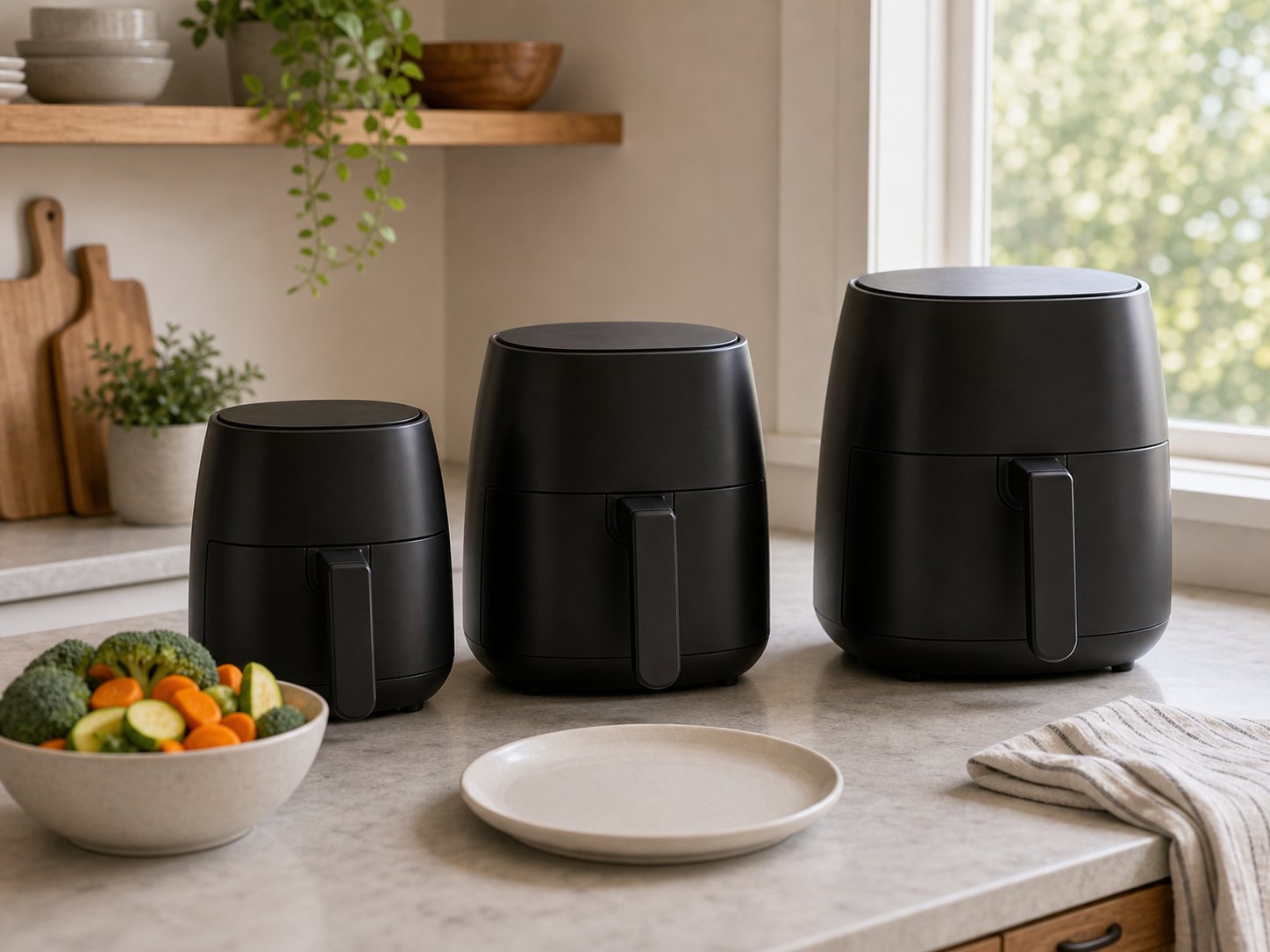
I bought a 2-quart air fryer. I returned it in a week.
It was one of those impulse purchases — sleek, compact, $35 on sale. The Amazon listing showed golden fries and crispy chicken tenders. What it did not show was the basket, which was roughly the size of a cereal bowl. I could fit exactly four chicken tenders in a single layer. Four. For a household of three. That meant running three batches to make enough for one meal, which took 36 minutes. My regular oven could have done the same job in 20. The air fryer that was supposed to save me time was stealing it.
The next one I bought was an 8-quart. It sat on my counter like a small ottoman. I could barely fit my coffee maker next to it. My wife asked me if I was opening a restaurant. That one lasted two weeks before I moved it to the garage and started actually researching what size I needed.
That research turned into two years of testing. I have now owned or tested 14 air fryers across every size category, from 2-quart personal models to 13-quart family units. I have measured how many wings fit in each basket, timed how long batch cooking takes, and tracked which sizes actually stay on the counter versus which ones end up in a cabinet (where air fryers go to die). This guide is everything I have learned, and it starts with the one thing nobody tells you before you buy.
Quick Answer
For most households a 5–6 quart air fryer is the sweet spot — big enough for 2–4 people, small enough to live on a counter. Singles and couples can go 3–4 quarts; families of five or more, or anyone who batch cooks, want 8+ quarts or an oven-style unit. Match the quart size to how many people you cook for and how much counter space you actually have.
Why Size Matters More Than You Think
Here is the problem with air fryer marketing: every brand shows the same beautiful food photography regardless of the model size. A 2-quart air fryer listing shows a basket overflowing with fries. A 6-quart listing shows the same thing. The images look identical. The experience is not.
Air fryers work by circulating superheated air around food at high speed. That circulation is the entire point — it is what creates the crispy exterior without submerging food in oil. But for that air circulation to work, food needs space. When you overcrowd an air fryer basket, several things happen. The food closest to the heating element overcooks while the food in the middle steams instead of crisping. You end up with fries that are burnt on top and soggy on the bottom. You get chicken wings that are charred on the outside and barely warm in the center. The air fryer is not broken. You just asked it to do something physics will not allow.
This is why size is the single most important decision when buying an air fryer. Not wattage. Not brand. Not the number of preset buttons. Size determines how much food you can cook properly in a single batch, which determines whether the air fryer actually saves you time or just adds an extra appliance to your already crowded kitchen.
The other dimension nobody talks about is counter space. An air fryer needs to live on your counter to be useful. If it goes into a cabinet after every use, you will stop using it within a month — I have seen this pattern with friends and family members who bought models that were too large for their kitchen layout. The air fryer needs to earn its counter real estate every single day, and that means it needs to be small enough to fit comfortably but large enough to actually cook a useful amount of food.
Getting this balance right is what this guide is about.
Air Fryer Sizes Explained
Small: 2–3 Quart
These are the personal-size air fryers. They weigh 5-8 pounds, take up roughly the same footprint as a large toaster, and cost $25-50. They are marketed toward single people, dorm rooms, and “compact kitchens.”
Here is the honest truth: 2-quart air fryers are almost too small to be practical. In my testing, a 2-quart basket holds about 6 ounces of frozen french fries in a single layer — roughly one small fast-food serving. You can fit two chicken breasts if they are on the thin side, or about 8 chicken wings. For a single person eating a small portion, that works. For anyone else, you are batch cooking, and batch cooking defeats the air fryer’s speed advantage.
A 3-quart model is meaningfully better. That extra quart translates to roughly 40% more basket surface area (because volume scales geometrically, not linearly). A 3-quart basket holds about 10 ounces of fries, three chicken breasts, or 12 wings. Still not a family meal, but enough for one person with leftovers or two people eating moderate portions.
Best for: Solo apartments, dorm rooms, RVs, or as a secondary air fryer next to a larger model. I keep a 3-quart on my desk area for reheating lunch portions — it is genuinely useful for that specific purpose.
Skip if: You ever cook for more than one person, or if you want to make a main dish and a side simultaneously.
Mid-Size: 4–5 Quart
This is the Goldilocks zone for most buyers, and it is where the best-selling models live. The Cosori Pro II 5.8-quart, which has been one of the top-selling air fryers on Amazon for three consecutive years, lives in this range. So does the Ninja AF101 at 4 quarts and the Instant Vortex at 5.7 quarts.
A 5-quart air fryer hits a sweet spot where the basket is large enough to cook a practical meal but the unit is compact enough to live permanently on a standard kitchen counter. The footprint is typically 11-13 inches square — slightly larger than a standard coffee maker. Weight runs 11-14 pounds, which is heavy enough to feel sturdy but light enough that you can move it when you need the counter space.
In my real food tests, a 5-quart basket holds 1 pound of frozen fries in a single layer with room for air circulation, 4 chicken breasts (medium-size, about 6 oz each), 16-18 chicken wings, 2 salmon fillets with vegetables alongside them, or 6 mozzarella sticks plus 8 tater tots as a snack platter. That is a complete dinner for 2-3 people, or enough for a family of 4 if you are cooking just the main protein and using the oven or stove for sides.
Best for: Couples, small families (2-3 people), and anyone who cooks for themselves but occasionally hosts. This is the size I recommend to 70% of people who ask me.
Skip if: You regularly cook for 5+ people, you want to cook a whole chicken, or you batch-prep meals for the week.
Large: 6–8 Quart
This is where air fryers start becoming serious kitchen workhorses. A 6-8 quart model can handle family-size portions in a single batch, which eliminates the batch cooking problem that plagues smaller models. The Ninja Air Fryer Max XL at 5.5 quarts (which performs like a 6-quart due to its basket design) and various 8-quart models from Cosori, Instant, and GoWISE live in this category.
An 8-quart basket is a different animal. It holds 1.5 pounds of fries, 5-6 chicken breasts, 24-28 wings, a 4-pound whole chicken (in most models), or two full racks of baby back ribs cut in half. That is a proper family dinner from one appliance, one batch, no waiting.
The trade-off is size. An 8-quart air fryer typically has a footprint of 13-15 inches square and stands 12-14 inches tall. That is not enormous, but it is noticeably larger than a mid-size model. On a standard 25-inch deep countertop, it takes up about a third of the space between the wall and the counter edge. You need dedicated counter space for it, and it is heavy enough (14-18 pounds) that you probably will not be moving it around.
There is a practical consideration I learned from experience: if you have the counter space, always size up rather than down. I have never heard anyone say “I wish my air fryer were smaller.” I have heard dozens of people say the opposite. A 6-quart air fryer cooking a 4-person meal gives you headroom. A 4-quart cooking the same meal gives you overcrowding and disappointing results.
Best for: Families of 3-5, meal preppers, anyone who wants to cook a whole chicken or multiple items in one batch.
Skip if: You have very limited counter space (under 24 inches of available width), or you primarily cook for one person (the large basket is wasteful for small portions and uses more energy).
Extra-Large: 10+ Quart
At 10 quarts and above, you are no longer looking at a traditional basket-style air fryer. These are air fryer ovens — toaster oven-shaped appliances with multiple racks, rotisserie attachments, and dehydrator functions. Models like the Ninja Foodi Dual Zone (10-quart with two independent baskets), the Cosori Dual Blaze (6.8-quart but performs like a 10 due to dual heating), and the Breville Smart Oven Air Fryer (which is really a full-size convection oven with an air fry mode) live in this category.
The capacity is enormous. A 12-quart air fryer oven can hold a 5-pound chicken on the rotisserie, two full baking trays of fries on separate racks, a 12-inch pizza, or enough dehydrated jerky to last a month. Some models like the Ninja Dual Zone let you cook two different foods at two different temperatures simultaneously — fries at 400 degrees on one side, chicken nuggets at 375 on the other, both finishing at the same time.
The downside is obvious: these are large appliances. A 12-quart air fryer oven has a footprint of 15-17 inches wide by 14-16 inches deep, and stands 10-13 inches tall. That is roughly the size of a microwave. Many people who buy these end up replacing their toaster oven entirely, which actually saves counter space if you were running both appliances before.
Best for: Large families (5+), people who want to replace their toaster oven, batch meal preppers, and anyone who wants rotisserie or dehydrator functionality.
Skip if: You want a quick, grab-and-go cooking experience. These take longer to preheat and are overkill for reheating leftovers or making a quick snack.
Household Size Matching Chart
I have tested enough air fryers with enough different household configurations to build a reliable sizing chart. This is based on cooking a complete main dish in a single batch, without overcrowding:
| Household Size | Recommended Capacity | Basket Type | Notes |
|---|---|---|---|
| 1 person | 2–3 quart | Single basket | Compact enough for small kitchens; handles single servings easily |
| 1–2 people | 3–4 quart | Single basket | Sweet spot for couples; 1 batch for most meals |
| 2–3 people | 4–5 quart | Single basket | Most popular size on Amazon; fits on standard counters |
| 3–4 people | 5–6 quart | Single or dual basket | Handles family dinners in 1 batch; dual baskets let you cook protein + side simultaneously |
| 4–5 people | 6–8 quart | Dual basket or oven-style | Serious capacity; can cook a whole chicken |
| 5+ people | 8–12+ quart | Oven-style or dual basket | Multi-rack cooking; replaces toaster oven; handles batch meal prep |
A quick note on this chart: it assumes you are cooking a main dish for everyone in a single batch. If you are comfortable running two batches (which adds 8-15 minutes depending on the food), you can size down one tier. Many couples with 5-quart air fryers comfortably host dinners for four by running a second batch of sides while the first batch rests on a plate.
What Actually Fits Inside: Real Food Capacity Tests
Quart measurements are technically volume measurements, but nobody fills their air fryer basket like a measuring cup. Food has shapes, bones, and thickness. What actually matters is how many pieces of real food fit in a single layer with enough space for air circulation. Here are my actual test results across four size categories.
| Food Item | 3 Qt | 5 Qt | 8 Qt | 12 Qt (Oven) |
|---|---|---|---|---|
| Chicken wings | 8–10 | 16–18 | 24–28 | 36–40 (two racks) |
| Chicken breasts (6 oz each) | 2 | 4 | 5–6 | 8 (two racks) |
| Frozen fries (single layer) | 6–8 oz | 1 lb | 1.5 lb | 2+ lb (two racks) |
| Salmon fillets (6 oz) | 1 | 2–3 | 4 | 6 (two racks) |
| Hamburger patties (4 oz) | 2 | 4 | 6 | 8–10 (two racks) |
| Pork chops (bone-in) | 1 | 2–3 | 4 | 5–6 |
| Whole chicken | No | No (spatchcocked 3 lb max) | Yes (up to 4 lb) | Yes (up to 5 lb, rotisserie) |
| Mozzarella sticks | 4–5 | 8–10 | 14–16 | 20+ (two racks) |
A few things stood out during these tests. First, the jump from 3-quart to 5-quart is enormous in practical terms. You roughly double the number of wings and chicken breasts you can cook. The jump from 5-quart to 8-quart is significant but less dramatic — about 50% more capacity. And the jump from 8-quart to 12-quart mostly comes from the second rack in oven-style models, not from a larger individual cooking surface.
Second, the shape of the food matters as much as the size of the basket. Wings are irregular and create natural air gaps, so you can pack them slightly tighter than flat items like chicken breasts or salmon fillets. Fries can pile up to about 1.5 inches deep before the bottom layer stops crisping. And round items like meatballs can use a slightly fuller basket than flat items because air circulates between the spheres.
Third, the “shake halfway” rule matters more with smaller air fryers. In a 3-quart basket, there is almost no room for food to move naturally, so shaking or flipping at the halfway mark is essential for even cooking. In an 8-quart basket with a reasonable amount of food, the natural air gaps are large enough that shaking helps but is not critical. I have gotten perfectly even wings from an 8-quart model without shaking.
Counter Space Reality Check
I have measured 14 air fryers with a tape measure. Here is the counter space each size category actually requires, including the clearance you need on top and behind the unit for hot air venting.
| Size Category | Footprint (W x D) | Height | Total Space Needed (with clearance) |
|---|---|---|---|
| 2–3 Qt | 9″ x 9″ | 10–11″ | 9″ x 14″ x 15″ (5″ rear vent + 4″ top) |
| 4–5 Qt | 11–13″ x 11–13″ | 12–13″ | 13″ x 18″ x 17″ |
| 6–8 Qt | 13–15″ x 13–15″ | 12–14″ | 15″ x 20″ x 18″ |
| 10–12+ Qt (Oven) | 15–17″ x 14–16″ | 10–13″ | 17″ x 21″ x 17″ |
The clearance numbers are important and frequently overlooked. Air fryers vent hot air out the back (basket-style) or the top (some models). If you push an air fryer flush against a wall or under an upper cabinet, you are trapping 400-degree air against surfaces that may not be heat-resistant. I have seen scorch marks on cabinet undersides from air fryers placed too close. Leave at least 5 inches behind the unit and 4 inches above it. Some oven-style models vent from the top rear, requiring even more overhead clearance.
Here is a practical test you can do right now: grab a tape measure and check your available counter space. Measure from your backsplash to the counter edge (that is your depth). Subtract 5 inches for rear clearance. That remaining depth is what the air fryer has to fit in. Standard kitchen counters are 25 inches deep. After 5 inches of clearance, you have 20 inches — more than enough for any air fryer. But if your counter has a backsplash-mounted outlet strip, a spice rack, or appliances lined up against the wall, that usable depth shrinks quickly.
The width measurement is even more critical. How much linear counter space can you permanently dedicate to an air fryer? If the answer is 12 inches, you are limited to a 4-quart or smaller. If you can spare 16 inches, an 8-quart fits. If you are willing to sacrifice 18 inches and replace your toaster oven, a full air fryer oven works.
Basket vs Oven Style: Size Implications
When people say “air fryer,” they usually picture the basket style — a pod-shaped appliance with a pull-out drawer and a removable basket inside. But air fryer ovens, which look like traditional toaster ovens with convection fans, have become increasingly popular. The style you choose has a direct impact on effective cooking capacity.
Basket-style air fryers (2-8 quart) pile food in a single layer at the bottom of a deep basket. The heating element is on top, and a powerful fan blows hot air downward and around the food. The advantage is speed — the compact space heats up fast (most baskets reach 400 degrees in 2-3 minutes with no preheating needed). The disadvantage is that you only have one cooking surface. Whatever fits in the bottom of the basket is your maximum capacity.
Oven-style air fryers (10-14+ quart) spread food across wire racks or trays in a wider, shallower space. The heating element is usually on top and bottom, with a fan in the rear. The advantage is multi-rack cooking — you can cook fries on the top rack and chicken on the bottom, or dehydrate jerky across three racks simultaneously. The disadvantage is slower heating. The larger cavity takes 3-5 minutes to preheat, and cook times run slightly longer because the air has more space to cover.
Here is the size implication that surprises most people: a 6-quart basket air fryer and a 12-quart air fryer oven often cook roughly the same amount of food for a single dish. The basket concentrates all 6 quarts of space into one layer where food gets maximum airflow. The oven spreads 12 quarts across two racks, but each rack only holds about 6 quarts of food. The oven wins when you want to cook two different things at once (protein on one rack, vegetables on another), but for a single item like wings or fries, the basket is equally efficient at half the quoted capacity.
Dual-basket models like the Ninja Foodi DZ201 are a hybrid approach. You get two independent baskets (each about 4 quarts, totaling 8 quarts) that can cook different foods at different temperatures. They are wider than a single-basket model but not as large as an oven-style. If you frequently cook a main dish and a side at the same time, dual-basket models are arguably the most practical design — they just take up more counter width (about 17 inches).
My Size Recommendations by Lifestyle
After two years of testing, here is how I would advise different people based on how they actually cook, not just how many people they feed.
The Solo Apartment Dweller
Get a 3–4 quart basket. You do not need a big air fryer, but you do need one bigger than 2 quarts. A 3-4 quart model handles single servings with room to breathe, reheats leftover pizza better than a microwave (truly — this is the air fryer’s killer app), and takes up minimal counter space. If your counter is tiny, look for a compact 3.5-quart model that is under 10 inches wide.
The Busy Couple
Get a 5-quart basket. This is the sweet spot for two people. You can cook dinner for both of you in a single batch — two chicken breasts with room for a small portion of vegetables alongside them, or a full pound of fries for movie night. The 5-quart Cosori Pro II is the model I have recommended more than any other air fryer, and the people I have recommended it to are still using it a year later. That is the highest compliment I can give a kitchen appliance.
The Family of Four
Get a 6–8 quart basket or a dual-basket model. A 6-quart handles family dinners in one batch most of the time. An 8-quart gives you comfortable headroom so you never have to play Tetris with chicken breasts. If you can afford the counter space, a dual-basket model lets you cook the main dish and the side simultaneously, which means dinner is fully ready in 15-20 minutes from a cold start. That is faster than ordering delivery.
The Meal Prepper
Get an 8–12 quart oven-style. If you batch-cook on Sundays for the week, you need maximum throughput. An oven-style model with two or three racks lets you cook 6 chicken breasts, 2 pounds of vegetables, and a tray of sweet potatoes all at once. Yes, the appliance is large. But you are using it as a production tool, not a casual countertop gadget, and the time savings over multiple batches in a small basket are enormous. One Sunday session instead of three.
The Person Who Entertains
Get a 10+ quart oven-style or dual-basket, and keep a small backup. When you are making appetizers for 8 people — wings, mozzarella sticks, spring rolls, stuffed mushrooms — you need volume and the ability to cook different items at different temperatures. An oven-style with multiple racks or a Ninja dual-basket handles the heavy lifting. I also keep a 3-quart basket on standby for last-minute batches and reheating. Two air fryers sounds excessive until you are running three appetizers and a side for a game day party, and then it sounds like genius.
One final piece of advice that applies to everyone: do not buy an air fryer based on aspirational cooking habits. Buy one based on how you actually eat right now. If you cook for two people on weeknights and occasionally have friends over, get the 5-quart that serves your daily life, not the 12-quart that serves the dinner party you host three times a year. The best air fryer is the one you use every day, and the one you use every day is the one that is the right size for your counter and your routine.
Find Your Perfect Air Fryer
Frequently Asked Questions
What size air fryer do I need?
Match capacity to household size: 3–4 quarts for 1–2 people, 5–6 quarts for 2–4 people (the most popular range), and 8 or more quarts — or an oven-style unit — for families of five-plus or batch cooking. Cooking style matters too: if you like everything done in one go, size up.
Is a 5-quart air fryer big enough for a family?
For a family of three to four, a 5–6 quart basket handles most weeknight meals, though you may cook the protein and sides in separate batches. Families of five or more will be happier with an 8+ quart basket or an oven-style air fryer that cooks multiple racks at once.
How many quarts do I need to cook for 4 people?
Around 5–6 quarts covers four people for most meals. Step up to 8 quarts if you want a full meal — protein and sides together — done in a single batch rather than two.
Basket vs oven-style air fryer — which holds more?
Oven-style units generally hold more and cook several racks at once, but they take up more counter space. Basket units are more compact and easier to fit in a small kitchen, which is why capacity and counter space have to be weighed together.
Does the quart rating match how much food actually fits?
Not exactly. Usable capacity is smaller than the quart number because food needs airflow around it to crisp. That’s why real-food capacity — how many chicken breasts or fries actually fit in a single layer — is a better guide than the rating printed on the box.
How much counter space does an air fryer need?
Larger units need real counter room plus clearance above and behind so the hot air can vent. Measure your space before buying — underestimating clearance is one of the most common reasons people regret jumping straight to an 8+ quart model.
You May Also Like
- Best Air Fryer Under $100: Top 5 Budget-Friendly Picks for 2026
- Best Air Fryer Toaster Oven Combo 2026: Top 5 Picks Tested
- Ninja Air Fryer Max XL Review 2026
- Cosori Pro II Air Fryer Review 2026
- Air Fryer vs Toaster Oven vs Microwave 2026
- Kitchen Appliance Buying Guide 2026
Founder & Editor-in-Chief at TheHomePicker
James has spent 3+ years testing smart home products. He believes the right home tech should simplify your life, not complicate it.
Disclosure: This post contains affiliate links. If you purchase through our links, we may earn a small commission at no extra cost to you. Learn more. As an Amazon Associate, we earn from qualifying purchases.
A new twist on capacity: if the nonstick basket is what puts you off a bigger air fryer, Ninja’s first glass-basket model rethinks the whole thing. See our look at the Ninja Crispi DualZone glass air fryer.