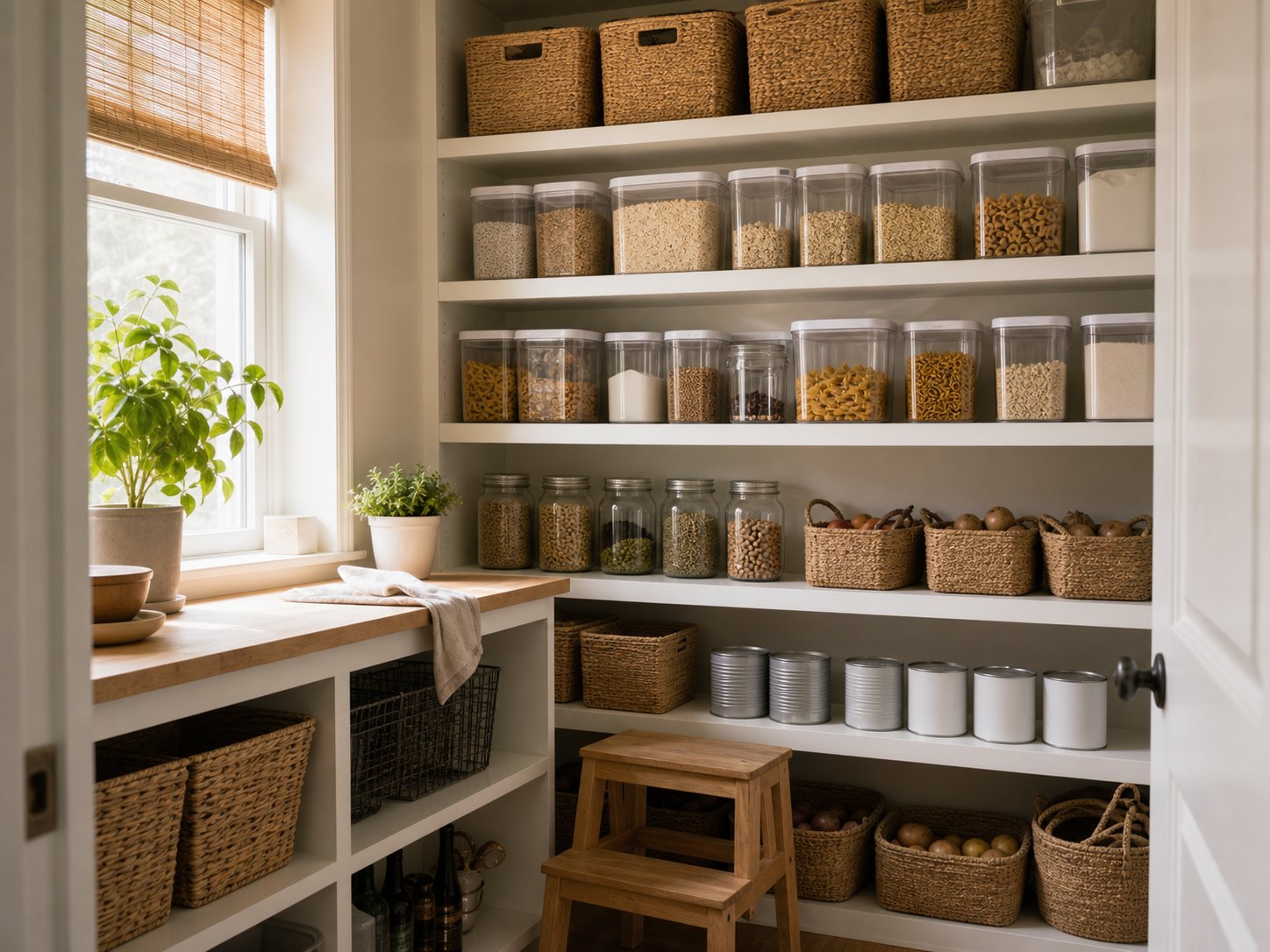
I opened my pantry and three cans of chickpeas fell on my foot. Not rolled off a shelf gently. Fell. From the second shelf, where they had been balanced behind a half-empty bag of quinoa that was propped against a box of granola bars from 2024. My foot was fine. My patience was not.
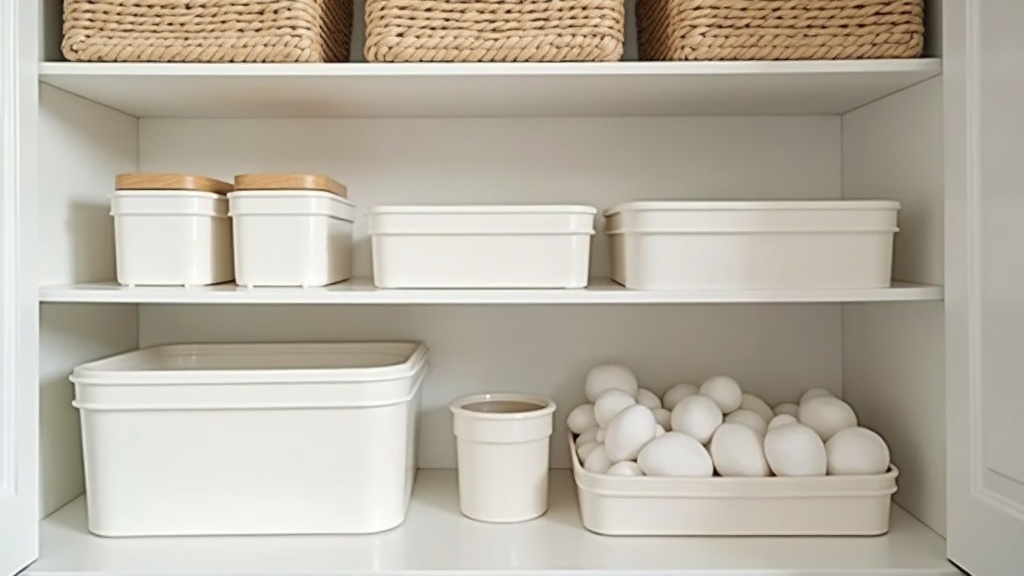
That was eight months ago. I spent the following weekend tearing everything out and rebuilding my pantry from scratch using a system I had been reading about, tweaking, and procrastinating on for months. Eight months later, my pantry still looks organized. Not Instagram-perfect — I have a toddler and a husband who thinks “putting it back” means anywhere on the correct shelf — but organized enough that nothing has fallen on anyone since.
This guide is the exact system I used. It is not a product roundup. I am not going to show you 47 different bins and tell you to buy all of them. Instead, I am going to walk you through a step-by-step process that works regardless of whether your pantry is a walk-in the size of a bedroom or a single cabinet next to the stove. The products I mention are the ones I actually bought, and I will tell you where I spent wisely and where I wasted money. The whole project cost me $127 and took one Saturday afternoon. You can do it for less, and I will show you how.
Quick Answer
Build a working pantry system in five steps: empty and purge everything first, measure your space and plan zones (daily staples, backups, baking, snacks), add organizers that actually fit, label every container, then keep it up with a quick weekly reset. A functional pantry makeover runs roughly $50 to $200 depending on how far you take the matching containers.
The 4-Zone Pantry System
Before you buy a single bin or touch a single shelf, you need a framework. Every pantry organization method I tried before this one failed because I was organizing by product type (all cans together, all boxes together) without thinking about how I actually use my kitchen. The 4-Zone System changed that.
The idea is simple. Divide your pantry into four zones based on frequency of use and the type of cooking you do.
Zone 1: Daily Essentials (eye level, easiest to reach). This is the shelf or area directly at your eye line when you open the pantry door. It holds things you grab every single day: coffee, tea, cooking oils, salt, pepper, your go-to spices, snack bars, bread, peanut butter. If you reach for it at least four times a week, it lives in Zone 1. This zone should be the least crowded and the most accessible. Nothing should be stacked behind other items here.
Zone 2: Cooking Staples (one shelf above or below eye level). These are the ingredients you use multiple times a week but not every single day: pasta, rice, flour, sugar, canned tomatoes, broth, sauces, baking supplies. Zone 2 items are the backbone of your meals. You need them frequently enough that they should be easy to find, but they can handle being one reach away from prime real estate.
Zone 3: Occasional and Bulk (top shelf or lower shelves). This is for items you buy in bulk or use once or twice a month: extra cereal boxes, backup canned goods, specialty ingredients for that one recipe you make at Thanksgiving, large bags of rice or flour. Zone 3 gets the least accessible real estate — the highest shelf you need a step stool for, or the lowest shelf where you have to bend down.
Zone 4: The Door and Sides (pantry door rack, side walls, floor). The pantry door is one of the most underused storage spaces in most kitchens. It is perfect for lightweight, frequently used items: spice packets, seasoning mixes, small snack bags, and condiment packets. The floor of the pantry handles heavy, bulky items that would be dangerous on shelves: 25-pound bags of rice, cases of water, pet food bags, bulk paper towel packs.
This framework works because it is based on your behavior, not arbitrary categories. You will stop buying duplicates because you can see everything. You will stop wasting food because forgotten items are not hidden behind a wall of cans on the same shelf. And you will spend less time staring into the pantry trying to figure out what to cook, because your cooking staples are all in one visible zone.
Step 1: Empty & Purge Everything
I know. You do not want to do this part. I did not want to do this part. But pulling everything out of the pantry is non-negotiable, and here is why: you cannot organize what you cannot see, and you cannot see what is buried behind three years of accumulated groceries.
Set aside two hours. Clear your kitchen table or a large stretch of counter space. Then pull every single item out of your pantry. Every can, every box, every half-open bag of chips, every mystery spice jar from 2022. All of it.
Once everything is out, sort it into four piles.
Keep. Anything unexpired that you have used in the last three months or will realistically use in the next month.
Donate. Unexpired items you bought with good intentions but never used. That quinoa blend. The coconut aminos. The specialty hot sauce your friend recommended that you tried once and did not love. If it is sealed and within its best-by date, your local food bank wants it.
Toss. Anything expired, stale, opened and forgotten, or of questionable origin. If you cannot identify it or remember buying it, it goes. No guilt. That bag of lentils from 2023 is not feeding anyone.
Relocate. Items that ended up in the pantry but belong elsewhere. Batteries, light bulbs, random tools, birthday candles, takeout menus — these migrate into pantries like they are drawn by gravity. Return them to their actual homes.
When I did this, I threw away 23 items and donated 11. I had four cans of coconut milk (I thought I was always out because they were scattered across three different shelves), two identical bags of brown sugar (same reason), and a box of instant oatmeal that expired in 2023. The purge alone freed up about 30% of my shelf space. That is 30% more room for organization without buying anything.
While the pantry is empty, wipe down every shelf. Remove shelf liners if they are peeling or sticky and replace them with fresh ones. A clean slate makes the reorganization feel intentional, and it takes five minutes.
Step 2: Measure & Plan Your Zones
With your empty pantry staring back at you, it is time to measure and plan. This step takes 15 minutes and saves you from the most common pantry organization mistake: buying organizers that do not fit.
Grab a tape measure and record three numbers for each shelf.
Width (left to right). Measure the usable width, not the total shelf width. If your pantry has side walls that are slightly angled or brackets that eat into shelf space, measure between those obstacles.
Depth (front to back). This is the measurement most people forget. A bin that is 14 inches deep on a shelf that is 11 inches deep will either hang off the front or not fit at all. Measure from the back wall to the front lip of the shelf.
Height (between shelves). Measure from the surface of one shelf to the bottom of the shelf above it. This determines whether you can use shelf risers, stackable bins, or tall containers. If your shelves are adjustable (metal brackets with multiple holes), note that — you may want to adjust spacing once you know what goes where.
Now assign your zones. Using the 4-Zone framework above, decide which shelves get which zones. In most standard pantries with four to five shelves, the layout looks like this:
Top shelf: Zone 3 (occasional and bulk, lighter items only — heavy items on high shelves are dangerous).
Second shelf: Zone 2 (cooking staples).
Third shelf (eye level): Zone 1 (daily essentials).
Fourth shelf: Zone 2 (more cooking staples or overflow from Zone 1).
Bottom shelf / floor: Zone 3 (heavy bulk items).
Door: Zone 4 (lightweight, frequently used packets and small items).
Write this down. Tape a sticky note to each shelf if it helps. This map is your blueprint for everything that follows.
If your shelves are adjustable, now is the time to reconfigure spacing. Most pantries come with evenly spaced shelves, but your storage needs are not even. Your Zone 1 shelf (daily essentials) probably needs 10-12 inches of height for bottles and tall containers. Your Zone 2 shelf (canned goods and boxes) may only need 7-8 inches. Adjusting shelf heights to match what actually goes on them can add the equivalent of an extra shelf without any new hardware.
Step 3: Essential Organizers That Actually Work
This is where most pantry organization guides turn into product catalogs. I am going to take a different approach. After testing more organizers than I care to admit — including several that are now in my garage holding screws — I have narrowed it down to five types of organizers that solve real problems in a pantry. You do not need all five. You might only need two or three. Buy based on the problems you actually have, not the problems Instagram tells you to worry about.
1. Clear Stackable Bins (the workhorse). These are the single most useful pantry organizer. Period. A clear bin with a flat bottom, straight sides, and no lid serves three purposes: it groups related items together (all snack bars in one bin), it lets you see contents without moving anything, and it turns a deep shelf into a pullout drawer (grab the bin handle, slide the whole thing forward). I use six of these across my Zone 1 and Zone 2 shelves. They hold snacks, baking supplies, packet mixes, tea bags, and breakfast items. Get ones that are at least 10 inches deep to match your shelf depth, and measure your shelf width so you can fit two or three bins side by side without dead space. A solid set of clear pantry organizer bins runs about $25-35 for a set of six to eight, and they will be the best money you spend on this entire project.
2. Lazy Susan Turntable (the corner saver). If your pantry has deep shelves, items in the back disappear. A lazy Susan solves this by letting you spin everything to the front. I use two: one for cooking oils and vinegars (Zone 1) and one for sauces and condiments (Zone 2). The key is getting one with a non-slip surface or a lipped edge — cheap turntables without edges let bottles slide off when you spin. A 10-12 inch diameter fits most pantry shelves without dominating the space. They cost $8-15 each and they eliminate the “forgotten bottle in the back corner” problem overnight.
3. Shelf Risers (the space doubler). A shelf riser is a simple U-shaped platform that creates a second level on an existing shelf. It is the closest thing to free storage in a pantry. I use one on my canned goods shelf — the riser holds one row of cans at the back, elevated about 4 inches, while the front row sits on the shelf surface. I can see every can at a glance instead of having to move the front row to find what is behind it. Shelf risers also work brilliantly for spice jars, allowing you to create a tiered display where every label is visible. Expandable risers that adjust from 15 to 25 inches wide are the most versatile. They cost about $12-18 each.
4. Can Organizer Rack (the gravity helper). If you use more than a dozen canned goods regularly, a can organizer is worth the investment. These are angled racks where cans roll forward as you remove one from the front, like a vending machine. They keep cans visible, accessible, and automatically rotated (first in, first out, so older cans get used before newer ones). I have a three-tier rack on my Zone 2 shelf that holds about 36 standard-size cans. It cost $20 and replaced what used to be a chaotic pile of cans stacked on top of each other with labels facing every direction. If you only use five or six cans at a time, skip this and just use a bin. The rack only pays off if you stock cans in volume.
5. Door-Mounted Rack or Pockets (the bonus shelf). Your pantry door is empty real estate. An over-the-door rack or a set of mounted pockets turns it into Zone 4 storage. Wire racks work well for spice jars, seasoning packets, and small snack bags. Fabric or clear pocket organizers work for flat items like seasoning packets, tea bags, and snack bars. I use a simple three-tier wire rack on the inside of my pantry door for spice packets and small items that used to float around the shelves. It cost $15 and holds about 30 items that were previously homeless.
One thing I would not buy again: decorative matching canisters for flour, sugar, rice, and pasta. They look beautiful on Pinterest. In practice, they take up more space than the original packaging, they require you to transfer everything (messy and time-consuming), and you lose the cooking instructions that are printed on the original bag. Clear bins that hold the original packaging are more practical and cheaper.
Step 4: Label Everything (Yes, Everything)
Labeling is the step that separates a pantry that stays organized from one that descends back into chaos within two weeks. I resisted labeling for years because it felt excessive. Then I labeled everything, and I will never go back.
Labels serve two purposes. First, they tell you where things go, which prevents the slow drift of items from their designated zones. When the bin is labeled “Snack Bars,” you do not absent-mindedly toss a bag of chips in there because it was convenient. Second, they tell everyone else in your household where things go. This is the crucial part. My pantry stayed organized for exactly four days before my husband put the cereal on the baking shelf. After I added labels, the cereal has been in its correct bin for eight months.
You have three labeling options, and all of them work.
A label maker. This is the gold standard for durability and readability. A basic label maker like the Brother P-Touch costs about $20 and produces clean, waterproof, adhesive labels that last for years. I use mine for bin labels, shelf labels, and even the inside of cabinet doors. If you enjoy organizing (and if you are reading this guide, you probably do), a label maker becomes one of those tools you wonder how you lived without.
Chalkboard labels. These are reusable adhesive labels with a matte black surface that you write on with a chalk pen. They look nicer than printed labels (more of that farmhouse aesthetic) and they are easy to update when you change what goes in a bin. A pack of 40 chalkboard labels plus a chalk pen costs about $8. The downside is that chalk pen text can smudge if you handle the labels frequently, and the handwritten look is only as neat as your handwriting.
Painter’s tape and a marker. This is the zero-cost option and honestly, it works fine. Painter’s tape removes cleanly, it is easy to rewrite, and it does the job. I started with this method and upgraded to a label maker after a month because the tape kept curling at the edges. But if you are on a strict budget, do not let the lack of a label maker stop you from labeling. A $4 roll of painter’s tape and a Sharpie will keep your pantry organized just as effectively as a $20 gadget.
What to label:
- Every bin (“Snack Bars,” “Baking,” “Breakfast,” “Pasta & Rice,” “Sauces”)
- Every shelf edge (“Zone 1: Daily” or simply the category: “Cooking Oils & Spices”)
- The lazy Susan sections if you have one (“Oils” on one side, “Vinegars” on the other)
- The door rack shelves (“Spice Packets,” “Tea,” “Small Snacks”)
- Any container you transferred dry goods into (“All-Purpose Flour,” “Brown Sugar” — include the date you transferred it)
Label placement matters. Put labels on the front of bins, not the top. You look at the front of a bin far more often than you look down at it. For shelf labels, stick them on the front lip of the shelf so they are visible when you open the pantry door.
Step 5: The Maintenance Habit
Here is the uncomfortable truth about pantry organization: the organizing part is actually the easy part. Maintaining it is where most systems fail. Your pantry will not stay organized on its own. Entropy is real, especially when multiple people live in your house and none of them read the same organization blog you did.
The maintenance system that has kept my pantry functional for eight months is embarrassingly simple. It takes about 10 minutes per week and it has three components.
The Weekly Scan (5 minutes, pick a day and stick to it). Every Sunday evening, before I write the grocery list for the week, I open the pantry and do a quick scan. I check three things. First, are there any items that migrated out of their designated zone? If so, I move them back. This takes about 30 seconds and catches problems before they compound. Second, are there any items running low that need to go on the shopping list? Seeing everything organized in zones makes this almost instant — you can spot a low bin at a glance. Third, are there any items that are expired or stale? I pull those out immediately. The weekly scan prevents the slow accumulation of chaos that leads to another chickpea avalanche.
The Grocery Putaway Rule (2 minutes per shopping trip). When groceries come home, they go directly into their designated zone. Not on the counter to deal with later. Not on the nearest empty shelf space. Into the correct zone, in the correct bin, behind existing stock (so older items get used first). This is the single most important habit in the entire system. If groceries always go in the right place from the start, the weekly scan has almost nothing to fix. I time myself on this now and it genuinely takes less than two minutes because I know exactly where everything goes.
The Quarterly Deep Clean (30 minutes, once every three months). Four times a year, I pull everything out again (just like Step 1, but much faster because the pantry is already organized), wipe down the shelves, check for expired items, and reassess whether the zone assignments still make sense. Eating habits change. You might discover that you stopped using an ingredient and its bin is sitting mostly empty while another category is overflowing. The quarterly reset is your chance to adjust. It also catches the five or six items that somehow escaped the weekly scans.
One more tip that made a significant difference: I put a small notepad and pen on the inside of the pantry door. When anyone in the house finishes something or notices we are running low, they write it on the notepad. When I do the weekly scan, I transfer those notes to the grocery list. This replaced the old system of “I finished the peanut butter three days ago but forgot to mention it and now we have no peanut butter and everyone is upset.” Low tech, highly effective.
Budget Breakdown: $50 vs $100 vs $200 Pantry Makeover
One of the questions I get asked most often is “how much does this actually cost?” The answer depends entirely on the state of your pantry and how far you want to take the system. Here are three realistic budget tiers with exactly what you get at each level.
| Item | $50 Budget | $100 Budget | $200 Budget |
|---|---|---|---|
| Clear Bins (set) | 4-pack ($15) | 8-pack ($30) | 10-pack + 4 narrow ($45) |
| Lazy Susan | 1 ($10) | 2 ($18) | 2 non-slip ($22) |
| Shelf Risers | — | 1 expandable ($15) | 2 expandable ($28) |
| Can Organizer | — | — | 3-tier rack ($20) |
| Door-Mounted Rack | — | 3-tier wire ($15) | 5-tier adjustable ($25) |
| Labels | Painter’s tape ($4) | Chalkboard labels ($8) | Label maker ($22) |
| Shelf Liners | 1 roll ($6) | 2 rolls ($12) | Premium grip liner ($18) |
| Airtight Containers | — | — | 6-piece set ($20) |
| Total | ~$35–50 | ~$98–110 | ~$190–210 |
My recommendation: Start at the $50 level. Seriously. Clear bins and a lazy Susan solve 80% of pantry problems. Live with that setup for a month, identify what is still not working, and then add shelf risers or a door rack to address specific pain points. The biggest waste of money in pantry organization is buying everything at once before you know what you actually need. The $200 tier is for people who already know their pantry’s specific problems and want to solve all of them at once — or for walk-in pantries with significantly more shelf space to fill.
For the bins alone, a good set of clear pantry organizer bins on Amazon runs $25-35 for an 8-pack. That is less than two fancy coffees per bin, and each one will serve you for years.
Common Mistakes That Undo Your Hard Work
I have reorganized my pantry three times over the past five years (before landing on the system in this guide), and I have made every mistake on this list at least once. Save yourself the frustration.
Buying organizers before measuring. I cannot stress this enough. A beautiful set of matching bins means nothing if they are half an inch too wide for your shelves or two inches too tall for the gap between shelves. Measure first. Buy second. Always.
Making the system too complicated. If your system requires 15 sub-categories and a color-coded index card, it will not survive contact with your actual life. Four zones. Labeled bins. That is it. The simpler the system, the more likely you (and everyone in your household) will actually follow it.
Ignoring the door. The inside of your pantry door is free storage space. Even a $15 wire rack adds meaningful capacity for small items that otherwise float around your shelves creating clutter. Use it.
Decanting everything into matching containers. This is the Pinterest trap. Yes, uniform containers look beautiful. They also take up more space than original packaging, require time-consuming transfers after every grocery trip, and you lose the nutritional info and cooking instructions printed on the original bag. Save decanting for items that genuinely benefit from airtight storage (flour, sugar, baking soda) and keep everything else in its original packaging inside clear bins.
Skipping labels because “I will remember.” You will not. Your family definitely will not. Label everything. It takes 20 minutes and it is the difference between a system that lasts eight months and one that lasts eight days.
Not adjusting shelves. If your pantry has adjustable shelves and they are still at the factory-default spacing, you are wasting vertical space. Move them. Match the shelf height to what actually goes on each shelf. This alone can create room for an extra shelf’s worth of storage.
What My Pantry Looks Like 8 Months Later
I want to be honest about this because I think most organization content creates unrealistic expectations. My pantry does not look like a Container Store display. The bins are not perfectly aligned. There is a half-eaten bag of tortilla chips that my husband did not clip shut sitting in the snack bin right now. One of the chalkboard labels on the lazy Susan has partially smudged because my kid grabbed it with wet hands.
But here is what has stayed consistent for eight months. Every item has a home. I have not bought a duplicate of something I already had since I set up this system (I used to do that at least twice a month). Nothing has fallen off a shelf. I can see every item in my pantry without moving anything. My grocery shopping takes 15 minutes less per trip because I know exactly what I need before I leave the house. And the weekly 5-minute scan has become automatic — I do not even think about it anymore. It is just what I do on Sunday evenings while the oven preheats for dinner.
The total investment was $127 (I landed between the $100 and $200 tiers), one Saturday afternoon, and roughly 10 minutes per week since then. For the amount of daily frustration it eliminated, it is one of the best home investments I have made. Better than the robot vacuum, honestly — and I love that robot vacuum.
If three cans of chickpeas have ever fallen on your foot — or if you have ever stood in front of your pantry for two minutes trying to find the paprika that was right there yesterday — give this system a weekend. You will not regret it.
Start Your Pantry Makeover
Frequently Asked Questions
How do I organize a pantry step by step?
Work in five steps: (1) empty and purge everything so you can see what you have, (2) measure the space and plan zones, (3) add organizers that fit your shelf depth, (4) label every container, and (5) build a short maintenance habit. Doing it in order stops you from buying bins before you know what actually needs storing.
What is the 4-zone pantry system?
It groups food by how you use it instead of by type: keep daily staples at eye level, backups and bulk items up high, baking and cooking ingredients together, and snacks where the people who reach for them can get to them. Zoning is what makes a pantry stay organized instead of drifting back to chaos.
How much does it cost to organize a pantry?
About $50 gets you a basic refresh with clear bins and labels, roughly $100 covers a mid-level makeover with risers and lazy Susans, and around $200 buys a full system with matching airtight canisters. You get most of the benefit at the lower end — the pricier tiers are mostly aesthetics.
What pantry organizers actually work?
Clear stackable bins, shelf risers, lazy Susans for corners, and airtight canisters for flour, sugar and cereal do the real work. The key is measuring your shelf depth first — the most common wasted money is organizers that don’t fit the space you actually have.
Do I really need to label pantry containers?
Yes. Labeling every container is what keeps the system running, because it tells everyone in the house exactly where things go back. Without labels, decanted staples slowly get returned to the wrong spot and the whole system unravels within a few weeks.
How do I keep my pantry organized long-term?
A short weekly reset — wipe a shelf, re-sort anything out of place, and note what needs restocking — is enough to hold the system in place. It’s a few minutes a week versus a full re-organization every few months, and it’s why a well-built pantry still looks good eight months later.
You May Also Like
- Best Pantry Organizer Bins in 2026: Top 7 Picks
- Best Kitchen Drawer Organizer 2026: Top Picks
- How to Organize a Small Kitchen 2026
- Best Under-Sink Organizer 2026
- The Complete Home Decluttering Guide 2026
- Home Organization Buying Guide 2026
Founder & Editor-in-Chief at TheHomePicker
James has spent 3+ years testing smart home products. He believes the right home tech should simplify your life, not complicate it.
Disclosure: This post contains affiliate links. If you purchase through our links, we may earn a small commission at no extra cost to you. Learn more. As an Amazon Associate, we earn from qualifying purchases.
Stocking the shelves: see the pantry bins we recommend.