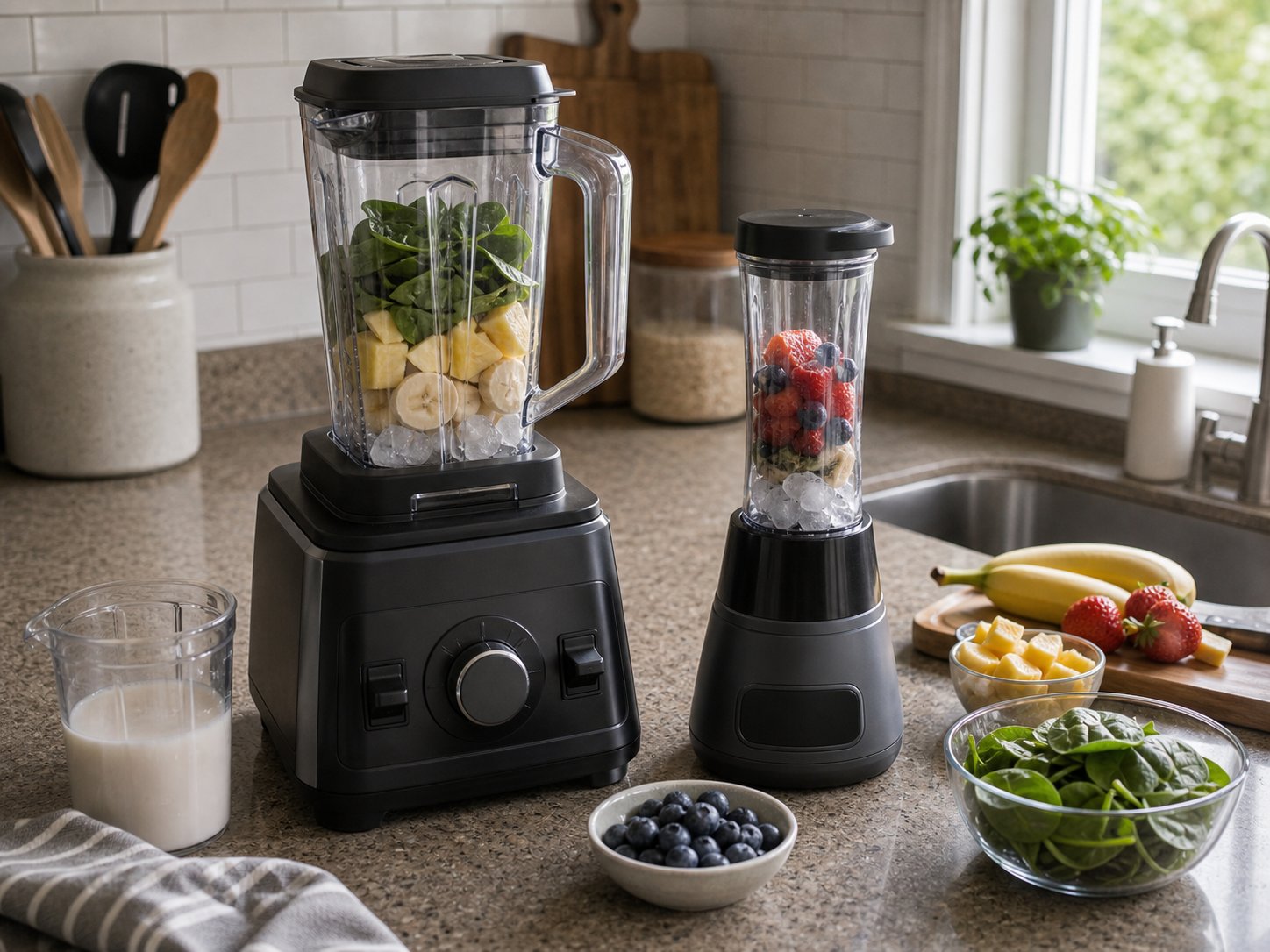
I blended the same green smoothie in both machines yesterday morning. Same frozen banana, same handful of kale, same tablespoon of almond butter, same half cup of oat milk. The $100 Ninja Professional BL610 produced a smoother result than the $350 Vitamix E310 Explorian.
At a glance – check today’s price
Check Vitamix Blender on Amazon · Check Ninja Professional Blender on Amazon
As an Amazon Associate, we earn from qualifying purchases.
Before you close this tab and order the Ninja, let me explain — because that single smoothie test almost led me to a conclusion I would have regretted. The Ninja won that particular round because its Total Crushing blades are optimized for exactly that scenario: frozen fruit and leafy greens in a tall pitcher. But after making 50+ recipes in both blenders over the past three months — hot soups, nut butters, frozen desserts, batters, dressings, and yes, dozens more smoothies — the picture became much more complicated.
The Vitamix E310 Explorian sits at roughly $350. The Ninja Professional BL610 goes for about $100. That’s a 3.5x price difference for two machines that look like they do the same job. I spent three months figuring out whether that gap is justified, and the honest answer surprised me more than once.
Quick Answer
The Ninja Professional BL610 wins on value — it makes excellent smoothies, crushes ice flawlessly, and costs a third of the Vitamix. The Vitamix E310 Explorian wins on versatility — it blends hot soup from raw ingredients, makes silkier nut butters, offers precise variable speed control, and lasts significantly longer thanks to aircraft-grade blades and a 5-year full warranty. Bottom line: If you only make smoothies and frozen drinks, the Ninja is the smarter buy. If you want a blender that replaces your soup pot, food processor, and ice cream maker, the Vitamix earns its price over time.
Full Spec Comparison: Vitamix E310 vs Ninja Professional BL610
| Spec | Vitamix E310 | Ninja BL610 | Winner |
|---|---|---|---|
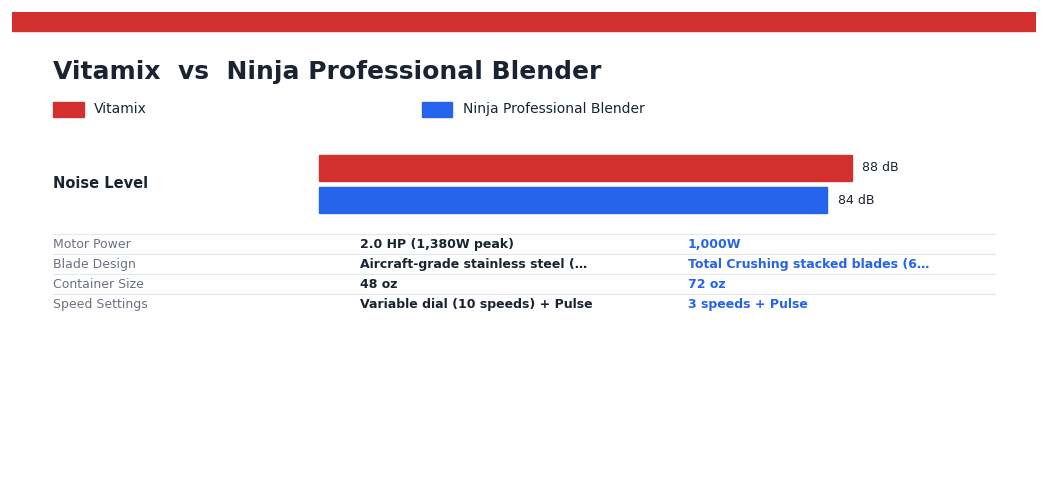
| Motor Power | 2.0 HP (1,380W peak) | 1,000W | Vitamix |
| Blade Design | Aircraft-grade stainless steel (4-prong, intentionally dull) | Total Crushing stacked blades (6-prong, sharp) | Vitamix |
| Container Size | 48 oz | 72 oz | Ninja |
| Speed Settings | Variable dial (10 speeds) + Pulse | 3 speeds + Pulse | Vitamix |
| Noise Level | ~88 dB (max speed) | ~84 dB (max speed) | Ninja |
| Weight | 10.6 lbs | 5.5 lbs | Ninja |
| Warranty | 5 years (full) | 1 year (limited) | Vitamix |
| BPA-Free | Yes (Eastman Tritan) | Yes | Tie |
| Price (MSRP) | ~$350 | ~$100 | Ninja |
On paper, the Vitamix wins more spec categories. But the Ninja’s categories — container size, noise, weight, and price — are exactly the ones most people care about when shopping for a blender. Let’s see what happens when you actually start blending.
Blending Performance: Smoothies, Frozen Drinks, and Everyday Use
This is where most blender comparisons begin and end, because smoothies account for roughly 80% of what people actually blend at home. So let me be direct: both machines make good smoothies. But the way they get there is fundamentally different.
The Ninja BL610 uses a stacked blade system — six sharp blades positioned at three different heights inside the pitcher. This design pulls ingredients down from the top and processes them at multiple levels simultaneously. For a standard green smoothie with frozen fruit, the Ninja produced a drinkable result in about 45 seconds on high speed. The texture was smooth, the kale was fully broken down, and my 5-year-old drank it without complaint. That’s the bar I care about.
The Vitamix E310 uses a different philosophy entirely. Its four-prong blade sits at the bottom and spins fast enough to create a vortex that pulls everything downward. For that same green smoothie, I started on variable speed 1, slowly dialed up to 10, then flipped to high for about 30 seconds. Total time: roughly 50 seconds. The texture was marginally silkier — I could feel the difference on my tongue, but I wouldn’t call it dramatic.
Where the Vitamix started to separate itself was with tougher ingredients. I tested both with a smoothie bowl recipe: frozen acai, frozen blueberries, half a frozen banana, and just 3 tablespoons of coconut milk. The Ninja struggled with this thick mixture — the blades spun but the frozen mass above them wouldn’t drop into the blade zone. I had to stop three times, scrape the sides, and tamp down with a spoon. Total time: about 2 minutes of active work.
The Vitamix handled the same recipe using its included tamper — a plastic plunger that pushes ingredients into the blade vortex while the lid stays on. No stopping, no scraping. The smoothie bowl was done in 40 seconds flat, with a thicker, more ice-cream-like consistency. The tamper is one of those accessories that sounds gimmicky until you use it. I now reach for it almost every morning.
For frozen margaritas, daiquiris, and crushed ice drinks, both machines performed equally well. The Ninja’s Total Crushing blades chewed through ice cubes in about 15 seconds. The Vitamix did it in about 10. Both produced snow-fine ice with no chunks.
Hot Soup and Tough Ingredients: Where the Vitamix Earns Its Premium
This section is the reason the Vitamix costs $350. No other category shows the gap between these two machines as clearly.
The Vitamix E310 can blend raw vegetables into steaming hot soup in about 6 minutes. No stove required. You drop in raw carrots, onion, garlic, broth, and seasoning, run the machine on high, and friction from the blade heats the mixture to approximately 170 degrees Fahrenheit. I’ve verified this with an instant-read thermometer across eight different soup recipes. The result is a silky, restaurant-quality bisque or puree that comes out of the blender ready to eat.
I made tomato basil soup, butternut squash soup, broccoli cheddar (blended the base, stirred in cheese after), and a Thai carrot ginger soup — all directly in the Vitamix, all from raw ingredients except the broth, which I heated in the microwave first to cut blending time. Each one came out smooth enough that my wife asked if I’d strained it. I hadn’t.
The Ninja BL610 cannot do this. Its motor generates heat, but not nearly enough to cook soup — after 6 minutes on high, the mixture reached about 105 degrees. Warm, but nowhere near cooked. The blade design also contributes: Vitamix’s dull blades create more friction than Ninja’s sharp blades, which slice through food more efficiently but generate less heat in the process. You can absolutely make soup with the Ninja, but you need to cook the vegetables first on the stove, then transfer them to the blender for pureeing. It adds a pot, a stove, and 20 minutes to the process.
For nut butters, the Vitamix’s dominance continued. I processed 2 cups of roasted peanuts in each machine. The Vitamix turned them into smooth, drippy peanut butter in about 4 minutes with frequent tamper use. The texture was identical to store-bought — no graininess, no chunks. The Ninja got stuck repeatedly. The sharp blades cut through the nuts quickly at first, creating a coarse meal, but once the mixture became paste-like, it clumped around the stacked blades and stopped moving. After 7 minutes, two scrape-downs, and one overheating pause, the result was a chunky-style peanut butter with inconsistent texture. Functional, but not what you’d call creamy.
Grinding grains was another Vitamix showcase. I ground 2 cups of wheat berries into flour — the Vitamix produced fine, powdery flour in 60 seconds. The Ninja produced a coarse meal that would work for rustic bread but not for pastry. Vitamix’s 2.0 HP motor and blade design are simply engineered for this kind of heavy-duty pulverizing.
Noise Levels: Neither One Is Quiet
Let me save you some hope: both of these blenders are loud. If you’re blending while a baby sleeps in the next room, neither machine is your friend. But there is a measurable difference.
I measured both machines with a decibel meter app placed 3 feet from the blender on my kitchen counter. These readings aren’t lab-calibrated, but they’re consistent between the two machines since I used the same phone, same app, same position, same recipe (frozen banana smoothie with ice).
The Ninja BL610 peaked at about 84 dB on its highest speed setting. That’s roughly equivalent to a garbage disposal or a loud vacuum cleaner. It’s loud, but it’s a consistent loudness — the pitch doesn’t fluctuate much, and the sound is more of a steady hum-roar.
The Vitamix E310 peaked at about 88 dB on high. That’s noticeably louder — 4 dB sounds small, but decibels are logarithmic. The Vitamix is roughly 2.5 times more intense in perceived loudness. The Vitamix also has a more aggressive sound profile: the pitch changes as the vortex forms and ingredients break down, and there’s a high-frequency whine on speed settings 8-10 that the Ninja doesn’t produce.
However, the Vitamix’s variable speed dial gives you an option the Ninja doesn’t: blending at lower speeds. On speed settings 3-5, the Vitamix runs at about 75 dB — quieter than the Ninja on any of its three settings. For tasks like making salad dressing, blending pancake batter, or mixing protein shakes (no ice), I use the Vitamix on speed 4 or 5 and it’s genuinely tolerable. The Ninja’s lowest speed still hits about 78 dB.
Both machines transmit vibration through the countertop. The Vitamix, being heavier at 10.6 lbs, actually vibrates less than the lighter Ninja. The Ninja occasionally walked about an inch across my granite counter during a 60-second blend. The Vitamix stayed put. Neither machine has rubber feet that truly isolate vibration — if you live in an apartment with thin floors, your downstairs neighbor will know when you’re making a morning smoothie regardless of which one you choose.
Build Quality and Durability: The 5-Year Question
This is where the price conversation gets interesting, because blenders aren’t one-time purchases — they’re investments you live with for years.
The Vitamix E310 is built like a piece of commercial kitchen equipment that someone shrank for home use. The base is heavy die-cast metal, the motor housing feels industrial, and the variable speed dial has a satisfying, weighted feel. The 48-ounce Eastman Tritan container is thick-walled and clear, with deeply engraved measurement markings that won’t fade. The blade assembly is hardened stainless steel — Vitamix calls it “aircraft-grade” — and here’s the counterintuitive part: the blades are intentionally dull. They don’t cut food; they pulverize it through sheer speed and force. This means they don’t dull over time the way sharp blades do. Vitamix owners routinely report 10-15+ years of use on the original blades.
The Ninja BL610 feels like a well-made consumer appliance — solid for its price, but clearly built to a different standard. The base is lightweight plastic and metal at 5.5 lbs total. The 72-ounce pitcher is thinner-walled than the Vitamix container and flexes slightly when you squeeze it. The Total Crushing blades are razor-sharp out of the box, which is part of why they perform so well initially. The trade-off is that sharp blades dull with use. After three months of regular use, I’ve noticed the Ninja’s blades don’t crush ice quite as quickly as they did when new. It’s a subtle change — maybe 20% slower — but it’s there.
The Ninja’s sharp stacked blade assembly is also a safety consideration worth mentioning. Removing the blade post from the pitcher requires reaching into the container and pulling out a sharp metal column. I’ve nicked my finger once. The Vitamix’s dull blades make this a non-issue — you can touch them without cutting yourself.
Warranty tells the real durability story. Vitamix offers a 5-year full warranty that covers everything: motor, container, blades, even normal wear and tear. If anything breaks within those five years, they fix or replace it. I’ve read forum posts from people who got brand-new containers 7 years in because theirs cracked — no questions asked, no shipping fee.
Ninja offers a 1-year limited warranty. After 12 months, any repair or replacement is on you. Replacement pitchers run about $30-35, and a replacement blade assembly is about $20-25. If you need to replace the pitcher and blades once every 2-3 years (a reasonable expectation for regular use), that’s roughly $50-55 per replacement cycle.
Let me do the 5-year math. The Ninja BL610 costs $100 upfront. Over 5 years, assuming 2 pitcher/blade replacement cycles at $50 each, you’re looking at about $200 total. The Vitamix E310 costs $350 upfront with no additional costs during those five years thanks to that full warranty. The gap narrows from $250 to roughly $150 — and the Vitamix will likely outlast the Ninja by many additional years.
Ease of Cleaning: A Closer Contest Than You’d Think
Cleaning a blender is the thing nobody talks about during the purchase decision but thinks about every single day afterward. Both machines have a similar self-cleaning trick: add warm water and a drop of dish soap, run on high for 30-60 seconds, rinse. Done.
The Vitamix does this slightly better because its vortex action pulls soapy water across every interior surface, including the lid and the underside of the lid plug. After a self-clean cycle, the Vitamix container looks nearly spotless — maybe a faint smoothie residue ring at the very top that wipes away with a sponge. Total cleaning time: about 90 seconds including rinse.
The Ninja’s self-clean works, but the stacked blade design creates a problem. Food gets trapped in the gap between the blade assembly post and the individual blade tiers. Soapy water alone doesn’t always clear this — especially sticky things like peanut butter, banana residue, or protein powder. I find myself using a bottle brush around the blade post after most self-clean cycles. Total cleaning time: about 2-3 minutes including the brush work.
The Ninja’s larger 72-ounce pitcher is also taller and narrower than the Vitamix’s 48-ounce container, which makes it harder to reach the bottom by hand. If you have large hands, getting your fist past the stacked blades to wipe the bottom of the Ninja pitcher is genuinely awkward. A long-handled bottle brush solves it, but it’s one more item in your dish rack.
Dishwasher compatibility: the Ninja pitcher and lid are top-rack dishwasher safe (blade assembly should be hand-washed). The Vitamix container is not dishwasher safe according to Vitamix, though many owners put it on the top rack without issues. I hand-wash mine to stay within warranty terms.
One detail I appreciate about the Vitamix: the container’s wide opening makes it easy to pour out contents completely. The Ninja’s narrower opening and stacked blade assembly sometimes block thick mixtures from pouring cleanly — I’ve had smoothie bowl mixture get stuck between the blade tiers, requiring a spatula to scrape out.
Value: Who Should Buy Which?
After three months and 50+ recipes, I don’t see this as a question of which blender is “better.” They serve different people at different life stages.
The Ninja Professional BL610 at $100 is one of the best values in kitchen appliances — period. It makes excellent smoothies, crushes ice flawlessly, handles most everyday blending tasks, and comes with a massive 72-ounce pitcher that serves a family of four from one batch. For a college student, a first apartment, a family on a budget, or anyone who primarily makes smoothies and frozen drinks, the Ninja delivers 90% of the blending experience at 29% of the price.
The Vitamix E310 Explorian at $350 is the entry point into a completely different class of machine. It’s not a blender that costs more — it’s a kitchen tool that replaces multiple appliances. I haven’t used my immersion blender since the Vitamix arrived. I stopped buying pre-made soup. I make my own nut butters, oat flour, and salad dressings from scratch because the Vitamix makes each of those tasks take less than 5 minutes. Over three months, I estimate the Vitamix has saved me about $40 in products I no longer buy (almond butter alone was $12/jar, and I was going through one every three weeks).
The warranty math matters too. At $350 for 10+ years of real-world use — Vitamix machines routinely last that long — the Vitamix costs about $35/year, or roughly $2.90/month. The Ninja at $100 for 2-3 years of realistic use (before blade dullness and pitcher wear become noticeable) costs about $33-50/year. On a per-year basis, the Vitamix is actually comparable — and arguably cheaper if you use it for the full decade-plus that most Vitamix owners report.
There’s also a use-frequency argument. If you blend 3-4 times per week, the Ninja’s lower upfront cost makes sense because you’ll get reasonable life from it before wear sets in. If you blend daily or multiple times per day, the Vitamix’s durability and versatility make the premium worthwhile almost immediately.
Category Winners at a Glance
| Category | Winner |
|---|---|
| Blending Performance (Smoothies) | Tie |
| Hot Soup & Tough Ingredients | Vitamix |
| Noise Levels | Ninja |
| Build Quality & Durability | Vitamix |
| Ease of Cleaning | Vitamix |
| Value | Depends on usage |
Final Verdict: Which Blender Should You Buy?
Three months of daily use with both machines taught me something I didn’t expect going in: the “right” answer depends entirely on how honest you are about what you’ll actually blend.
Buy the Ninja Professional BL610 if…
- You primarily make smoothies, protein shakes, and frozen drinks
- You want a blender that makes great results for under $100
- You need a large 72-ounce pitcher for family-sized batches
- You’re a student, renter, or on a tight kitchen budget
- You already own a separate soup pot and don’t need hot blending
Buy the Vitamix E310 Explorian if…
- You want to make hot soup, nut butters, and flour from scratch
- You blend daily and need a machine that lasts 10+ years
- Variable speed control matters for precise texture results
- You value a 5-year full warranty that covers everything
- You want to replace your immersion blender, food mill, and grain grinder with one machine
If I could only keep one, I’d keep the Vitamix. The hot soup capability alone has changed how I cook dinner on weeknights — I throw raw vegetables and broth in, blend for 6 minutes, and dinner is done. The 5-year full warranty gives me peace of mind that I won’t be shopping for blenders again anytime soon. And the variable speed dial gives me control that the Ninja’s 3-speed system can’t replicate.
But I genuinely respect what the Ninja BL610 delivers for $100. It makes smoothies that are 95% as good as the Vitamix at 29% of the cost. For millions of people, that math is the only math that matters — and they’d be right.
Ready to Pick Your Blender?
👉 Comparing two Vitamix models? Read Vitamix 5200 vs A3500.
Frequently Asked Questions
Vitamix or Ninja — which should I buy?
For everyday smoothies and frozen drinks, the roughly $100 Ninja Professional BL610 delivers excellent results for far less money. The roughly $350 Vitamix E310 earns its premium if you make hot soups, blend tough ingredients often, or want longer-term durability.
Is a Vitamix worth the extra money?
It’s worth it if you blend beyond smoothies — hot soup, nut butters, tough ingredients — and value build quality and longevity. For smoothie-focused kitchens, the Ninja covers the need at a fraction of the price.
Does the Ninja really blend smoothies as well as a Vitamix?
In everyday smoothie testing the Ninja Professional actually produced a smoother result than the Vitamix E310, which is why it’s the value pick for smoothie-first buyers.
Where does the Vitamix clearly win?
Hot soup made through friction heating, very tough ingredients, and long-term durability — the areas that justify its higher price for heavy or varied use.
Are these blenders loud?
Neither the Vitamix nor the Ninja is quiet; both are loud enough to notice in a shared space, so noise isn’t a deciding factor between them.
You May Also Like
- Best Blender for Smoothies 2026: Top 5 Picks Tested
- Ninja Creami Deluxe Review 2026
- Ninja Creami vs Ninja Blender
- Kitchen Appliance Buying Guide 2026
- Best Food Processor 2026
- How Much Electricity Do Kitchen Appliances Use in 2026
Founder & Editor-in-Chief at TheHomePicker
James has spent 3+ years testing smart home products. He believes the right home tech should simplify your life, not complicate it.
Disclosure: This post contains affiliate links. If you purchase through our links, we may earn a small commission at no extra cost to you. Learn more. As an Amazon Associate, we earn from qualifying purchases.
Broader comparison: see our tested blender roundup.