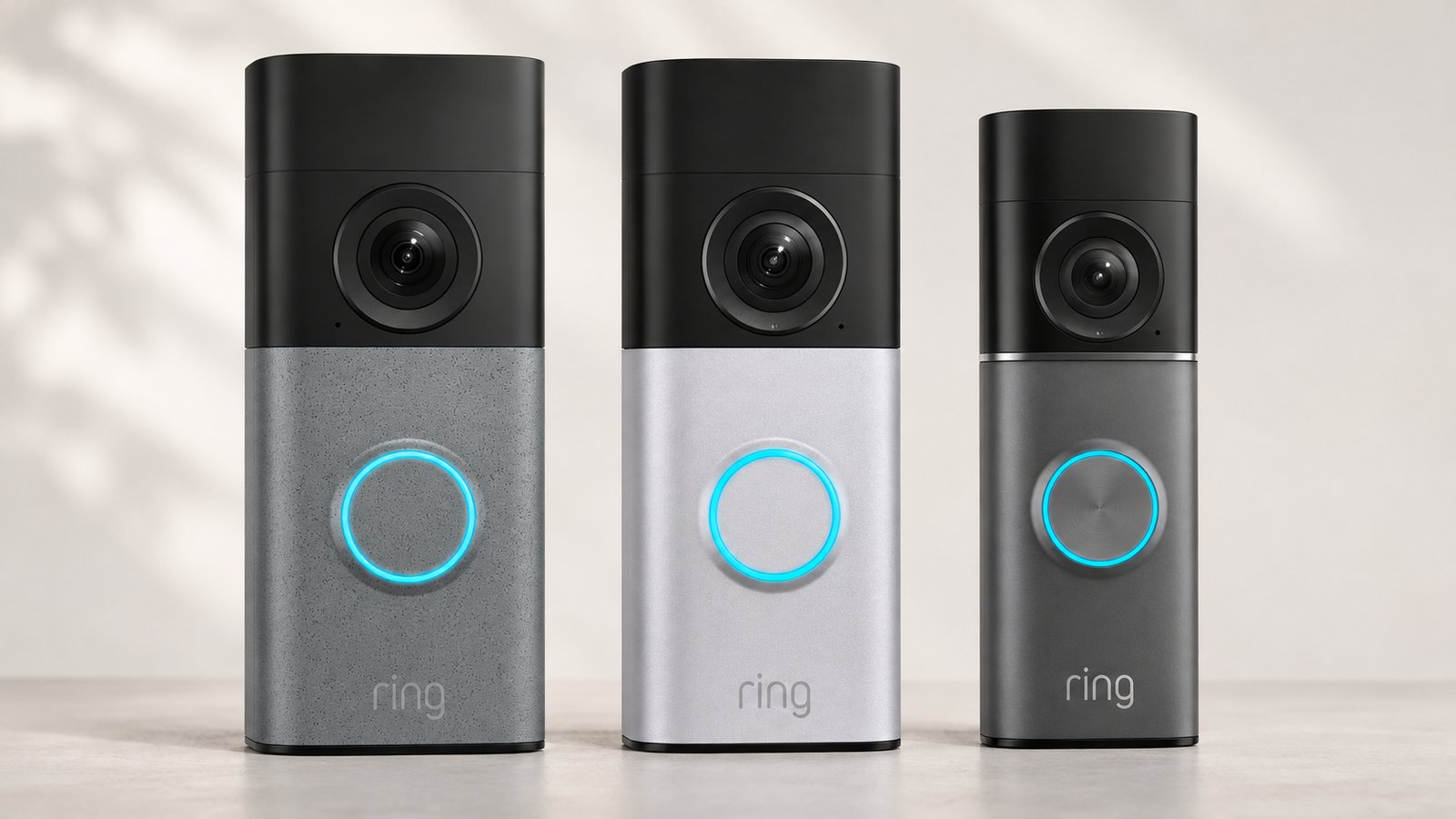
Buy Ring’s Wired Doorbell 2K Plus, or the Wired Doorbell 4K Pro on doorbell wiring, and the ding-dong in your hallway goes quiet. Ring’s own hardwiring guide says both “are not compatible with existing chimes, unless Wired Doorbell 4K Pro is powered by PoE,” and each ships with a small speaker called Chime Kit Mini that takes over the chime’s job with a single tone. Ethernet-powered models aside, the Ring doorbells that Ring says can keep an existing chime ringing are two older wired models and, less obviously, its battery doorbells wired into the doorbell system. Add years of renaming, in which “Wired Doorbell Pro” has meant two different doorbells, and choosing the right model comes down to two labels in your house: the one on the transformer and the one inside the chime.
AI disclosure: The text on this page was prepared with AI assistance.
We did not install or test these doorbells. This guide is built from Ring’s US support articles and product pages and Amazon’s product data, all checked on November 9, 2026. Where Ring’s own pages disagree, we show both. It is not wiring advice: Ring says “installation by a qualified electrician might be required in your area,” and that permits and professional installation might be required by law.
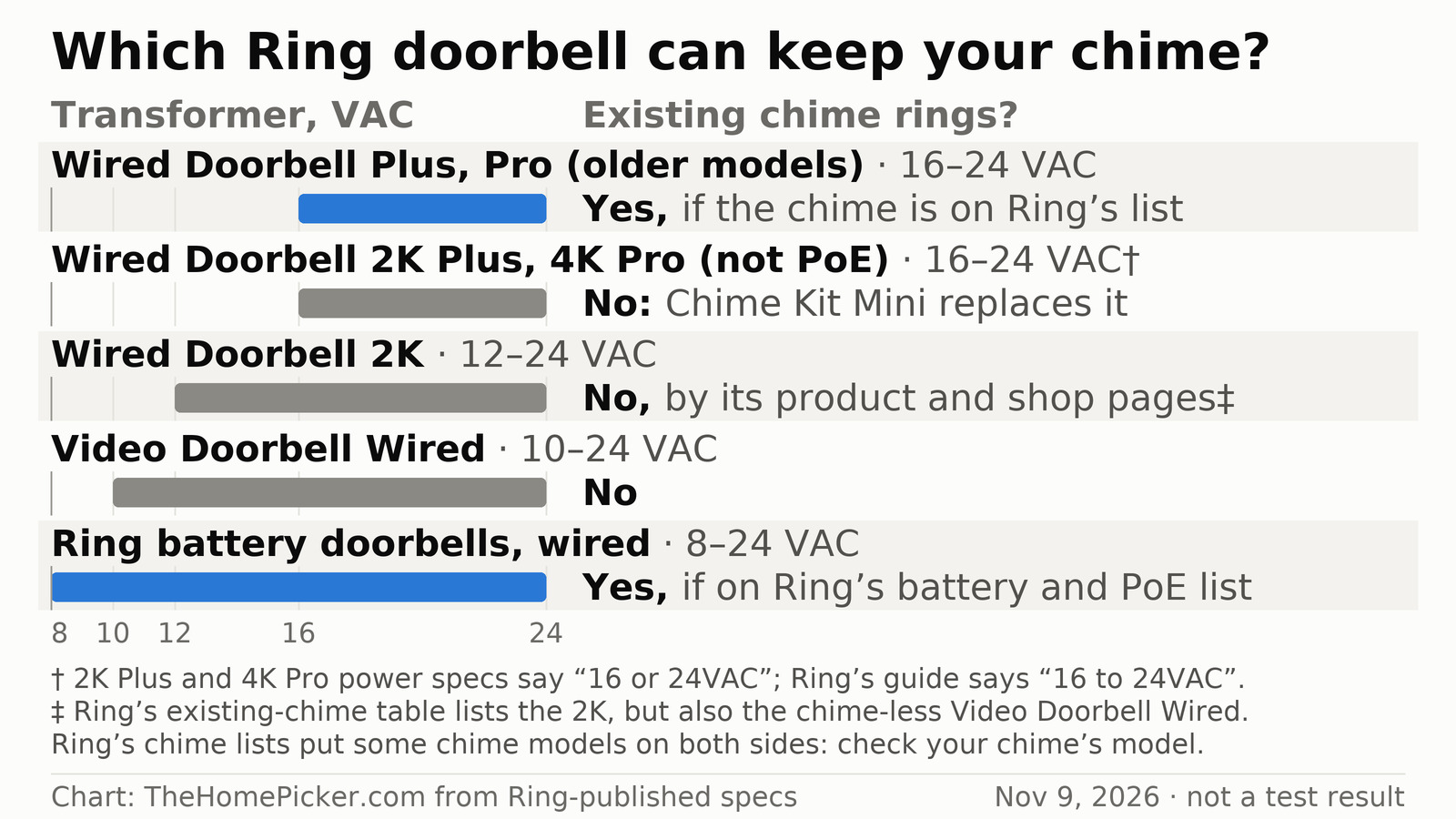
Quick answer: If your existing chime has to keep ringing on an ordinary doorbell transformer, the wired models Ring checks against a tested chime list are the older Wired Doorbell Plus and Wired Doorbell Pro. The Amazon listings we found for both were “Like-New” units, so we don’t link them; Ring’s battery doorbells, which Ring lists at 8 to 24 VAC when wired to an existing chime and checks against their own chime list, are the other route. If you are happy for the chime to be replaced, the Wired Doorbell 2K Plus and Wired Doorbell 4K Pro need a 16 to 24 VAC transformer rated 10 to 40 VA and include Chime Kit Mini. If your transformer label reads below 16 VAC, rule out both of those and the older Plus and Pro; the Wired Doorbell 2K accepts 12 to 24 VAC, but its product page says it doesn’t support mechanical chimes.
Old name, new name
Two rounds of renaming matter here. In the first, in Ring’s words, “Video Doorbell Pro and Video Doorbell Pro 2 are now Wired Doorbell Plus and Wired Doorbell Pro,” and instructions written for the old names still apply. The second came on August 5, 2026, when Ring swapped generation labels for resolution: Wired Doorbell (2nd Gen) became Wired Doorbell 2K, Wired Doorbell Plus (2nd Gen) became Wired Doorbell 2K Plus, and Wired Doorbell Pro (3rd Gen) became Wired Doorbell 4K Pro. Wired Doorbell Elite (2nd Gen) had become Wired Doorbell 4K Elite on July 21. Ring calls the change cosmetic only, says the device and its features are unchanged, and warns that boxes made before it may still carry the old name.
Two pairs of names cause most of the trouble. “Wired Doorbell Plus” is the old Video Doorbell Pro, a 1080p doorbell, while the Wired Doorbell 2K Plus is a 2025 release whose ring.com address still reads wired-doorbell-plus. And “Wired Doorbell Pro” on its own is the 2021 doorbell once sold as the Pro 2, with 1536p video, while Ring’s own store sells the 4K Pro in a bundle titled “Wired Doorbell Pro (Newest Model).” Those two Pros differ on exactly the points this guide is about, the chime and the box contents, so if a review or listing just says “Pro,” look for 4K, 3rd Gen or Newest Model before you rely on it.
Power and the chime are two separate questions
“Wired” describes where the doorbell gets its power, not whether the chime inside rings. Every model below can draw power from an existing doorbell transformer, and Ring publishes a separate answer for each question: a transformer range for power, and, for some models, a chime list for sound.
| Model (earlier name) | Rings your existing chime? | Transformer Ring lists | Chime part Ring specifies |
|---|---|---|---|
| Wired Doorbell 2K (Wired Doorbell 2nd Gen) | No, by its product and shop pages | 12–24 VAC, up to 40 VA | Bypass cable; no Pro Power Kit |
| Wired Doorbell 2K Plus (Wired Doorbell Plus 2nd Gen) | No; Chime Kit Mini replaces it | 16–24 VAC, 10–40 VA; 30–40 VA recommended | Chime Kit Mini |
| Wired Doorbell 4K Pro (Wired Doorbell Pro 3rd Gen) | No when on doorbell wiring; yes for the PoE version | 16–24 VAC, 10–40 VA; 30–40 VA recommended; or 24 VDC, 12 W | Chime Kit Mini (wired installs) |
| Wired Doorbell Pro (Video Doorbell Pro 2) | Yes, if the chime is on Ring’s list | 16–24 VAC, 10–40 VA | Pro Power Kit |
| Wired Doorbell Plus (Video Doorbell Pro) | Yes, if the chime is on Ring’s list | 16–24 VAC, 10–40 VA | Pro Power Kit |
| Video Doorbell Wired | No | 10–24 VAC, 8–40 VA | Jumper cable to bypass the chime |
| Ring battery doorbells, wired to the doorbell system | Yes, if the chime is on Ring’s battery and PoE list | 8–24 VAC, 5–40 VA | None for current models |
If the old chime has to keep ringing
Rule out the 2K Plus and the hardwired 4K Pro. Ring’s Chime Kit Mini page is blunt: these doorbells require Chime Kit Mini, “which bypasses and replaces your existing in-home chime. Your original chime will not produce sound after installation.” The replacement offers a single ringtone and can’t be used with a Ring Plug-In Adapter. For more than one sound, Ring points to a plug-in Ring Chime, Chime Plus or an Alexa device, sold separately. Ring’s chime troubleshooting article adds the Video Doorbell Wired to the same list of doorbells that don’t support an in-home chime.
Don’t count on the Wired Doorbell 2K either, even where Ring’s articles leave room for doubt. Ring’s hardwiring guide lists the 2K in its table headed “Connecting your Video Doorbell to an existing chime,” with a 12 to 24 VAC range, but the same table lists the Video Doorbell Wired, which Ring says doesn’t work with in-home chimes, so a row there gives a transformer range rather than a promise that the chime rings. Ring’s chime troubleshooting article also leaves the 2K off its list of doorbells without chime support. But the 2K’s own product page answers “Will Wired Doorbell 2K work with my existing doorbell chime?” with “No, Wired Doorbell 2K doesn’t support mechanical chimes,” Ring’s shop page says it “does not activate your home’s internal doorbell chime,” a Ring power article says Ring’s 2K and 4K wired doorbells “are not compatible with any in-home chimes,” and the box includes a bypass cable. Our reading is that the product page is the one to plan around, which fits with Ring and Amazon both selling the 2K bundled with a plug-in Chime.
The older Plus and Pro are the wired pair Ring tests against chimes. Ring keeps a list of “tested and confirmed chimes” for the Wired Doorbell Plus and Wired Doorbell Pro, mechanical and digital, and says it applies to devices in the United States and Canada. The same list also names incompatible chimes, and makers appear on both sides: Edwards’ C210 and C211 even appear on both the compatible and the incompatible mechanical lists. So the brand alone settles nothing; you need the model, which Ring says is often printed inside the chime cover. The catch is buying one. The Amazon listing we found for the 2021 Wired Doorbell Pro describes the unit as a certified refurbished “Like-New” device, and the only Wired Doorbell Plus listing we found was also “Like-New” and showed only a future availability date, so we don’t link either.
A battery doorbell can be the better wired doorbell here. Ring’s hardwiring guide lists its battery doorbells, including the Battery Doorbell 2K, 2K Plus and 4K Pro, in the existing-chime table at 8 to 24 VAC, and gives 5 to 40 VA for battery doorbells on an existing doorbell system. Ring keeps a separate tested chime list for battery and PoE doorbells, and it isn’t the same as the Plus and Pro list: the NuTone K16, for example, is compatible on the battery list and incompatible on the Plus and Pro list. The battery list has its own contradictions, too, with the Amseco MBL-10 and Edwards’ C210 and C211 on both its compatible and incompatible mechanical lists. Our guide to Ring’s battery doorbells covers the current battery models, which it lists under their pre-August names, such as Battery Doorbell Plus 2nd Gen for what is now the 2K Plus.
Power over Ethernet is the other exception. Ring says the PoE version of the Wired Doorbell 4K Pro “can connect to your existing internal chime and does not require Chime Kit Mini,” and the Wired Doorbell 4K Elite runs on PoE too. Both need an Ethernet run to the door rather than the existing doorbell transformer, which puts them outside this guide. Among the Amazon 4K Pro listing’s variations we found only color options and a 2-pack, not a separate PoE version.
Read the transformer label before you choose
Ring says the transformer is a small metal box often found away from the chime, in a garage, basement, attic or closet, with a label giving a voltage (V) and a volt-amp (VA) number, or one for each combination if it has three terminal screws. Ring also says to turn off power at the circuit breaker before examining your wiring, and warns that an incompatible transformer or chime could damage your devices. Every range in Ring’s tables tops out at 24 VAC; the bottom end is what separates the models.
- 16 to 24 VAC: the voltage fits every model in the table. Ring lists 10 to 40 VA for the Plus, Pro, 2K Plus and 4K Pro, and the 2K Plus and 4K Pro product pages recommend 30 to 40 VA “for optimal performance.”
- 12 to 15 VAC: rule out the Plus, Pro, 2K Plus and 4K Pro. The Wired Doorbell 2K’s 12 to 24 VAC range covers it, without the chime; a battery doorbell covers it and can keep a chime on Ring’s battery list ringing.
- 10 or 11 VAC: the Video Doorbell Wired (10 to 24 VAC, no chime) or a battery doorbell.
- 8 or 9 VAC: only Ring’s battery doorbells, among the models here.
- Above 24 VAC, or a halogen or garden-lighting transformer: none of these. Ring’s pages for the 4K Pro, 2K Plus, Pro and Plus rule out halogen and garden-lighting transformers by name.
Two cautions for a borderline transformer. Ring says more than one hardwired Ring doorbell on one transformer, or features like Package Detection and Bird’s Eye View, may need a higher VA rating. And Ring words the 16-volt range two ways: “16 to 24VAC” in its hardwiring guide and in the 2K Plus product page’s own FAQ, but “16 or 24VAC” in the power specs on the 2K Plus and 4K Pro product pages. For a label in between, such as 18 VAC, ask Ring before you buy. Ring’s power troubleshooting article also lumps all wired doorbells under “16-24 VAC,” which misses the 2K’s 12 VAC floor; the figures above come from the per-model pages.
If your transformer falls short, Ring says “you will need to install a new one,” and sells a Ring Hardwired Transformer rated 16 VAC, 30 VA. That is electrical work on the house side of the doorbell system, and the point where Ring’s own advice is to check local codes and consider a qualified electrician.
The Pro Power Kit question
The Pro Power Kit is the part that sits at the chime for the Wired Doorbell Plus and Pro; Ring describes its advantage as “a resettable fuse.” Ring’s articles disagree on when it is needed. The direct-to-transformer table marks it required for both the Plus and the Pro, and the kit’s installation article opens with “You must use the Pro Power Kit with your Wired Doorbell Plus and Pro,” then says “the Wired Doorbell Pro does not require the Power Pro Kit to sidestep the in-home chime.” For a buyer it matters less than it looks: Ring’s box lists for both include the kit, so you aren’t buying one separately, and which setup uses it is a question for Ring’s installation guide. The same table marks the kit as not required for the Wired Doorbell 2K, 2K Plus and 4K Pro, which come with a bypass cable or Chime Kit Mini instead.
The three we link to
Wired Doorbell 2K: a 12 VAC transformer, and no plans for the old chime
The 2K has the widest transformer range of the three doorbells we link, 12 to 24 VAC, which is the reason to pick it if your label reads 12 to 15 VAC. It records in Retinal 2K with up to 6x Enhanced Zoom and connects over single-band 2.4 GHz Wi-Fi, and Ring recommends at least 10 Mbps of upload speed. Plan on a plug-in Ring Chime or an Alexa device for sound inside the house; Amazon also sells the 2K bundled with Ring’s Chime (3rd Gen), but we link the doorbell on its own.
Wired Doorbell 2K Plus: a 16 VAC or higher transformer, and a new chime sound is fine
This is the doorbell Ring sold as the Wired Doorbell Plus (2nd Gen) until August 2026, not the older Wired Doorbell Plus. It needs 16 to 24 VAC at 10 to 40 VA, with 30 to 40 VA recommended, and Chime Kit Mini comes in the box to replace the chime’s sound. Over the 2K, it adds dual-band 2.4 and 5 GHz Wi-Fi and what Ring calls Low-Light Sight with Adaptive Night Vision.
Wired Doorbell 4K Pro: the same power needs, with 4K video
Formerly the Wired Doorbell Pro (3rd Gen), a 2025 release. On doorbell wiring it needs 16 to 24 VAC at 10 to 40 VA, with 30 to 40 VA recommended, or 24 VDC at 12 W, and like the 2K Plus it ships with Chime Kit Mini, which can’t be used with a Ring Plug-In Adapter. It records 4K video with up to 10x Enhanced Zoom, connects over dual-band Wi-Fi 6, and Ring recommends at least 15 Mbps of upload speed for its 4K devices.
When a Ring wired doorbell isn’t the answer
With no doorbell wiring, or a transformer outside every range above that you don’t plan to replace, a battery doorbell on its own pack is the simpler buy; our guide to Ring’s battery doorbells compares them. If your chime must keep its own sound and its model isn’t on the Ring list for the doorbell you are considering, don’t buy on the assumption that it will. And if rewatching recordings matters to you, Ring’s Amazon listings tie recording history and the AI-powered alerts to a Ring subscription, sold separately.
How to choose
- Existing chime must keep ringing, transformer 8 to 24 VAC: a Ring battery doorbell wired to the system, with your chime on Ring’s battery and PoE list.
- Existing chime must keep ringing, transformer 16 to 24 VAC: the older Wired Doorbell Plus or Pro, with your chime on their list, if you can find one sold new.
- Chime can be replaced, transformer 16 to 24 VAC: Wired Doorbell 2K Plus, or the 4K Pro for 4K video.
- Transformer 12 to 15 VAC, no need for the old chime: Wired Doorbell 2K.
- Ethernet already at the door: the PoE 4K Pro or the 4K Elite, outside this guide.
- No doorbell wiring: a battery doorbell.
Frequently asked questions
Does the Ring Wired Doorbell 2K Plus work with an existing chime?
No. Ring says the Wired Doorbell 2K Plus and the hardwired Wired Doorbell 4K Pro aren’t compatible with in-home chimes. Both include Chime Kit Mini, which bypasses the existing chime and plays a single tone instead; Ring says the original chime will not produce sound after installation.
Is the Ring Wired Doorbell Plus (2nd Gen) the same as the Wired Doorbell 2K Plus?
Yes. Ring’s name-change list says Wired Doorbell Plus (2nd Gen) became Wired Doorbell 2K Plus on August 5, 2026, and that only the name changed. It is a different doorbell from the older Wired Doorbell Plus, which Ring sold as the Video Doorbell Pro.
What is the Ring Video Doorbell Pro 2 called now?
Wired Doorbell Pro. Ring says instructions for the Video Doorbell Pro 2 still apply to it. Don’t confuse it with listings titled “Wired Doorbell Pro (Newest Model),” which Ring uses for the 4K Pro, formerly the Wired Doorbell Pro (3rd Gen), a doorbell that doesn’t ring an existing chime when hardwired.
Which Ring doorbell works with a transformer below 16 VAC?
Ring lists 16 to 24 VAC for the Wired Doorbell Plus, Pro, 2K Plus and 4K Pro, so a lower label rules them out. Ring lists 12 to 24 VAC for the Wired Doorbell 2K, which doesn’t support mechanical chimes by its product page, 10 to 24 VAC for the Video Doorbell Wired, and 8 to 24 VAC for its battery doorbells wired to a doorbell system. Ring sells a 16 VAC, 30 VA hardwired transformer, and says installation by a qualified electrician might be required in your area.
Do I need to buy a Ring Pro Power Kit?
Not separately for the models in this guide, by Ring’s box lists. The Wired Doorbell Plus and Wired Doorbell Pro include one, and Ring’s direct-to-transformer table marks a Pro Power Kit as not required for the Wired Doorbell 2K, 2K Plus and 4K Pro; the 2K Plus and 4K Pro include Chime Kit Mini instead. Ring’s articles differ on when the Pro needs its kit, so follow Ring’s installation guide for your setup.
How we put this together: We compare Ring’s US support articles, product pages and name-change list with Amazon’s product data, checked on November 9, 2026; we did not install or test these doorbells. For your own installation, follow Ring’s installation guide for your model or ask a qualified electrician.
As an Amazon Associate, TheHomePicker.com earns from qualifying purchases.