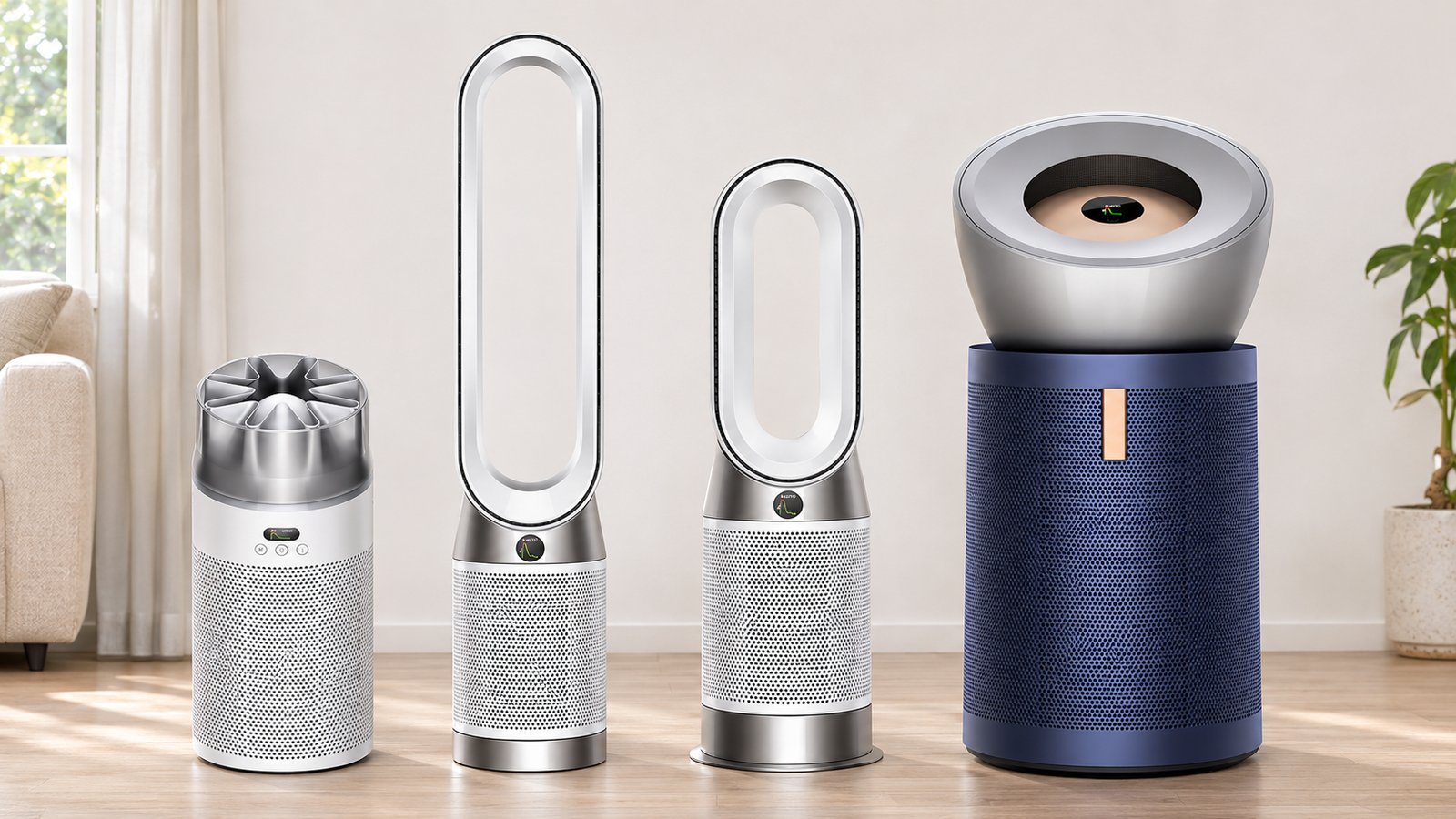
Search for the Dyson TP07’s CADR and you run into Dyson’s own case against the number. The company calls CADR “the metric generated by old test methods dating back to the 1980s,” measured in a test chamber of 28 to 30 cubic meters, and it rated the TP07 with its own POLAR test instead. Then, on its newest HushJet machines, Dyson started printing a CADR anyway. That shift is a useful map of the lineup Dyson sells in the US now. The names changed: Dyson’s US support list now puts the Purifier Cool PC1, the Purifier Hot+Cool HP1 and “De-NOx” versions of both ahead of the TP07 and HP07. A small HushJet Compact and a big Big+Quiet sit at either end. The way to choose is by the one extra job you want the machine to do: cool you, heat the room, humidify it, go after particular gases, or fill a large space.
AI disclosure: The text on this page was prepared with AI assistance.
We did not test these purifiers or measure them. This guide is built from Dyson’s US product, support and technical-specification pages and Amazon’s product data, all checked on November 9, 2026. Where Dyson’s own figures disagree, we show both.
Quick answer: For a room up to 203 sq ft where you only want cleaner air, the HushJet Purifier Compact is the only model in our table that Dyson gives a square-footage figure for, and its particle filter is rated for up to five years, though its separate carbon filter is a yearly change. If you also want a cooling fan, look at the Purifier Cool PC1; if you want winter heat too, the Purifier Hot+Cool HP1. Pay for a De-NOx version (PC2, HP2 or PH2) only if nitrogen dioxide or formaldehyde is the reason you are buying, and for the Humidify+Cool only if you will refill a one-gallon tank and run its monthly deep-clean cycle. For a large open space, the Big+Quiet Formaldehyde projects air over 32 feet. And if you want to size a purifier by an AHAM-certified CADR, none of the Dyson pages we read gives one for these models.
Old name, new name: where the TP07 and HP07 fit
Dyson’s US support list pairs several new names with model codes: Purifier Cool De-NOx (PC2/TP12), Purifier Hot+Cool (HP1/HP11), Purifier Hot+Cool De-NOx (HP2/HP12) and HushJet Purifier Compact (HJ10/SP01). The Purifier Cool PC1 is listed without a second code, and Amazon’s listing for it carries the model code TP11, which also has its own entry further down Dyson’s list. The TP07 and HP07 still have support pages, and Dyson’s HP07 product page now reads, “Unfortunately, we no longer sell this product.” Amazon also sells a Hot+Cool “Gen1” HP10, which Dyson lists as a separate model from the HP1.
We found no page where Dyson says the PC1 is a renamed TP07. What its documents do show is how little separates the two on paper. The TP07’s US technical sheet lists a 41.34-inch tower on an 8.67-inch base, 290 liters per second of airflow at the top fan setting (about 76.6 gallons, our conversion) and a HEPA-and-carbon filter that lasts one year at 12 hours a day. Dyson lists the PC1 at 41 inches tall on an 8.7-inch base, with “over 76 gallons per second” of airflow and a combined HEPA and carbon filter it recommends replacing every 12 months. The HP07 and HP1 line up the same way: 30.08 inches tall on the HP07 sheet against 30 inches for the HP1, the same 5.12-inch figure front to back, and a one-year filter on both. The published weights drift a little: 12.13 lb on the HP07 sheet against 12.5 lb for the HP1. Dyson’s own TP07 documents disagree with each other on weight, 10.25 lb on the technical sheet and 11 lb on the product page.
Our reading: a review of a TP07 or HP07 describes a machine with the same published size, airflow and filter schedule as the PC1 or HP1, but Dyson hasn’t confirmed they are the same machine, so check the current model’s page before relying on an old review for a specific feature. The Find+Follow Purifier Cool (PC3) is outside this guide.
Choose by the extra job you want done
| Model | What it adds to purifying | Room claim on Dyson’s US page | Filter schedule Dyson gives |
|---|---|---|---|
| Purifier Cool PC1 | Cooling fan | “Whole room”; no sq ft | HEPA + carbon, 12 months |
| Purifier Cool De-NOx PC2 | Cooling fan; K-Carbon for NO₂; formaldehyde filter | “Whole room”; no sq ft | HEPA + K-Carbon, 12 months; catalytic filter never |
| Purifier Hot+Cool HP1 | Heats the room, cools you | “Whole room”; no sq ft | 12 months |
| Purifier Hot+Cool De-NOx HP2 | Heat, plus NO₂ and formaldehyde | “Whole room”; no sq ft | 12 months |
| Purifier Humidify+Cool PH2 De-NOx | Humidifier with a one-gallon tank; cooling fan | “Whole room”; no sq ft | HEPA + K-Carbon, 1 year |
| HushJet Purifier Compact | Nothing; purifies only | Up to 203 sq ft | Particle filter up to 5 years; carbon filter 12 months |
| Purifier Big+Quiet Formaldehyde | Large spaces; cools you when needed | Projects air over 32 ft; no sq ft | HEPA 5 years |
Cooling. The PC1 and PC2 double as fans, and Dyson is careful to call them that: “Fan; not air conditioning unit.” If you don’t want a breeze, the PC2 has a Diffused mode that, in Dyson’s words, “diverts airflow through the back of the machine. To purify without cooling you.”
Heating. The Hot+Cool HP1 and HP2 add a heater that Dyson says “heats the whole room evenly,” and Dyson’s comparison lists both as Energy Star certified. If you never need heat, a Hot+Cool adds a part you won’t use; the Purifier Cool PC1 pairs the same type of HEPA and carbon filter with a fan and no heater.
Humidifying. Dyson’s own FAQ says “an air purifier is not designed to directly help with humidity levels in the air.” That is the gap the Humidify+Cool PH2 De-NOx fills. It has a one-gallon tank that Dyson says lasts up to 36 hours between refills, a monthly deep-clean cycle, and a manual that warns hard-water areas may need that cycle more often and recommends filtered water. It weighs 17.9 lb on a 12.3-inch base, against 10.8 lb and 8.7 inches for the PC2, and Dyson’s US page lists its oscillation at 90 degrees rather than the PC2’s 350. Buy it only if you would otherwise run a separate humidifier.
A large room. The Big+Quiet Formaldehyde is built around projection rather than a room size: Dyson says it “projects air over 32 feet.” A small room is the HushJet Compact’s job, which we cover next to the CADR question below.
Is De-NOx worth paying for?
“De-NOx” is about two gases. On the PC2 and PH2, Dyson describes a K-Carbon filter impregnated with potassium carbonate that “can adsorb 50% more nitrogen dioxide,” and the HP2 carries the same 50%-more-NO₂ claim. The footnote matters: that comparison is against regular activated carbon, in a 3-cubic-meter chamber at fan speed 10, run by a third-party lab to a Dyson test method. Dyson names gas appliances, open flames and wood-burning stoves as sources of the gas. The PC2 and PH2 also have a catalytic filter that Dyson says destroys formaldehyde and “never needs replacing”; the HP2 is listed as destroying formaldehyde too. On the heater pair, the HP2’s sensor list adds formaldehyde and CO₂ to the HP1’s PM2.5, PM10, VOCs, NO₂, temperature and humidity.
Our judgement: if particles and everyday odors are what you are buying for, the PC1 and HP1 already pair a HEPA H13 filter with a layer of activated carbon, and NO₂ capture isn’t unique to De-NOx; Dyson says the HushJet Compact’s carbon filter captures it too. Choose De-NOx when a gas stove, a wood stove or new furniture is the specific reason you want a purifier. We don’t link the PC2 or PH2 here: when we checked, Amazon.com’s own new PC2 offer showed only a future availability date, and the only PH2 offer we found was a used unit. We didn’t confirm the HP2’s Amazon listing at the item level, so it has no link either. Dyson’s Big+Quiet Formaldehyde page also advertises a K-Carbon filter that “captures 3x more NO₂,” but its footnote measures that against “the standard carbon filter in Dyson Purifier Big+Quiet Formaldehyde (BP03).” So the BP03, the Big+Quiet we link to below, is the comparison point, not the K-Carbon machine.
Room size and the CADR question
Dyson’s objection to CADR is specific. It says the standard test chamber is small, that CADR ratings “are not generated in auto mode,” and that they are “inherently linked to the test chamber size.” Its own POLAR test runs in an 81-cubic-meter room with no external fan. So the TP07 and HP07 technical sheets give no CADR; each lists room coverage of 27 square meters “to POLAR,” about 290 sq ft by our conversion (the unit is misprinted on the US sheets; Dyson’s UK and Australian versions show square meters). The current PC1, PC2, HP1, HP2 and PH2 pages say the machines purify the “whole room” (Dyson’s footnotes on the PC2 and heater pages say coverage was tested in Auto mode), without a square-footage figure on the pages we read.
The HushJet models break that pattern. The HushJet Compact is rated for rooms up to 203 sq ft, which its Amazon listing ties to 4.8 air changes per hour, and Dyson quotes 24 dB in Sleep mode. Newer HushJet models go further. The HushJet Hot+Cool Pure+ page says it “delivers CADR of 200cfm, for up to 310ft² room coverage,” while the specification list on the same page says 350 ft². The HushJet Big+Quiet Cool Pure+ Formaldehyde page gives a CADR of 42,377 cubic feet per hour, about 706 cfm by our conversion, for up to 916 sq ft. None of those pages, as we read them, says the CADR is AHAM-certified.
That matters if you size purifiers the way AHAM suggests: a tobacco-smoke CADR of at least two-thirds of the room’s area, so at least 80 for a 120 sq ft room. Our air purifier size calculator does that arithmetic, but feed it only a number the maker identifies as an AHAM smoke CADR. If a certified number is a must for you, check AHAM’s directory for the exact model before you buy.
Filters: one year, two years or five
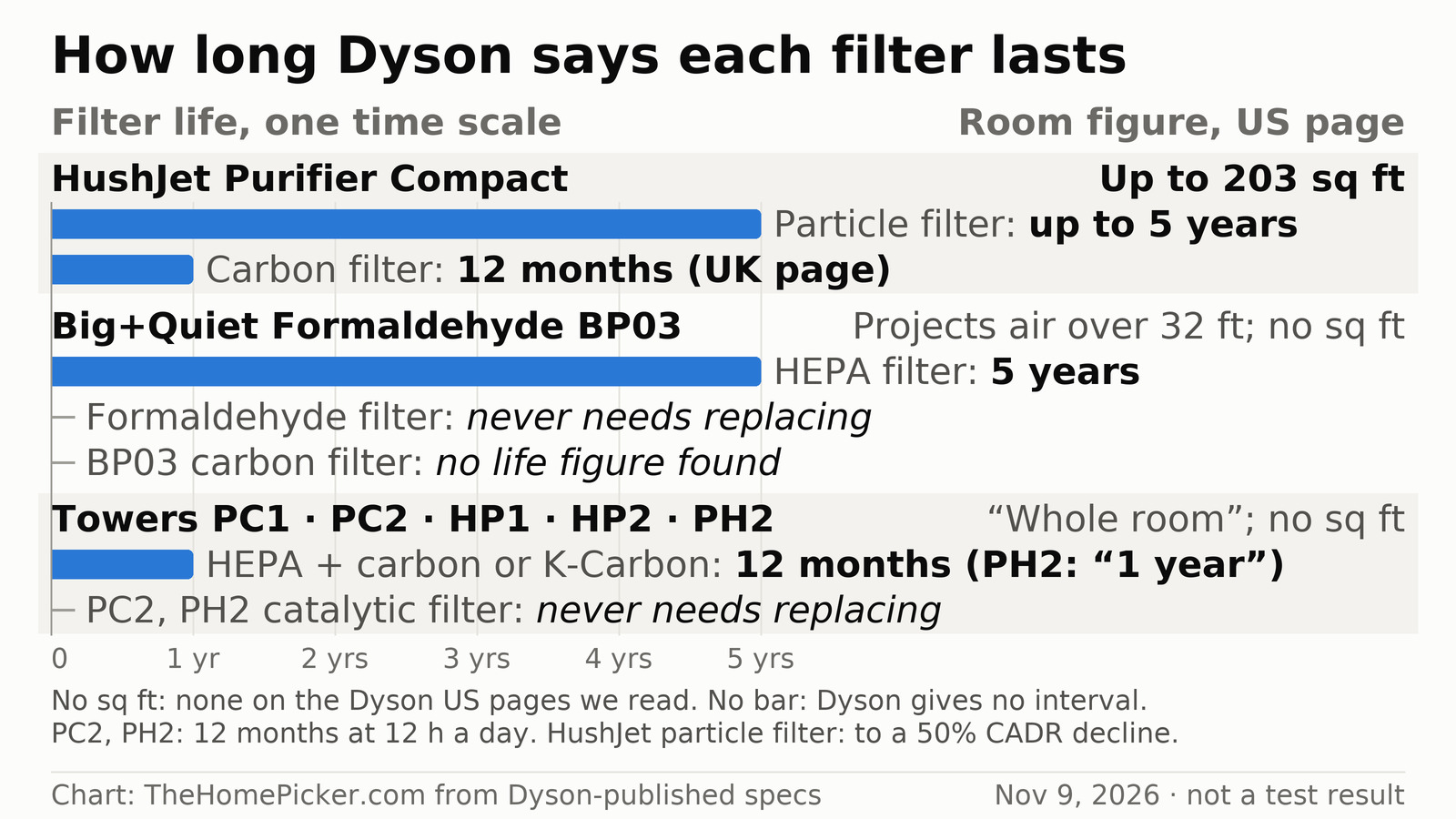
The towers are the one-year machines. Dyson recommends a new HEPA and carbon filter about every 12 months on the PC1, PC2, HP1, HP2 and PH2; the PC2 and PH2 pages base that on 12 hours of use a day, and the TP07 and HP07 sheets add that 24 hours a day halves it to six months. The HushJet Compact’s electrostatic particle filter is the outlier at up to five years, and the footnote defines the end point: tested to a 50% decline in CADR, at 12 hours a day. Its activated carbon filter is a separate part, and Dyson’s UK support page recommends replacing it every 12 months at 12 hours a day. The Big+Quiet Formaldehyde splits the difference: Dyson says its HEPA H13 filter is 3.8 times larger than its predecessor and lasts five years, and the formaldehyde filter never needs replacing. The same page gives two years for its K-Carbon filter, but that is the version Dyson compares against the BP03’s standard carbon filter, and we didn’t find a life figure for the BP03’s own carbon filter. Among the newest models, Dyson gives up to two years for the HushJet Hot+Cool Pure+ and up to 18 months for the HushJet Big+Quiet. For how much carbon makers actually disclose, see our look at activated carbon in purifiers.
The four we link to
HushJet Purifier Compact: one small room, purifying only
The only model in our table that Dyson rates by square footage, up to 203 sq ft. Its electrostatic particle filter is rated for up to five years; the separate activated carbon filter is a 12-month part by Dyson’s UK support page. It doesn’t cool, heat or humidify. Dyson says its electrostatic filter is passive and doesn’t release ozone, and its activated carbon filter captures odors and NO₂. Our HushJet Compact review goes further into how it compares with a small non-Dyson purifier.
Purifier Cool PC1: purifying plus a summer fan
The tower that matches the TP07’s published size, airflow and filter schedule: a HEPA H13 filter, a layer of activated carbon and 350° oscillation. Choose it if you want a fan and don’t need heat, humidity or the De-NOx filters.
Purifier Hot+Cool HP1: the same idea with winter heat
The heater version, 30 inches tall and 12.5 lb by Dyson’s listing, with the same 12-month filter schedule as the PC1. If you want formaldehyde and CO₂ readings and the formaldehyde filter as well, that is the HP2.
Purifier Big+Quiet Formaldehyde BP03: for a large open space
Dyson’s pitch is projection, over 32 feet, rather than a room size, plus a HEPA filter Dyson rates for five years against the towers’ 12 months, and a formaldehyde filter that never needs replacing. It is the one to consider for an open-plan living area. Don’t buy the BP03 for the K-Carbon claim on Dyson’s Big+Quiet page: Dyson’s footnote sets that filter against the BP03’s standard carbon filter, and the BP03 listing we checked doesn’t mention K-Carbon.
When to look outside Dyson’s lineup
If you need an AHAM-certified CADR to compare brands, the towers in this guide don’t give one, so start with certified models. If dry air rather than dirty air is the problem, a dedicated humidifier is the simpler buy. And for a room larger than about 200 sq ft, the HushJet Compact is too small by Dyson’s own figure; the PC2 and the Hot+Cool pair can send their air out of the back to purify without cooling you, but Dyson gives none of them a square-footage figure to check against your room.
How to choose
- One room up to 203 sq ft, purifying only: HushJet Purifier Compact.
- Purifying plus a cooling fan: Purifier Cool PC1.
- Purifying, a fan and winter heat: Purifier Hot+Cool HP1.
- Nitrogen dioxide or formaldehyde is the reason you are buying: a De-NOx model, PC2 or HP2.
- You would otherwise run a humidifier too: Purifier Humidify+Cool PH2 De-NOx.
- A large open space: Purifier Big+Quiet Formaldehyde.
- You must size by an AHAM-certified CADR: check AHAM’s directory for the exact model first.
Frequently asked questions
What is the Dyson TP07 called now?
Dyson hasn’t said, on any page we read, that the TP07 was renamed; its US support list keeps the TP07 as a separate entry. The closest current model on Dyson’s published figures is the Purifier Cool PC1: about the same height and base, about 76 gallons per second of airflow and a 12-month HEPA and carbon filter. The HP07 matches the Purifier Hot+Cool HP1 the same way, and Dyson’s HP07 page says it no longer sells that model.
What is the CADR of the Dyson TP07?
Dyson’s US technical sheet for the TP07 gives no CADR. It lists room coverage of 27 square meters to POLAR, Dyson’s own test, about 290 sq ft by our conversion. Dyson’s newest HushJet models do print a CADR, but the pages we read don’t say it is AHAM-certified.
What does De-NOx mean on a Dyson purifier?
It marks the PC2, HP2 and PH2. On the PC2 and PH2, Dyson describes a K-Carbon filter, impregnated with potassium carbonate, that can adsorb 50% more nitrogen dioxide than regular activated carbon in a 3-cubic-meter test chamber at fan speed 10; the HP2 carries the same 50%-more-NO₂ claim. The PC2 and PH2 also have a catalytic filter that Dyson says destroys formaldehyde and never needs replacing.
How big a room does the Dyson HushJet Compact purify?
Dyson says the HushJet Purifier Compact can purify rooms up to 203 sq ft, and its Amazon listing ties that figure to 4.8 air changes per hour. Dyson rates its electrostatic filter for up to five years at 12 hours a day.
How often do Dyson purifier filters need replacing?
It depends on the model. Dyson recommends replacing the HEPA and carbon filter about every 12 months on the Purifier Cool PC1 and PC2, Hot+Cool HP1 and HP2 and Humidify+Cool PH2, and on the PC2 and PH2 pages that assumes 12 hours of use a day. It rates the HushJet Compact’s electrostatic particle filter for up to five years, though its separate carbon filter is a 12-month part, and the Big+Quiet Formaldehyde’s HEPA filter for five years.
How we put this together: We compare Dyson’s US product, support and technical-specification pages and Amazon’s product data, checked on November 9, 2026; we did not test or measure these purifiers.
As an Amazon Associate, TheHomePicker.com earns from qualifying purchases.