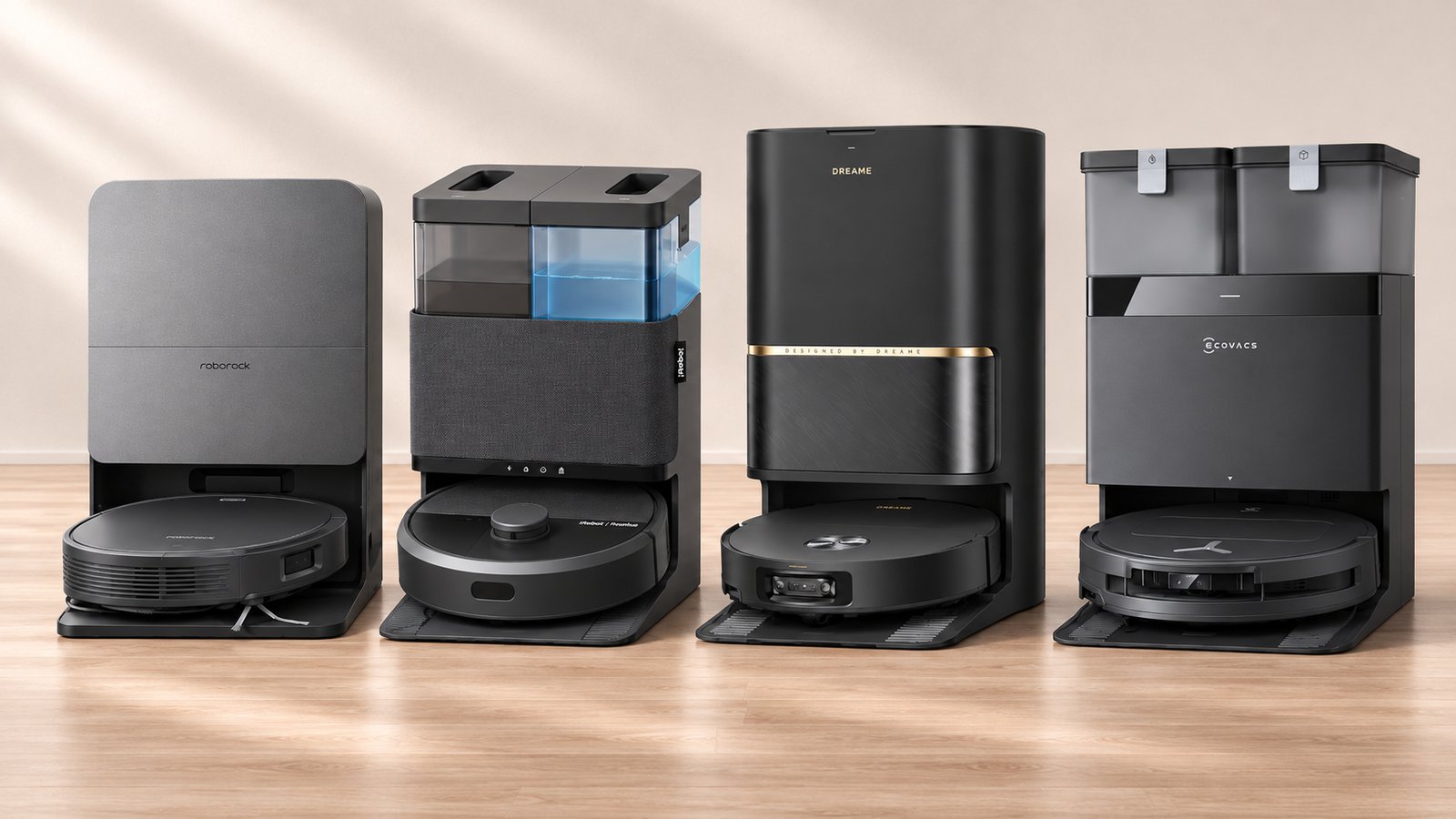
Before you work out whether a self-emptying, mop-washing dock will fit, know that the makers don’t measure the space the same way. iRobot asks for 1.5 feet of open floor on both sides of the Roomba Plus 405’s dock. Dreame and ECOVACS ask for about 2 inches beside the Dreame L60 Ultra and DEEBOT T50 PRO Omni stations. Roborock gives the Saros 20 a box to keep free instead: 0.75 m (2.47 ft) tall, 0.4 m (1.32 ft) wide and 1.2 m (3.94 ft) deep. Those rules change the answer more than the few inches between the docks themselves.
AI disclosure: The text on this page was prepared with AI assistance.
We did not test, measure or use these docks. This guide is built from each maker’s US manual or owner’s guide, its US product and support pages, and Amazon’s product data, checked on November 8, 2026 (US time). Where a maker’s own pages disagree, we show both.
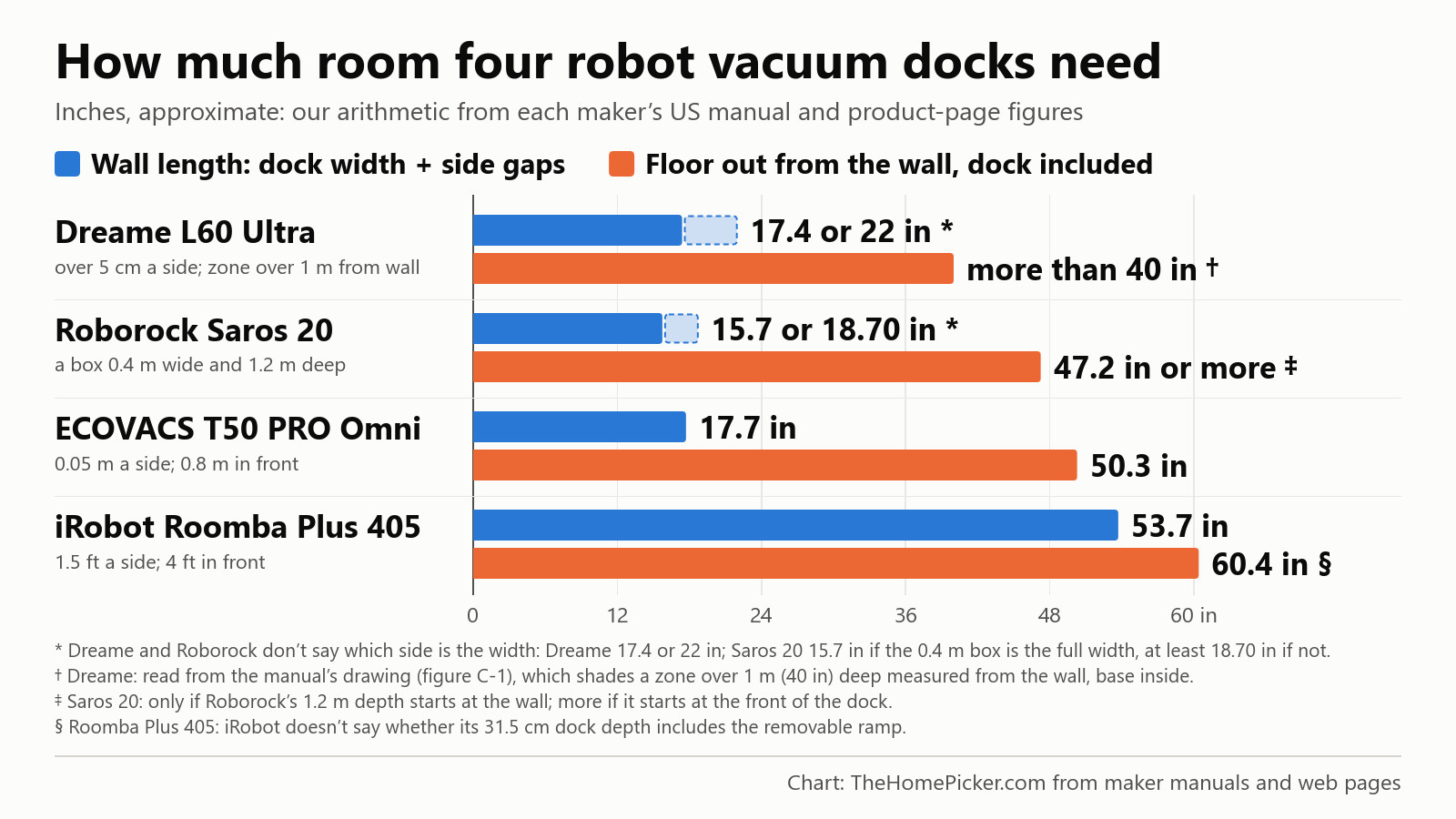
Quick answer: Measure three things: the wall you can give the dock, the open floor in front of it, and the height above it. In a narrow nook, the T50 PRO Omni and the L60 Ultra need the least extra room, about 2 inches a side, or roughly 17 to 22 inches of wall in all. The Roomba Plus 405 needs the most, about 4.5 feet. Roborock’s 0.4 m box for the Saros 20 may be as narrow, but Roborock doesn’t say which way its dock faces. With a short stretch of floor, measure out from the wall with the dock counted in: Dreame’s drawing shades more than 40 inches for the L60 Ultra, the T50 PRO Omni comes to about 50.3 inches (0.8 m past an 18.78-inch-deep station), and the Roomba Plus 405 to about 60.4 inches. Roborock’s 1.2 m (47.2 in) for the Saros 20 may or may not include the dock. Under a shelf, the Saros 20’s manual is the only one of the four with a height figure; iRobot’s support article adds 1 ft above the canister of any auto-evac dock.
Three measurements that decide it
The wall. iRobot’s US owner’s guide for the Roomba Plus 400 series shows 1.5 ft (0.5 m) on both sides of a dock that iRobot’s support table lists at 44.96 cm (17.70 in) wide. That is about 53.7 inches of wall for a dock under 18 inches wide. ECOVACS asks for nothing within 0.05 m (0.16 ft) of either side of a station it lists at 350 mm wide, about 17.7 inches in all. Dreame draws more than 5 cm (2 in) on each side of the L60 Ultra’s base: about 17.4 or 22 inches, depending on which way the base faces. Roborock asks for a space at least 0.4 m (1.32 ft) wide, about 15.7 inches.
The floor in front. Every one of these manuals asks for more room in front than beside, but they don’t measure it from the same place. ECOVACS asks for 0.8 m (2.62 ft) in front of the station, and iRobot for 4 ft (1.2 m) in front of the dock with, in its support article’s words, “no furniture such as tables or chairs within this area.” Dreame’s drawing shades a zone more than 1 m (40 in) deep measured from the wall, with the base standing inside it. Roborock asks for a space 1.2 m (3.94 ft) deep but doesn’t say whether that depth starts at the wall or at the front of the dock. If you can’t tell, plan for 1.2 m of clear floor in front of the dock. Counted out from the wall with the dock included, the L60 Ultra needs more than 40 inches, the Saros 20 about 47.2 inches if Roborock’s 1.2 m starts at the wall, the T50 PRO Omni about 50.3 inches and the Roomba Plus 405 about 60.4 inches.
The space above. All four manuals have you lift or take the clean-water tank out to fill it, so a shelf just over the dock can get in the way even when the dock slides under it. Only Roborock’s manual writes down a height: 0.75 m (2.47 ft), about 10 inches more than its 19.21-inch dock. iRobot’s general dock article, which says it covers Plus 400 models and AutoWash docks, asks for nothing within 1 ft (0.3 m) of the top of the canister on any auto-evac dock. Dreame’s and ECOVACS’s manuals give no overhead figure, and the L60 Ultra’s station is the tallest of the four at 23.23 inches.
The four docks side by side
| Model | Dock size (maker) | Maker’s clearance | Wall needed (our math) |
|---|---|---|---|
| Roborock Saros 20 | 15.00 x 18.70 x 19.21 in, sides unlabeled | Box 0.4 m W x 1.2 m D x 0.75 m H | 15.7 in, if 0.4 m is full width |
| iRobot Roomba Plus 405 | 17.70 W x 12.40 D x 18.60 H in | 1.5 ft each side, 4 ft in front | About 53.7 in |
| Dreame L60 Ultra | 13.39 x 17.95 x 23.23 in, sides unlabeled | >2 in each side; zone >40 in from wall | About 17.4 or 22 in |
| ECOVACS DEEBOT T50 PRO Omni | 13.78 W x 18.78 D x 20.98 H in, with base | 0.05 m each side, 0.8 m in front | About 17.7 in |
“Wall needed” is our arithmetic: the dock’s width plus the maker’s gap on each side. We converted iRobot’s centimeter and ECOVACS’s millimeter figures to inches. Roborock and Dreame don’t label which side of their dock is the width, and Amazon’s Saros 20 listing calls the 18.7-inch side the width.
The four docks, one at a time
Roborock Saros 20: a box to keep free
Roborock’s rule reads like a parking space. Its US user manual, the FCC edition listed on Roborock’s US support page, says to put the dock on a hard, flat floor such as wood, tile or concrete, flat against a wall, and to “reserve a space of at least 0.75 m (2.47 ft) in height, 0.4 m (1.32 ft) in width and 1.2 m (3.94 ft) in depth.” Roborock’s US product page lists the dock at 15.00 x 18.70 x 19.21 in without labeling the sides. The 0.4 m only works as the full width if the 15.00-inch side faces the room, so in a tight spot, plan for at least 18.70 inches across. The manual also warns that a power cord hanging straight down to the floor may be caught by the robot. These figures belong to the Saros 20. For another Roborock, such as the Qrevo 2 Pro, read that model’s own manual.
iRobot Roomba Plus 405: the widest ask
The US owner’s guide for all Roomba Plus 400 series combo models adds 4 ft (1.2 m) from stairs, with a warning to keep the dock at least 4 feet from stairs so the robot doesn’t fall down them. iRobot’s support table gives the Roomba 405 series AutoWash dock as 44.96 cm wide, 31.5 cm deep and 47.24 cm tall (17.70 x 12.40 x 18.60 in), the shallowest of the four and wider than it is deep. From the wall to the end of the clear zone is about 60.4 inches. The table doesn’t say whether its depth includes the removable ramp the guide has you snap onto the dock.
If width is the problem, the Roomba Plus 415X looks like the narrower choice: iRobot lists its retail box at 15.67 x 13.66 x 20.55 in, which couldn’t hold the 405’s 17.70 x 12.40 x 18.60-inch dock in any orientation. iRobot’s table lists the Roomba Plus 415 series dock at 33.0 x 34.0 x 48.5 cm (about 12.99 x 13.39 x 19.09 in), though it labels that dock AutoEmpty while iRobot sells the 415X with what it calls an AutoWash dock. The US guide for the 410–419 models marks more than 1.5 ft (0.46 m) beside the dock and more than 4 ft (1.22 m) in front, about 49 inches of wall if the side gap applies on both sides. Our Roomba Plus 405 vs 415 vs 415X comparison covers the other differences.
Dreame L60 Ultra: 2 inches beside, the tallest station
Dreame’s US user manual for the L60 Ultra lists robot model RPL51FE0, the model number Amazon’s data gives for this listing. Its setup drawing shades a clear zone with more than 5 cm (2 in) on each side of the base and more than 1 m (40 in) of depth measured from the wall, with the base standing inside it, and it recommends placing the base station on tile or marble floors to keep water stains off wood floors and carpets. Dreame’s US product page lists the base at 13.39 x 17.95 x 23.23 in without naming the width or saying whether those figures include the ramp extension plate the manual has you install. Dreame’s own pages disagree on the gaps: a Dreame US blog post on dock size, written as general advice rather than for any one model, says to allow 12–20 inches in front and at least 4 inches on each side. The manual is written for this model, so we’d start there and try 4 inches at the sides if the robot struggles to dock. One more trap: Dreame’s global site uses the L60 Ultra name for a robot with different specifications and a 340.4 x 456.6 x 589 mm base, so check that you are on Dreame’s US page.
ECOVACS DEEBOT T50 PRO Omni: 0.8 m past a deep station
ECOVACS’s US instruction manual, the one linked from its US product page, asks for level, hard ground against a wall with no objects within 0.05 m on either side or 0.8 m in front. That 0.8 m is the shortest gap any of the four manuals states in front of the dock itself, and the side gap is the same 5 cm Dreame draws. ECOVACS lists the station at 350 mm wide, 477 mm deep and 533 mm tall with its base, and 294 mm deep without it. Amazon’s listing shows 13.78 x 11.57 x 20.98 in, which matches the figures without the base, so plan from the 18.78-inch depth or you will come up about 7.2 inches short. With the front clearance, that is about 1,277 mm (50.3 in) from the wall. That is more floor than the 1 m (40 in) minimum Dreame’s drawing shades for the L60 Ultra, base included. The manual also says to cover mirrors or reflective skirting lines near the station from the ground up to 14 cm. ECOVACS’s older US help page, last updated in 2020 and written about “the charging dock” in general, asks for 0.5 m (1.64 ft) on the left and right and 1.5 m (4.92 ft) in front. We’d start from the manual and move toward those distances only if the robot struggles to find the station.
What the manuals don’t settle
These distances are each maker’s minimums for its own model. They don’t tell you whether a particular spot in your home will work, and we can’t judge that from here. One more caution: Amazon’s dimensions are not always dock dimensions. Besides the ECOVACS listing, the Roomba Plus 405 listing shows 15.0 x 19.8 x 18.5 in and the L60 Ultra listing 17.0 x 16.0 x 27.0 in, and neither matches the maker’s dock figures; only the Saros 20 listing lines up. If a robot keeps missing its dock after setup, our guide to why a robot vacuum keeps getting stuck covers the usual causes.
How to choose
- A narrow nook between furniture or walls: the DEEBOT T50 PRO Omni or the L60 Ultra, whose US manuals ask for about 2 inches a side, or the Saros 20 if the nook takes at least 18.70 inches. Skip the Roomba Plus 405, which needs about 4.5 feet of wall.
- A short floor in front, such as a hallway: measure from the wall, dock included. Dreame’s drawing asks for the least, more than 40 inches for the L60 Ultra; the T50 PRO Omni needs about 50.3 inches and the Roomba Plus 405 about 60.4 inches. The Saros 20 needs 1.2 m (47.2 in) if Roborock’s depth starts at the wall, more if it starts at the dock.
- A shelf or counter above: compare dock heights, from 18.60 inches for the Roomba 405 series dock to 23.23 inches for the L60 Ultra, and leave room to lift the tanks out.
- Wood floor or carpet under the spot: Dreame recommends tile or marble under the L60 Ultra’s station.
- Stairs nearby: iRobot asks for 4 feet between its dock and the stairs. Read your own model’s manual on drops before you settle on the spot.
- No spot in the room meets these figures: a self-emptying, mop-washing dock may not be the right buy for that room.
Frequently asked questions
How much space does a robot vacuum dock need?
It depends on the model. In their US manuals, ECOVACS asks for 0.05 m on either side of the DEEBOT T50 PRO Omni’s station and 0.8 m in front; Dreame, more than 2 inches on each side of the L60 Ultra’s base and a clear zone more than 40 inches deep from the wall, base included; iRobot, 1.5 ft on both sides of the Roomba Plus 400 series dock and 4 ft in front; and Roborock, a space at least 0.75 m tall, 0.4 m wide and 1.2 m deep for the Saros 20.
How much height does the Roborock Saros 20 dock need?
Roborock’s US product page lists the Saros 20 dock at 15.00 x 18.70 x 19.21 in, and its US user manual asks you to reserve a space at least 0.75 m (2.47 ft) in height. That works out to about 10 inches above the dock.
Do Amazon listings show the dock’s real size?
Not reliably. The DEEBOT T50 PRO Omni listing shows 13.78 x 11.57 x 20.98 in, which matches ECOVACS’s figures for the station without its base; with the base, ECOVACS gives a depth of 477 mm (18.78 in). The Roomba Plus 405 and L60 Ultra listings don’t match their makers’ dock figures either. Plan from the maker’s product page and manual.
How we put this together: We compared the dock sizes and placement distances in each maker’s US manual or owner’s guide and US product and support pages, and checked each model against Amazon’s product data on November 8, 2026. We did not test, measure or use any of these docks. Figures marked as our math are arithmetic from the makers’ numbers.
As an Amazon Associate, TheHomePicker.com earns from qualifying purchases.