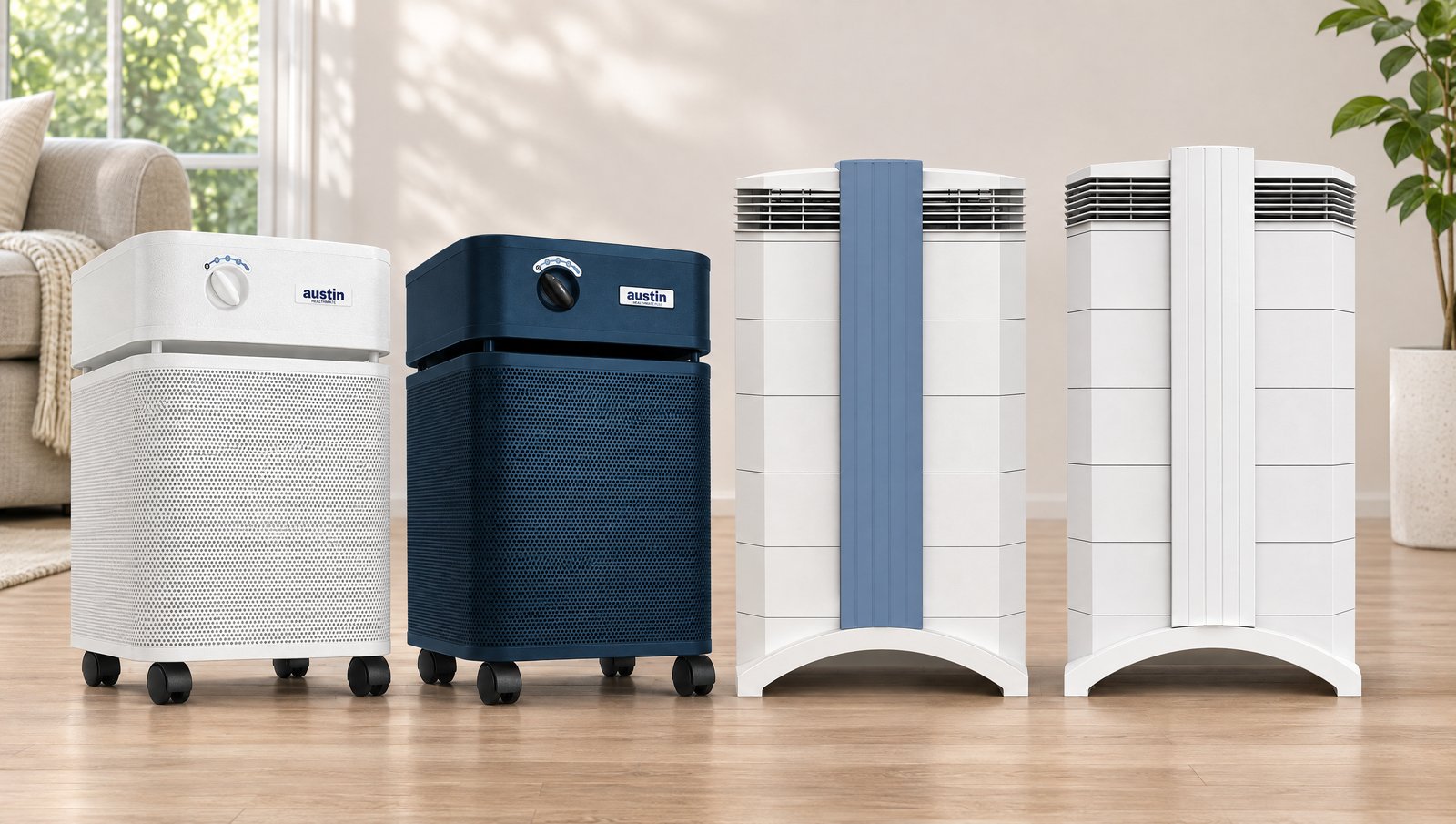
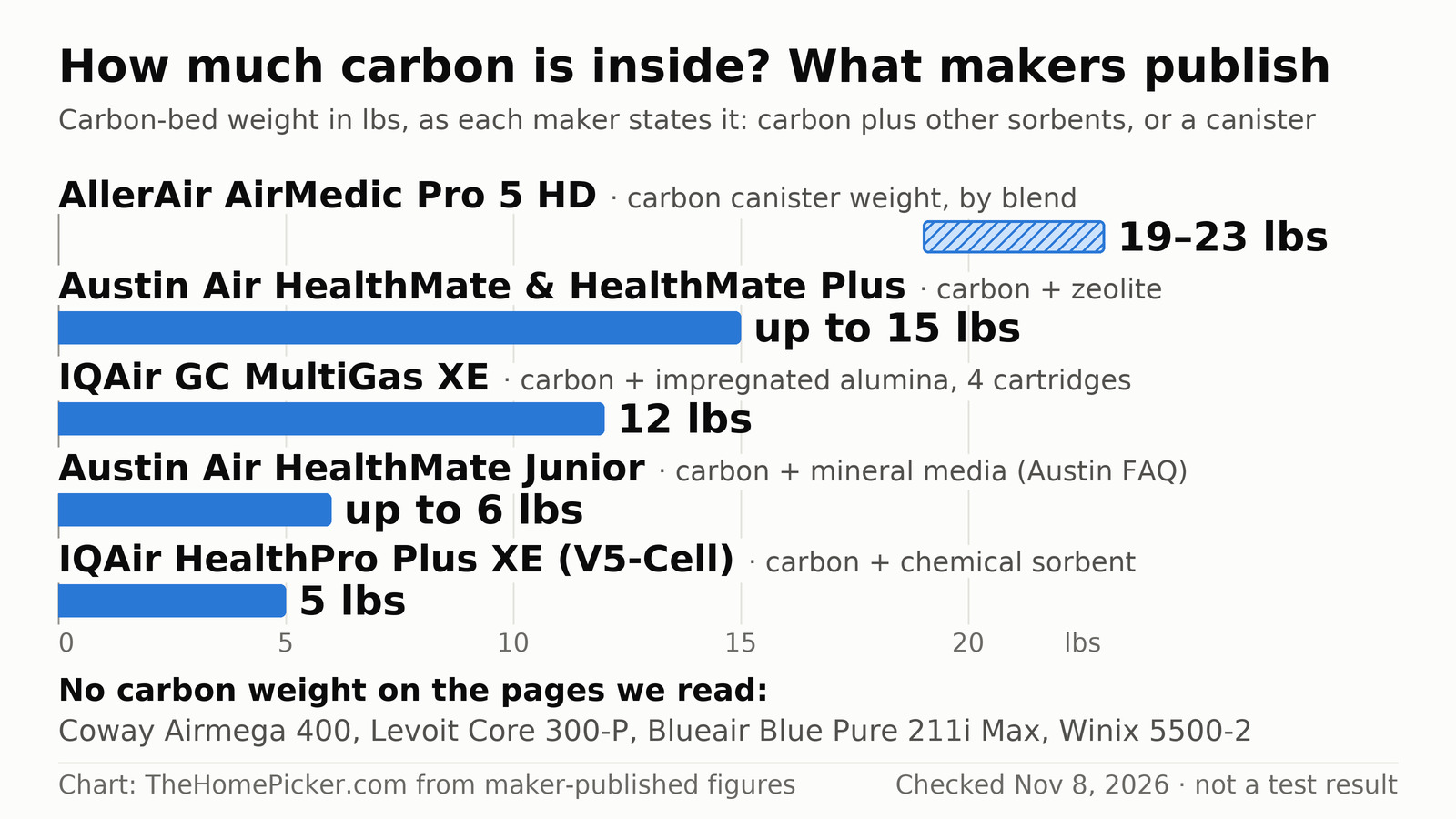
If you are buying an air purifier for cooking smells, smoke odor or fresh paint, the part doing that work is the bed of activated carbon, not the particle filter, and many product pages don’t say how much is in it. Two makers do, for the models linked here: Austin Air says its full-size HealthMate and HealthMate Plus hold up to 15 lbs of activated carbon and zeolite, and IQAir says its GC MultiGas XE holds 12 lbs of carbon and impregnated alumina and its HealthPro Plus XE’s V5-Cell holds 5 lbs. The popular Coway, Levoit, Blueair and Winix models we checked name a carbon filter but give no weight for it on the pages we read.
AI disclosure: The text on this page was prepared with AI assistance.
We did not test or measure any of these purifiers. This guide compares what the makers publish on their US product and replacement-filter pages, two US EPA publications on home air cleaners, and Amazon’s product data, all checked on November 8, 2026. Where a maker’s own page gives no weight, we say so; we did not fill the gap from retailer listings.
Quick answer: If smells are the main problem, start with the largest published beds among the models we link: the Austin Air HealthMate (up to 15 lbs) or the IQAir GC MultiGas XE (12 lbs). Choose between the two Austin models by what is in the bed, since the weight is the same: Austin’s own filter guide lists the HealthMate for “everyday clean air” and the HealthMate Plus for “heavy chemicals & smoke.” If particles come first and smells second, IQAir’s HealthPro Plus XE pairs a 5-lb V5-Cell with a higher-rated particle filter than the GC’s. A model with no published weight gives you nothing to compare, and CADR won’t fill the gap: the EPA says it covers particles only.
The carbon figures makers publish
| Model | Maker’s figure | What the bed holds | Maker’s filter life |
|---|---|---|---|
| Austin Air HealthMate (B400) | Up to 15 lbs; over 780 cu in | Activated carbon and zeolite | 5 years, normal residential use |
| Austin Air HealthMate Plus (B450) | Up to 15 lbs; over 780 cu in | Carbon, potassium iodide–treated carbon, zeolite | 5 years, normal residential use |
| IQAir GC MultiGas XE | 12 lbs in four cartridges | Activated carbon and impregnated alumina | 2.5 years in the spec table; 6 to 18 months in the FAQ |
| IQAir HealthPro Plus XE | 5 lbs (V5-Cell) | Activated carbon and a chemical sorbent | About 2 years |
| AllerAir AirMedic Pro 5 HD | Carbon canister: 19–22 lbs (Exec) or 21–23 lbs (Vocarb) | Carbon blends | Not in the specs we read |
| Austin Air HealthMate Junior | Up to 6 lbs (FAQ); about 270 cu in | Activated carbon and zeolite | 5 years, normal residential use |
None of these figures is carbon alone. Austin Air’s is “up to” 15 lbs of “activated carbon and Mineral-Based Filtration,” which its blog identifies as clinoptilolite, a zeolite found in volcanic rock. IQAir’s GC product page says “12 lbs. of activated carbon,” but its cartridge page specifies “12 lbs. (5.4 kg) granular activated carbon and impregnated alumina.” AllerAir gives a carbon canister weight range without saying whether the canister itself is counted. For the HealthMate Junior, the product page gives only a volume, about 270 cubic inches, while Austin Air’s FAQ says Junior units use “up to 6 lbs of activated carbon and Mineral-Based Filtration mix.” IQAir’s spec-table life figures assume 10 hours a day on fan speed 3.
What a carbon weight can tell you, and what it can’t
The number is worth hunting for because no standard rating covers smells. The EPA’s guide to home air cleaners says “there are no widely used performance rating systems for portable air cleaners or filters designed to remove gases. The CADR rating system is for particles only.” It adds that activated carbon filters “can be effective, provided that there is a large amount of material used in the filter,” and the EPA’s technical summary on residential air cleaners says “the thicker the media, the more efficient the filter will be for longer periods of time,” while thin layers “can become quickly saturated.” A figure in pounds is the closest a shopper gets to evidence on that point. That is also where its usefulness ends.
It doesn’t tell you which gases. The EPA’s technical summary says activated carbon “is not especially effective against oxides of sulfur, hydrogen sulfide, low molecular weight aldehydes (e.g., formaldehyde), ammonia, and nitrogen oxide.” IQAir’s beds and the HealthMate Plus add a chemically treated medium to the carbon, and that is the part a weight hides. The HealthMate and HealthMate Plus list the same “up to 15 lbs,” but Austin Air says the Plus uses carbon impregnated with potassium iodide, “designed for better adsorption of specific chemicals such as formaldehyde.”
It doesn’t tell you how long the bed lasts in your home. Every life figure comes with the maker’s own conditions, and IQAir’s GC page gives two answers: 2.5 years in its specification table, and gas-phase filters that “typically last 6 to 18 months, depending on air quality and usage” in its FAQ.
It doesn’t tell you how much air passes through. Carbon only works on the air the fan moves through it, and the EPA notes that “higher fan speeds and longer run times will increase the amount of air filtered.” IQAir publishes airflow for each fan speed on its product pages; Austin Air’s product pages give none, and the one Austin figure we found is in a 2020 blog post.
It doesn’t make two makers’ numbers equal. Carbon with zeolite, carbon with alumina, a canister range and a volume are four different measures, and none of the maker pages we read gives a test result for how much of a given smell the bed removes. Our read: a published weight is a reason to shortlist a model, not a score that settles the order. A model with no published weight may still have a useful carbon layer; its page just gives you nothing to compare.
The four models we link, and who each suits
All four are sold on Amazon by the maker itself, Austin Air Systems or IQAir, rather than by Amazon.com. Each listing linked below was new and in stock in Amazon’s product data when we checked.
Austin Air HealthMate B400: the plain carbon-and-zeolite bed
Austin Air says the HealthMate was its flagship product in 1990, and the design is still simple: a 47-lb steel cabinet, 14.5 x 14.5 x 23 in, that draws air in from all sides through two pre-filters, then more than 780 cubic inches of carbon and zeolite, and finally 60 sq ft of HEPA. Austin says the filter is built to last five years under normal residential conditions and backs it with a five-year pro-rated filter warranty. The gap is sizing. Austin’s product page gives no airflow figure, and its FAQ says Austin does not endorse CADR and that square footage “is very difficult to pin down,” so it gives no room size. The only airflow figure we found from Austin is in a 2020 blog post: 250 CFM on high and 125 on medium for its standard-size units. The Amazon listing’s “Covers Up To 1,500 sq ft” is not a figure we found from Austin.
Austin Air HealthMate Plus B450: same weight, different chemistry
The Plus shares the HealthMate’s cabinet, its 47 lbs, its “up to 15 lbs” and its “over 780 cubic inches.” What changes is the blend: Austin Air says it mixes carbon, carbon impregnated with potassium iodide and zeolite, and its filter guide lists wildfire smoke and renovation fumes among this model’s uses. Its product page also names homes with off-gassing materials “like flooring, cabinets, adhesives, or paint.” So if the smell is fresh paint, new cabinets or smoke, this is the Austin model the maker steers you to. The five-year filter and warranty are the same, though Austin’s FAQ says a filter’s life “will diminish sooner” in an area with “new carpeting, paint fumes, heavy smoking,” the uses this model is pitched for. Of the HealthMate Plus listings we checked, the Midnight Blue one linked here is sold by Austin Air Systems; the other two colors came from third-party sellers with limited stock.
IQAir GC MultiGas XE: the gas-first IQAir
IQAir builds this one around gas. Where the HealthPro uses one square cartridge, the GC MultiGas XE uses four cylindrical cartridges holding 12 lbs of granular activated carbon and impregnated alumina, each in a post-filter sleeve, with an H11 pre-filter as the first stage. IQAir describes it as designed for pollution “caused by chemicals, gases, and odors,” off-gassing materials included. It is 28 x 15 x 16 in without casters, weighs 44 lbs with filters and moves 40 to 275 cfm across six speeds; IQAir’s 1,125 sq ft room size assumes two air changes an hour at the top speed. The trade-off is particles: IQAir certifies the GC system at 99% or better for particles of 0.3 microns and larger, while it rates the HealthPro Plus XE’s HyperHEPA filter at 99.97% or better at the same size. For cartridge life, plan around both of IQAir’s numbers, not just the 2.5 years.
IQAir HealthPro Plus XE: particles first, a smaller gas stage
This is IQAir’s particle-first machine with a gas stage added. Its V5-Cell, one square cartridge of 13 x 13 x 5 in, holds 5 lbs of granular carbon and a potassium permanganate chemisorbent, by IQAir’s description, alongside a HyperHEPA filter IQAir rates at 99.97% or better for particles of 0.3 microns and larger. IQAir lists it at the same 28 x 15 x 16 in as the GC MultiGas XE, at 35 lbs with filters and up to 300 cfm, with the same “up to 1125 sq. ft.” claim. So in the same footprint, the GC carries more than twice the gas media and the HealthPro Plus the finer particle filter. IQAir gives the V5-Cell about 2 years of life at 10 hours a day on speed 3 and a 2-year shelf life, worth knowing before you stock spares. Skip the HealthPro Compact if smells are the point: IQAir says the V5-Cell doesn’t fit it, and its spec sheet lists the Compact with no gas and odor filter. Our IQAir HealthPro Plus review covers the rest of this machine.
Popular purifiers whose pages give no carbon weight
On the US product pages and the manual we read, these four models name a carbon filter and give no weight for it. The only weight on each page is the machine’s own.
- Coway Airmega 400: its Max2 filter is listed as “Activated Carbon + HEPA.”
- Levoit Core 300-P: a “High-Efficiency Activated Carbon Filter.” The same page lists Smoke Remover and Toxin Absorber replacement filters, without a carbon weight either; our Levoit filter guide matches those variants to models.
- Blueair Blue Pure 211i Max: its SmokeBlock filter “uses 2x more activated carbon,” twice an amount the page doesn’t state.
- Winix 5500-2: a washable AOC carbon filter; the US manual’s specification table lists the unit at 15 lbs and says nothing about the carbon.
That doesn’t mean their carbon does nothing; it means a smell-first buyer has no figure to set beside 12 or 15 lbs. The Coway, Levoit and Blueair pages do publish CADR figures, which help with particles, not gases. AllerAir, the third maker in the table, does publish a figure, but our search of Amazon’s product data didn’t return an AllerAir listing, so it isn’t linked here.
Before you buy for smells
A purifier won’t erase every smell. The EPA’s guide reminds buyers that “no air cleaner or filter will eliminate all of the air pollutants in your home” and that “some air cleaners or filters are targeted to specific types of gases or VOCs,” so read what the maker says its bed is for, not just its weight. If wildfire smoke is the reason, particles matter as much as the smell; our wildfire smoke purifier guide covers HEPA, CADR and room sizing.
Frequently asked questions
How much activated carbon does an air purifier need for odors?
No standard sets a number. The EPA says carbon filters can be effective when there is “a large amount of material used in the filter (the thicker the better),” without naming a weight. The maker figures we found run from 5 lbs in IQAir’s V5-Cell to up to 15 lbs in Austin Air’s full-size HealthMate, plus a 19–23 lb carbon canister range from AllerAir, and they are not measured the same way.
Does CADR tell you how well an air purifier removes smells?
No. The EPA’s guide to home air cleaners says “the CADR rating system is for particles only” and that there are no widely used performance rating systems for filters designed to remove gases. A smoke CADR describes smoke particles, not the smell.
Is the 15 lbs in an Austin Air HealthMate all carbon?
No. Austin Air describes it as up to 15 lbs of “activated carbon and Mineral-Based Filtration,” the mineral being a zeolite called clinoptilolite, and we did not find the split between the two on its pages.
Which IQAir holds more carbon, the GC MultiGas XE or the HealthPro Plus XE?
The GC MultiGas XE. IQAir lists 12 lbs of granular activated carbon and impregnated alumina across its four cartridges, against 5 lbs in the HealthPro Plus XE’s V5-Cell. The HealthPro Plus XE has the higher-rated particle filter.
How we put this together: We compare manufacturer specifications, US EPA guidance and verified US listings, and note where published figures disagree or are missing. We did not test these purifiers or measure any of them. Model availability was checked with Amazon’s product data on November 8, 2026.
As an Amazon Associate, TheHomePicker.com earns from qualifying purchases.