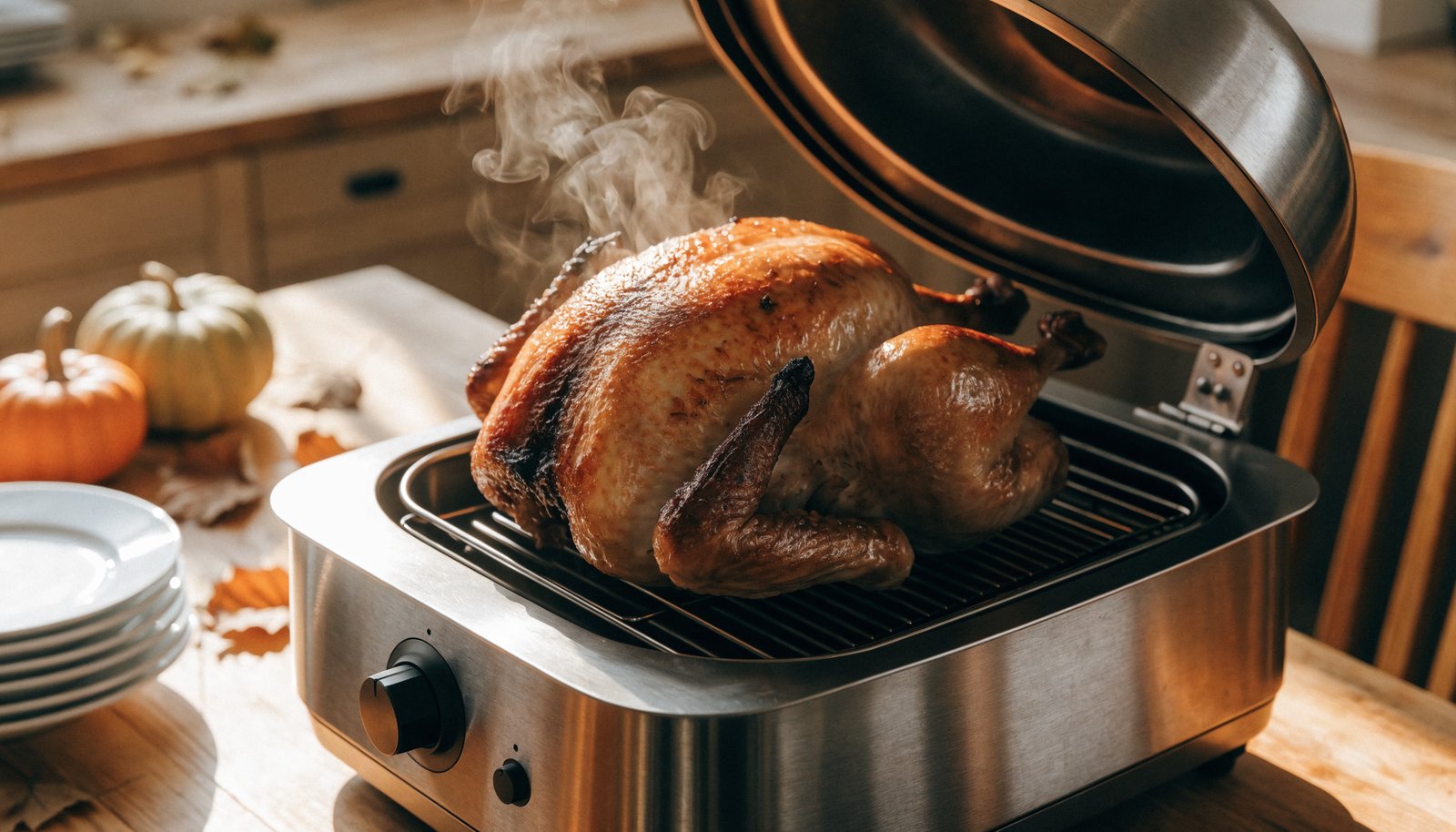
Twenty-four pounds is the number to keep in your head this Thanksgiving. It is the top of the turkey range in the USDA Food Safety and Inspection Service table for electric roaster ovens, which runs from 8 to 24 pounds, and it is also the exact weight Proctor Silex gives for its 18-quart roaster, the 32211. The same 18 quarts gets you 22 pounds in a NESCO MWR18. So the quart number printed on the box is not the answer to the question every host is really asking, which is whether this particular bird will fit.
This guide settles that question first, then the four others that decide whether a roaster oven helps or hurts on the day: whether it fits your counter, whether your kitchen circuit can carry it next to everything else that is plugged in, how to cook the turkey so it is safe, and how much cleanup you are signing up for. Where USDA guidance and a maker manual say different things, you will see both.
Start with the turkey, not the quart number
USDA FSIS suggests planning on 1 pound of turkey per person, so a table of 12 points you to a bird of about 12 pounds, and a crowd of 20 to about 20 pounds. With that weight in hand, look up the maximum turkey weight the maker states for the exact roaster model. The table shows why the quart size alone misleads: Hamilton Beach says its 20-quart 32210 takes a 26-pound turkey, the same figure Oster gives for its 22-quart roaster, while the Hamilton Beach 22-quart 32215 is rated for 28 pounds.
| Roaster | Size | Stated turkey maximum | New on Amazon.com, Nov 7, 2026 |
|---|---|---|---|
| Proctor Silex 32211 | 18 qt | 24 lb | Yes, sold by Amazon.com |
| NESCO MWR18 | 18 qt | 22 lb | No, every color we found was out of stock |
| Hamilton Beach 32210 | 20 qt | 26 lb | No new listing found |
| Oster CKSTRS23-SB | 22 qt | 26 lb (an older CKSTRS23 listing says 22 lb) | No, used only |
| Hamilton Beach 32215 | 22 qt | 28 lb | No, only a renewed listing with no seller |
| NESCO 4816-14 | 6 qt | No turkey listed; chart stops at a 5 lb chicken | Yes, sold by Amazon.com |
Turkey figures come from each maker product page or manual, except Oster, whose figures come from its product listings. Stock changes daily, so treat the last column as a snapshot.
A small bird is the opposite problem. Makers state maximum weights, not minimums, so a roaster rated for a whole turkey has room for a 7-pound one. The FSIS roaster table starts at 8 pounds, though, so for a smaller bird or a turkey breast, follow your roaster manual and the thermometer; the Proctor Silex manual gives a time for a 5 to 7 pound turkey breast. The 6-quart NESCO is the exception worth knowing about, because its roasting chart lists no turkey at all.
A very large bird is where roaster ovens stop being the easy answer. The FSIS roaster table ends at 24 pounds, and the Oster CKSTRS23-SB and Hamilton Beach 32215, the 22-quart models rated for 26 and 28 pounds, had no new unit on Amazon.com when we checked on November 7, 2026. Amazon also carries a number of newer-brand roasters labeled for 26 to 30 pound turkeys; for the ones we checked, the brand store page and the Amazon listing disagreed on the turkey weight, or no turkey weight was given, so they are not here. For a bird over 24 pounds, the main oven is the straightforward place for it, or you can split the meal into two smaller turkeys, which keeps the one in the roaster inside the FSIS range.
For a turkey of 24 pounds or less: Proctor Silex 32211
Of the full-size roasters from Oster, Hamilton Beach, NESCO, Elite Gourmet and Proctor Silex that we checked, the Proctor Silex 32211 was the only one with a new unit sold by Amazon.com on November 7, 2026. It is an 18-quart roaster with a domed self-basting lid, and Proctor Silex says it holds a 24-pound turkey. One knob runs it from 125 to 450°F. The roasting pan lifts out of the base for washing, and a lift-out rack carries the bird up and out at the end, which is the moment a hot 20-pound turkey and a pan of juices make you glad for handles.
Two details from its manual are worth knowing before the day. Its roasting chart, at 325°F, gives 2 to 3 hours for a 14 to 18 pound whole turkey and 3 to 3.5 hours for 19 to 24 pounds. That is well short of the FSIS oven timetable for an unstuffed bird, 3.75 to 4.25 hours for 14 to 18 pounds and 4.25 to 5 hours for 18 to 24 pounds, and the manual adds that large turkeys touching the sides of the pan may cook faster. The same manual, which also covers the sister model 32200, carries a 25 to 28 pound row in that chart. The 32211 product page says 24 pounds, and that is the number to plan around.
On the counter it measures 23.15 inches wide, 15.63 inches deep and 12.93 inches tall by Proctor Silex figures; Home Depot lists it at 16.88 inches deep and 9 inches tall, so check the space against the larger numbers. Its manual rates it at 1450 watts on 120 volts.
If the turkey stays in the big oven: a small roaster for the rest
Plenty of hosts keep the turkey in the main oven and simply run out of room for everything around it. For that job a 6-quart roaster is a different tool, not a smaller turkey roaster. The NESCO 4816-14 puts a removable porcelain enamel cookwell on a 750-watt base with a 200 to 450°F dial, and NESCO says it serves up to 6 people. Its roasting chart stops at a 3.5 to 5 pound whole chicken and a 3 to 5 pound precooked ham, with no turkey listed, so think of it as the place for the ham or a side dish rather than the bird.
The 750 watts matter on a crowded kitchen circuit too. That is about half of the 1450 watts listed for the Proctor Silex 32211 and the NESCO MWR18.
Will it fit the counter, and the circuit?
Measure before you buy. A full-size roaster is close to two feet long: the Proctor Silex 32211 and the Hamilton Beach 32210 are both 23.15 inches wide and 15.63 inches deep, with the Hamilton Beach standing 13.92 inches tall to the 12.93 inches of the Proctor Silex. Then leave air around it. The Proctor Silex manual says not to let curtains, walls, cabinets, backsplashes or other flammable materials touch any part of the roaster while it runs, and NESCO asks for a flat, heat-resistant surface in a well-ventilated area away from walls. Oster suggests a hot pad or trivet under its roaster, because some countertops are not built for prolonged heat.
Power is the part hosts forget. A 1450-watt roaster on a 120-volt outlet draws about 12 amps, which is simply 1450 divided by 120 using the rated wattage. The Proctor Silex manual says not to run another high-wattage appliance on the same circuit. If you need an extension cord, its electrical rating must be equal to or greater than the rating of the roaster, and it should be arranged so it cannot be pulled down or tripped over. Which of your kitchen outlets share a circuit is something your breaker panel can tell you; this guide cannot.
Cooking the turkey: what USDA says, and where manuals differ
The USDA FSIS guidance for electric roaster ovens is short. Generally, the cooking time and oven temperature setting are the same as for conventional cooking, but check the roaster use and care manual for the time and temperature its maker recommends. Preheat to at least 325°F. Set the turkey on the roaster rack so it sits above the juices, and leave the lid on, lifting it as little as possible, because every look slows the cooking. The turkey is safe when a food thermometer reads at least 165°F in the innermost part of the thigh and wing and the thickest part of the breast. For quality, FSIS suggests letting it stand 20 minutes before carving.
Manuals and listings do not always line up with that. Hamilton Beach roaster guides say the roaster cooks turkeys in less time than conventional ovens, Oster product listings say its self-basting lid speeds cooking time, and the Proctor Silex chart above runs well short of the FSIS oven times. Treat the earliest time on any chart as the moment to start checking the thermometer, not the moment to carve. Some instructions also print a higher finished temperature, 180°F in the Proctor Silex chart and in a NESCO turkey recipe. FSIS sets 165°F as the safe minimum and notes that some people choose to cook turkey to higher temperatures for personal preference.
Two more FSIS points apply in a roaster. Stuffing is safest cooked outside the bird in a casserole, and if you do stuff the turkey, the center of the stuffing must also reach 165°F. A cooking bag can go in a roaster oven as long as it does not touch the sides, bottom or lid, but read your manual first: Proctor Silex allows foil oven roasting bags and does not recommend plastic ones. And start thawing early. FSIS allows about 24 hours in the refrigerator for every 4 to 5 pounds, which works out to 5 to 6 days for a 20 to 24 pound bird.
A covered roaster browns less than an open pan. Oster suggests holding back liquids, other than basting butter or oil, until the last 30 minutes for darker, crisper poultry skin, and Hamilton Beach guides describe roaster turkey as moist and juicy but less brown than an oven-roasted one.
Cleanup, and why to run it once before the holiday
Proctor Silex says some smoke and odor may appear during the first use of the roaster and should not come back after that first heating, and NESCO goes further for its 6-quart model, asking for a one-time smoke out: the empty base runs at 450°F for about 60 minutes, or until any odor or smoking disappears. Both are better done on a quiet weekday than with guests at the door. After cooking, the Proctor Silex lid, rack and roasting pan wash in hot, soapy water; burned-on food can soak and then come off with a nylon scouring pad, and the manual warns that the lid may discolor in a dishwasher. The base, cord and plug never go in water.
The NESCO cookwell has its own routine. To loosen baked-on food, NESCO suggests filling the cookwell with water and heating it at 350°F for 30 minutes, then washing it once it has cooled, and a white mineral film wipes off with household vinegar. Its porcelain enamel finish is durable, but NESCO says it will chip if it takes sharp blows, and that cooking high-acid foods such as tomatoes may discolor the enamel.
If the roaster is part of a bigger holiday setup, the kitchen appliance buying guide on this site covers the rest of the counter, and the guides to Dutch ovens, bread makers and countertop ice makers go deeper on three other hosting tools.
Frequently asked questions
What size roaster oven do I need for a turkey?
Use the maximum turkey weight the maker gives for the exact model rather than the quart number. Among 18-quart roasters, NESCO lists 22 pounds for its MWR18 and Proctor Silex lists 24 pounds for its 32211; Hamilton Beach lists 26 pounds for its 20-quart 32210 and 28 pounds for its 22-quart 32215. The USDA FSIS table for electric roaster ovens covers turkeys of 8 to 24 pounds.
What size roaster oven do I need for a 7 pound turkey?
A roaster whose maker rates it for a whole turkey has room for a 7-pound bird, because makers state maximum weights, not minimums. The USDA FSIS table for electric roaster ovens starts at 8 pounds, so for a smaller bird follow your roaster manual. The Proctor Silex 32211 manual gives 1 to 1.5 hours at 325°F for a 5 to 7 pound turkey breast, while the FSIS oven timetable gives 1.5 to 3.25 hours for a 4 to 8 pound breast. A 6-quart roaster such as the NESCO 4816-14 lists no turkey at all; its chart stops at a 3.5 to 5 pound whole chicken. Whatever the chart says, cook to at least 165°F on a food thermometer.
Does a roaster oven cook a turkey faster than a regular oven?
USDA FSIS says that, generally, the cooking time and oven temperature setting are the same as for conventional cooking, and to follow the roaster manual. Some makers say otherwise: Hamilton Beach guides say the roaster cooks turkeys in less time, and the Proctor Silex chart lists 3 to 3.5 hours for a 19 to 24 pound turkey where the FSIS oven timetable gives 4.25 to 5 hours for 18 to 24 pounds. Start checking the thermometer at the earliest time on your chart.
What temperature should a roaster oven be for a turkey?
Preheat to at least 325°F, the USDA FSIS minimum for roaster ovens, and use the setting your roaster manual gives. The turkey is done when a food thermometer reads at least 165°F in the innermost part of the thigh and wing and the thickest part of the breast.
Can I use an extension cord with a roaster oven?
Only as the manual for your model allows. The Proctor Silex 32211 manual permits an approved extension cord whose electrical rating is equal to or greater than the rating of the roaster, arranged so it does not drape over the counter, and it says not to run another high-wattage appliance on the same circuit.
How we put this together: we compared maker product pages and use and care manuals, USDA FSIS turkey guidance and Amazon product data, and we show both figures where they disagree. We did not test these roasters. Amazon availability was checked on November 7, 2026, and it changes. This page was rewritten in November 2026 after we found that its earlier shopping links pointed to different products or to listings that were out of stock.
As an Amazon Associate, TheHomePicker.com earns from qualifying purchases.