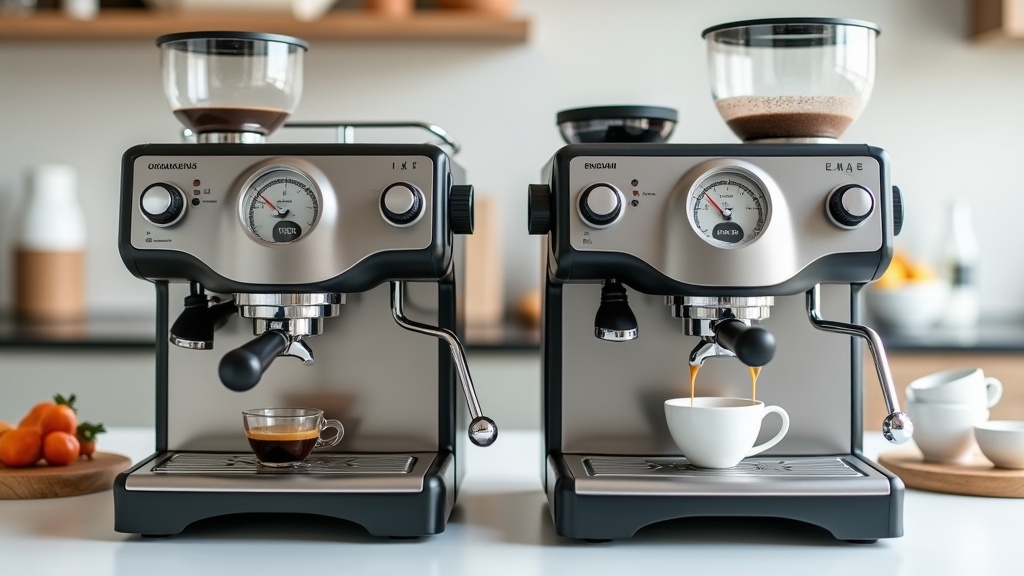
Ninja walked into a category Breville has owned for over a decade and pointed straight at the champ. The marketing barely hides it: the Luxe Café is pitched as doing everything the Barista Express does, except it grinds, doses, tamps, and froths your milk for you — no ten hours of YouTube tutorials required. That’s a bold swing at the machine that’s been the default “first real espresso setup” recommendation since before Ninja sold a single portafilter. So does the newcomer actually kill the king, or is this the usual “great on paper” story? I dug through both spec sheets, current retail pricing, and the expert reviews I trust to settle it the way I would for a friend across the kitchen counter. Here’s my honest call.
Quick verdict: For most people buying their first serious espresso machine in 2026, the Ninja Luxe Café Premier (ES601) is the smarter buy — it is $499.99 at the time of this update, and it hands you café-quality espresso and hands-free microfoam with almost no learning curve. It also doubles as a drip and cold brew maker. Buy the Breville Barista Express (BES870XL) — which is $699.95 at the time of this update, about $200 more — if you actually want to learn the craft, pour latte art with a manual steam wand, and own a proven all-metal machine with a decade-long track record and a massive accessory and repair ecosystem behind it. Ninja wins on ease, automation, and features-per-dollar. Breville wins on control, build, and longevity. Neither is a bad machine — they’re built for two different people.
Check Ninja Luxe Café Price →
Check Breville Barista Express Price →
What you’re actually buying at $500–$700
First, let’s clear up the confusion, because Ninja’s lineup makes this harder than it should be. The machine that goes head-to-head with the Breville Barista Express is the Ninja Luxe Café Premier, model ES601. It is $499.99 on Amazon at the time of this update. There’s also a step-up Luxe Café Pro (ES701) that costs more — if you’ve seen wildly different prices floating around, that’s the two models getting crossed. For this matchup, ES601 is the one you want, and it’s the one I’m comparing throughout.
Both are what the industry calls all-in-one or “grind-to-cup” machines: the grinder is built into the body, so you go from whole beans to a pulled shot without a separate grinder cluttering your counter. The Breville Barista Express (BES870XL) pioneered this format for the mainstream and has been the benchmark since — an integrated conical burr grinder, a 54mm portafilter, a 15-bar Italian pump, a thermocoil heating system, a manual 360-degree steam wand, and Breville’s clever Razor dose-trimming tool, all in a heavy stainless-steel body. It’s semi-automatic: it assists you, but you’re still the barista.
The Ninja Luxe Café Premier takes the same grind-to-cup idea and automates the parts beginners find intimidating: a conical burr grinder with 25 settings, a built-in scale for weight-based dosing, an assisted tamper, a 9-bar pump with PID temperature control, and a “Dual Froth” hands-free milk system that steams your milk while you walk away. Ninja calls the umbrella feature “Barista Assist” — the machine watches temperature and pressure and nudges your grind for you. On top of that, it’s a 3-in-1 that also makes drip coffee and cold brew. So you’re not comparing two espresso machines so much as a focused espresso trainer against an automated do-everything hub.
Round 1 — Grinder and dosing: Ninja
Both machines grind fresh into the portafilter, which already puts them ahead of anyone pairing a cheap machine with pre-ground beans. But the way they dose is where they split. The Breville uses an integrated conical burr grinder with 16 grind settings and dosing controls, then hands you the Razor tool to trim the puck to a consistent level — a genuinely smart, low-tech fix that’s worked for years. It’s proven and repeatable once you dial it in, but it’s still fundamentally volumetric: you’re grinding by time and trimming by eye.
The Ninja does something the Breville doesn’t: it grinds by weight. There’s a built-in scale, and the machine doses to a target gram weight across 25 grind settings, aiming for the same 18g puck every single time regardless of how the beans settle or how oily the roast is. For a beginner chasing repeatability, that’s a real advantage — weight-based dosing is exactly what you’d do manually with a $150 coffee scale on a serious setup, and here it’s baked in. The Ninja also ships with multiple unpressurized baskets (an 18g standard plus larger and smaller options), so you’re not locked into one dose.
Winner: Ninja Luxe Café — built-in scale and weight-based dosing beat trim-by-eye for consistency, especially for newcomers.
Round 2 — Espresso quality and temperature control: Breville, narrowly
Here’s where the fanboys expect the newcomer to fall apart — and it mostly doesn’t. The Ninja runs a legitimate 9-bar pump (the espresso-standard extraction pressure), uses genuine unpressurized baskets, and has PID temperature control that actively holds and adjusts brew temp. Reviewers consistently report it pulls real espresso with real crema, not the watery faux-spresso that pressurized-basket machines fake. For a $500 all-in-one, that’s a strong showing and the single biggest reason this comparison is even close.
So why does Breville still take the round? Control and ceiling. The Barista Express is semi-automatic by design, so an experienced user can chase exactly the shot they want — grind, dose, and extraction are all in your hands, backed by a decade of dial-in knowledge, mods, and community troubleshooting. The Ninja’s automation is fantastic for getting a great shot fast, but the same “Barista Assist” hand-holding that helps beginners can feel like a ceiling to someone who wants total manual command. Be honest about which camp you’re in: if you want the best shot with the least fuss, the gap is small and the Ninja may genuinely satisfy you; if you want to master espresso, the Breville is the platform.
Winner: Breville Barista Express — more manual control and a higher skill ceiling, though the Ninja’s shot quality is closer than the price suggests.
See the Ninja Luxe Café on Amazon →
Round 3 — Milk steaming: depends who you are
This is the round that most cleanly divides the two philosophies. The Breville has a manual 360-degree swivel steam wand. To make good microfoam, you have to learn to “surf” the milk — position the wand, control the stretch, texture it smooth. It takes real practice, sometimes weeks, and reviewers are upfront that the learning curve is steep. The payoff: once you can do it, you can pour actual latte art and control texture precisely for a flat white versus a cappuccino. That skill is the whole point for a lot of home baristas.
The Ninja throws that entire learning curve in the trash. Its Dual Froth system combines a spinning whisk with an automatic steamer — you pour milk into the jug, press a button, walk away, and come back to near-perfect microfoam. The steam wand even self-cleans, purging automatically after every shot. For someone who just wants a good latte on a weekday morning without babysitting a wand, this is genuinely a game-changer, and it works with dairy and non-dairy milks.
So who wins? If your idea of a great morning is a consistent latte with zero effort, the Ninja is the obvious pick and it’s not close. If pouring your own latte art and controlling milk texture by hand is part of the fun, the Breville’s manual wand is the one you want. This round is a genuine tie decided entirely by your personality.
Winner: Tie — Ninja for hands-free ease, Breville for skill and latte art.
Round 4 — Ease of use and automation: Ninja
No contest here. The Ninja was engineered from the ground up to remove friction. Barista Assist guides you through each step, the scale doses for you, the tamper is assisted, and the frother is hands-free. Reviewers repeatedly frame it the same way: it delivers great coffee now, without the tutorials, and it’s the machine you hand to someone who wants espresso but is intimidated by the process. It also collapses two or three appliances into one, since it covers drip and cold brew alongside espresso.
The Breville is approachable for a semi-automatic — it’s genuinely one of the friendliest ways into real espresso — but “friendly for a semi-auto” still means a learning curve. You’ll spend your first week or two dialing in grind size, learning the wand, and getting your dose consistent. That’s a feature if you enjoy the process and a bug if you don’t. For pure out-of-the-box ease, the Ninja wins clearly.
Winner: Ninja Luxe Café — automation and the near-zero learning curve are its entire reason for existing, and it delivers.
See the Breville Barista Express on Amazon →
Round 5 — Build quality and longevity: Breville
This is where experience beats novelty. The Breville Barista Express has been on the market for over a decade in essentially this form. That track record matters: we know it lasts, we know which parts wear out and when, and there’s an enormous ecosystem of replacement parts, gaskets, baskets, cleaning kits, and repair guides. It’s built like a tank — heavy stainless steel that reviewers describe as looking and feeling like a proper appliance you’ll keep for years. If something breaks in year four, you can fix it.
The Ninja is the new machine on the block. It’s well built for its class and the stainless finish looks sharp, but it leans on more plastic in places and doesn’t have the years of field data behind it that the Breville does. More moving parts and more automation also mean more things that can eventually fail, and we don’t yet know how the scale, the assisted tamper, or the Dual Froth mechanism hold up after years of daily use. That’s not a knock on quality — just an honest acknowledgment that “unproven” is a real factor when you’re spending $500.
Winner: Breville Barista Express — a decade of proven longevity and a deep parts-and-repair ecosystem the Ninja can’t match yet.
Round 6 — Value: Ninja
Now we settle it on price. At the time of this update the Ninja Luxe Café Premier is $499.99 and the Breville Barista Express is $699.95 — the Ninja is $199.96 cheaper, which is not a rounding error. And that is before you count what it pulls ahead on for that $499.99: it throws in drip coffee, cold brew, a built-in scale, and hands-free milk automation. On a pure dollars-per-capability basis, the Ninja packs more in for less money.
The counterargument is real: value isn’t only the sticker. The Breville’s proven longevity, resale value, and parts availability are all strong — if it lasts eight years and the Ninja lasts four, the “cheaper” machine isn’t actually cheaper. That’s a legitimate long-game case. But for the buyer deciding today with a specific budget, the Ninja delivers more features and more versatility for less money, and that’s the definition of value at the point of purchase.
Winner: Ninja Luxe Café — $199.96 cheaper at the time of this update, and more machine and more versatility for the money.
Ninja Luxe Café vs Breville Barista Express: the full comparison
| Feature | Ninja Luxe Café Premier (ES601) | Breville Barista Express (BES870XL) |
|---|---|---|
| Price (Aug 25, 2026) | $499.99 | $699.95 |
| Pump pressure | 9-bar with PID temp control | 15-bar pump (extracts at the same ~9-bar standard), thermocoil heating |
| Portafilter | ~53–54mm, unpressurized baskets (18g standard) | 54mm, 18g dose |
| Grinder | Conical burr, 25 settings, built-in scale (dose by weight) | Conical burr, 16 settings, Razor dose trimmer |
| Milk steaming | Hands-free Dual Froth, self-cleaning wand | Manual 360° steam wand (latte art capable) |
| Water tank | 70 oz | 67 oz + carbon water filter |
| Extra drinks | Drip coffee + cold brew (3-in-1) | Espresso only |
| Learning curve | Minimal (Barista Assist automation) | Moderate (semi-automatic, learn the wand) |
| Track record | New (2024+), long-term durability unproven | 10+ years, proven, huge parts ecosystem |
| Best for | Beginners, convenience seekers, value buyers | Aspiring baristas, tinkerers, long-haul owners |
Check Ninja Price →
Check Breville Price →
My verdict: who should buy which
Buy the Ninja Luxe Café Premier if:
- You want great espresso and hands-free lattes now, without spending weeks learning to steam milk or dial in a shot.
- You value repeatability — the built-in scale and weight-based dosing take the guesswork out of every cup.
- You want one appliance that also makes drip coffee and cold brew, not just espresso.
- You want more versatility (drip, cold brew, auto-milk) and automation, and you would rather keep the $199.96 difference.
Buy the Breville Barista Express if:
- You genuinely want to learn espresso as a craft and grow your skills over time.
- Pouring your own latte art with a manual steam wand is part of the appeal, not a chore.
- You care about proven, decade-long durability and a deep ecosystem of parts, accessories, and repair guides.
- You’re comfortable with a moderate learning curve in exchange for full manual control.
Get the Breville Barista Express →
My bottom line: for the person who wrote me that email — “I just want great coffee and I don’t want a second job learning how” — I’m handing them the Ninja Luxe Café, and I’m confident they’ll be thrilled. It’s the better value, the friendlier machine, and the espresso is far closer to the Breville than the price gap implies. But the king isn’t dead. If you want to become a home barista rather than just be served by one — latte art, manual control, a machine you’ll still be tuning and repairing in 2035 — the Breville Barista Express is still the platform I’d point you to, and I won’t talk you out of it. Match the machine to who you actually are, not to whichever spec sheet shouts louder.
Want to round out your coffee corner? See our picks for the best smart coffee makers of 2026 if app-controlled brewing is your thing, and pair either espresso machine with one of the best electric kettles of 2026 for pour-overs and tea on the side.
Frequently asked questions
Is the Ninja Luxe Café as good as the Breville Barista Express?
For espresso quality, it’s closer than the price gap suggests. The Ninja uses a real 9-bar pump, unpressurized baskets, and PID temperature control, so it pulls genuine espresso with real crema. The Breville still edges it on manual control and skill ceiling, but for everyday café-style drinks with far less effort, the Ninja holds its own — and at the time of this update it costs $199.96 less while also doing drip and cold brew.
Which is better for a complete beginner?
The Ninja Luxe Café, clearly. Its Barista Assist automation, built-in dosing scale, assisted tamper, and hands-free milk frother remove the parts beginners struggle with most. You get a good latte on day one. The Breville is beginner-friendly for a semi-automatic, but it still asks you to learn grind dial-in and manual milk steaming, which takes a week or two of practice.
Does the 54mm vs 58mm portafilter debate matter here?
Not for this matchup — both machines use roughly 54mm portafilters (the Ninja is around 53–54mm, the Breville is 54mm), so they’re in the same class. The 58mm size is a commercial and high-end prosumer standard with a bigger accessory pool, but at this price and use case, 54mm is completely normal and neither machine is disadvantaged against the other.
Is a built-in grinder good enough, or should I buy a separate one?
For this price tier, both built-in grinders are genuinely good enough to make excellent espresso. The Ninja’s weight-based dosing across 25 settings is especially beginner-friendly, and the Breville’s 16-setting grinder plus Razor trimmer is proven. Standalone grinders can outperform them, but you’d spend several hundred dollars more to meaningfully beat what’s already built into either machine.
Is either machine really worth $500–$700?
Yes, if you drink espresso drinks regularly. A daily latte habit at a café runs well over $1,500 a year, so either machine pays for itself fast. The Ninja gets you there for less up front with more automation; the Breville costs more but has proven it lasts many years, which strengthens its long-term value. Pick based on whether you want convenience now (Ninja) or a proven long-haul craft machine (Breville).
Related: our full Breville Barista Express review.
Affiliate disclosure: The Home Picker is a participant in the Amazon Services LLC Associates Program, an affiliate advertising program. As an Amazon Associate, we earn from qualifying purchases. When you buy through links on this page, we may earn a commission at no additional cost to you. This never affects our verdicts — our recommendations are based on published specifications and independent expert reviews. Prices and availability are accurate as of publication and subject to change.