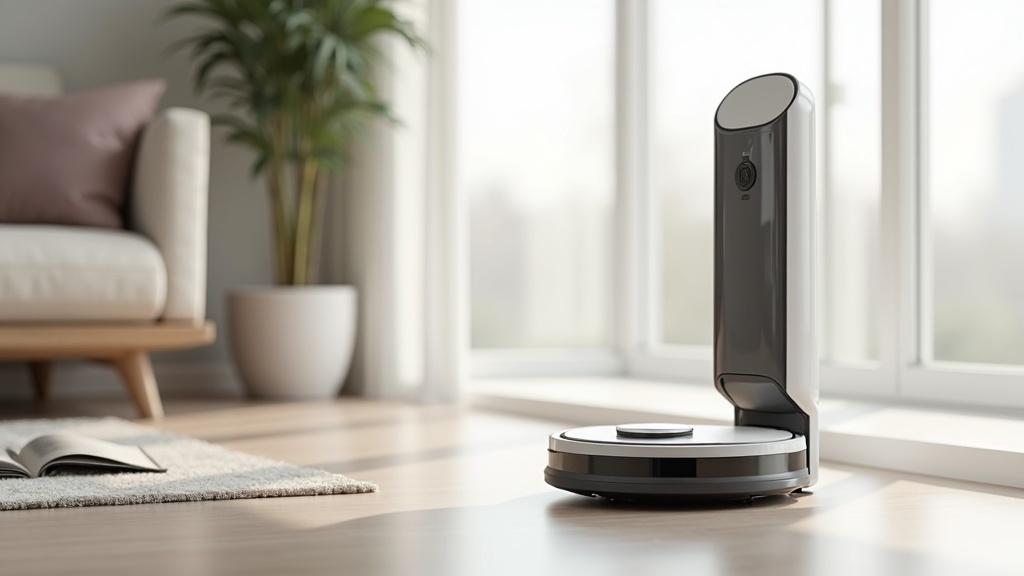
I have tested enough robot vacuums to be deeply skeptical of the word “revolutionary.” So when Ecovacs launched the Deebot X12 OmniCyclone in April 2026 with an industry-first bagless cyclone dock and a stain-blasting mop, my first reaction was suspicion, not excitement. Every premium robot I have recommended in the last three years quietly signed you up for a subscription you never asked for: proprietary dust bags at $60 to $90 a year, forever. A $1,499 flagship that promises to kill the bag got my attention for the right reason. The question is whether the rest of the machine earns its price — or whether the dock is a clever headline wrapped around a merely good robot.
Here is my honest read, built from Ecovacs’ published specs and the first wave of hands-on expert reviews. Because this machine only shipped in spring 2026, I attribute the specific performance numbers to their sources rather than pretend I ran a lab. What I will not hedge on is the verdict.
Quick verdict: The Deebot X12 OmniCyclone is the best mopper Ecovacs has ever shipped, and its bagless Pure Cyclone 2.0 dock is the first genuinely good reason to pay flagship money in 2026 — it removes the $60–$90/year dust-bag tax for good.
The bagless angle’s real payoff — and the tradeoff: You never buy another bag, which saves roughly $200–$450 over the robot’s life. The catch is honest: “bagless” means “cheaper and greener,” not “zero maintenance.” You still rinse a 1.6 L cyclone bin every ~48 days and occasionally clean the filter net, so you touch the dust a little more than a sealed bag would. If you want a hands-off flagship that also lowers running cost, this is the one to beat. If you only care about raw vacuuming on hard floors, keep reading — the value math gets more interesting.
Check the Deebot X12 OmniCyclone Price on Amazon →
The bagless cyclone dock: the headline feature, examined honestly
Let’s start where Ecovacs wants you to look, because for once the marketing and the substance actually line up. Almost every high-end robot vacuum on the market empties its dustbin into a disposable bag sealed in the dock. That bag is proprietary, it fills up, and you replace it — typically four to six times a year at $12–$18 a pop. Over the three-to-five-year life of a robot, bagged docks quietly burn $200 to $450 in consumables you never think about at checkout.
The X12’s OMNI Station replaces the bag with what Ecovacs calls the Pure Cyclone 2.0 system: cyclonic separation spins debris into a reusable 1.6-liter bin. It is the same physics that made bagless stick vacuums popular a decade ago, finally engineered into a self-emptying robot dock. Per Ecovacs’ spec sheet and early hands-on reviews, the station also washes and dries the mop roller with 63°C hot water, refills the clean-water tank, empties the dirty-water tank, and dispenses cleaning solution — the full hands-off routine you expect at this price.
Now the part I promised to be straight about. Bagless is not maintenance-free. Early reviewers report you empty and rinse the cyclone bin roughly every 48 days, and you need to occasionally clean the filter net that keeps fine dust out of the motor. Ecovacs added a “Quick-clean Scraper Ring” that wipes residual dust off the bin wall and filter net with a single push, which reduces how much you actually handle the dirt — but it does not eliminate it. A sealed bag is the cleaner experience for allergy sufferers who never want to see dust; the cyclone bin trades a little more contact for a lot less recurring cost. That is the real deal, and it is a fair trade for most people.
My take: this is the first bagless flagship dock I would recommend without an asterisk on the maintenance. If the running-cost math matters to you — and at $1,499 it should — the dock alone reframes the whole purchase. You can check the current X12 OmniCyclone price on Amazon to see where it lands after launch promos.
See Current Deebot X12 Deals on Amazon →
Vacuuming, suction, mopping, and FocusJet stain pre-dissolve
On paper, the X12 is a monster: Ecovacs rates it at up to 22,000 Pa of suction driven by its BLAST airflow system, with airflow bumped about 22% over the previous X11. Early lab testing backs the numbers up where it counts — reviewers reported strong suction, perfect first-pass debris pickup on hard floors and low-pile carpet, 100% pet-hair removal, and zero hair tangles in seven-inch hair tests thanks to the upgraded ZeroTangle 4.0 roller system. If you have a shedding dog or long-haired humans in the house, that tangle-free result is the number I would frame on the wall.
Two honest caveats surfaced across reviews. First, at least one reviewer found hard-floor vacuuming underwhelming relative to the 22,000 Pa headline — big suction ratings do not always translate to proportional real-world pickup on bare floors. Second, high-pile carpet is where this robot is weakest; suction drops and tangling risk climbs. If your home is mostly plush carpet, temper your expectations regardless of the spec sheet.
Mopping is where the X12 genuinely pulls ahead, and it is the reason I would pick it over most rivals. The OZMO Roller 3.0 mop is roughly 50% wider than the X11’s, spins at about 220 RPM, lifts ~15 mm to clear carpets, and washes itself with fresh water mid-clean. The marquee trick is FocusJet, an industry-first stain pre-dissolving system: infrared detection spots a dried stain, then high-pressure water jets soak it before the roller mops, giving the dried gunk time to break down. Early reviewers logged above-average dried-stain removal while leaving very little water behind — one of the best combined mopping scores on record. Ecovacs claims the pre-soak handles coffee, sauce, and dried food that ordinary robot mops just smear.
Is FocusJet flawless? No. One reviewer noted the mop still struggled with a stubborn dried ketchup stain, so treat “pre-dissolving” as a real advantage, not black magic. There is also a genuinely annoying software gap: there is no mop-only mode in the app — the robot always vacuums before it mops, even when you just want a mop pass. For a $1,499 machine, that omission is hard to defend, and I hope a firmware update fixes it.
Navigation, obstacle avoidance, and the app
Obstacle avoidance is a strength. In early testing the X12 dodged 23 of 24 objects and led every Roborock model one reviewer had run through the same lab course — impressive for a brand that has traditionally chased cleaning hardware over navigation smarts. TruEdge 3.0 adaptive edge cleaning also does a noticeably better job hugging walls, corners, and baseboards than most robots I have used.
The honest weak spots: reviewers found the AI navigation struggles most in dark or heavily cluttered rooms, and the ~2.4 cm maximum climbing height is a touch below average for the price class — a tall threshold or thick transition strip can stop it. Ecovacs leans hard on “AI” branding in its marketing, but after a week-plus of testing, reviewers were not convinced the AI was earning its billing yet. My advice mirrors theirs: buy the X12 for the hardware it ships with today — the dock, the mop, the tangle-free roller — and treat the AI as a bonus that may improve through updates, not a reason to buy.
For a broader look at how Ecovacs stacks up against its two biggest rivals on navigation and mapping, my Roborock vs Dreame vs Ecovacs 2026 breakdown goes deeper than I can here.
Comparison: X12 vs a bagged flagship vs a cheaper Ecovacs
Here is how I frame the decision. The X12 is not competing in a vacuum (pun intended) — it is bracketed by a pricier bagged flagship above it and a near-identical cheaper Ecovacs below it.
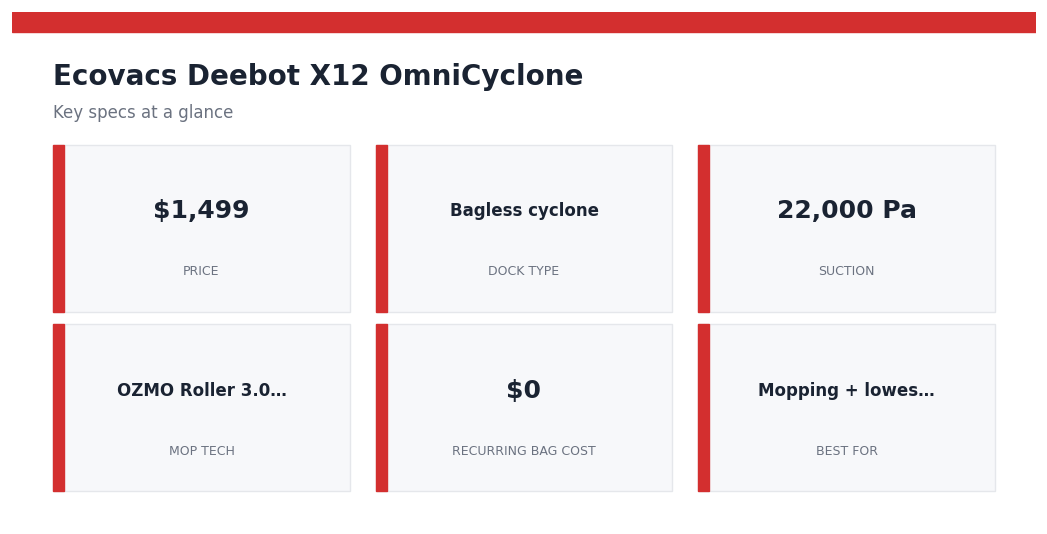
| Deebot X12 OmniCyclone | Roborock Saros 10R (bagged flagship) | Deebot X11 OmniCyclone (cheaper Ecovacs) | |
|---|---|---|---|
| Price (2026) | $1,499 | ~$1,599 | ~$899 |
| Dock type | Bagless cyclone (no bags) | Bagged auto-empty | Bagless cyclone (60-day) |
| Suction | 22,000 Pa | ~22,000 Pa | 19,500 Pa |
| Mop tech | OZMO Roller 3.0 + FocusJet stain pre-dissolve | Dual spinning pads, no pre-soak jet | OZMO Roller (narrower, no FocusJet) |
| Recurring bag cost | $0 | ~$60–$90/yr | $0 |
| Best for | Mopping + lowest running cost | Best navigation/mapping | Value buyers who skip FocusJet |
The pattern is clear. Against a bagged flagship like the Roborock Saros line, the X12 wins on mopping and running cost but concedes the navigation crown — Roborock still has the edge in mapping and path planning. Against its own cheaper sibling, the X11 OmniCyclone at around $899, the X12 is honestly a close call: you are paying roughly $500 more for FocusJet, a wider mop, and a modest suction bump. For a lot of buyers, that X11 is the smarter-value play, and I will say so plainly. If you want the sibling comparison in the family, my Ecovacs Deebot X2 Omni review shows how far the line has come.
Compare Deebot X12 Prices on Amazon →
Shop the Cheaper Ecovacs X11 →
The running-cost angle: what “no bags” is actually worth
This is the argument that turns the X12 from “expensive” into “defensible,” so let me quantify it roughly. A bagged flagship dock typically consumes $60–$90 a year in proprietary bags. Keep a robot for the realistic three-to-five years most people do, and that is $180 to $450 in bags you would spend on a competing flagship — money the X12 simply deletes from the equation.
The X12 is not truly zero-cost: you will still replace the mop roller and cyclone filter net periodically. But those are shared with almost every robot in this class, bagged or not — the bag line item is the one the X12 uniquely erases. Net it out and the effective price gap between the X12 and a bagged $1,599 flagship narrows meaningfully over the ownership window; you are essentially pre-paying for the dock’s savings at checkout. For a spec-by-spec look across brands as you shop, our 2026 robot vacuum database lays out the running costs side by side.
Who should buy the Deebot X12 — and who should skip it
Buy it if: mopping is a top priority and you have pets or hard floors that see real spills; you want the best combined vacuum-and-mop hardware Ecovacs makes; and — most of all — you are tired of the dust-bag subscription and want a flagship whose running cost actually goes down over time. The FocusJet pre-soak and tangle-free roller are the features I would genuinely pay for here.
Skip it if: your home is mostly high-pile carpet (suction and tangling weaken there), you navigate around a lot of dark or heavily cluttered rooms (the AI struggles), or you simply want the best value — in which case the near-identical X11 OmniCyclone at ~$899 is the smarter buy and I will not pretend otherwise — you can compare the cheaper Ecovacs Deebot lineup on Amazon before you commit. Also skip if a sealed-bag, never-see-the-dust experience matters more to you than the savings.
My verdict: The Deebot X12 OmniCyclone is the most complete robot-vacuum-and-mop Ecovacs has ever built, and the bagless dock is the first premium feature in a while that pays you back instead of billing you. It is not the perfect flagship — hard-floor pickup, high-pile carpet, and the missing mop-only mode all keep it a notch below flawless. But if mopping and long-term cost are your priorities, this is the flagship to buy in 2026. Confident recommendation, honestly qualified.
Check Today’s Deebot X12 OmniCyclone Price →
Frequently asked questions
Is a bagless cyclone dock actually better than a bagged one?
For running cost and waste, yes — the X12’s Pure Cyclone 2.0 dock removes the $60–$90/year proprietary-bag expense entirely, which adds up to $180–$450 over a typical ownership window. The tradeoff is that you rinse the reusable 1.6 L bin roughly every 48 days and occasionally clean the filter net, so you handle the dust a little more than with a sealed bag. If you value low cost and less waste, bagless wins; if you want to never see dust, a bagged dock is cleaner.
What are the recurring costs of the Deebot X12?
The big one — dust bags — is $0, because the dock is bagless. You will still periodically replace the mop roller and the cyclone filter net, and cleaning solution is optional. Those consumables are shared with essentially every flagship in this class, so the X12’s ongoing cost is genuinely lower than a comparable bagged robot’s.
How does the X12 compare to a Roborock flagship?
The X12 generally wins on mopping (FocusJet stain pre-dissolve plus a wide self-washing roller) and on running cost thanks to the bagless dock. Roborock’s flagships tend to win on navigation, mapping accuracy, and path planning. Buy the X12 if mopping and cost matter most; lean Roborock if pinpoint navigation in a complex floor plan is your priority.
Is the Deebot X12 worth $1,499?
If mopping and long-term running cost are priorities, yes — the FocusJet mop system, tangle-free roller, and bag-free dock justify the price for the right buyer. If you mostly want raw vacuuming value, the near-identical X11 OmniCyclone at around $899 delivers most of the experience for roughly $500 less, and it is the smarter buy for value-focused shoppers.
Is the Deebot X12 OmniCyclone available on Amazon?
Yes. Ecovacs launched the X12 OmniCyclone in April 2026 at $1,499 MSRP, sold through Ecovacs.com and Amazon. Because it is a flagship, the Amazon listing is where launch promotions and spring discounts tend to show up first, so it is worth checking the live price before you buy. Check the current Deebot X12 price on Amazon here.
Affiliate disclosure: As an Amazon Associate, TheHomePicker.com earns from qualifying purchases. This post contains affiliate links, and we may earn a commission if you buy through them at no additional cost to you. Our editorial opinions are our own, and this review is based on published manufacturer specifications and early independent expert testing of the Ecovacs Deebot X12 OmniCyclone. We do not fabricate personal test measurements for newly launched products.
You May Also Like
- Ecovacs Deebot X2 Omni Review 2026: Square Robot Vacuum Tested
- Ecovacs vs Roborock 2026: Which Robot Vacuum Wins?
- Roborock vs Dreame vs Ecovacs (2026): Which Robot Vacuum Brand Is Actually Best for You?
- Ecovacs Deebot T30S Combo (Black) Review: 9 Weeks Tested
- Roborock Saros Z70 Review (2026): The Robot Vacuum With a Real Robotic Arm – Worth $1,300?
- Best Dreame Robot Vacuums in 2026: X60 vs L40 vs L50 Compared